
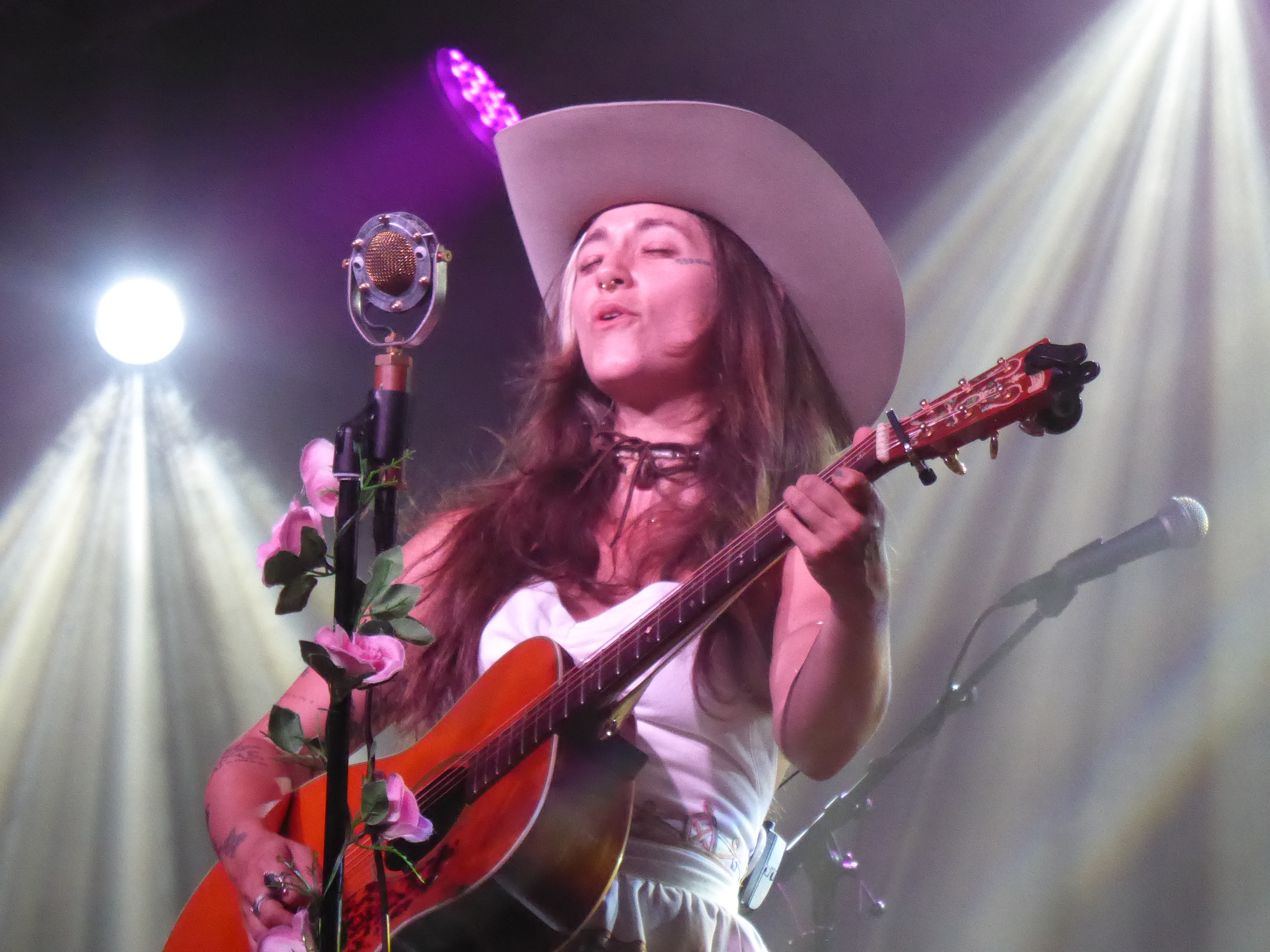
Sierra Ferrell, in clover. (Jim Motavalli photo)
The heavens had their way with the 10th annual Red Wing Roots Festival in Mount Solon, Virginia, with thunder and lightning on Friday and Saturday June 23-24, causing site evacuations and a soggy parking lot. But the event was so well run that the evacuation was orderly, and alternative parking was quickly found. The bus drivers were amazingly stoked. The mud got covered in straw—it was like Woodstock ’69 (and I was there).
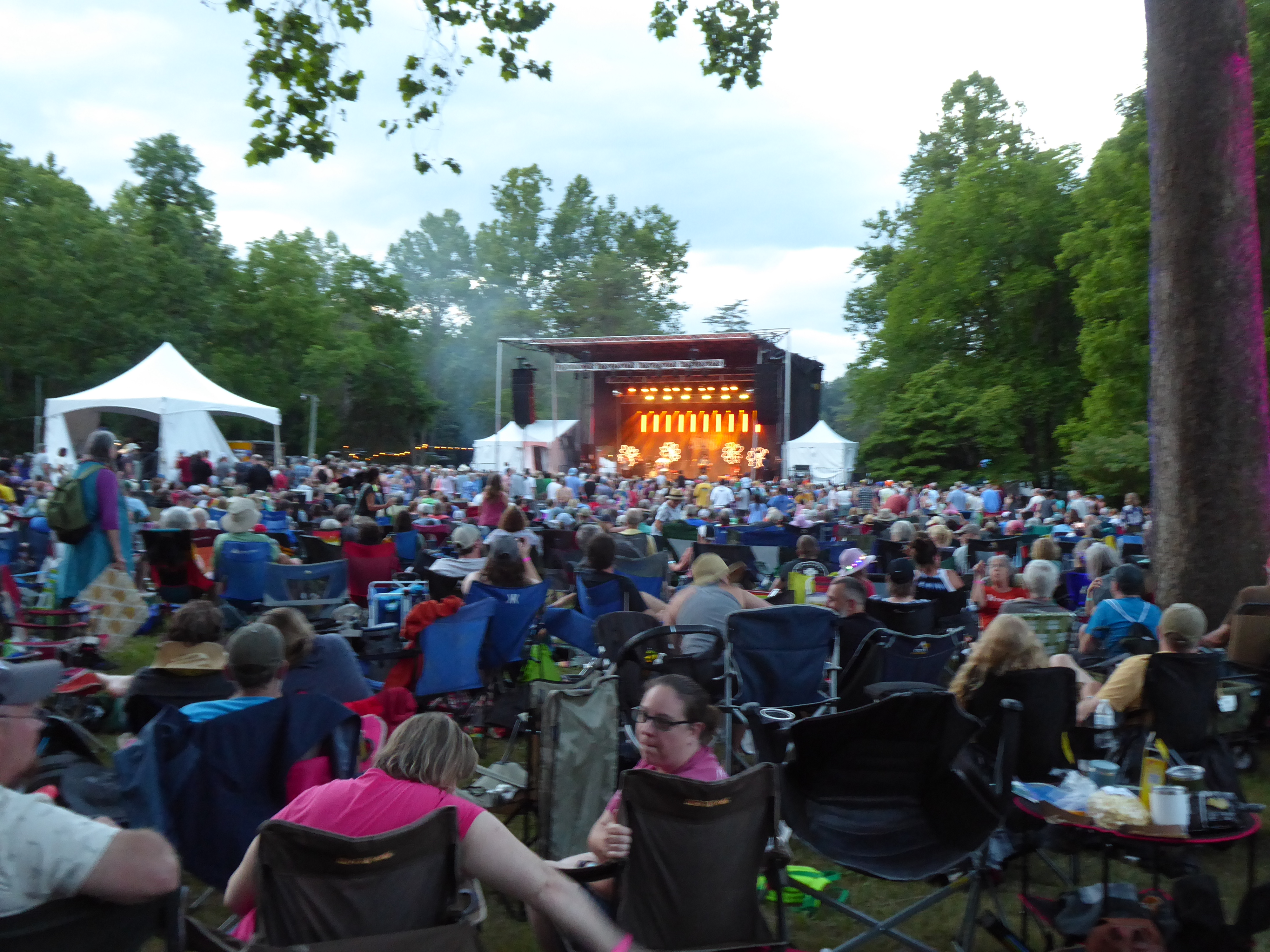
The Steel Wheels, from afar. (Jim Motavalli photo)
The Steel Wheels, an increasingly popular Americana band rooted in bluegrass and its antecedents, has run Red Wing since its inception, and they also open it. Among their many tricks, they turbocharge old-timey songs, including in this case “Jack of Diamonds” and “Cluck Old Hen.” The guitar/banjo/fiddle front line is very adaptable. The group boasts an abundance of vocal and instrumental prowess, including on a plethora of new originals. “Every secret is a station/Every whisper is a train,” that’s a good line. “Kitchen Girl,” an instrumental, pioneers a new category called “chamber grass.”

Michaela Anne, not smoking. (Jim Motavalli photo)
Michaela Anne grew up in a military family, moving from post to post with a dad who was a submarine captain. At the age of 7, she became semi-famous with a song called “Hey Don’t Smoke.” These days, a number of her songs deal with that peripatetic youthful experience. She was the “new kid” a lot. The highly personal songs were good enough to get her signed to Yep Rock. James Paul Mitchell was on guitar.
Michaela Anne’s pick hit was the uptempo “If I Wanted Your Opinion, You’d Know It,” written with friend Mary Bragg. This is not a woman who welcomes unsolicited advice (including at the merch table) from men. Don’t say that her capo is in the wrong place.
The Larry Keel Experience sounded interesting but I only catch snatches, given the reality of only being able to visit one of five stages at any one time. But I was able to spend much more attention to A.J. Lee and Blue Summit. A.J. has a big voice, and all members of her young band can really play and sing. It was bluegrass, but also somehow not. “City of Glass” was a standout original, and they also did right by Rowland Salley’s “Killing the Blues” (a song that somehow works without any actual rhymes) and Bob Dylan’s “Meet Me in the Morning.” A favorite moment was when they suddenly switched to playing a more-than-competent swing tune, with jazzy solo spots for all the players.
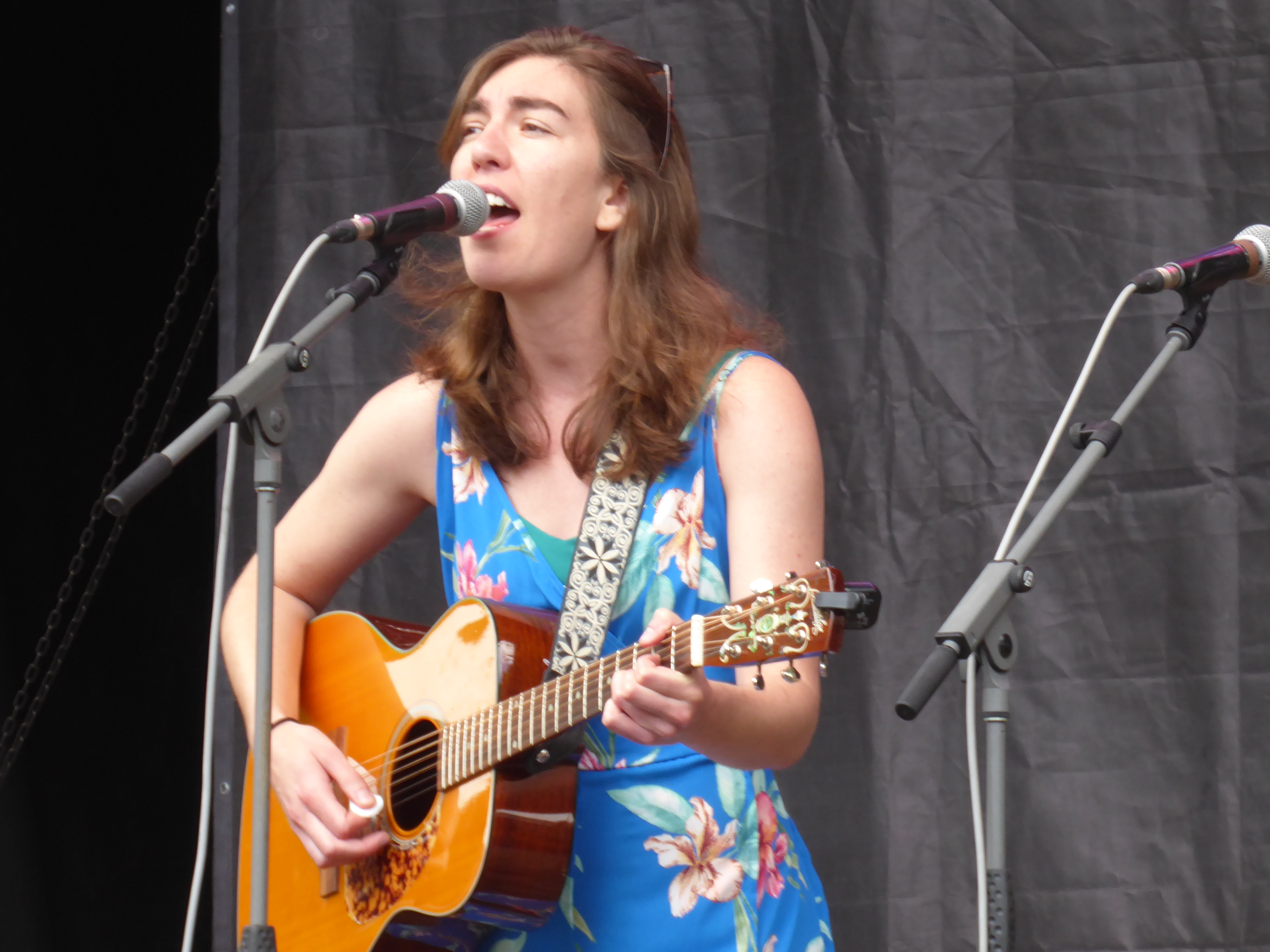
Maya de Vitry just before the plug got pulled. (Jim Motavalli photo)
Portland, Oregon’s John Craigie teamed up with Maya de Vitry, about whom more later. He’s a self-effacing sort of guy who tells long, funny, relatable stories when he’s not playing songs that reminded me of Loudon Wainwright. “I was advised to come out and play all my hits, and as soon as I have any hits I’ll be happy to oblige,” he said. Craigie claimed to be paralyzingly shy, but it wasn’t apparent from his outgoing stage persona. “I Am California” was one of his better songs.
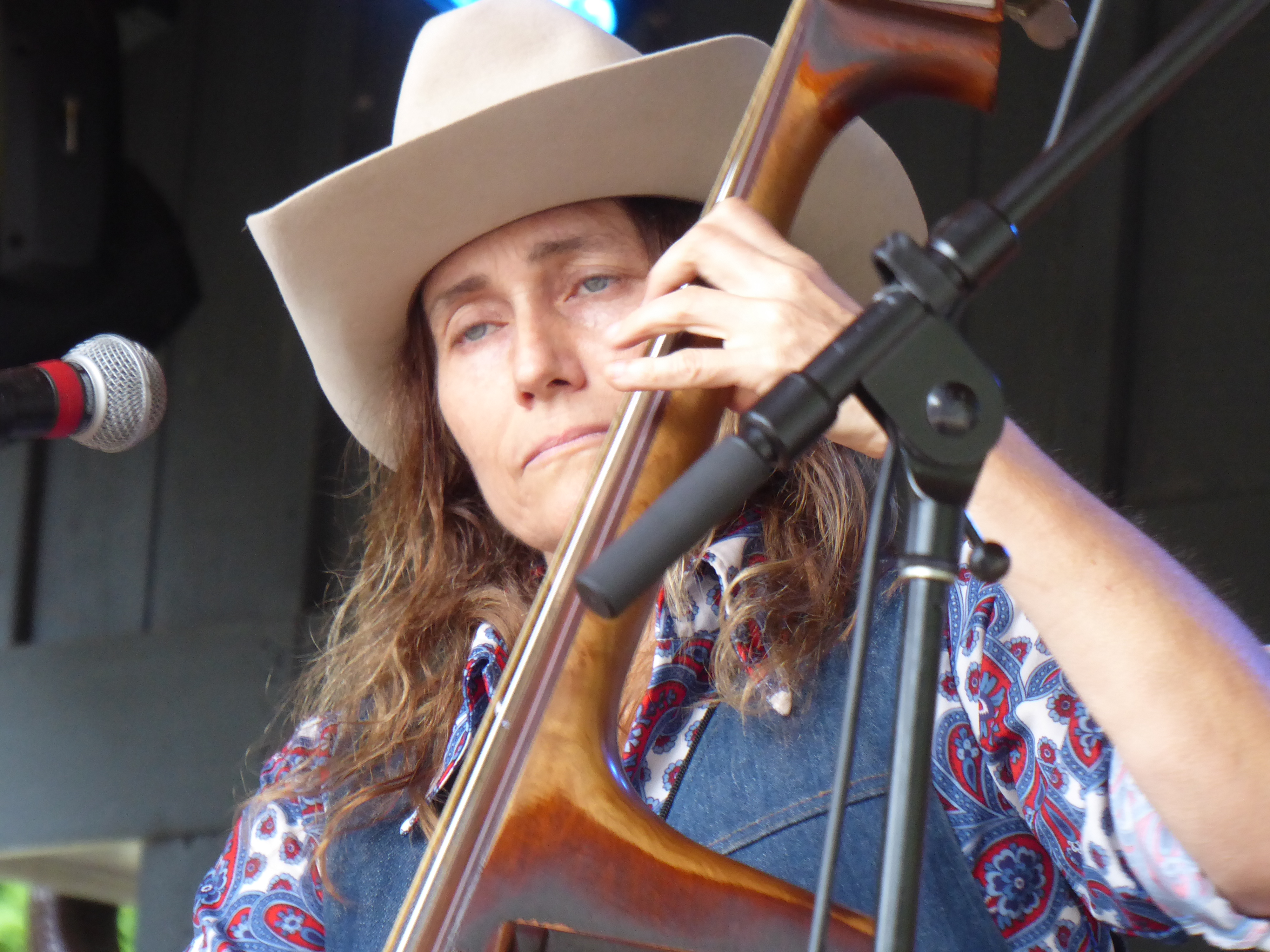
Melissa Carper: from the hills of Nebraska. (Jim Motavalli photo)
I quite enjoyed the set from Nebraska-born Melissa Carper. She has a from-the-hills voice reminiscent of Hazel Dickens, but her songs seem to incorporate a variety of influences, including honky-tonk and the Great American Songbook. She is old-fashioned in the best sense, and her music would play well at a 1962 concert in a VFW hall. Most of all, songs like “My Only Regret” have a welcome swing to them. Did I hear her right in saying she had a song on Star Trek? She ended with “Don’t Let the Aliens Take Him Away,” so maybe that was the one.

Reeb on the left, Caleb on the right. (Jim Motavalli photo)
The Caleb Klauder and Reeb Wilms Band serve up classic country songs that could have been written in the ‘50s but were instead likely penned last week. The pedal steel was helpful. Klauder is a fine mandolin player as well as singer. Wilms invokes her farm childhood very well in a song called “Same Old Heart.” Their tunes have swing in common with Carper—you could dance to the best of them. The Lil Smokies had energy and a jam band feel, and drew a hugely enthusiastic young crowd to the Roots Stage. Similar to them were Sam Burchfield and the Scoundrels and Goodnight Texas.

The big-voiced Miko Marks. (Jim Motavalli photo)
If you like big-voiced African-American folk/rock divas like Odetta and Mavis Staples, you’d love Miko Marks, born of a single mother in Flint, Michigan. Her versions of Stephen Foster’s “Hard Times” and the Monroe Brothers’ “Long Journey Home” really connected. Marks took a long break from music but is now back at it, and things seem to be working for her.

The famous Natural Chimneys. (Jim Motavalli photo)
I only heard about 30 seconds of Old Crow Medicine Show, playing at around 8 p.m. Friday night, when the plug was pulled on them and the entire audience was sent off the site because of lightning nearby. Nobody got trampled; it was all very orderly, but the torrential rain turned the parking lot into solid mud. The later evening shows had to be canceled. Early Sunday the same thing happened again about five songs into an excellent solo set from May de Vitry. (You may know her from the Stray Birds, whose bass player, Charlie Minch, remains onboard). The storm turned out to be fleeting, and we only had to shelter under some wooden roofs for a short time.
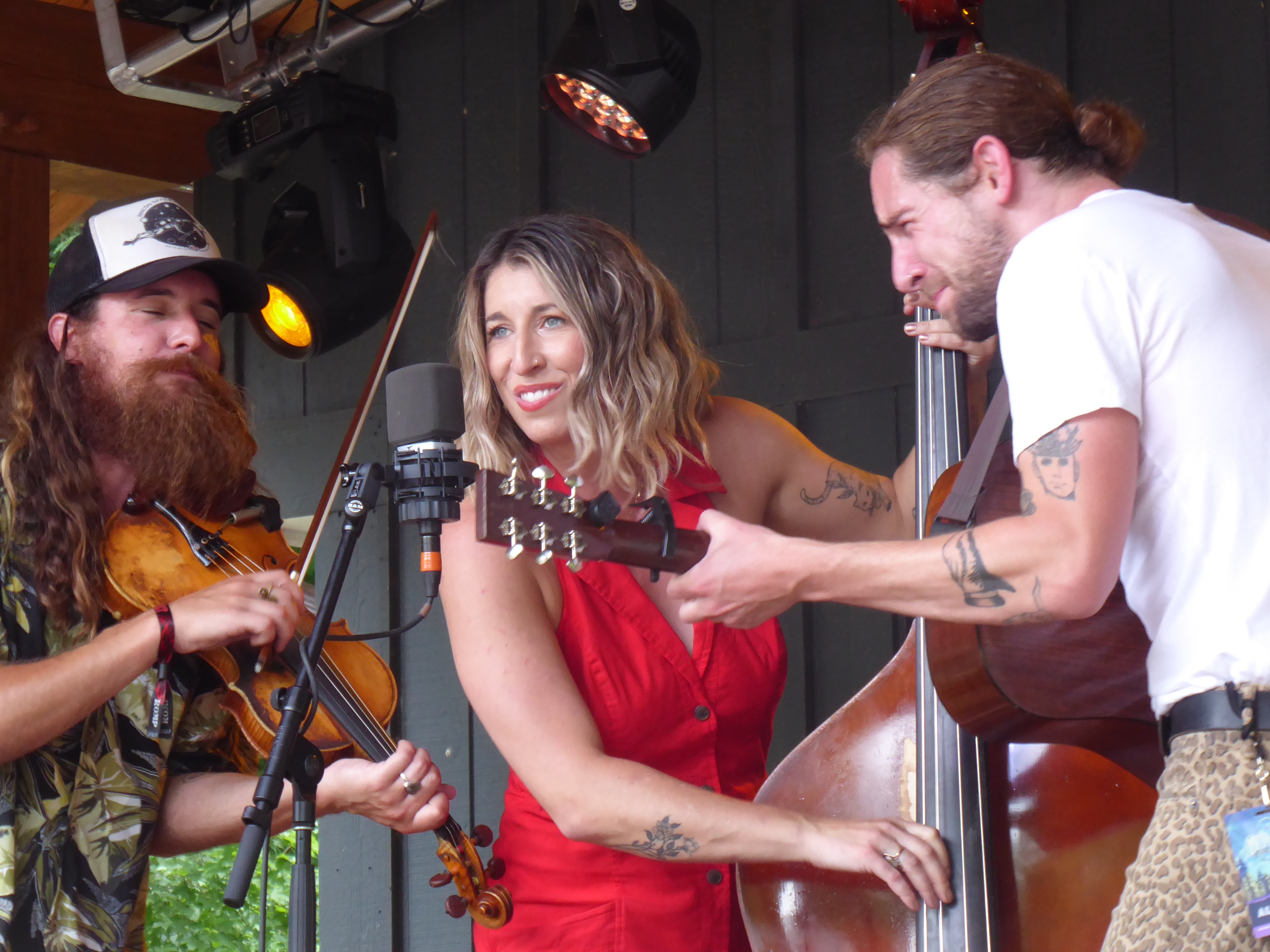
Damn Tall Buildings in full cry. (Jim Motavalli photo)
On Saturday, the parking lot remained unusable but some alternatives were found and everyone got in. The first thing heard was Damn Tall Buildings, who put a lot of old-timey in their music (Bill Monroe’s “Uncle Pen”) but also Roy Orbison’s unkillable “Blue Bayou.” Sasha Dubyk is a fine singer, and Avery Montana has solid fiddle chops.
Palmyra plays “Shenandoah.”
Palmyra, formed at nearby James Madison University, was an interesting band. These long-haired guys seemed too young to be so depressed! “The older I get the more restless I get,” was one line. “When did I start losing my grip?” was another, and “I’m so damned lonely” a third.

Palmyra has a rough time on the road. (Jim Motavalli photo)
One of the two principal songwriters “had to be talked off a ledge.” But they rallied to perform an excellent version of “Shenandoah,” with local relevance.

Seeing Hubby Jenkins (above) is like having a black musical history lesson. He’s an amazing banjo player, opening with a fast improvisation with vocal interjections. He offered a long gospel medley (see below) and talked about the influence of the church and the coding inserted into the songs. Moving chronologically, he talked about the bizarre blackface minstrel tradition, which typically only accepted real African-American musicians if they performed with their faces blackened. And he talked about early recording figures like Ralph Peer (who waxed the country music session that gave us the Carter Family and Jimmie Rodgers) but who wanted black performers restricted to blues and jazz (so-called “race” records).
Jenkins played songs like “Little Log Cabin in the Lane”—essentially an older black person waxing nostalgic about slavery days—through huge layers of irony. The banjo is an African-American instrument, but it was wholly appropriated by white country musicians, and few recordings of black string bands were made. That legacy is now being recovered through musicians like Rhiannon Giddens and Hubby Jenkins.

Danny Knicely (center) with Chao Tian and an ace band. (Jim Motavalli photo)
For something entirely different there was the group led by old-timey musician Danny Knicely (an ace mandolin player), complemented by Chinese dulcimer player Chao Tian and group. It was really effective fusion music, with jazz, Americana and Asian music all blending into a very listenable mix. Transcendent, really.

The Honey Dewdrops. (Jim Motavalli photo)
The Honey Dewdrops, Kagey Parrish and Laura Wortman, make a fine noise. Wortman is a really strong songwriter with a lovely voice. Parrish can play anything with strings (especially electric guitar and mandolin) and has a high voice that he nonetheless uses to good advantage on songs like “When God Made Me (He Made a Rambling Man).” There’s a bit of Hank Williams in what he does. The duo harmonizes well.

Peter One: His group got bigger. (Jim Motavalli photo)
I’ve been enjoying the music of Peter One, from the Ivory Coast, on his new album. He came out solo, then was joined by two singers, a keyboard player and—amazingly enough—pedal steel. It worked just fine, singing in French and English. The pick hit is “Don’t Go Home.”
By then it was dark and time for Sierra Ferrell, who just gets better and better. She was first encountered on the Red Wing Roots Stage two years ago, and since then her career has taken off meteorically on the strength of constant touring and a superb first album.
Ferrell is a real character, one of our very best songwriters, and a snappy dresser, too. Check out her many flamboyant YouTube and Instagram postings. She was in a white backless number at Red Wing and her band was in black, and everyone wore hats. It’s hard to see how her set could have been improved. She tore through most of her first album, and previewed much of her soon-to-be-released second. “I Can Drive You Crazy” is a future classic. Her band is super-tight, both in its virtuoso-level playing and its coordinated movements. I knew Ferrell was a good guitarist, but she also offered some competent fiddle work.
And Ferrell is an absurdly charismatic leader, with a voice that cuts through like a buzzsaw. The audience was in her corner before the music started—many people knew all the words—but by the end of the long set they were ready to follow her anywhere. I was too. A fine collection could be made of her cover songs, including “Gum Tree Canoe,” a 19th century favorite, and Patsy Cline’s “I Fall to Pieces.” In her Red Wing set were the traditional “Don’t Let Your Deal Go Down,” John Anderson’s “Years” and the Beatles “Don’t Let Me Down.”
A lovely event, despite the thunder and rain, thanks to the hard-working and expert Red Wing staff.
 Territorial Imperatives