
TRUMANSBURG, NEW YORK—One of the great things about music festivals is the act of discovery. I love events that have multiple acts I’ve never heard of. It’s whole undiscovered countries of exciting sounds. The fact is, music is such a deep well you never get to its bottom.

Walter Mouton and the Scott Playboys. Walter formed the group in 1952. (Jim Motavalli photo)
Chronological works here. I walked in on the Boston-based Dead Sea Squirrels performing for some enthusiastic square dancers. It was raining, so the dance tent was a good place to set up. The dancers didn’t even need to sit down, because up next was Walter Mouton and the Scott Playboys. Cajun/zydeco music always goes down well at folk festivals, even when it rocks out. Mouton is a legendary accordion player who put together the first version of the Playboys in 1952 but, now 85, he was at the pedal steel—an instrument I haven’t seen in zydeco before. He also sang a little. The band has a fantastic young fiddle player, but I got distracted by a girl in a top hat dancing on stilts.
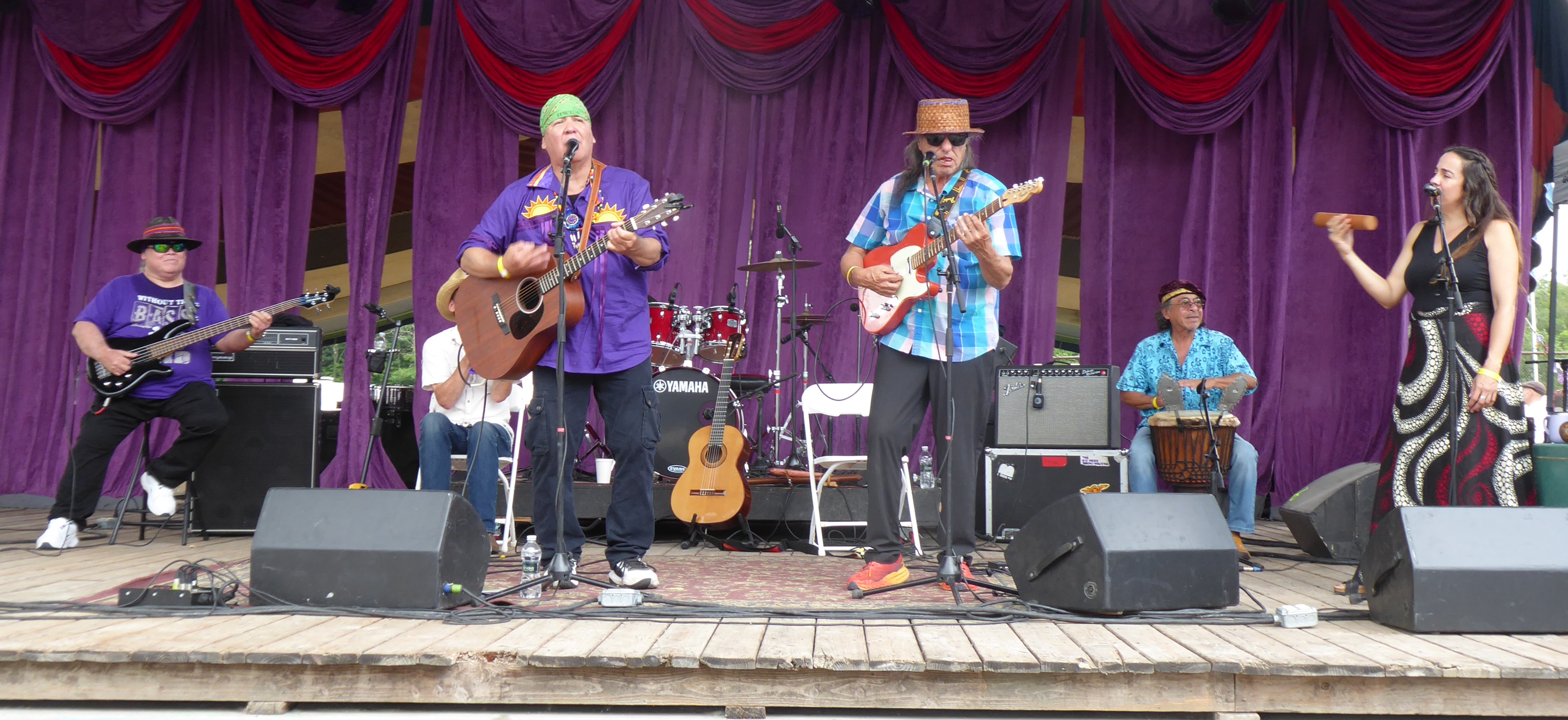
December Wind, big boys now. (Jim Motavalli photo)
December Wind with Keith Secola (who also led his own set) is an impressive Native American band. Their song “Imma Big Boy,” backed by slide guitar, was captivating. I want to know more about the local-to-Ithaca Fall Creek Brass Band, which had no less than nine horns (three trumpets, four trombones, two saxophones) in the front line. A sousaphone handled the bass duties. An original “We the People” captured the essence of New Orleans brass band music.

Richie and Rosie: Grassroots regulars. (Jim Motavalli photo)
Richie and Rosie (with Rose Newton also leading Rose and the Bros) are a Grassroots institution. Richie Stearns is a native of Ithaca and has been in some of its legendary bands, including the Horseflies and Donna the Buffalo. Richie and Rosie is the two of them, with Rosie on fiddle and Richie on banjo and guitar. Both are fine singers/players, and Richie is an excellent songwriter, as witness his “Nowhere in Time” and “I Am With You Always.” The latter is on their Tractor Beam release. I also loved a bluegrass-heads-east piece called “Last Train to Rajasthan.” That one’s on Nowhere in Time. “I’ve Endured” came via the great Ola Belle Reed.
Richie and Rosie did a fine version of Dirk Powell’s “Waterbound,” with unison singing. We listened to the music through an ancient Fender Princeton Reverb tube amp, so beat up they didn’t mind leaving their drinks on it.
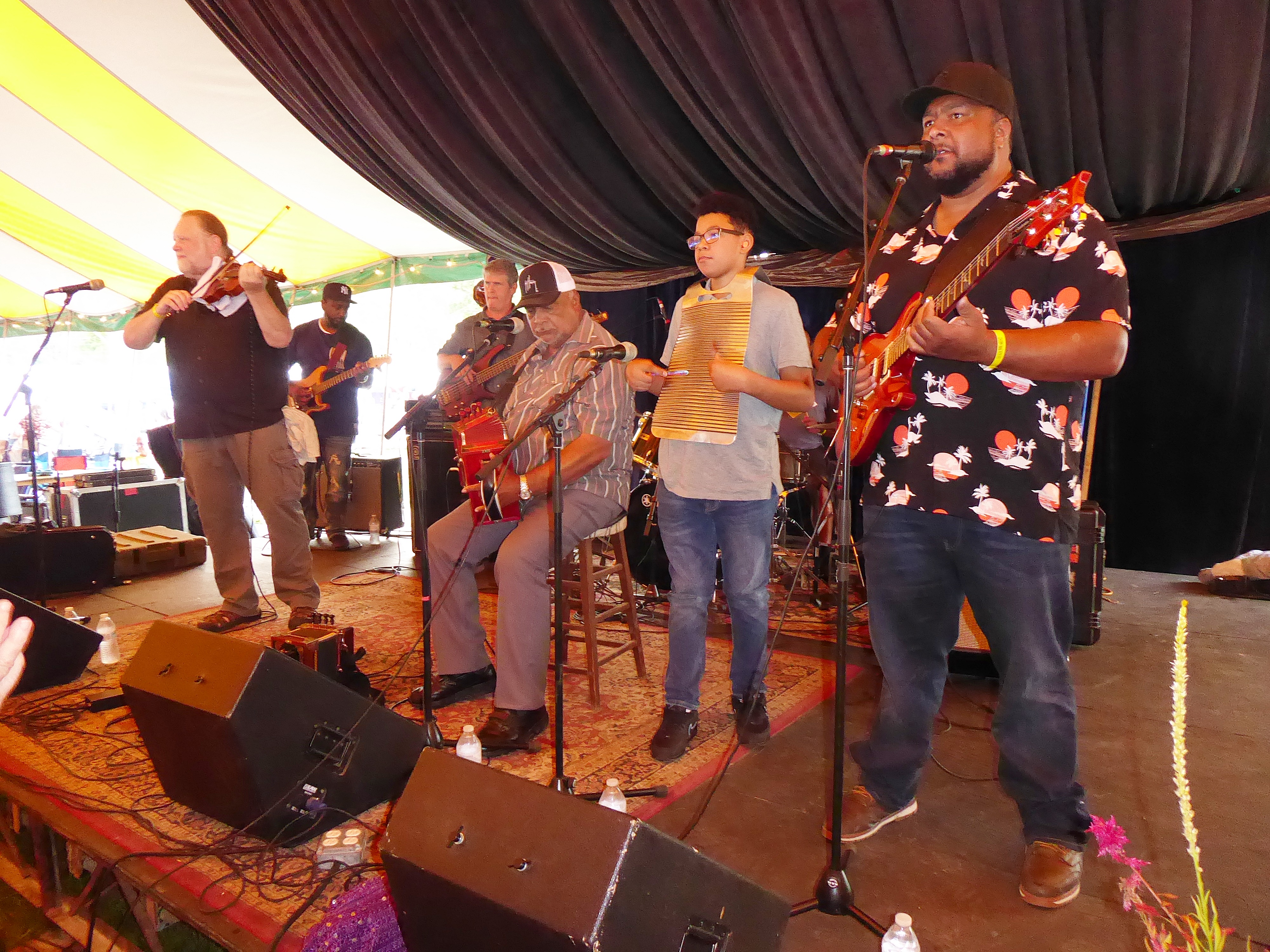
Preston Frank and band. Note the presence of Dirk Powell. (Jim Motavalli photo)
More cajun came from Preston Frank and his Zydeco Family Band. My notes say, “The most infectious sound in the world.” The music makes you happy, but Frank himself is very deadpan. The 12-year-old rub board player is a grandson. Or maybe a great-grandson. There are no grandstanding soloists in this music; it’s all about the groove.

Jim Lauderdale fronts the Buffalo. (Jim Motavalli photo)
Singer-songwriter Jim Lauderdale made an album with the hosts, Donna the Buffalo. Wait ‘Til Spring came out in 2006, though it seems much more recent than that. The Buffalo is more or less Lauderdale’s backing band on the project, though their signature sound can’t help popping up. They clearly enjoyed each other at Grassroots. The Campbell Brothers took forever to set up, but appeared to have it together with their sacred steel before I had to leave. The Flying Clouds of South Carolina, with a rocking approach to gospel, were very convincing.
Day Two started with Jeb and Friends, featuring the laid-back Jeb Puryear of Donna fame. At least he was laid back on stage—organizing the festival (plus three others) with Tara Nevins and the local village must be quite taxing, as well as Donna’s energetic concert schedule.
The set was many of Jeb’s new songs, plus some by friends Uniit Carryou—a very appealing and warm Celtic-influenced singer—and aided by Hank Roberts on truly jaw-dropping cello. I’d like to know more about both of them. Roberts demonstrates why folk music needs more cello. Together it was Woodstock-adjacent upstate New York music. Willie Nelson’s “Bloody Mary Morning” sure sounded good—it had that Texas outlaw vibe, a second cousin to “Sunday Morning Coming Down.” I didn’t get the bass player’s name, but he switched to guitar and led a couple of fine songs. They closed out with a rousing version of Donna’s “Conscious Evolution.”
Drank the Gold offered old-time duets and some contemporary singer-songwriting. Oona Grady brought out her ornate Norwegian Hardanger fiddle, with a second set of strings under the bridge. They also played “The Fox,” which is sometimes described as the oldest folk song in English—dating to the 15th century. But it’s undergone considerable updating since then. My earliest recollection is of Pete Seeger singing it. Maybe “Sumer is Icumen in” is older, since it’s from the 13th century—but it’s in Middle English. “Froggie Went a Courtin’” is pretty ancient, too.

Vivian Leva and Riley Calcagno–their talents came together. (Jim Motavalli photo)
I can’t say enough about North Carolina-based Viv (Leva) and Riley (Calcagno). Vivian, folk royalty through her parents, James Leva and Carol Elizabeth Jones, carries on the family tradition—she’s also in a duo! Leva is a fine autobiographical songwriter and singer, and Calcagno is a virtuoso player, especially on fiddle but also on guitar and banjo. The group loves the tradition, as their seven-minute “Bury Me Not on the Lone Prairie” (not any version I’m familiar with) definitely demonstrated. They also revived a song by the great unaccompanied singer Texas Gladden called “Cold Mountains,” and put a lovely chorus to it. The group’s new album, Imaginary People, is out in September. Here are two videos.
Dirk Powell’s set was a highlight for me. His band includes his daughter, Amelia, on guitar and vocals. Powell is one of our best old-time interpreters, but he’s also steeped in cajun music, having married Christine Balfa and played in her father Dewey’s band, Balfa Toujours. He was a sideman with Preston Frank, too. The band opened with a trip down to New Orleans, Amelia on lead vocals—she’s good at it, too. The music was driving, with multi-instrumentalist Dirk on fiddle. The band was enhanced with Riley Calcagno’s fiddle, and there were some intense duets with Dirk—on cajun and bluegrass/old-time.
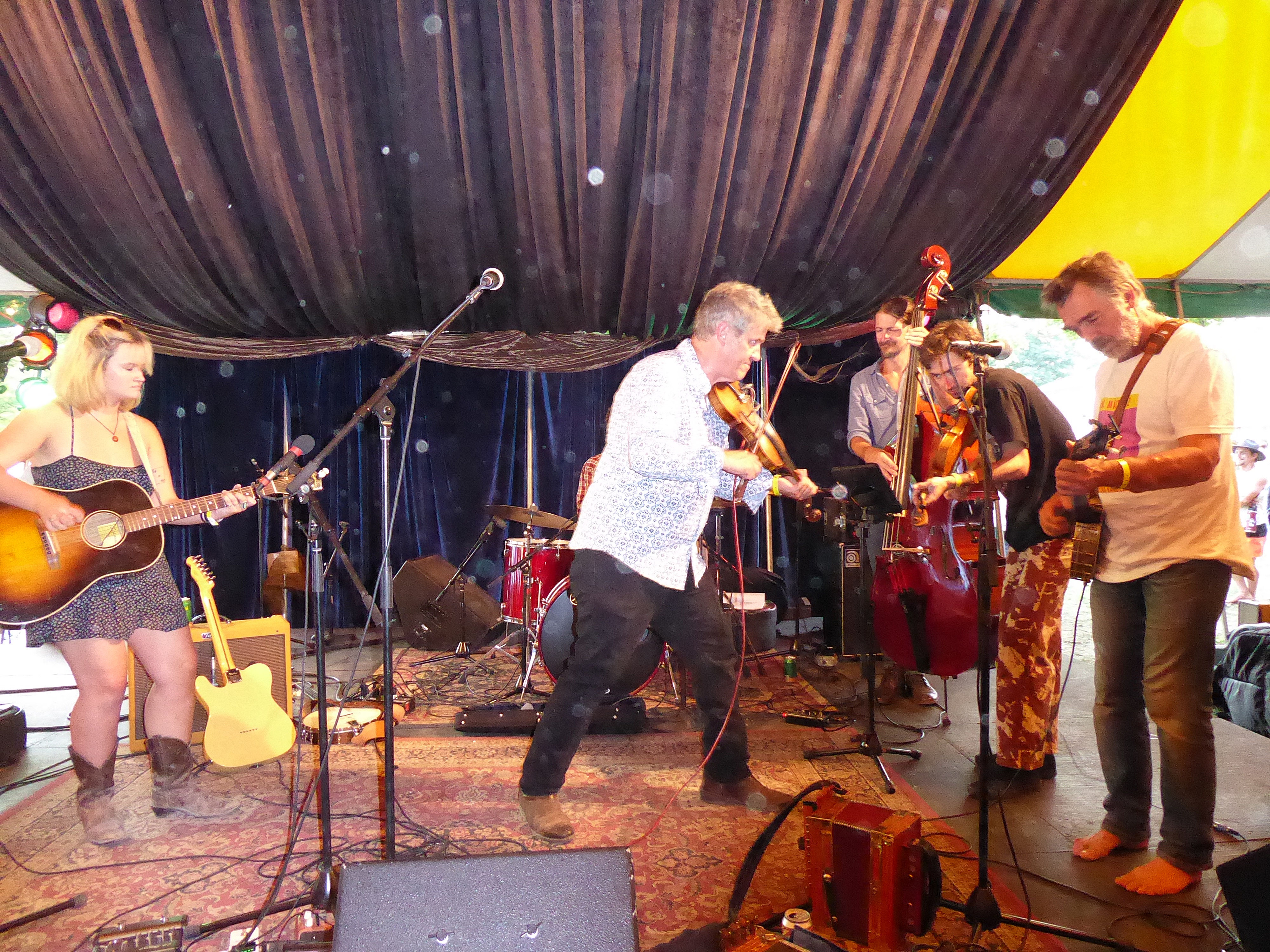
Dirk Powell with daughter Amelia, Riley Calcagno and Richie Stearns. (Jim Motavalli photo)
Coming back up north, the band made an Amythyst Kiah song, “The Worst,” their own. Kiah, who is from Chattanooga and currently lives in the early old-time epicenter of Johnson City, Tennessee, is a student of early African-American banjo music, among other things. Then, having heard that Richie and Rosie did his song, Powell offered his own just-fine version of “Waterbound,” which morphed into a spirited take on “Cumberland Gap.” Here’s the video:
Powell’s set was quite varied. He also did a rockabilly-type song with Chuck Berry overtones that was part of a workshop challenge to produce a song in an hour. The man can rip an electric guitar. Richie Stearns was also brought up to the stage on banjo. Powell used to live in the Ithaca area and knows the scene there. They concluded with a square dance.
Rising Appalachia has many fans in Ithaca. Their mix of old-time and a sort of New Age trance music was quite well received. And Watchhouse proved that a shredding mandolin can be the lead instrument in a driving and almost commercial folk approach. Good songs from Andrew Marlin definitely help. His wife, Emily Frantz, is a very strong singer.
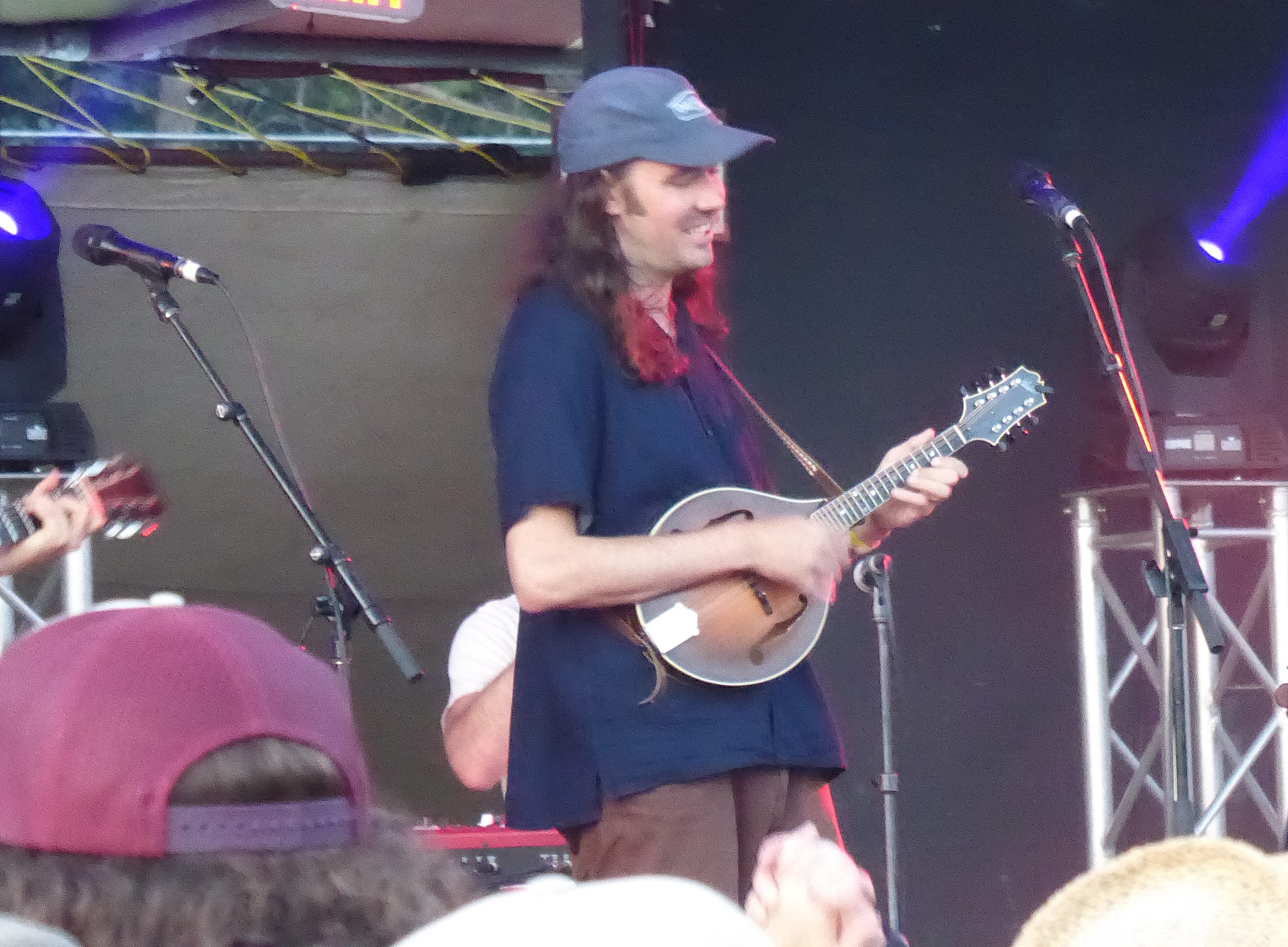
Andrew Marlin of Watchhouse, making the mandolin sing. (Jim Motavalli photo)
Donna the Buffalo wasn’t coming on until nearly 11 p.m., and I had miles to go before I slept. I’ll catch them the next time. Memories of 20 other Donna shows will have to hold me for a while.
 Territorial Imperatives