

Michelle Lordi in flight at Maureen’s in Nyack. (Jim Motavalli photo)
Maureen’s Jazz Cellar in Nyack, New York is indeed down a flight of steps, opening up to a cozy space with pretty good sight lines and—despite “jazz” in the title—many pictures of Jerry Garcia. It seems the place is pleasantly schizophrenic, supporting both jazz and Americana/bluegrass. Maureen Budway, the club’s namesake, was a jazz singer who passed in 2015; the club is under the direction of her brother and musical collaborator, pianist David Budway.
We were at Maureen’s, for the first time, to see jazz singer Michelle Lordi, who just released the lovely and challenging album Two Moons. David Budway was to have played the piano, but he was reported out with a cold. Ian Macauley, who’s performed with Clark Terry, John Legend and Joe Lovano, was on guitar. Tim Horner was on drums, and Matt Parrish, Lordi’s partner, on bass. The stage was set.
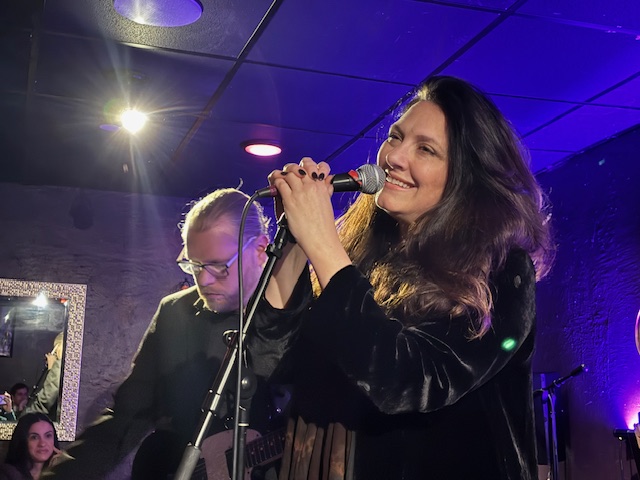
Lordi with guitarist Ian Macauley. (Jim Motavalli photo)
Based in Philadelphia, Lordi is a singer in constant development. Early recordings are quite nice but conventional—singing standards with in-the-tradition bands she sounds lovely but not who’s-that arresting. On the alt-country jazz of Break Up with the Sound (2019) and now on Two Moons, she’s evolved into something that’s entirely her own. Both albums are deeply experimental in their instrumentation without ever losing the essential groove.
And Lordi makes the albums enthralling with her cool, expressive vocals and increasingly strong songwriting. She has lovely microphone technique, and uses held notes judiciously.

Bassist Matt Parrish helps shape Lordi’s sound. (Jim Motavalli photo)
In Nyack, performed a few songs from Two Moons (“Blue Moon,” “Close Your Eyes,” “Never Break”), “Red House Blues” and “Poor Bird” from Break Up, and other material—including a bit of Jobim and Legrand, plus one of the saddest songs ever, Hank Williams’ “I’m So Lonesome I Could Cry,” and “a great song by a jerk,” Ryan Adams’ “When the Stars Go Blue.” The band by itself played “Beautiful Love,” which was evidently the love theme from The Mummy (as played by the Victor Young Orchestra in 1931).
Only Parrish, who teaches at Princeton and tours with the venerable Houston Person, was on both Two Moons and the gig in Nyack. He’s key to Lordi’s evolving conception, very upfront, propulsive and insistent—playing a bass made in 1850. Parrish played on and produced the big-band album Dream a Little Dream as well as Break Up with the Sound, and co-produced Two Moons. Horner, with a huge jazz resume, is a great man with the brushes and very sensitive and nuanced in accompanying Lordi (who, by the way, also teaches at Princeton–contemporary voice/jazz).
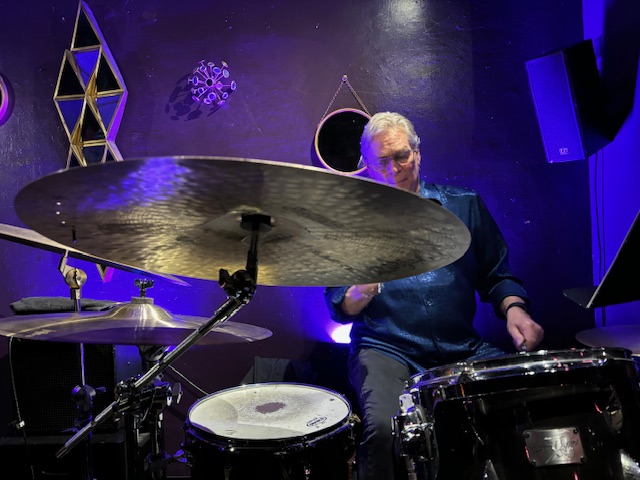
Drummer Tim Horner. (Jim Motavalli photo)
Macauley is a bebopper with an edge, also a fine colorist—essential in Lordi’s music. She does great work with guitarists. Macauley’s volume was a bit low, but from what we could hear he did fine.
Other musicians need to hear Lordi’s compositions, which get better the more you hear them. “Red House Blues,” one of several songs she does about her dreams, was incredibly atmospheric—in the club and on record. And as for “Poor Bird,” judge for yourself—here it is on video from Nyack:
After the house turned over at Maureen’s, a bluegrass trio came on featuring Arthur Toufayan and Gregg Terlizzi of Particle Theory—guitar, fiddle and mandolin. Very nice, with a definite nod to the music Jerry Garcia made with mandolin player David Grisman, and with the Dead, too. “Shady Grove,” “Jack a Roe,” “Deep Ellum Blues,” “Swing Low, Sweet Chariot” and “Roll On, Buddy” (a/k/a “Nine Pound Hammer”), all delivered very competently.
“Jack a Roe” is an example of a trad song that Garcia made his own—it’s just one of many old songs about women dressing as men to be close to the soldiers or sailors they love. The fact that the Dead had roots in bluegrass and jug band music is why they tower over the jam bands that came after them. Check out Donna the Buffalo for another example of sweet jamming that’s built on the tradition.
Upcoming from Lordi, in addition to club dates you should catch, is a live album with Xavier Davis on piano and Randy Napoleon, and an album with saxophonist Houston Person.


 Territorial Imperatives