
In the alternative world of the Gotham Jazz Festival, held at the opulent circa-1859 Down Town Association clubhouse near Wall Street, Bix Biederbecke is a bigger star than Prince. That’s judging from the number of times bandleaders called tunes with the legendary cornet player, who died in 1931.

The New York Hot Jazz Camp ensembles were superb. This is Jazznauseam. (Jim Motavalli photo)
This was my second Gotham, a joint effort of Patrick Soluri’s Prohibition Productions and the Bria Skonberg/Molly Ryan New York Hot Jazz Camp. It packs the city’s best swing bands (plus some out-of-town visitors) into three floors of continuous music that starts at 1 p.m. and goes on until near midnight.
Andy Schumm and his Gang are from Chicago, and play there regularly. Schumm is a cornetist, pianist and arranger who really respects the old songs. The first number I heard was “Blues My Naughty Sweetie Gives to Me,” circa 1919 and played in the style of clarinetist Jimmy Noone, dead in 1944. Yes, Schumm doubles on clarinet, and he was accompanied by a brilliant group featuring bass sax, piano (the amazing Dalton Ridenhour, a stride specialist) and trombone.
Later, a banjo/guitar player (who’d been given wrong time zones) showed up. The Gang was brilliant with or without him, and an absolute time capsule. “Where the Sweet Forget-Me-Nots Remember,” as performed by Ben Pollack and His Park Central Orchestra circa 1929, when was the last time that snappy number was performed live? When I moved on they were swinging into an adaption of Bix’ 1928 version of “Somebody Stole My Gal.”
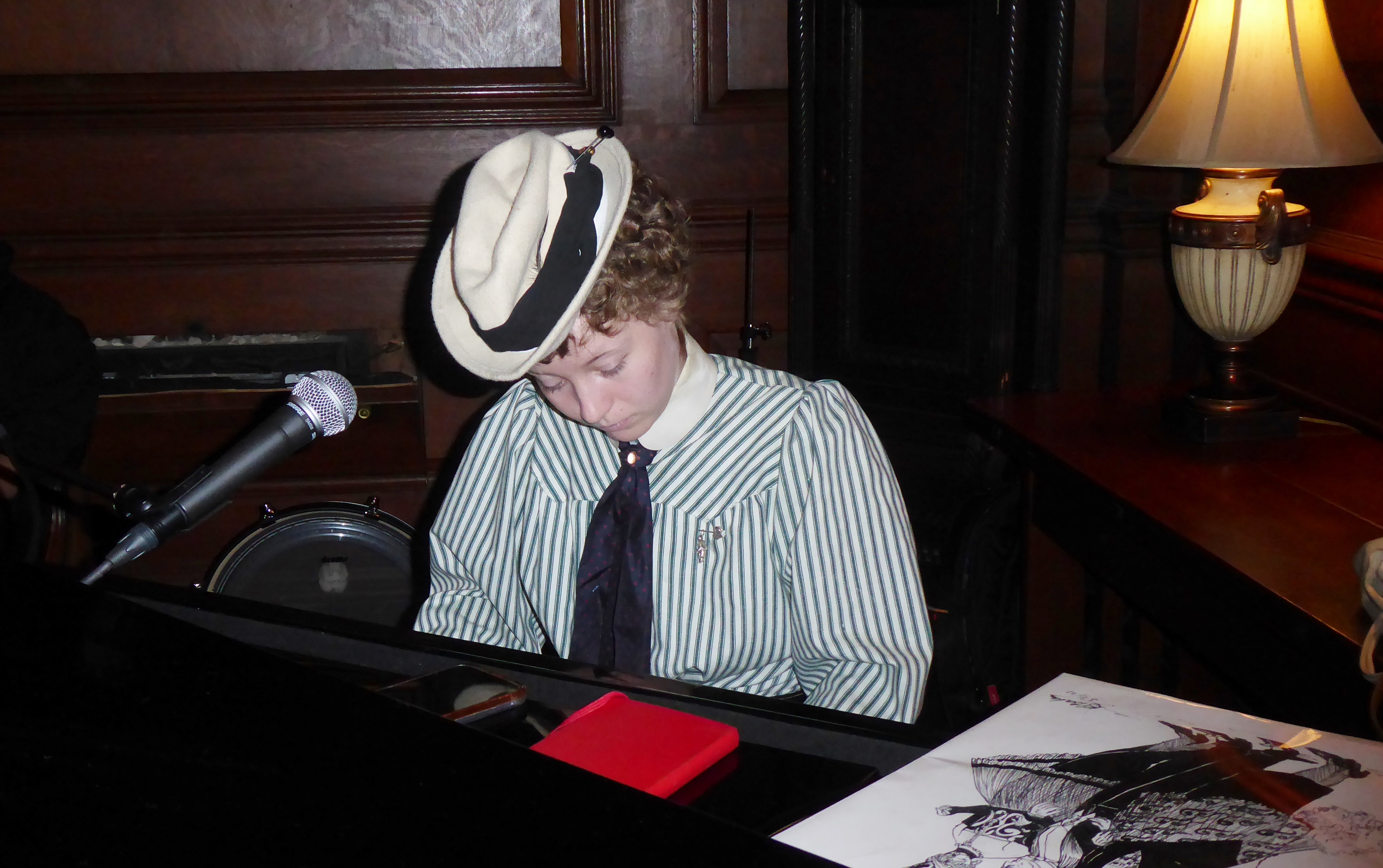
Ramona Baker, ragtime piano. She also makes her own clothes and makes prints, as seen in the foreground. (Jim Motavalli photo)
Down in the first-floor lounge and bar, ragtime pianist Ramona Baker (dressed in period clothes she made herself) was holding forth. She sounded great to me, and only 23 years old. Her songs were from 1902 (“Tell Me Dusky Maiden”), 1905 (“Dixie Queen,” which Freddie Hubbard used to play) and even “Southern Hospitality” from 1899.
I really enjoyed the sets by the New York Hot Jazz Camp students last year, and they were just as enjoyable in 2024. I heard Marit DeHoog sing “St. Louis Blues” with Jazz Cappuccino a la Créme, and faculty support from pianist Rossano Sportiello—a Gotham All-Star. A stirring “Dinah” by way of Fats Waller was next.
Julie Boyle was the featured vocalist with Jazznauseam, and the song was “After You’ve Gone” (1918). These are full bands sounding rehearsed and ready. Boyle could really sing, and was fully gowned in 1920s style.
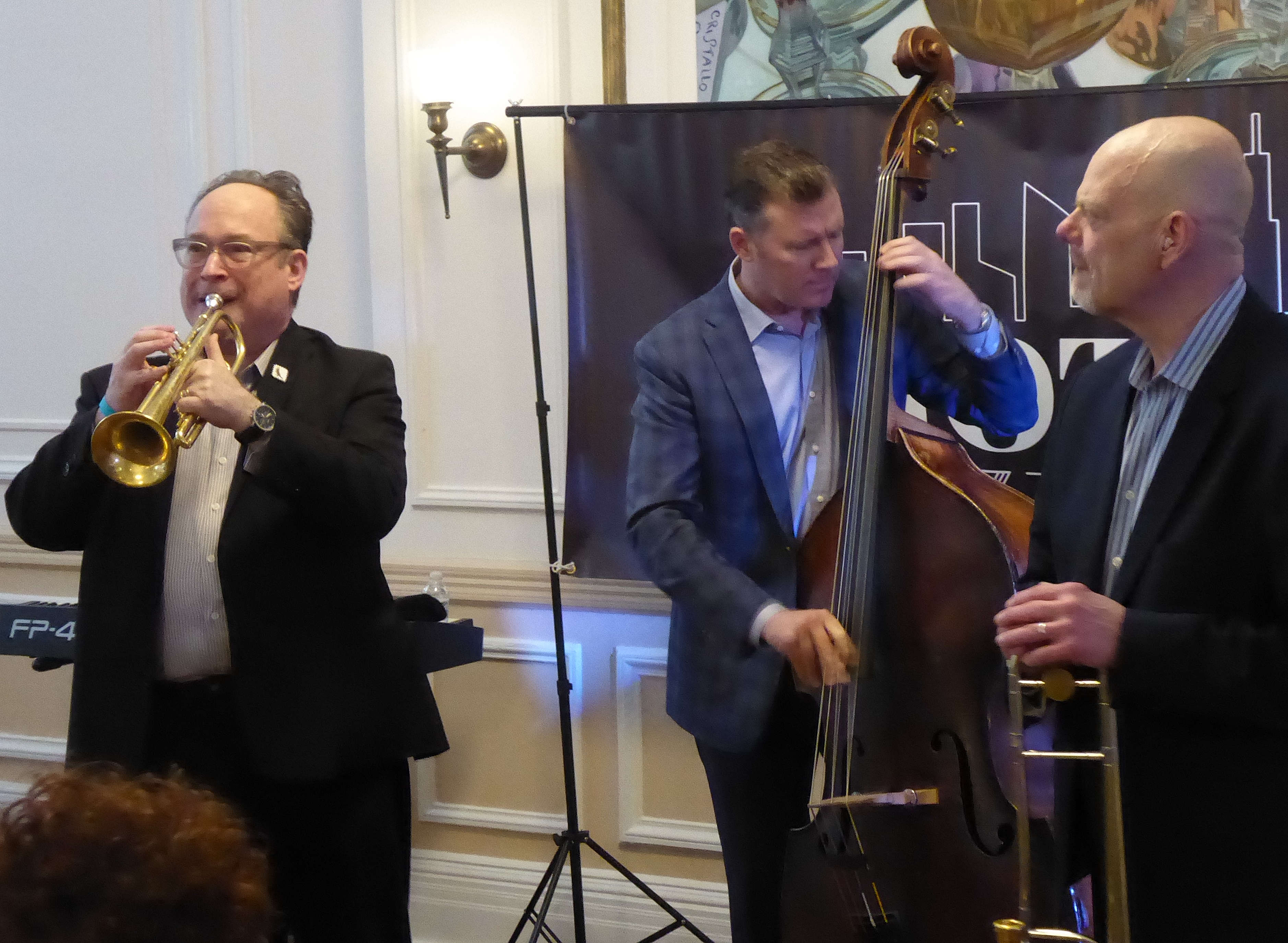
Jon-Erik Kellso (left) on trumpet, with John Allred (trombone) and Neal Miner on bass. (Jim Motavalli photo)
Jon-Erik Kellso is a trumpet star in swing circles, and plays Sunday nights with his Ear Regulars at the Deer Inn. All About Jazz says, “The music is a hybrid, with one foot planted securely in the time-honored Dixie tradition, the other marching steadily toward swing.” I’ll buy that. Matt Munisteri was featured on guitar, and Neal Miner was brilliant on bass. “At the Jazz Band Ball” was a very early composition from the Original Dixieland Jazz Band, circa 1917. To hear what their descendants sound like, check out Jon-Erik Kellso and The EarRegulars Live at The Ear Inn on Arbors (2023).
It was Munisteri’s birthday, so he got to sing and play on “You’re Bound to Look Like a Monkey When You Get Old,” which is from 1930 and was first recorded by The Hokum Trio.
The evening session was even better. In the Reading Room on floor 1.5 (don’t ask) I saw Eyal Vilner’s Swing Band swinging wildly for a full floor of dancers. The room went into pandemonium when Vilner called “Big Apple Contest” for “all you lindy hoppers.” I had no idea that many New Yorkers knew how to do the lindy hop, a fairly complicated African-American art form. To see World War II-era lindy hopping in all its glory, watch this 1941 selection from Hellzapoppin’:
Alphonso Horne and the Gotham Kings were entertaining. He’s a New Orleans trumpet player and vocalist a la the great Kermit Ruffins.
I’ve written extensively about Catherine Russell elsewhere on this blog, but here is that major jazz treasure with “I Found a New Baby,” accompanied by the New York Hot Jazz Camp faculty all-stars:
The all-stars deserve the name. Mike Davis is a monster period trumpet player and vocalist who leads his own ensembles. Ron Wilkins was all over the festival on hot trombone. Dan Levinson should be better known on saxophone and clarinet. They tore through numbers like “Three Little Words,” “Tin Roof Blues,” and, yes, “Somebody Stole My Gal” again.

Mike Davis (center) and the New York Jazz Camp Faculty All-Stars, Dan Levinson (left), Ron Wilkins (right). Tal Ronen (bass) and Kevin Dorn (drums) are in the background, and pianist Rossano Sportiello is obscured. (Jim Motavalli photo)
Have you heard the Anderson Brothers, Julliard grads Peter and Will? They’re huge talents on saxophone and clarinet. The twins played with the Jazz at Lincoln Center Orchestra, the Vanguard Jazz Orchestra, Wycliffe Gordon, Cecile McLorin Salvant, Paquito D’Rivera, Wynton Marsalis, and are on the soundtrack of HBO’s Boardwalk Empire with Vince Giordano’s Nighthawks. At Gotham, they backed organizer, Molly Ryan, a strong vocalist on “You’d be So Nice to Come Home To.”

The Anderson twins, Peter and Will. (Jim Motavalli photo)
Bria Skonberg is central to Gotham’s success, and we were lucky she found time to get on stage and pick up her muted trumpet. She also goes way back for her repertoire. “Tiger Rag,” with tuba for bass, is another Original Dixeland Jazz Band number, from 1917. Skonberg’s a fine vocalist, too, whether tackling vintage numbers or the Great American Songbook.

Bria Skonberg (right with Arnt Arntzen (left) and Jen Hodge (middle). (Jim Motavalli photo)
Accompanying Skonberg was another pair of brothers, the Arntzens from a musical family in Saskatchewan, Canada. They both sing, and Evan plays clarinet and Arnt banjo and guitar. Their grandad, Lloyd Arntzen, bought his first jazz records from money he made killing gophers, Arnt said. Skonberg generously gave them some stage time to rip through a song they got from granddad, “Viper Mad.”
I had to leave to catch a train, so caught only one number by The Hot Toddies, featuring Patrick Soluri on drums and the protean Justin Poindexter on guitar and vocals. Alas, missed other singers that were slated to join them, Queen Esther and Hannah Gill. I missed much music I’d have liked to have heard: Charles Turner and Uptown Swing, The Hot Sardines, the all-star Mona’s Hot Four jam, Terry Waldo.
Altogether another wonderful, out-of-time Gotham Jazz Festival. On to 2025.

 Territorial Imperatives