
When most people rattle off the names of great blues guitarists, they name such British stalwarts as Jimmy Page, Eric Clapton and Jeff Beck. Of course, this does a total disservice to the African-American luminaries they all learned from, including Buddy Guy, T-Bone Walker, Albert Collins, B.B., Freddie and Albert King, Muddy Waters, and Howlin’ Wolf.

Sue Foley, tearing it up in Ridgefield. She’s a one-guitar woman. (Jim Motavalli photo)
And let’s not forget the women: Sister Rosetta Tharpe, Geeshie Wiley, Etta Baker, Elizabeth Cotten and Memphis Minnie included. But the discrimination against women in this field is still continuing. Proof is the show I saw August 20 at CHIRP in Ridgefield, Connecticut—the Sue Foley Trio.
How this woman remains below the radar is beyond me. I first heard her in approximately 1994, following the release of her first album, Young Girl Blues (1992). Amazingly enough, the same guitar that’s one the cover is the one she played in Ridgefield.
The Canada-born Foley is simply an astounding blues guitarist, a very accomplished songwriter, a fine singer (reminding me a bit of Bonnie Raitt, complete down to the red hair), and an amiable leader. In Ridgefield, she played one amazing song after the other, with solos that made the hair on my arms stand up. Here’s proof, a song called “Fool’s Gold.” For some reason, the vocals didn’t come through clearly. But the guitar sure does:
Again, I can only surmise that sexism is holding her back. If you offered a blindfold test with one of her solos and told people it was the vaunted Stevie Ray Vaughan, then the critics would sit up and listen. Or maybe it’s Foley’s refusal to compromise. The aforementioned Bonnie Raitt long ago crossed over, but she became a pop star and largely left unadulterated blues music behind. Eric Clapton claims to be a blues purist but his most popular music is laid-back pop.

Foley acknowledges the blues women on acoustic. (Jim Motavalli photo)
Foley’s most recent record is One Guitar Woman (A Tribute to The Female Pioneers of Guitar), covering artists like Memphis Minnie on her acoustic. In Ridgefield, she opened her show solo and played some songs from it, including Elizabeth Cotton’s “Oh Babe, It Ain’t No Lie” and Minnie’s “In My Girlish Days.” A highlight of that set was Foley’s own “Maybelle’s Guitar,” a tribute to that Carter Family stalwart and proof Foley listens to country, too.
Foley is 56, and much of that time has been spent on the road, playing blues all over the world. She’s built up a following—the park was crowded the night I saw her—but a wider public should be hers.
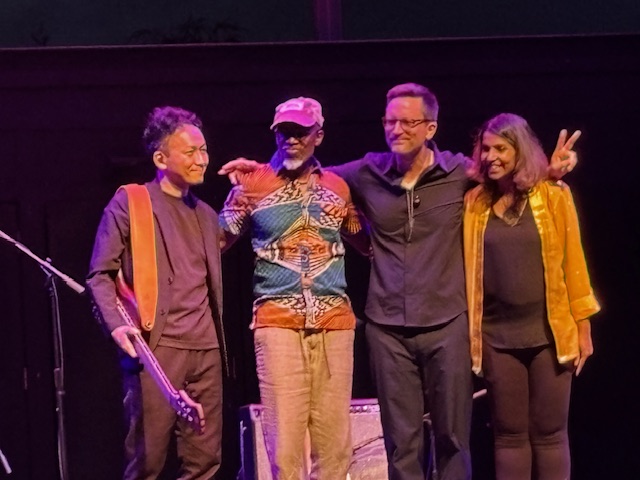
APQ takes a bow. Shah is at right, Ross second from right. Rudy Royston is a regular fill-in on drums. And Nakamura is an outstanding bass player. (Jim Motavalli photo)
Also in local live shows, I saw the wonderful American Patchwork Quartet at the Levitt Pavilion in Westport, Connecticut. It’s fusion music at its best, combining Falguni Shah, a 11th generation Hindustani classical vocalist with the Americana and old-time folk of Clay Ross, founder of the Gullah group Ranky Tanky. The Japanese bassist is Yasushi Nakamura, and the drummer (on the record) is Ellis Marsalis protégé Clarence Penn, but in Westport it was acclaimed jazz player Rudy Royston.
Ross and Shah do a great job of explaining what they’re doing to folks just out for a good time. As they put it, “APQ is a deliberately designed homage to America’s past and a showcase of its dynamic present.” The cultures blend wonderfully well, particularly on their takedown of the ancient folk tune “The Devil’s Nine,” a/k/a “The Devil’s Nine Questions.” Mark how Shah colors the English tradition with her own roots music:
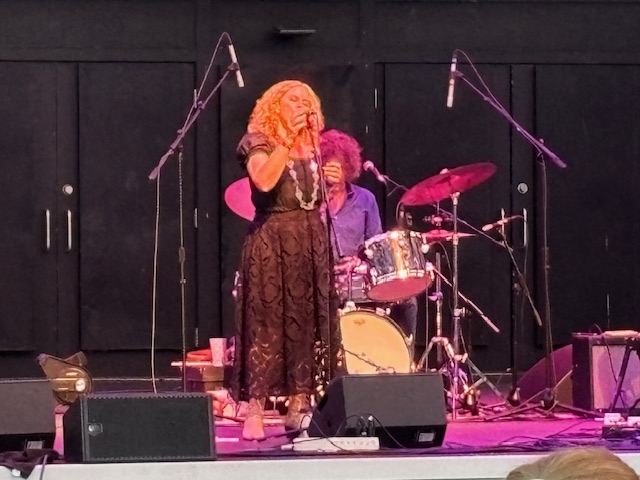
Amy Helm’s star has risen. (Jim Motavalli photo)
Also at Levitt was a reunion of the group Ollabelle, getting some recognition now as Amy Helm’s star rises. Check out her fine Silver City release. The eponymous Ollabelle album came out in 2004, when there weren’t all that many old-timey releases around. I guess they were ahead of their time, but I loved it and played it often on WPKN for their take on “How Long?” (acapella), “See Line Woman” (via Nina Simone), “John the Revelator” (via Son House), “Soul of a Man” (via Blind Willie Johnson), “Storms are on the Ocean” (Carter Family), and “Ain’t No More Cane on the Brazos” (every Village folkie, including Bob Dylan).
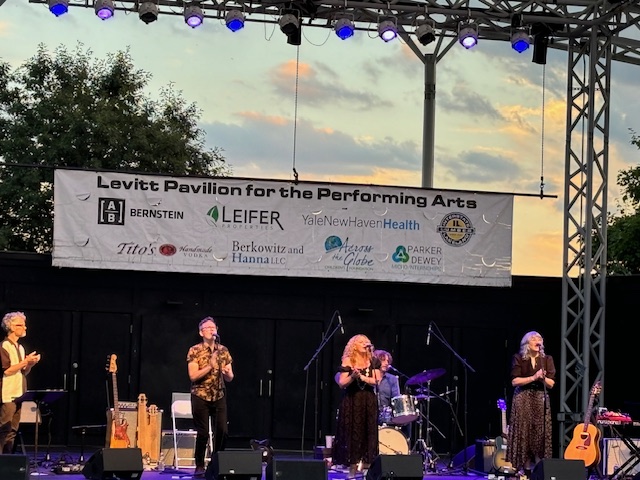
Olabelle are back! (Jim Motavalli photo)
Helm, the Australia-born Fiona McBain and keyboard player Glenn Paschka all have excellent voices, and they worked up quite a head of steam for a group that’s been dormant for a while. It was nice to hear they’re working on a new album, because the last one was in 2011. As we were walking out, McBain was giving “Brokedown Palace” by the Grateful Dead a workout.




 Territorial Imperatives