
It looked like we’d lose the wonderful Oldtone Festival, one of the few annual events centered on old-time music. There was no festival in 2020, limited events during COVID in 2021 and 2022, and 2023 went dark with some very regretful goodbyes. But the festival was back in full force this year, the eight annual from September 5-8, as a nonprofit Oldtone Arts Inc. event with sponsorship by the New York Foundation for the Arts. The festival in Hillsdale, New York is actually near the border with Connecticut and Massachusetts, so maybe those states could be supportive, too.

Talking Hearts on the Medicine Wagon stage. (Jim Motavalli photo)
Other than kids walking around with buckets to solicit donations, the festival was otherwise unchanged from its very effective formula. It’s a compact event, with a small main stage, a dance tent, a workshop area and even what was referred to as a “medicine show wagon”—an old Chevy truck with a platform and a microphone, used for short between-act sets.
We arrived as Moonshine Holler was playing. This is a Massachusetts-based old-time trio. Vocalist and multi-instrumentalist Paula Bradley co-led the group with her late husband, Bill Dillof, for 20 years, but now it’s Paula with young musicians Rafe Wolman and/or Marco DePaolis. “I’m privileged to play with these guys,” Bradley said.
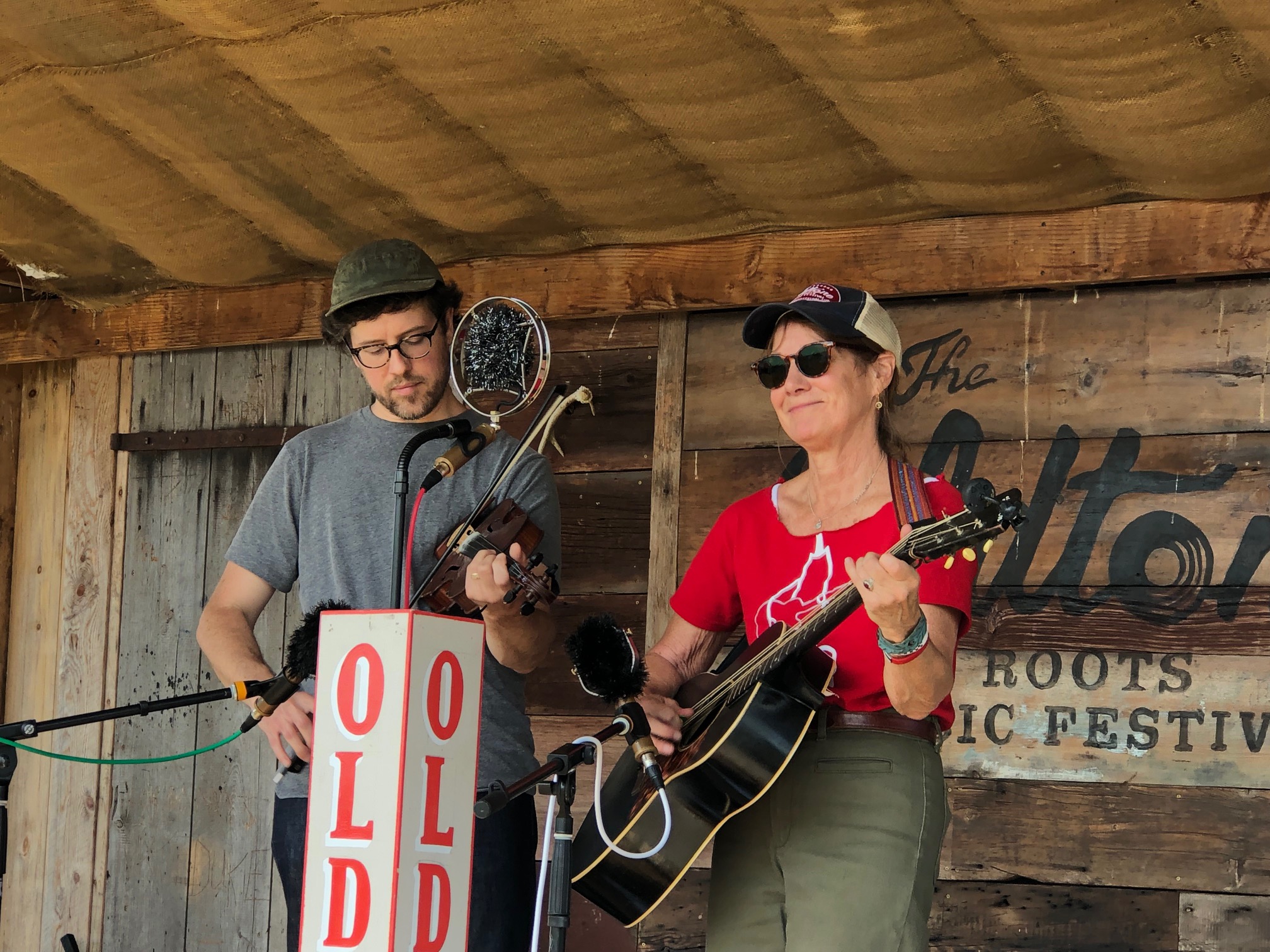
Moonshine Holler digs up the really old ones. (Jim Motavalli photo)
Paula’s a real historian of old-time music, as was Bill, and the group offered a program of both familiar old-timey tunes like “Devilish Mary” and obscurities from the likes of the Hackberry Ramblers and fiddler Clayton McMichen’s Wildcats (an offshoot of the Skillet Lickers). There was an incredible country interpretation of Adam and Eve in their garden. Apparently, they must have “shaken that thing.”
The Zach Bryson Band offered mainstream country, matching originals with Merle Haggard and Jimmie Rodgers. Later, he played solo.
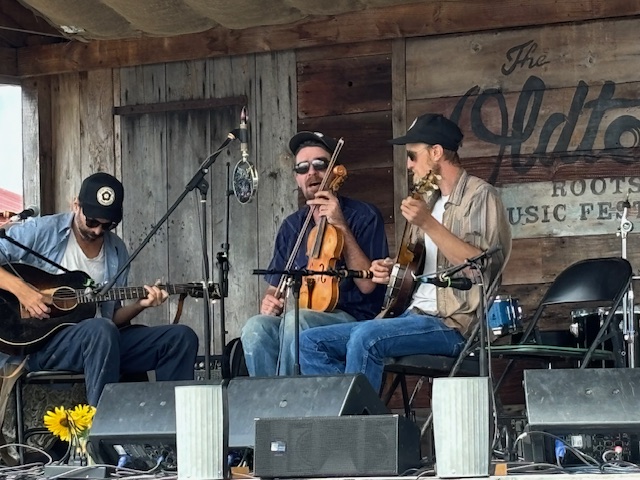
The Downhill Strugglers continue the tradition of urban old-time pioneered by the New Lost City Ramblers. (Jim Motavalli photo)
The Downhill Strugglers continue in the tradition of the New Lost City Ramblers, Mike Seeger’s assemblage of New York-based old-time advocates in the 1950s and 1960s. The Strugglers, mainstays of the Jalopy Theater in Red Hook and the Brooklyn Folk Festival (coming up November 8-10), just released their new album on Jalopy’s record label. Old Juniper is a collection of songs that sound ancient but were in fact written by members of the band. Walker Shepherd’s “Valley by the Stream” sounds absolutely authentic, as does Eli Smith’s “Picking Dandelions.” I’ll bet fiddler Jackson Lynch wrote “I’m Getting Ready to Go,” but all the songs are just credited to the band.
The Strugglers switch off on instruments, but have fiddle, guitar, banjo and harmonica pretty well covered. Here they are on video. This version of “The Girl I Left Behind Me” contains verses I hadn’t heard before:
And here’s the Strugglers from their second set, playing “Valley by the Stream”:
Krissie and the Kranks were a great find at this year’s Oldtone. Krissie Nagy is a fine singer of jazz standards and the Great American Songbook, echoes of Billie Holiday and her disciple Madeleine Peyroux. Here they are with Hoagy Carmichael’s fine song, “Up a Lazy River”:
One of the best things about Oldtone is that its view of old-time music includes 1920s and 1930s jazz. Krissie’s band (see below) was also great, and featured a fiddle player named Charlie Burnham. This guy has worked with James “Blood” Ulmer, Living Color, Cassandra Wilson, Steven Bernstein, Henry Threadgill, Medeski, Martin and Wood, Norah Jones, Sasha Dobson, Rufus Wainwright, and on and on. What a fine player. Joel Savoy, who also played cajun music at Oldtone this year, produced the group’s one album in Louisiana.

In the same vein and with some of the same standards, playing in the dance tent, was New York-based Sweet Megg, who is steeped in country swing and counts Patsy Cline and Billie Holiday as influences. She had great stage presence, and another great band.
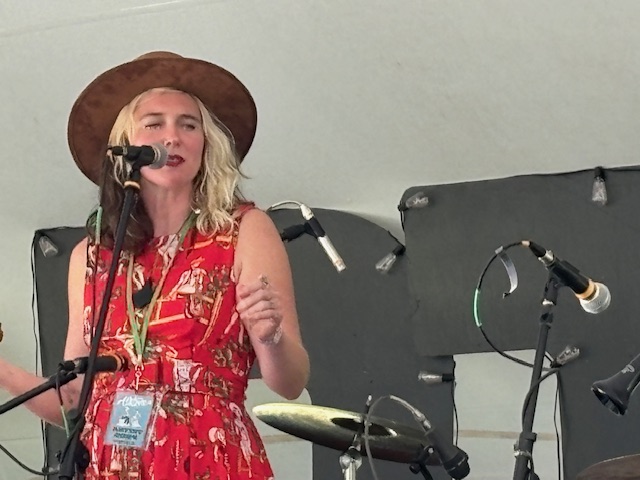
Sweet Megg also explored the old jazz tunes. (Jim Motavalli photo)
The Foghorn Stringband is Caleb Klauder (vocals, mandolin, fiddle), Reeb Willms (vocals, guitar), Nadine Landry (vocals, upright bass) and Stephen “Sammy” Lind (vocals, fiddle, banjo). They’ve been Oldtone regulars since the beginning, and I’ve also seen them at Red Wing in Virginia. They brought out that old story song “Willie Moore,” as well as “The Roving Gambler” and “Jack of Diamonds.” There were some fine originals, too, including one Wilms sang about a winding river. Wish I’d caught it on video!

The fully engaged Foghorn String Band. (Jim Motavalli photo)
At this point the heavens opened up and a hard rain started a-fallin’. Everyone headed either for their RVs, the dance tent or the shelter of their cars. The rain interrupted the program for a couple of hours and soaked the site, producing a lot of mud. But soon the action continued in the covered dance tent.
Most of the acts did get to play, including a really strong set by The Louisiana-based Deslondes. They’re a rock group in the best sense, with great songs and a revolving cast of singers. In fact, everyone but the pedal steel player had a vocal lead. They’ve been together 15 years, informally at first, and made four albums that are well worth investigating.
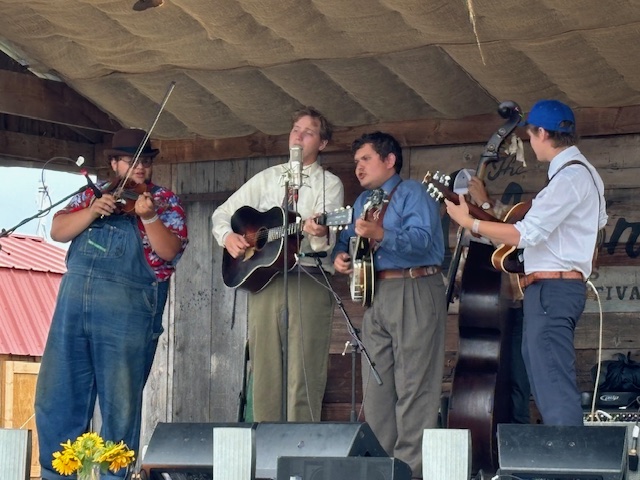
How could you not like the Chattanooga Dogs (above), a fine young bluegrass band? They were substituting for the Alum Ridge Boys and Ashlee, who were apparently ailing. They dug up a bunch of old Charlie Moore songs. The young group features Conner Vlietstra on guitar, vocals and fiddle, and Trevor Holder on banjo and voice. The latter has an uncanny ability to vocally echo the best 1940s bluegrass talent. “Hillbilly F-fever’s going ‘round,” they sang, and it indeed is.
Also in this vein was Danny Paisley and Southern Grass, mainstays of this music.
Probably the most valuable player for the weekend was locally based fiddle player Sophie Wellington, who appeared with numerous aggregations, including the Talking Hearts trio that sang from the medicine wagon. She’s a fine old-time musician who knows a lot of obscure tunes. She also appeared in her five-year-old Dumpster Debbie guise (that’s them below), leading a seven-piece band. That one was more like a rehearsal, with a lot of “what shall we play next?” comments. The audience would have benefited from a little context for the tunes.
Wellington was also heard during the Nadine Gospel Set segment. I wish I’d heard more of it, because I love old-time gospel music. Songs like Jesus is “Building a Mansion for Me.” And there she was again with the extravagantly bearded JP Harris, as fine an exponent of old-time and pre-1970 country music as exists in America today.
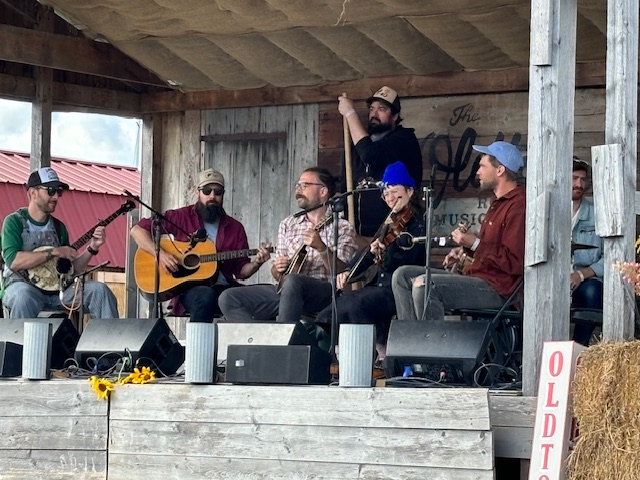
Harris had played with a full band late the previous night (too late for me, alas) but a little hoarse he was back on Sunday with an old-time trio. “I Wish I Were a Mole in the Ground,” “The Dying Cowboy,” “Been All ‘Round This World” were the songs he sang, but there were also fiddle tunes led by Wellington, such as “Belle of Lexington.” Harris said, “I owe all of my musical upbringing to the old-time scene.” He meant that he’s branched into more mainstream country—his most recent single is “Dark Thoughts”—but will never stop turning the clock back.
Here’s Harris on video doing a fine old song called “Mole in the Ground”:
The last act I saw was the Cajun Surprise. It was such a surprise I never did learn who they were, but the group—with accordion, guitar and two fiddles—sure sounded good.






 Territorial Imperatives