
“It was either go big or go home,” Scout Motors President and CEO Scott Keogh said to me when I told him this was the largest media/influencer gathering I’d been to in recent memory. “We had to do it.”
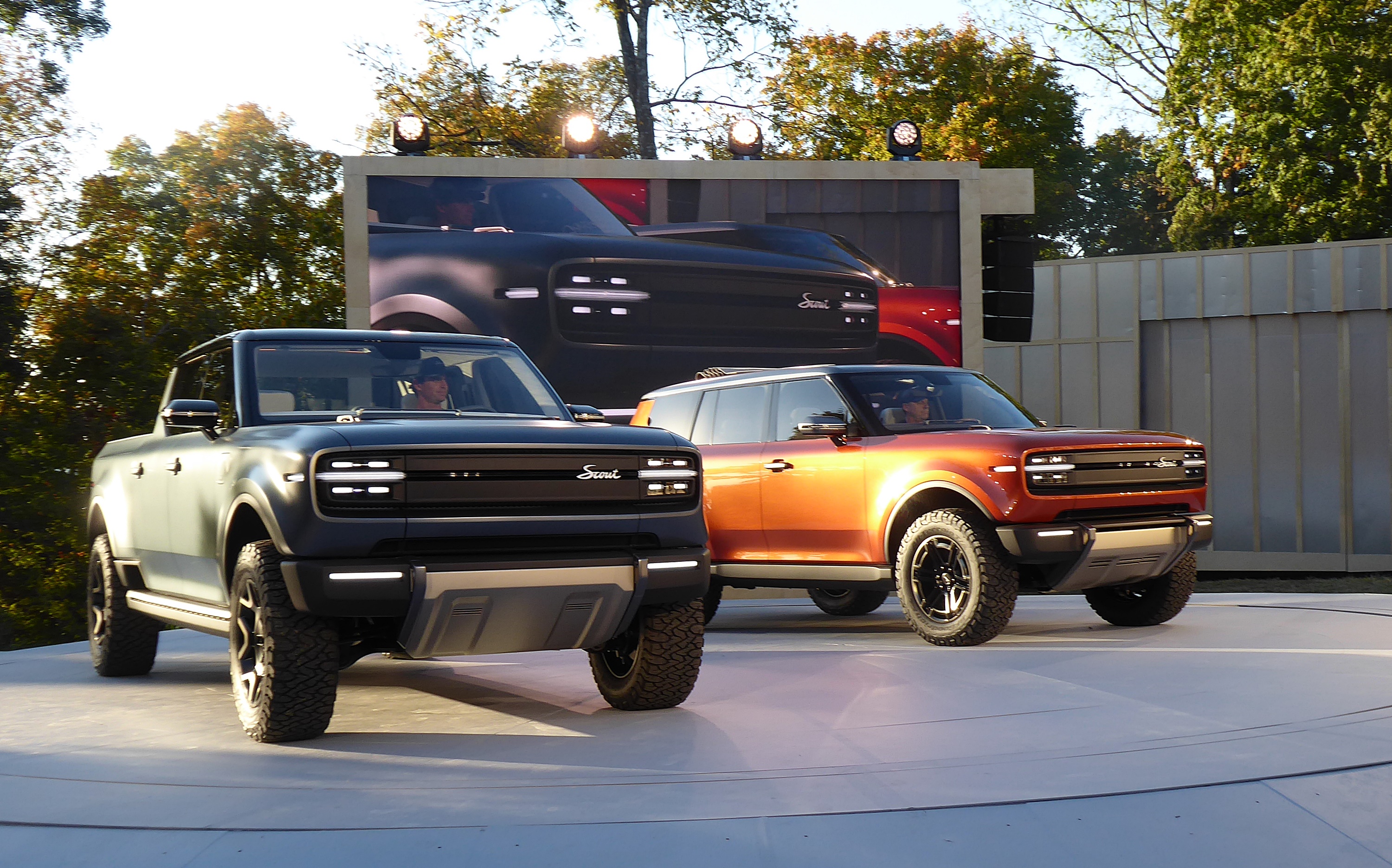
Scout Terra (left) and Traveler. (Jim Motavalli, all photos)
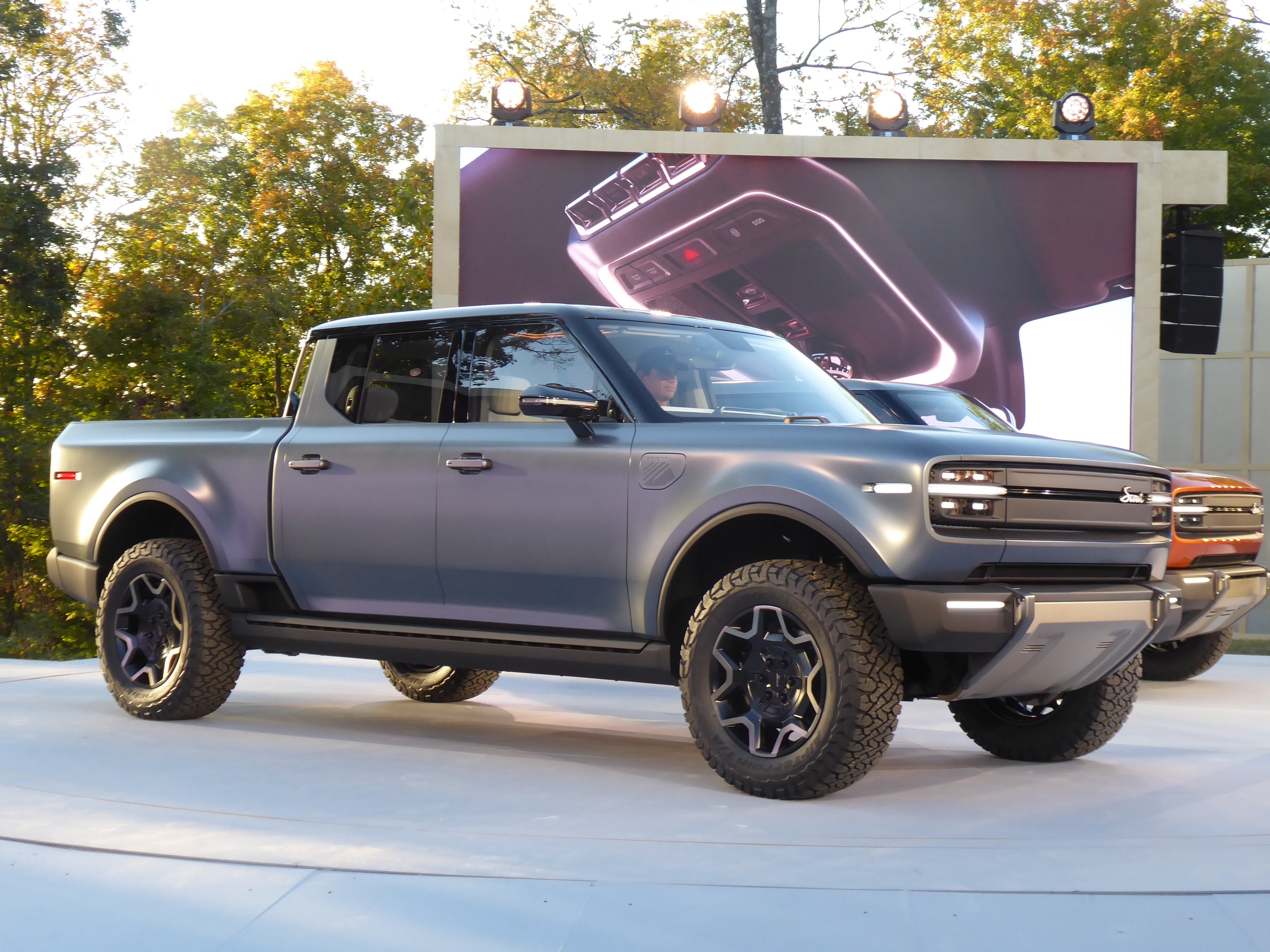
Minutes later, Keogh was up on the stand next to the new Scout electric four-door crew cab pickup (Terra, with a 5.5-foot bed) and SUV (Traveler, in tribute to the car’s origins in the International Scouts that ceased production in 1980). Both are standard with twin-motor all-wheel drive. The original Scouts were bare-bones off-roaders and work trucks, inexpensive to buy, prone to being worked hard and put away wet, and very rarely treated as garage queens. The steel bodies rusted, which is why, of the 500,000 made, only about half (a guess) are still alive, either running or rotting away behind a barn.
The new Scouts will be substantially different, though retaining some original DNA in their styling. They will be EVs with 1,000 pound-feet of torque and a zero to 60 time of 3.5 seconds. The range is up to 350 miles on just the battery pack, but a range extender (the Harvester option) is available to take that to 500 miles. Pricing starts under $60,000, but Scout is quick to add that it could be around $50,000 with the right federal and state incentives. The Scout will be built in an under-construction plant with 200,000-vehicle capacity in Blythewood, South Carolina (not the original’s Fort Wayne, Indiana, alas) and appear sometime in late 2027. Reservations are being taken on the website.

Scott Keogh introduces the Scout.
Some questions were left unanswered. There will be two battery packs, one for the range extender and the other for the standard model, Keogh told me, with different chemistries and sizes. But the sizes will be revealed down the road, he said. It’s quite likely they’re not finalized. The horsepower is also undivulged. The range extender will be mounted in the rear, and not compromise the front “frunk” space.
Scout Motors is a separate brand under the Volkswagen Group, and will have its own stand-alone sales and service network, but it’s emphasizing direct sales, with what Keogh said would be a 10-minute online purchase process, fixed and simplified no-haggle pricing, and a killer app. VW acquired the Scout name when its Traton truck division acquired Navistar, since renamed International Motors, for $3.7 billion in 2021. VW also inherited stillborn plans, developed over the years, to revive the Scout brand.
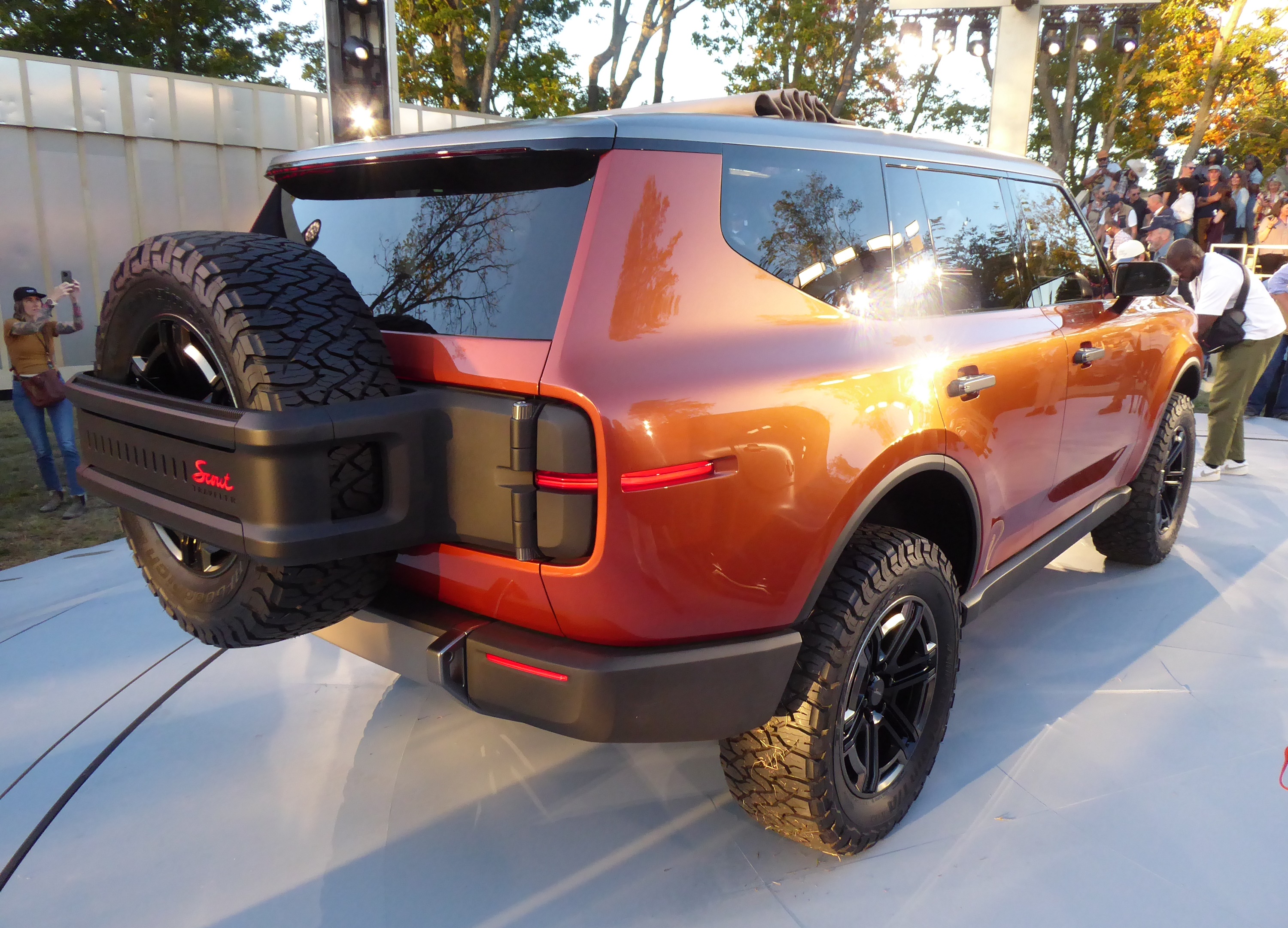
The Traveler retains cues to the original model.
“The original Scout was ahead of its time in inventing the American SUV market,” Keogh said. Of course, a little company called Jeep was also part of that, but this wasn’t the time to mention that. Blythewood will create 4,000 good-paying jobs, he said, and has the potential to “be profitable after its first calendar year of operations.” Parts and sub-assemblies will be sourced from Tier One suppliers within 200 miles of the plant’s location, he said.
According to Chief Design Officer Chris Benjamin, “A startup of a brand with such a rich and storied history is amazing.” He described the new body-on-frame SUV and pickup as “versatile multi-tools” that are “bold icons that will stand out in the marketplace.” First impressions are of a successful reimagining of Scout style in a decidedly more upscale manner, with Rivian (which has the same EV product line) as the most obvious competitor. The Scouts are not exactly cheap, but Rivians start around $10,000 more.
The old Scout logo is re-employed prominently, and on the pickup tailgate it even lights up. The SUV rocked a retro rollback “cabana” canvas sunroof. “The essence of the historic vehicles is preserved,” Benjamin said. “We’re picking up the character of the old Scout in a new and fresh way.”
Some features of the Scouts: buttons instead of on-screen controls for HVAC and infotainment volume, a stylish side step up on the pickup, a console that extends back into the second row of seats, a refrigerator/cool box, double wireless chargers, twin 110 outlets and a single 240, hemp wood accents as a sustainable touch, copious in-cabin storage. And there’s a bench seat option in both Terra and Traveler. Some of these things will be options, but this far ahead of launch that isn’t worked out yet.
The Scout Terra can tow up to 10,000 pounds and the Traveler 7,000. Both models have 2,000-pound payloads. They’ll come with Tesla’s NACS charging standard, and have 800-volt architecture, but not much was said about charging times. There wasn’t much about off-roading, either, though the one-foot ground clearance is high, three feet of water fording is possible, and the front skidplate protecting the undercarriage is part of the design. The tires will be up to 35 inches.
**
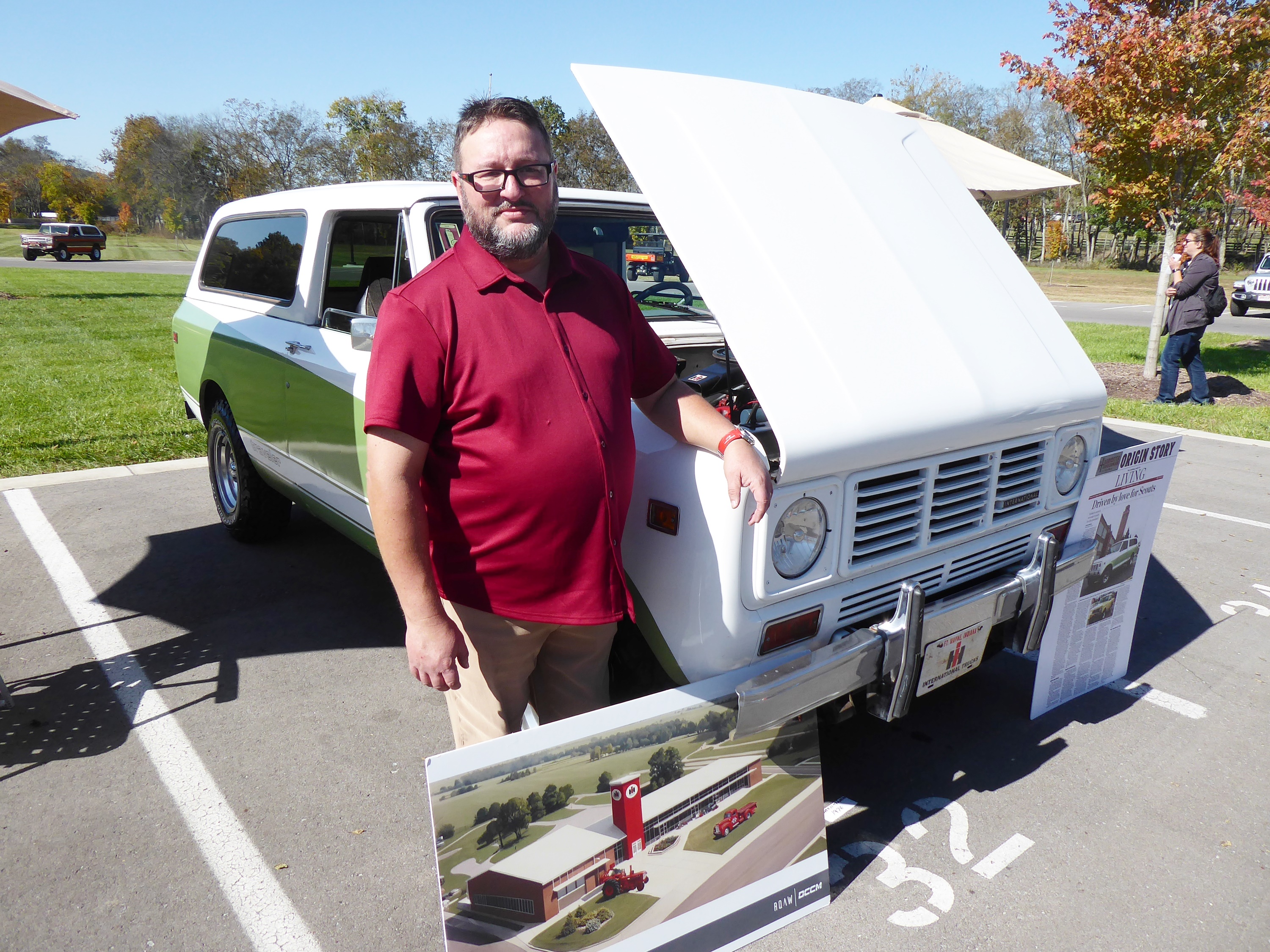
Ryan DuVall with his 1976 Scout.
Not far from where the Scouts were revealed on a hilltop at Southall farm-to-table resort in Franklin, Tennessee, a group from the Fort Wayne-based Harvester Homecoming (HH) had assembled 20 or more historic Scouts, including both the first (1961) and last ones (1980) built.
HH mastermind Ryan DuVall brought his green-and-white 1976 AWD Traveler (which could be ordered with a third seat). It was the Expedition/Suburban of its time, and DuVall’s example had what he called the “bulletproof” and sought-after 345-cubic-inch Scout V-8 engine. The Homecoming, held in Fort Wayne and first held in 2019, attracted more than 20,000 visitors in the peak year of 2021. Keough attended in 2022, while Scout Motors was being planned. HH is the largest Scout gathering in the world. The nonprofit inherited International Motors’ collection of historic vehicles, and a museum will be built to house them and related trucks in New Haven, Indiana.
DuVall takes issue with the idea that Scouts were especially prone to rust. “These vehicles were driven in winter, taken out in the worst conditions,” he said. “They were tough, rugged trucks, and they were used that way. They just saw more of the salted roads and the conditions that made them rust.”
DuVall is upbeat about the new Scout, though a bit bummed it’s not being built in Fort Wayne. But a pair of bricks from the old factory will be built into the new one.
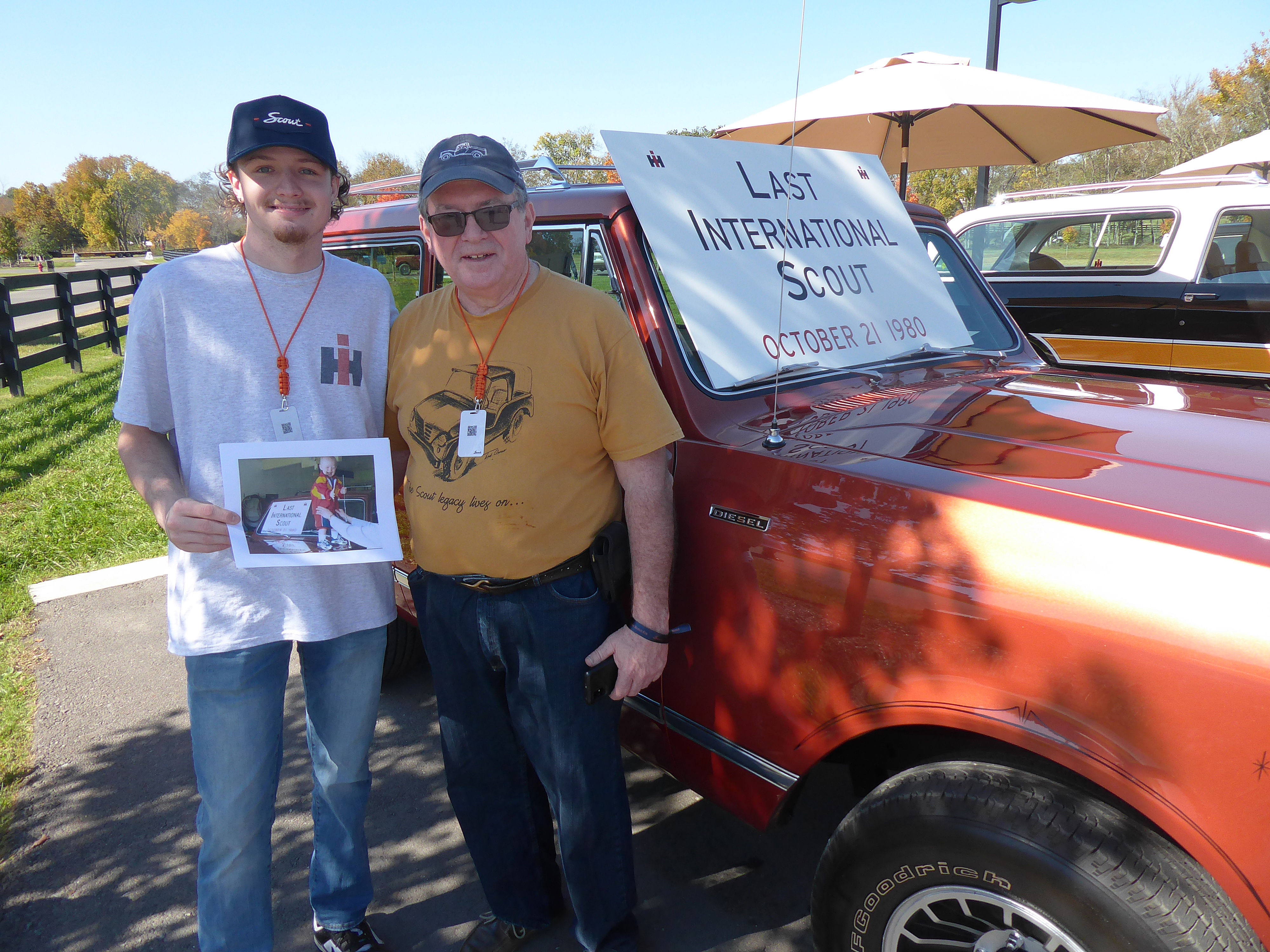
Mitchell (left) and Michael Bolton with the last Scout built. Until now, of course.
Up the row, young Mitchell Bolton was standing by his grandfather Michael Bolton’s 1980 diesel Scout II, the last Scout built—as photos document. “My grandpa got it from the original owner, who used it for hunting and camping trips,” Mitchell said. “It was a little rough. The restoration was started in 2016 and finished in 2020.”

Reportedly the first Scout 80 built in 1961, very bare bones.
Michael Bolton (yes, he gets teased about the name) said that the Scout died because “the CEO at the time decided to go to war with the unions, which resulted in a six-month strike in 1979 and 1980. It led to engine shortages and other problems. There were also emissions issues with the EPA, and finally the decision was made to close down the Scout division.” Ironically, at exactly the same time, the British car industry was going through the same process, and it led to the end for MG, Triumph and other iconic brands.
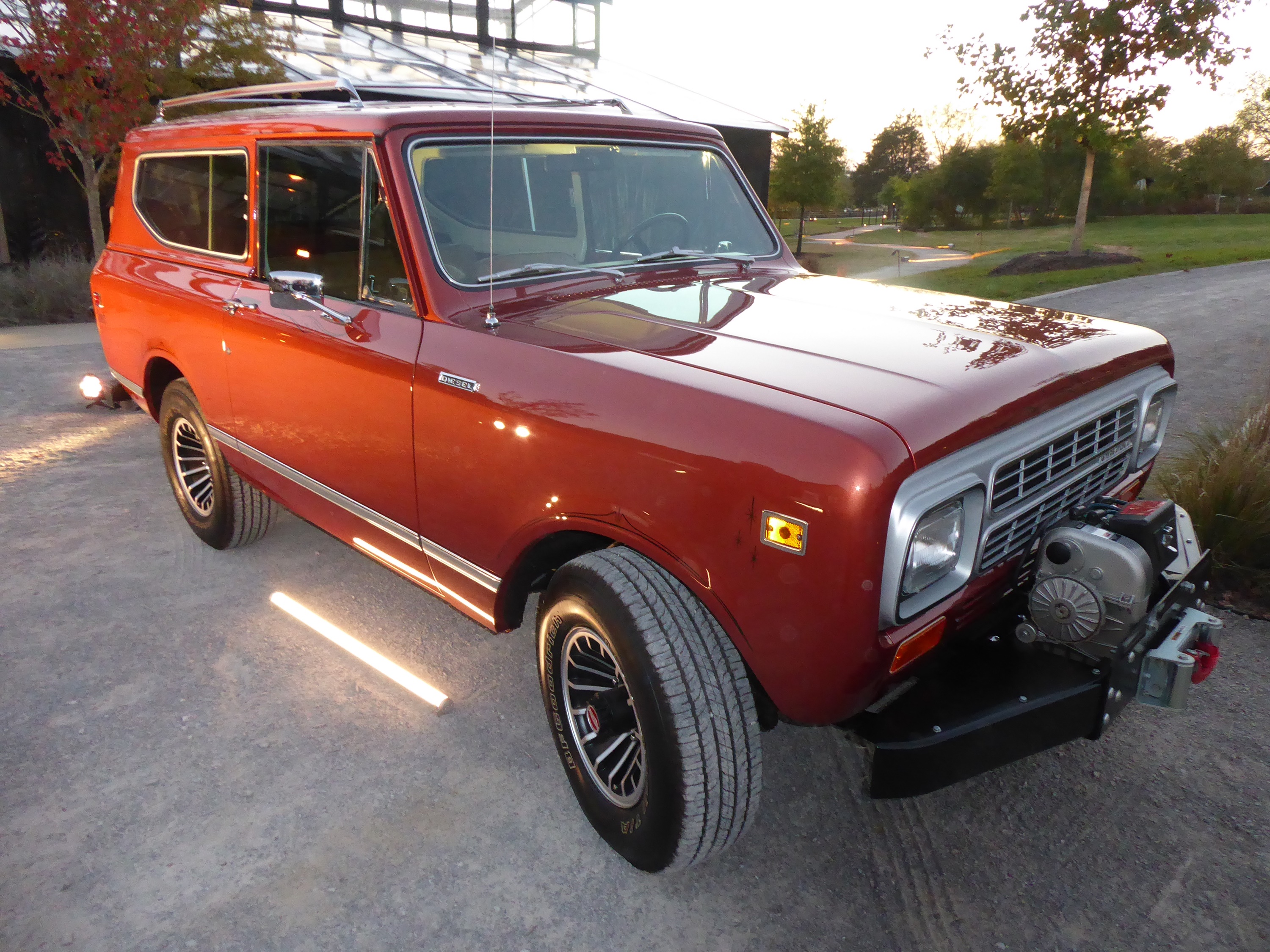
The last Scout built in 1980 is a Scout II model.
The first Scout 80 was up the row, a blue 1961 pickup with built in benches in the bed. It had four-cylinder power and was just as plain as could be—but somehow also timeless. There was also a pair of cool top-down Scout ragtops from the mid-60s.

A sad day back in 1980. (Scout photo)
**
In a workshop devoted to the South Carolina site, Joern Petri, Scout’s vice president for the plant launch, said that 74 sites had been considered (including Indiana), then narrowed down to just three. He declined to name the other two. Scout says the 4,000 jobs will expand to 9,500 when the supplier base is added. Blythewood is close to suppliers (Bosch and Mahle among them), a rail link, a highway, and a port (though the latter won’t be in demand until the vehicles expand beyond the initial North American base).The
BMW and Volvo also have plants in South Carolina, though I’m sure both would say (as Scout does) that it being a right-to-work state has nothing to do with it. Scout says it will cooperate with a union if that’s what the workers want, though it seems to be bending over backwards to build a contented work force that won’t want to organize. “We’re focused on creating an excellent workplace,” Petri said.
South Carolina is handling the leveling of the multi-grade, 1,100-acre site, which is being built up in stages, for VW. The plant should be finished by late 2025, and not long after a car will come off the assembly line every 80 seconds.
It’s possible that the plant will be used for the production of other VW Group vehicles, and there might also be some contract manufacturing, Petri said.
Finally, at the Customer Experience Workshop, Cody Thacker, vice president of growth, said Scout’s approach answered the question, “If an OEM could start anew, what would it do?” The answer, apparently, is orient sales of highly functional EVs around an app, but build a robust service network so that 85 percent of buyers are within 200 miles of a wrench. The other 15 percent will be served by mobile operations.
It’s unclear what Scout will do in those states (such as mine, Connecticut) that don’t permit direct sales. The answer would seem to be using the bricks and mortar to service the cars (the majority of the square footage) and introduce buyers to them, but have the transactions online. There will be 100 service locations, and 1,300 service bays, by 2032. “There will be one transparent price, with no hidden fees,” Thacker said. “People see buying a car as slow and cumbersome, and we’re out to change that.” There will be a pickup-at-the-factory option, with a customer center there in South Carolina.
Thacker assured the media that the Scout will be a 50-state vehicle, and there remains quite a long time before the first one is sold—direct sales could be resolved by then. The company is maybe ahead of itself a little in announcing the car now—and putting up billboards in Nashville—but it does have to build awareness of a brand that’s been dormant for more than 40 years.

 Territorial Imperatives