
The 16th Annual Brooklyn Folk Festival was one of this wonderful event’s widest ranging, retaining the core of its old-time roots but with very healthy dollops of international music as well. Groups from Mexico and India by way of Trinidad were new to me and thrilling.
And what a way to start on Friday afternoon. A young man named Royce Martin sat down at the piano and not only played some of the best ragtime I’ve ever heard but also his original compositions, which featured a form of word jazz seemingly of his own invention. “Make Believe” was “a song about confidence.”
Martin is from St. Louis, and worked as a pianist and lecturer at the Scott Joplin State Historic Site there. When he played master works like Joplin’s “Pineapple Rag” and Willie “The Lion” Smith’s “Echoes of Spring,” he channeled forms from his great-grandfather’s day. But he has the history, and also the will to take ragtime in new directions.
Samoa Wilson is a regular at Brooklyn; she’s a fine singer of vintage material, steeped in it through regular work with her uncle, Jim Kweskin of 1960s jugband fame. Wilson was at Brooklyn in a group with Sean Walsh, and delivered a fine version of Dylan’s “I’ll Be Your Baby Tonight.” Later she went on with the provocatively named duo Fatboy Wilson and Old Viejo Bones, with Ernesto Gomez.
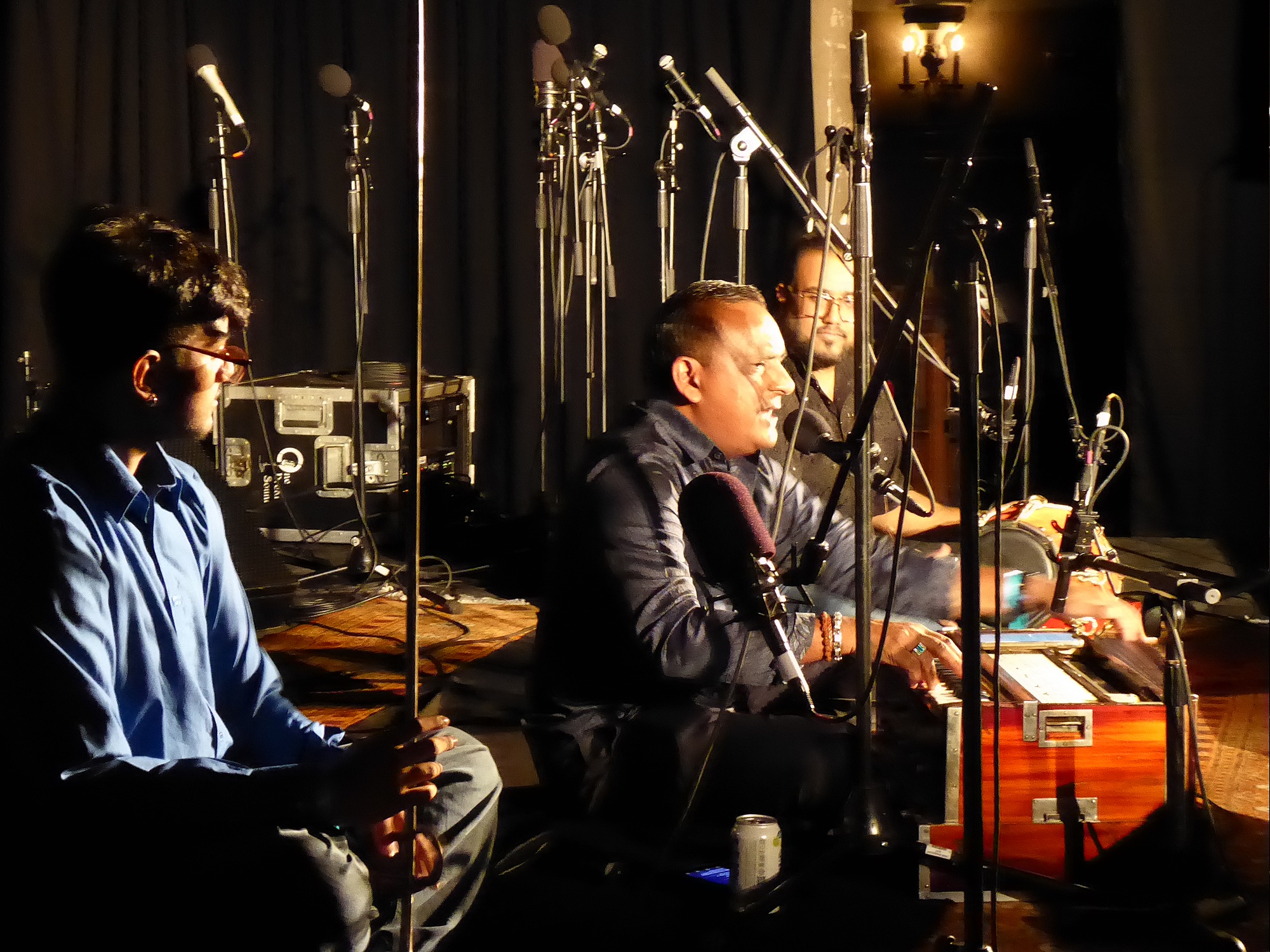
Shiva Lakhan (above), out of Trinidad, was unexpected. The trio played West Indian and “Chutney” vocal music that, in their version at least, is heavily percussive. The percussionist played a big double-sided hand drum, much larger—and louder—than tablas. I heard echoes of African music. The singer accompanied himself on a Paul and Co. harmonium, and it was intoxicating. A third musician banged a metal ring against a tall, thin pole, producing a chiming drone. Chutney is evidently a fusion of Indian folk and Bollywood with Caribbean calypso and soca. It’s heard not only in Trinidad and Tobago, but in Guyana, Suriname, Jamaica and as far away as Fiji.

The New York-based Guachinangos (above) were also deep into a world fusion, playing Mexican son jarocho with Colombian cumbia and other Latin American rhythms. They were highly theatrical, in a good way, and featured a very dramatic up-front dancer, whose moves reminded me of flamenco. The requinto jarocho (small Mexican guitar) player was a genius. And that dancer was mesmerizing. Juan Carlos Marin (that guitar player) appeared to be in charge.
The Cactus Blossoms from Minneapolis played winsome original folk that recalled the Everly Brothers. Jack Torrey and Page Burkum are also brothers, and that explains the close harmonies—it’s genetic! Their next booking was, the following day, CBS Saturday Morning.
A regular in Brooklyn is Ken Schatz, a singer of lusty sea shanties. But it’s not just him. He leads groups of novice singers in Staten Island and at South Street Seaport, and at the folk festival several of his regulars got up to lead us in songs like “Lowlands” and “The Rolling Sea.” Schatz’ version of “The Golden Vanity” was the one with the sadder ending, but then there are many versions of this song. “The songs often have floating verses, which can be inserted as needed,” Schatz said. I requested the seemingly obscure “Cape Cod Girls” (Patrick Sky did a version) and a young teenager got up to sing it, knowing most of the words.
Isto, a/k/a Christopher White, certainly goes his own way as a performer. He performed quite credible versions of Great American Songbook classics (as seen in his book containing guitar fingerpicking versions of same), but also his own idiosyncratic and amusing songs, including “Hot Dog Daddy,” which was not sexual innuendo at all. “He eats burgers on the sly.” He has Halloween and Christmas albums, a family band and a Hawaiian band. “When I Die and My Body is Reanimated” was “for all the zombies in the audience.” Isto, a Wesleyan graduate who studied with Anthony Braxton there, has a smooth voice, but he bends it like a pretzel.

Nora Guthrie led a slide show about her dad, Woody, and the part I heard was about Mermaid Avenue, Woody’s illness, the icon’s pilgrimages to Washington Square Park, and Bob Dylan’s visit. Dylan knew all of Woody’s songs, and that’s what this great American songster wanted to hear in his later years. “He was like a jukebox for Woody,” Nora said. Woody Guthrie’s grandson, Cole Quest, is also a folk festival regular, and his City Pickers were a spirited asset this year, and “Way Down Yonder in a Minor Key” (lyrics, Woody Guthrie, music, Billy Bragg) was wonderful to hear.
Seeing the Guthries complemented my recent visit to the Bob Dylan and Woody Guthrie museums and archives, which are next to each other in Tulsa, Oklahoma. And definitely worth a visit.
There are lectures, film showings–and book signings at the Brooklyn Folk Festival. I encountered Terri Thal, who was autographing copies of her book Dave, Bob and Me. She was married to Dave Van Ronk and was Dylan’s first manager, recording the famous Gaslight Tape when he first came to town. I asked her about the much-underrated Patrick Sky, who was close to Van Ronk in the early days. “Patrick was one of my best friends,” she said. “He was hilarious all the time.”

Jan Bell (at right above) is a singer from Yorkshire originally who sings of her family’s coal-mining roots. Her deep Americana album is Dream of the Miner’s Child, with Alice Gerrard (at Brooklyn last year) featured. Bell also has performed and recorded with The Maybelles.
Suzy Thompson is a gifted fiddle player, favoring old time and cajun, and also the founder and brains behind the Berkley Old-Time Music Convention. The next one is in September 2025. Accompanied by husband Eric on guitar, Suzy also did a couple tunes (“Bride 1945” and “Ballad of Honest Sam”) by the much-missed folk troubadour Paul Siebel. She recorded a whole album of his songs. Siebel up and quit the music business in the early 1970s after only two Elektra albums, and only recently passed away in 2022. It’s unfortunate that only his “Louise” gets heard at all—Siebel had many great songs.
Los Texmaniacs, a conjunto Tex-Mex band created by Max Baca, a great guitar player (or was it a “bajo sexto”), in 1997. The group had an accordionist of equal crowd-pleasing skill. Proving that folk music is a big tent, the Pine Leaf Boys from Louisiana performed a rocking set of mostly zydeco music. Thompson’s cajun was quieter, but it’s all roots from the same tree.

David Amram (above) was amazing. At 93, he’s still playing (pocket flutes, electric piano, a Chinese instrument) and singing in top form. This omnivorous musician has deep roots in folk, jazz and classical music, and a bunch of stories to tell about working with the Beats in the 1950s. In Brooklyn he was with a fine ensemble that included Sonny Rollins veteran Jerome Harris on guitar. Maybe that’s why the group did Rollins’ “St. Thomas,” during which Amram played two flutes simultaneously. The beat collaboration gave us Pull My Daisy, a groundbreaking 1959 short film, and Amram wrote the music for the song, and did it in Brooklyn:
Nora Brown, now a beginning Yale student, never misses the Brooklyn Folk Festival and she offered her usual menu of curated banjo tunes with her lived-in, expressive voice. But there was also a Dylan tune, “I Was Young When I Left Home,” somehow left off his early albums and only recently surfaced as part of the world’s most comprehensive reissue program. Fiddle player Stephanie Coleman joined Brown late in the set, taking the tempo up.
Sunday was an exceptional day, starting off with a rubber-limbed and genial cowboy kids’ performer named Hopalong Andrew. Everyone was in full western regalia, and the kids each got their own Hopalong hats. “Strollin’” appeared to have been adopted from the Rawhide theme.

And then came Roochie Toochie and the Ragtime Shepherd Kings (above), an indescribable mélange of ancient music and vaudeville-level comedy. Their album was recorded on wax cylinders. Unfortunately, the group gets together rarely these days, only once or twice a year, but you’d never know it. There were puppets, props, and a whole lot more. “Tiger Rag,” a song about salami, a protest against the insipid “Yes, We Have no Bananas” (a ubiquitous hit in 1923). What happens when you open The Compleat Unabridged Book of Jazz and broccoli falls out?
Vainos Paisanos played early 20th century dance music, mostly from Europe, east and west. The group truly inhabited these old songs, recapturing them from scratchy 78s. Fiddle player Rachel Meirs, who lives in Louisville now, started out by answering a waitressing ad for the Jalopy Tavern in 2011, and said she’d never know the eclectic bunch of musicians playing with her if that hadn’t happened.

Peter Stampfel (above) has more than 60 years of history with the Holy Modal Rounders, and he’s still at it, leading a cacophonous ensemble in Brooklyn. He was in a fine mood.
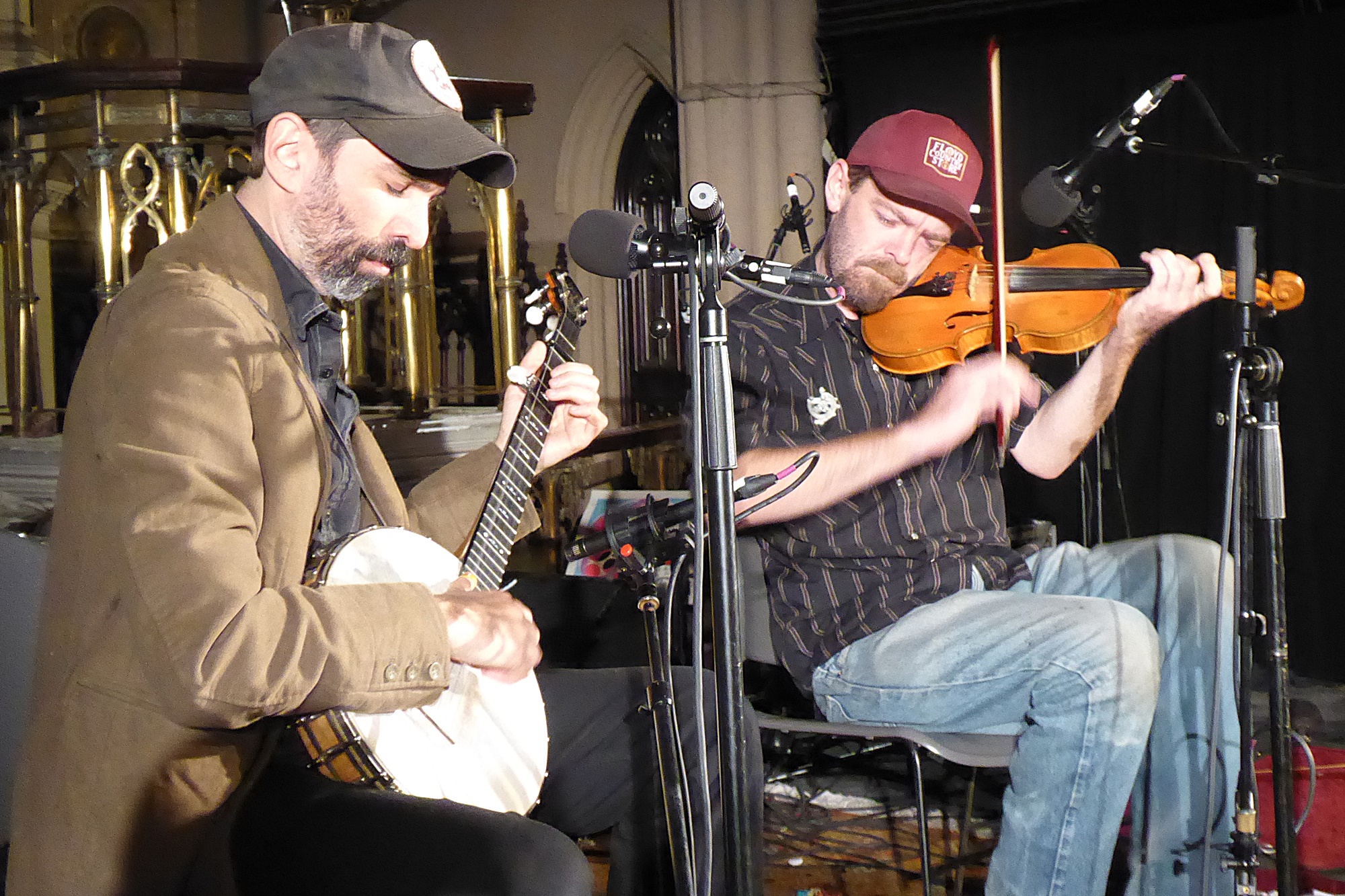
The Downhill Strugglers (above), which includes the festival’s guiding light and emcee Eli Smith, was down to two members (Smith and Jackson Lynch) because the third fellow, Walker Shepherd, was off having his first child. No matter, they were rousing anyway, performing songs from their latest on Jalopy Records, Old Juniper. Intriguing to hear “Casey Jones” the way it was originally sung, before the likes of Burl Ives got a hold of it.

Michael Hurley (above, right) is of similar vintage to Peter Stampfel in and around New York, and their collaborations go back many years. Hurley, in his 80s, is enjoying a renaissance with many young admirers, including performers such as Cat Power, Lucinda Williams, Elizabeth Mitchell, Rose and the Bros, Big Thief’s Adrianne Lenker, and many more.
Hurley, playing an electric guitar (that initially buzzed, the same way it did the last time he played Brooklyn) built momentum as he went and was soon flying along. A tap dancer joined him. Several unfamiliar songs were played, including this one, “Tennessee Easy Chair”:

I’ve been following Martha Spencer (middle above) since her start in Virginia with her family’s Whitetop Mountain Band. The Whitetop Mountaineers is a duo she leads with Jackson Cunningham that has recorded four albums. In Brooklyn, wearing a spectacular hat and a green-and-white checked country dress, she had a band. Her new solo album, quite eclectic, is Out in La La Land. Spencer is a really great Appalachian singer and is also accomplished on fiddle, banjo, guitar and (she played it with Gilly’s Kitchen) bass. Oh, she dances, too. I don’t know the name of this, but it was a lot of fun:
I don’t know much about Kyle Morgan, who appeared with veteran New York chanteuse Tamar Korn, but he’s a find. I got only half of this song, but I loved it. He played some really tasty guitar, too:


 Territorial Imperatives