
The first New York Auto Show in 1900 drew 160 cars from 69 countries, and—just like today—electric cars were featured. Of course, they were also touting steam back then, and it was unclear which technology would win out. The Trump administration seems determined to turn the clock back to when internal-combustion was king, but an emerging consensus at the 2025 edition of the show (now with International in the title) was that electrification will still win out, albeit on a somewhat longer timeline.

The unusual design of the Kia EV4 somehow works.
The most exciting new car in a severely limited round of press conferences (barely half a day for the important ones) was the Kia EV4. The Korean automaker is having a banner year, with what Eric Watson, a vice president for customer relations, said was the company’s best-ever quarter. Sales of EVs were up 22 percent. Part of the surge can be attributed to consumers buying cars before the tariffs kick in.
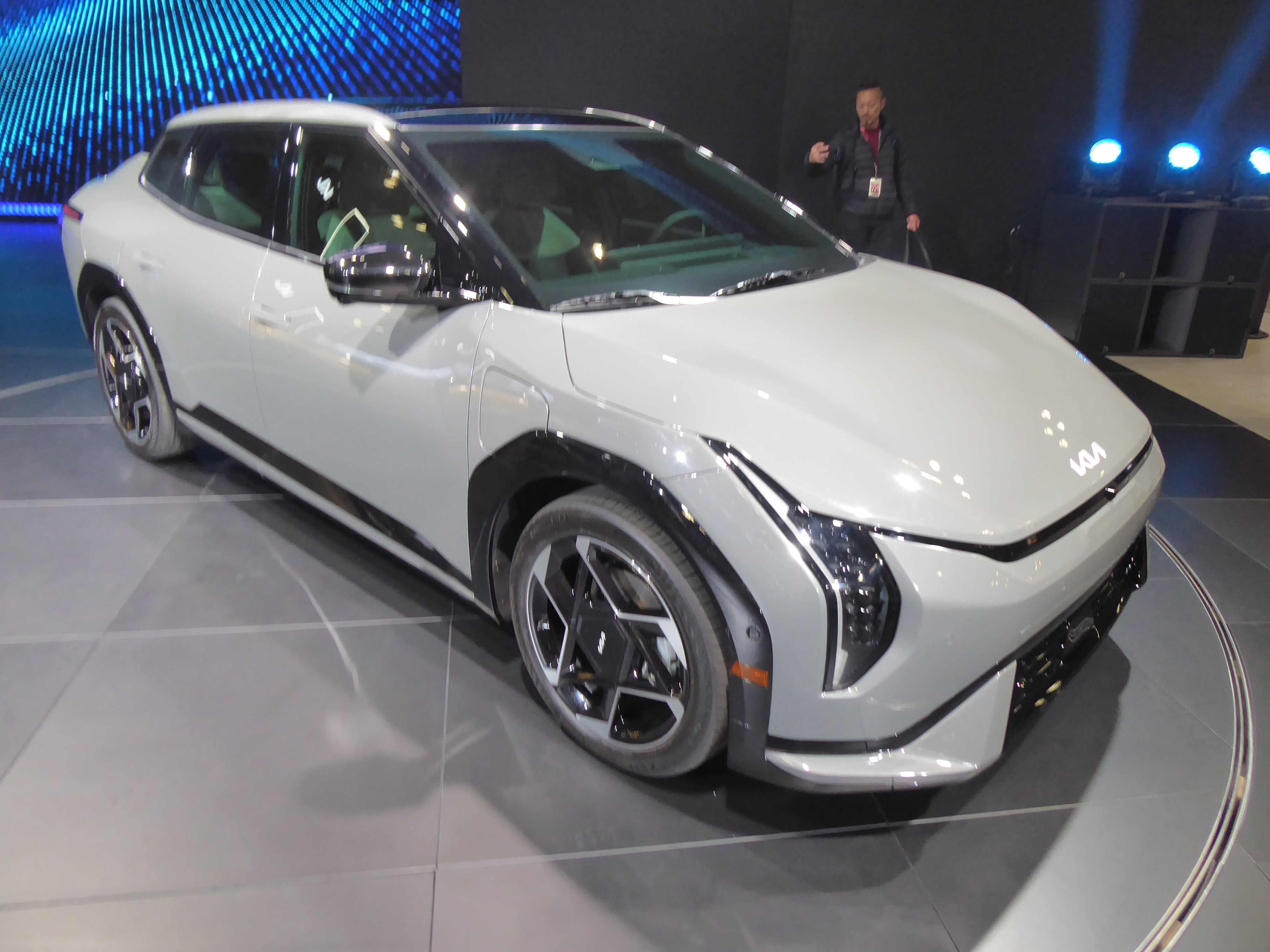
The EV4 will be built in South Korea.
According to Mike Stanton, president of the National Automobile Dealers Association (NADA) at the “Evaluating the Shifting EV Landscape” forum, “We have three million vehicles sitting on dealers’ lots that are tariff-free. Now is the time to buy,” he said, adding that it’s a particularly good time to buy an EV. Why? Because the federal $7,500 income tax credit may go away if Trump gets his way.
The Kia EV4 will be built at the Autoland Gwangmyeong EVO Plant in South Korea. Uh-oh, 25 percent tariffs. But the company is definitely looking into building it in the U.S. The Kia plant in West Point, Georgia already builds EVs—the EV6 and 9. No price was announced in New York, though the company repeatedly called it “affordable.” The current ballpark figure is a starting MSRP of $35,000 to $40,000 for the cheaper Light model. With the tax credit, could you snare one of these for $27,500? Don’t count on it.
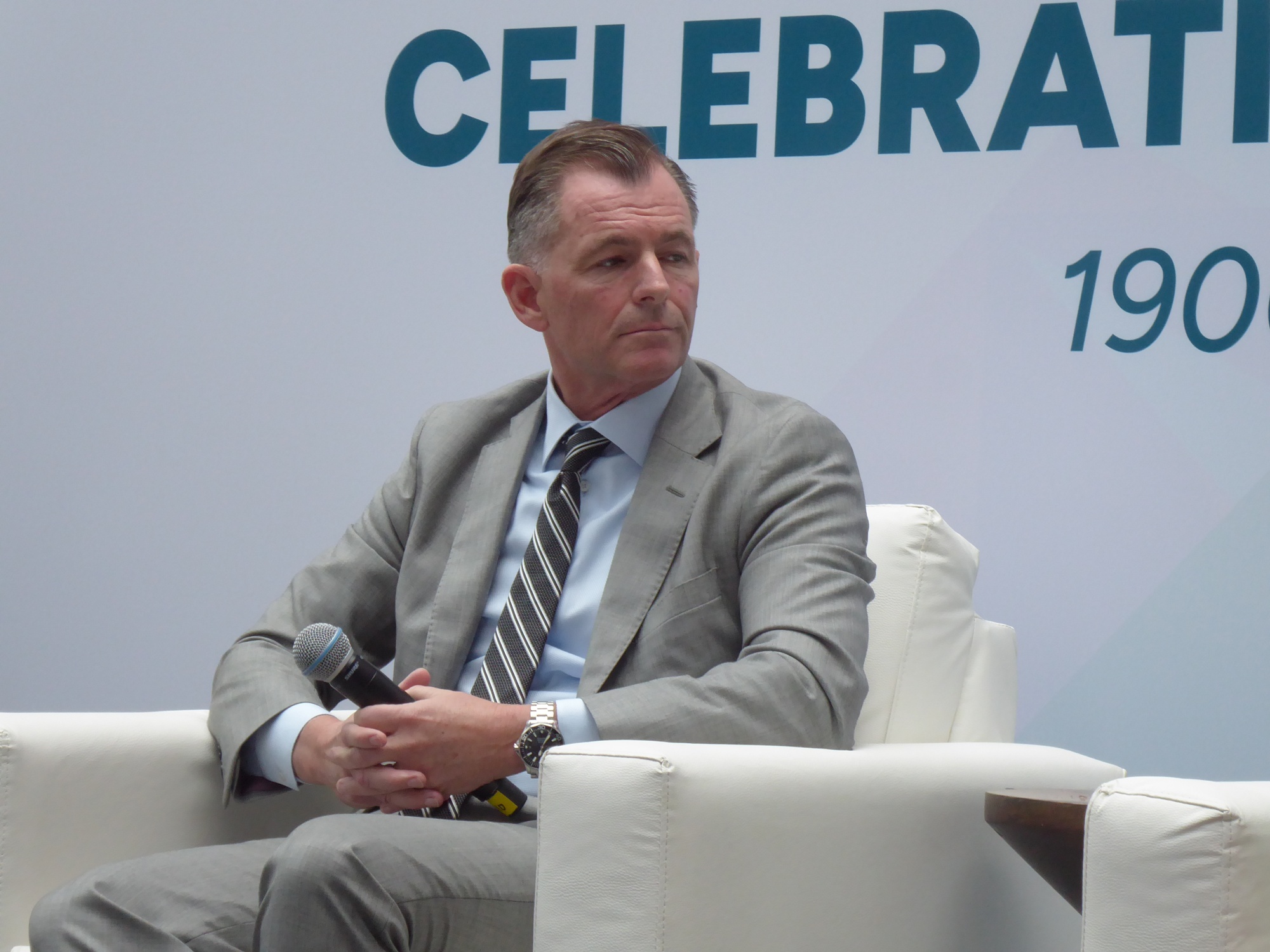
NADA’s Mike Stanton says, “Buy now!”
The EV4 styling was interesting and distinctive, a sedan with a few SUV cues, a low nose and a tall tail. It didn’t look particularly aerodynamic, but (thanks in part to full underbody covers) it is—with a drag coefficient of 0.23. There will be two battery sizes, 58.3 and 81.4 kilowatt-hours (standard in the Wind and GT-Line versions), with the latter providing up to 330 miles of range. With the smaller battery in the Light car, expect 235 miles.
Other features include standard 17-inch wheels (19-inchers are available), a 30-inch combined display, heated seats and wheel and 64-color ambient cabin lighting. The iPedal 3.0 regenerative braking now works in reverse. The EV4 can go from a 10 to 80 percent charge in 29 minutes, and includes a Tesla-type NACS charger. It should be in showrooms early next year, but the price point will depend on what happens with the auto tariffs.
Kia’s EV3 won World Car of the Year at the show, so the company is flying high with a pretty comprehensive EV lineup. It’s big-gun EV9 will now be available in a Nightfall Edition that mostly adds blackout trim. The little K4 (starting at $21,990) is now available in a hatchback version with 22 cubic feet of rear storage (or 59.3 with the back seats down) that’s 11 inches shorter than the sedan. Americans have hated the useful hatch format for some reason, but is it coming back? The K4 is built at the company’s Pesquería plant in Nuevo León, Mexico.
Across the hall, Hyundai Motor President and CEO José Muñoz (in office 100 days) noted that his Inster also was an award winner earlier—World Electric Car of the Year. Range is up to 229 miles, but we can’t ink a contract on an Inster because it’s sold only in Korea, Japan and Europe. Hyundai’s group is number two in EV sales in the U.S., and the company has invested $12.6 billion in a Georgia auto plant. Muñoz promised 100,000 U.S. jobs by 2028 and 21 new EVs globally by 2030.

The Hyundai Palisade is bigger and snazzier.
The three-row Hyundai Palisade moved 110,000 units last year, and the new one unveiled in New York is bigger and somewhat flashier, with a longer wheelbase and distinctive stacked light bars (topped by the head- and taillights) front and rear. A neat design touch, as pointed out by design chief SangYup Lee, is the brushed-aluminum D-pillar extending into the luggage rack.
A neat feature is a built-in dashcam recorder so you can show the post-accident tape to your insurance adjustor.
A hybrid Palisade version delivering up to 34 mpg is welcome. It uses a 2.5-liter turbo with two electric motors to deliver 329 horsepower and 330 pound-feet of torque. Making its world premiere was an XRT PRO version of the Palisade with an inch of extra ground clearance and off-road cues.

Genesis’ concept anticipates cars unashamed to eschew grilles.
Genesis didn’t do a press conference, but the night before it had shown its new and pretty big X Gran Equator Concept. Not exactly lovely, the squared-off concept showed what might happen when automakers give up on trying to give EVs grilles. (I know, the Tesla Model 3 took that step, but that nose has never worked for me either). The interior showed more innovative design than the exterior.
Subaru, which was late to EVs, had so much to say it actually had two press conferences. At the first one, it showed a new version of Solterra, its first-ever EV. The 2026 model will have 285-mile range (up 25 percent) thanks to a 74.7-kilowatt-hour battery pack. With a NACS port, it can visit 15,000 Tesla Supercharger sites.

Thumbs up at Subaru over the new Solterra.
In AWD form the new Solterra puts out 338 horsepower, up from 215. It can reach 60 mph in less than five seconds. The styling is somewhat anonymous, but OK, and the on-board tech has been beefed up. There is 8.3 inches of ground clearance. Pricing might be affected by the inconvenient truth that the new Solterra is built at the same Japanese plant that produces the similar Toyota BZ4X EV.
The new 2026 Trailseeker, again with some similarities to the Toyota, has a high greenhouse and an orientation to going off the road. It’s also made in Japan, but this time at a Subaru factory. Range is more than 260 miles. I found it amusing when Subaru said from the stage that the Trailseeker’s cladding “sets it apart from everything else on the road.” Actually, it makes it resemble everything else on the road.
With the larger pack (74.7 kWh), the Trailseeker is good for 260 miles, 25 more than the Solterra. The XRT version has a larger 84 kWh battery and thus more range. There’s plenty of power in the Trailseeker with 375 horsepower, and zero to 60 takes only 4.3 seconds. The NACS port can charge at 150 kilowatts, and there’s towing of up to 3,500 pounds—though it will cut into range.
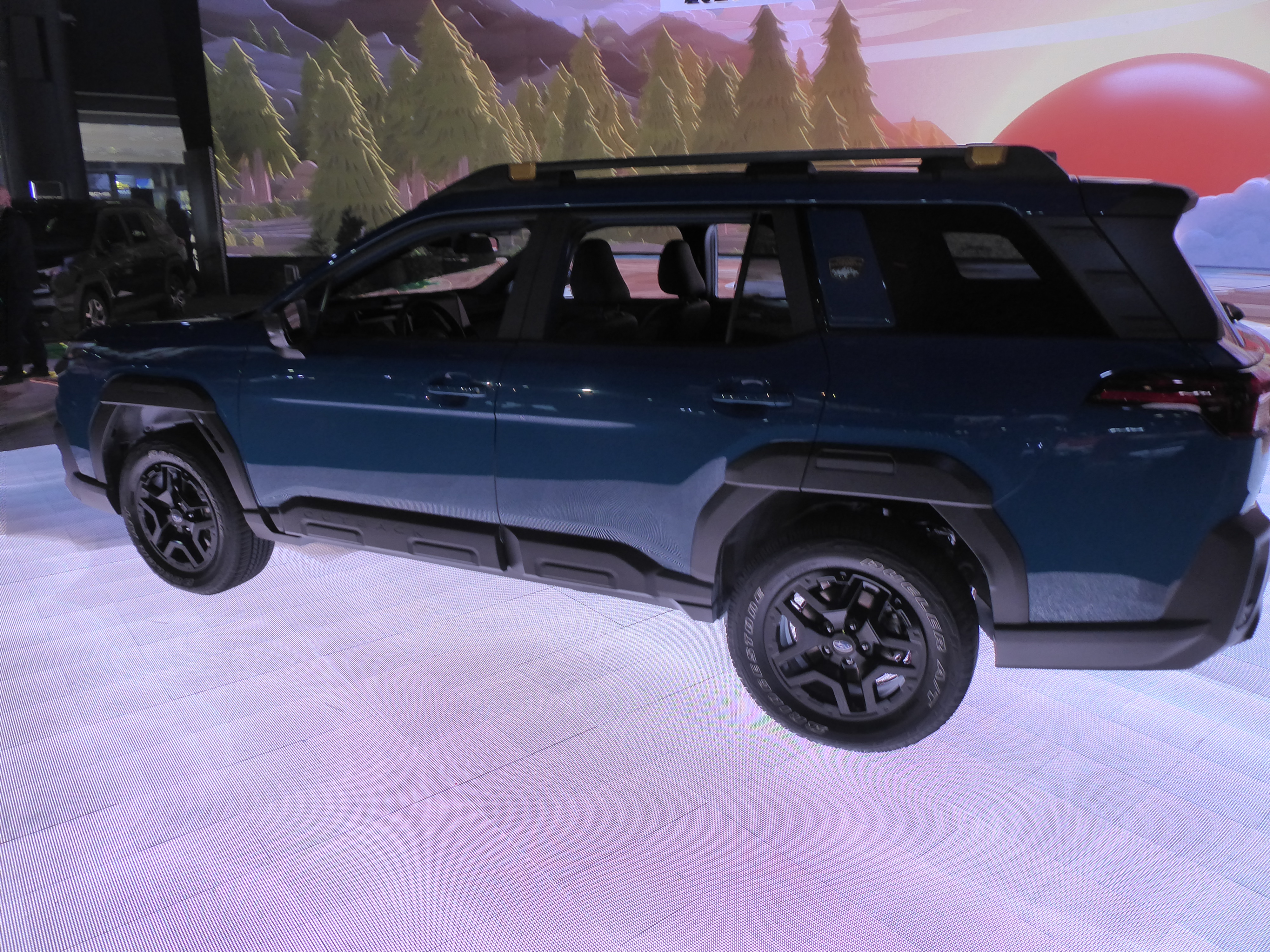
A surreal shot of the new Outback.
Later on, Subaru unveiled the new 2026 Outback, which has abandoned all reference to the Legacy station wagon that birthed it 30 years ago, and is now cladding-happy and boxy. It’s also two inches taller and one inch wider.
An incredible three million Outbacks have been sold in the U.S., more than any other of the company’s models. And 96 percent of the Outbacks sold here in the last 10 years are still on the road. That pattern should continue. Interior and cargo space are up in the new Outback, as is ground clearance (8.7 inches in the standard model, 9.5 in the more outdoor-friendly Wilderness version).
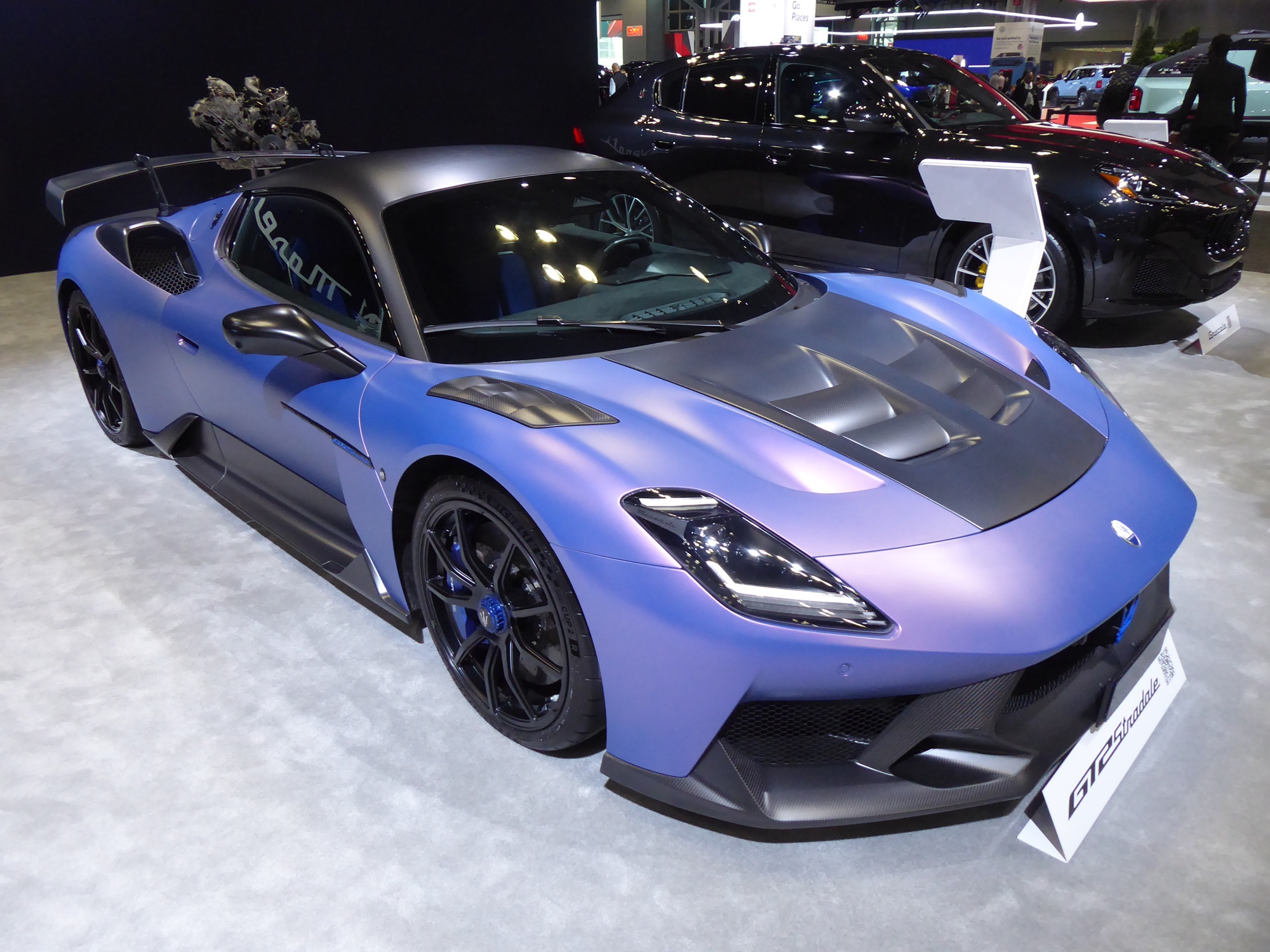
Maserati introduced the GT2 Stradale, a “barely legal” version of the MC20 with track aspirations.
Maserati was in New York with the limited-edition GT2 Stradale, a track-and-road-ready iteration of the MC20 that offers a 10-horsepower boost for its V-6 Nettuno power plant. So that equates to 631 horsepower, 201 mph and zero to 60 in 2.8 seconds. The car on display looked the business in matte blue.
Andrew Evans, the product specialist, called the new performance edition “barely legal,” meaning it’s only just registerable as a slightly civilized version of Maserati’s GT2 race cars that compete in European series. They’re built on the same assembly line. Only 914 of the GT2 Stradales will be built. The number is a homage to 1914, the year Maserati launched. But then why not make 1,914 of them? That may be more than the market can bear. The order book is open.
The Volkswagen ID.Buzz won World Design of the Year. The company’s press event at NYIAS revealed the 2026 Volkswagen Tiguan SEL R-Line Turbo.
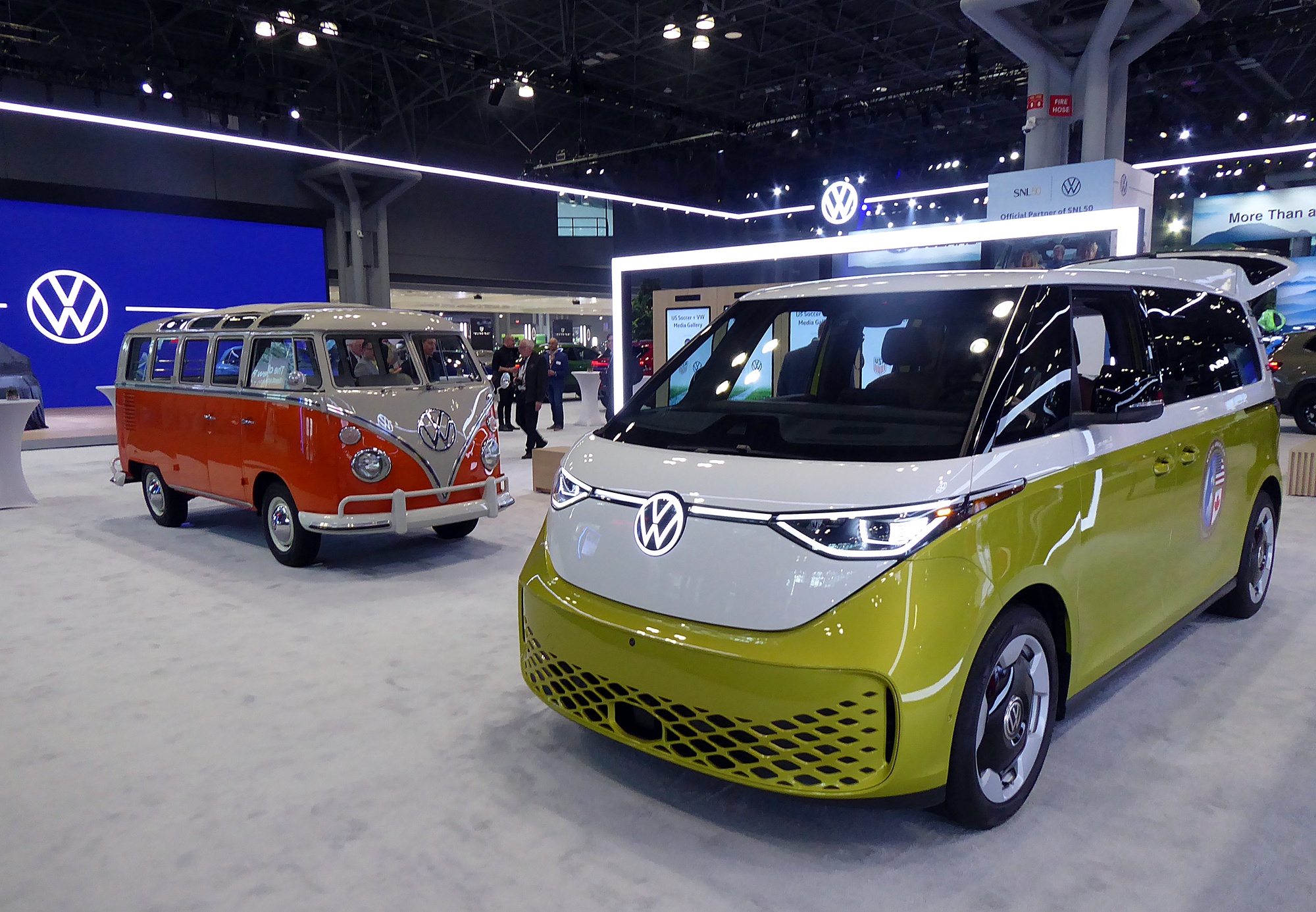
The VW ID.Buzz, with its Microbus ancestor behind, was an award winner at World Car.
Although it wasn’t debuting there, Lucid seemed to be doing land-office business introducing consumers to its new Gravity SUV—an enhanced Air in every way.

Look at all that chrome on the 1958 Buick Limited, with 1955 Packard Caribbean (one of 276 convertibles) behind.
Out in the Crystal Palace, NYIAS paid homage to its history with a display of cars from each decade of its existence since 1900. I liked the earliest, a 1909 Cadillac 30, and the latest, a 2022 Porsche 911 GT3 RS. In between there were milestones such as a 1963 “split-window” Corvette and a 1956 Mercedes-Benz 300SL Gullwing. Collector Bob Kerekes brought a trio of top-end 1950s American convertibles—1958 Buick Limited, 1957 Cadillac Eldorado Biarritz and 1955 Packard Caribbean (one of 276).
 Territorial Imperatives
good report Jim!