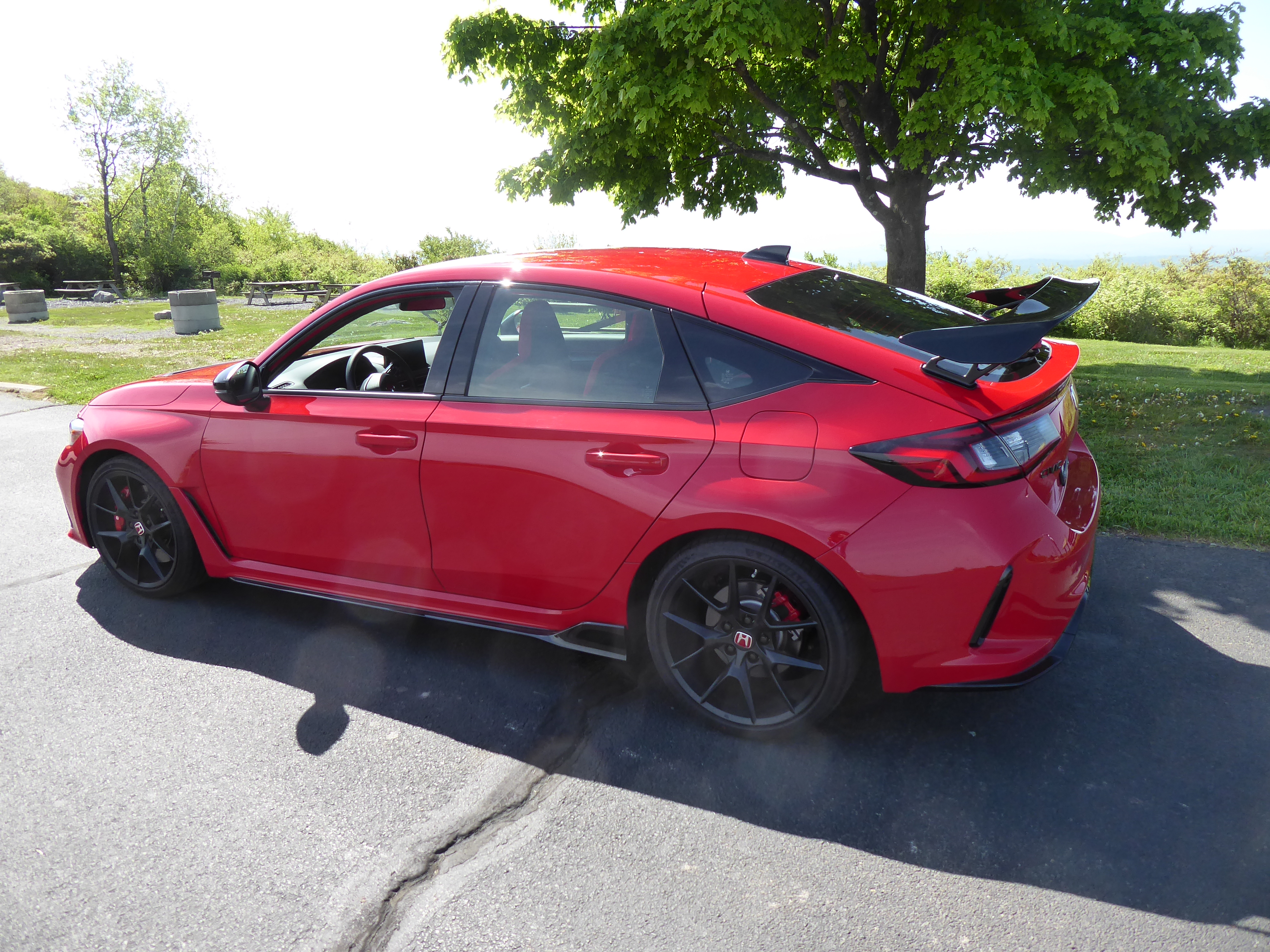
Testing the 2024 SUVs, Hybrids, EVs and Performers

As most of you know, I write about cars for a living. While the money isn’t spectacular, the fringe benefits include review cars for the week. If I was a movie critic, I’d get into films free. When I tell people about this, they say, first, “How did you get that job?” Then they think a bit and say, “I could do that job.” Who knows, maybe they could, but I’m the one who gets the keys, at least right now.

Here are quick hits on some cars that have been in my garage recently, all 2024 models:

Lexus UX 250h F Sport Premium. Hybrid SUVs hit a sweet spot in the market right now, so an upscale off-roader that gets good fuel economy (42 mpg combined) will undoubtedly attract tire kickers. The small size makes it easy to park but rear-seat passengers might want something roomier. The hybrid drivetrain produces 181 horsepower, yielding a car with fairly leisurely acceleration—around eight seconds to 60. The F Sport hybrid (above) starts at $44,120.

Lexus RX 500h F Sport. This one’s interesting, a biggish crossover SUV that’s been set up as a performance car. A bit schizophrenic, that. And the styling is a bit ungainly. But the car sure moves out. With a 2.4-liter turbo four and a pair of e-motors, there’s 366 horsepower and 406 pound-feet of torque. That’s a 91-horsepower upgrade from any other RX. The 500h can get to 60 mph in just 5.5 seconds. Given the luxury appointments and size, it’s not surprising the car weighs more than 4,700 pounds. It’s pricey at a starting price of $63,800.

Adding to the bottom line are some options you might want, including the Mark Levinson infotainment system, which includes a 14-inch touchscreen and updated navigation ($2,265). Unless the kids get cold easily, skip the heated rear seats ($1,230).

Volvo XC40 Recharge Twin Ultimate and XC60 Recharge eAWD Ultimate Dark. Volvo is in a good position to support customers who want to go green, with either battery electrics or plug-in hybrids in several sizes and prices. There’s also the Polestar offerings, with related powertrains, to consider (both companies are owned by China’s Geely). The specs on the XC40 (above) are impressive—293 miles of EV range, fast-charging capability of 10-80 percent in 28 minutes, and 402 horsepower on tap. It can reach 60 mph in 4.6 seconds. The Volvo is attractively styled, inside and out, and a very comfortable cruiser. Google is built in, and there’s an onboard air purifier. It’s a quite nice approach to electrification with seating for five, but rather pricey at $53,745 (the Core model; for the Ultimate version with updated Harman Kardon sound and adaptive cruise, it’s $60,095).

The XC60 Recharge is a plug-in hybrid that wrings 455 horsepower and 523 pound-feet from a two-liter four-cylinder turbo motor and a pair of electrics for AWD. The EV range is 35 miles, but the whole car will go 560 miles without needing to stop—a big advantage of PHEVs. It’s impressive that the XC60 Recharge delivers 63 MPGe but moving all that weight without electric assist yields 28 mpg. In normal operation you should save $1,500 in fuel costs over five years, compared to an average new car.  The SUV is quite luxurious inside, with features like Nappa leather and a crystal glass gear shifter. There are lots of thoughtful touches, and also Volvo’s state-of-the-art safety tech. Rear seat passengers will have plenty of legroom, and also heated seats. This is another pricey one at $67,850. The Ultimate Dark option produces a blackout treatment.

Toyota Highlander Hybrid Platinum Hybrid AWD. Toyota’s strategy of concentrating on hybrids and PHEVs is starting to look smart in the current marketplace. And the Highlander Hybrid (above) is going to win over a lot of fans. The hybrid drive (the same one that’s in the RAV4 Hybrid) yields 36 mpg combined. It can reach 60 mph in a bit over eight seconds, so no speed demon—but who buys a Highlander for performance? Frankly, if you’re buying a Highlander there’s no reason not to get the hybrid version, because there are no compromises in the passenger compartment or roadability, just a modest bump in the price. Don’t expect a roomy third row, but the Highlander is quite utilitarian otherwise. Families, unless they took Cheaper by the Dozen literally, are likely to love it. The LE starts at $40,970. The up-market Platinum (like the test car) is $51,425 before additional options.

Hyundai Kona Limited AWD. Hyundai and Kia are on a roll in 2024, producing some of the best cars in the world, beautifully styled and highly functional, at an attractive price. The Kona (above) is a good entry point, and even in its top form, the Limited, it’s still only $33,175 (the base model is $25,625). The extra money gets the upmarket 1.6-liter turbo motor that’s good for 190 horsepower. There’s an attractive cabin with a pair of 12.3-inch displays that sit together in a wide oval pod. The accent lighting is neat.

The Kona was updated for 2024 with a longer wheelbase and thinner front seats, which combine to make the back seat more comfortable. The fuel economy could be better: it’s 24 mpg city and 29 highway.

A Shadow Hangs Over a Montana Town

Old King by Maxim Loskutoff (W.W. Norton and Company)

Jim Motavalli

Lincoln, Montana is a real place, and Ted Kaczynski is, of course, a real person. In 1996, the “Unabomber” was arrested after a more than decade-long manhunt at his cabin in Lincoln. According to Wikipedia, it was the biggest thing to hit this town, known for logging and trapping, since Meriwether Lewis passed through on his way back to St. Louis in 1806.

Maxim Loskutoff. (W.W. Norton photo)

Maxim Loskutoff’s novel is not principally about Kaczynski, though the story is told from various viewpoints and the seriously troubled bomber is one of them. Upfront is the recently divorced Duane Oshun, first seen in Salt Lake City stealing a microwave from his ex-wife’s house. It’s 1976, and Oshun wants to get as far from his cheating spouse as possible. Lincoln fits the bill, even though he has to leave behind his beloved son, Hudson.

Oshun arrives in Montana with hardly anything, and lives in his little truck as he begins to eke out a bare existence. He meets Jackie, a townie waitress, too, and over the years (the book tends to skip ahead a lot) finally builds a snug cabin. With Jackie and Hudson there in the summers, Oshun starts to feel his life is at last coming together. But he doesn’t know that bicycle-riding Ted, who lives up the road, is a nihilistic killer.

The book plays out as a tragedy, told in magisterial prose. Loskutoff, who lives in western Montana, has a real feel for the land and the people who inhabit it, too. He’s good on the animals, too, wolves and grizzly bears among them. Jackie’s ex-husband is a Forest Ranger who’s on a collision course with the local poachers. There are very sad consequences for him, too; nobody in this book emerges unscathed.

At this point we begin to lose Oshun as a character, and he never really does come fully in focus. After an enormous loss, he just fades away. Jackie is also peripheral, and about Hudson we learn little beyond his love of off-road motorcycles. We want to know more. The fast-forwards are a bit jarring, too.

But the author fully captures not only Kaczynski and his incredible lack of human empathy, and the dogged Postal Inspector who goes after him. Loskutoff quotes liberally from Kaczynski’s manifesto, which the Washington Post ran to get him to stop killing people. His philosophy is senseless, but of course it is. Did you ever read a treatise (or court testimony) from one of these fools that wasn’t described as “disjoined” and “rambling”?

Even today, the man, who hanged himself in his cell last year, has followers. “Reject Modernity, Embrace Ted Kaczynski” is a track you can buy on Bandcamp for $1. Save your money. Buy Loskutoff’s novel instead. It’s darned good.

Swing Time at the Gotham Jazz Festival 2024

In the alternative world of the Gotham Jazz Festival, held at the opulent circa-1859 Down Town Association clubhouse near Wall Street, Bix Biederbecke is a bigger star than Prince. That’s judging from the number of times bandleaders called tunes with the legendary cornet player, who died in 1931.

The New York Hot Jazz Camp ensembles were superb. This is Jazznauseam. (Jim Motavalli photo)

This was my second Gotham, a joint effort of Patrick Soluri’s Prohibition Productions and the Bria Skonberg/Molly Ryan New York Hot Jazz Camp. It packs the city’s best swing bands (plus some out-of-town visitors) into three floors of continuous music that starts at 1 p.m. and goes on until near midnight.

Andy Schumm and his Gang are from Chicago, and play there regularly. Schumm is a cornetist, pianist and arranger who really respects the old songs. The first number I heard was “Blues My Naughty Sweetie Gives to Me,” circa 1919 and played in the style of clarinetist Jimmy Noone, dead in 1944. Yes, Schumm doubles on clarinet, and he was accompanied by a brilliant group featuring bass sax, piano (the amazing Dalton Ridenhour, a stride specialist) and trombone.

Later, a banjo/guitar player (who’d been given wrong time zones) showed up. The Gang was brilliant with or without him, and an absolute time capsule. “Where the Sweet Forget-Me-Nots Remember,” as performed by Ben Pollack and His Park Central Orchestra circa 1929, when was the last time that snappy number was performed live? When I moved on they were swinging into an adaption of Bix’ 1928 version of “Somebody Stole My Gal.”

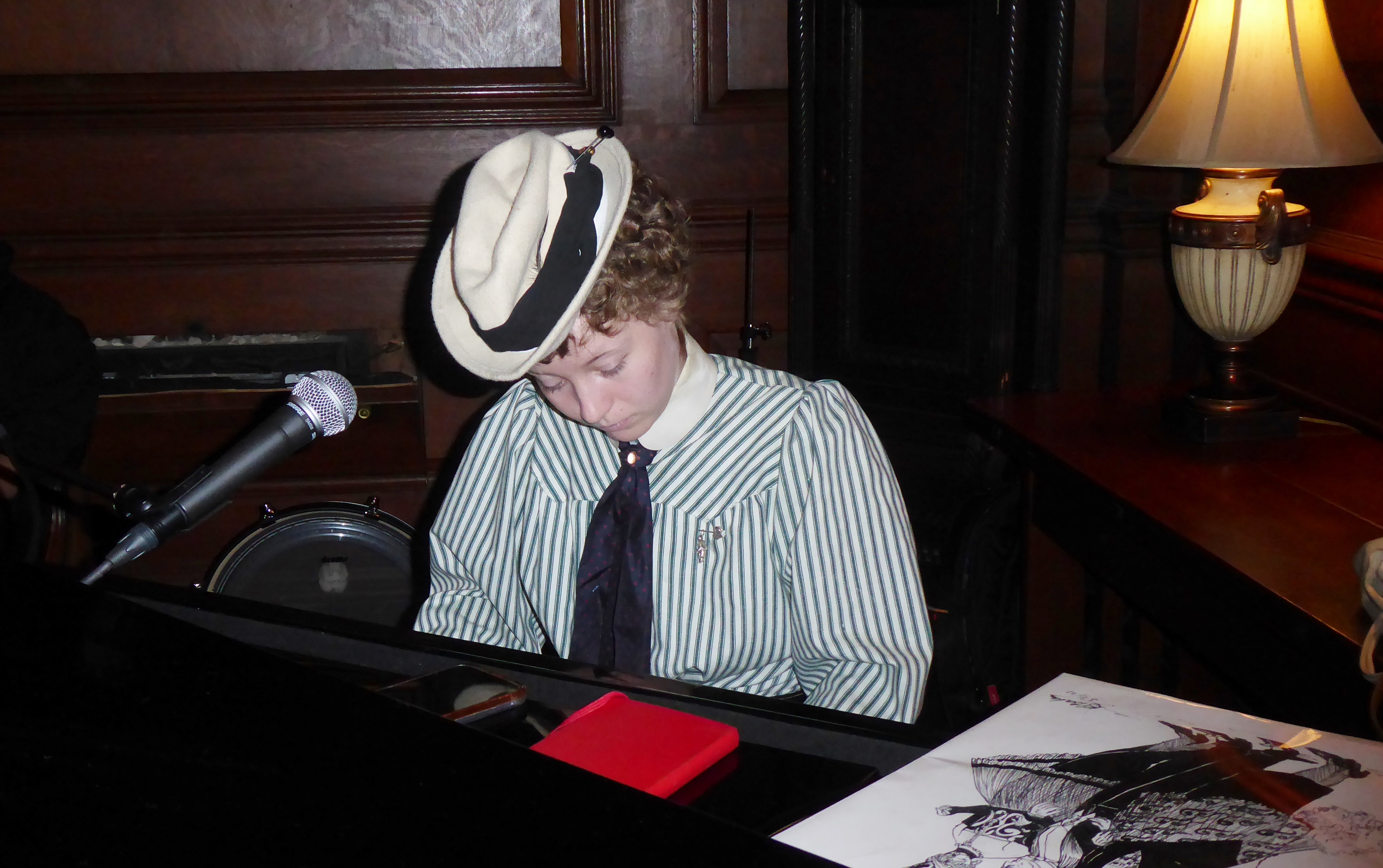
Ramona Baker, ragtime piano. She also makes her own clothes and makes prints, as seen in the foreground. (Jim Motavalli photo)

Down in the first-floor lounge and bar, ragtime pianist Ramona Baker (dressed in period clothes she made herself) was holding forth. She sounded great to me, and only 23 years old. Her songs were from 1902 (“Tell Me Dusky Maiden”), 1905 (“Dixie Queen,” which Freddie Hubbard used to play) and even “Southern Hospitality” from 1899.

I really enjoyed the sets by the New York Hot Jazz Camp students last year, and they were just as enjoyable in 2024. I heard Marit DeHoog sing “St. Louis Blues” with Jazz Cappuccino a la Créme, and faculty support from pianist Rossano Sportiello—a Gotham All-Star. A stirring “Dinah” by way of Fats Waller was next.

Julie Boyle was the featured vocalist with Jazznauseam, and the song was “After You’ve Gone” (1918). These are full bands sounding rehearsed and ready. Boyle could really sing, and was fully gowned in 1920s style.

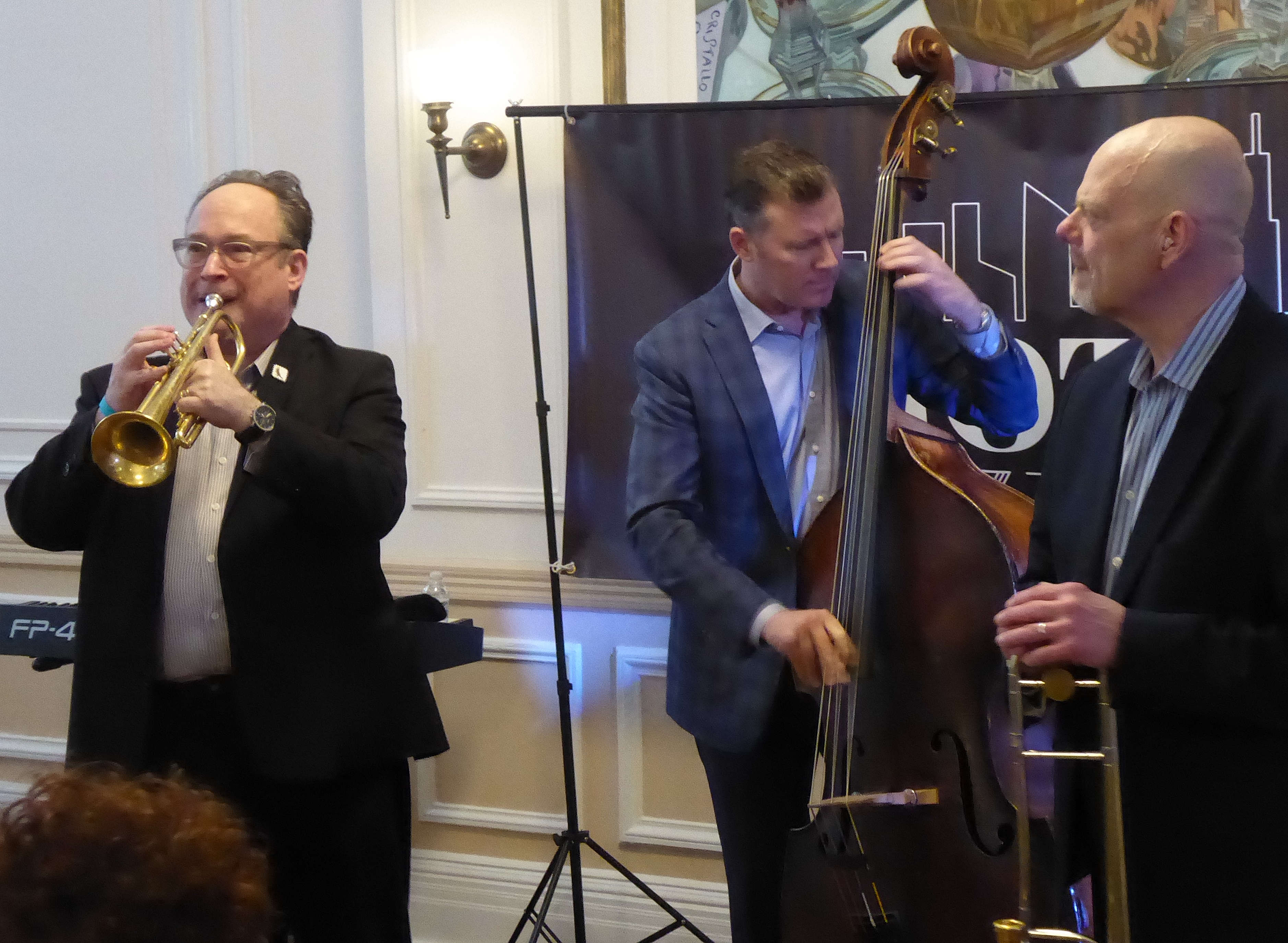
Jon-Erik Kellso (left) on trumpet, with John Allred (trombone) and Neal Miner on bass. (Jim Motavalli photo)

Jon-Erik Kellso is a trumpet star in swing circles, and plays Sunday nights with his Ear Regulars at the Deer Inn. All About Jazz says, “The music is a hybrid, with one foot planted securely in the time-honored Dixie tradition, the other marching steadily toward swing.” I’ll buy that. Matt Munisteri was featured on guitar, and Neal Miner was brilliant on bass. “At the Jazz Band Ball” was a very early composition from the Original Dixieland Jazz Band, circa 1917. To hear what their descendants sound like, check out Jon-Erik Kellso and The EarRegulars Live at The Ear Inn on Arbors (2023).

It was Munisteri’s birthday, so he got to sing and play on “You’re Bound to Look Like a Monkey When You Get Old,” which is from 1930 and was first recorded by The Hokum Trio.

The evening session was even better. In the Reading Room on floor 1.5 (don’t ask) I saw Eyal Vilner’s Swing Band swinging wildly for a full floor of dancers. The room went into pandemonium when Vilner called “Big Apple Contest” for “all you lindy hoppers.” I had no idea that many New Yorkers knew how to do the lindy hop, a fairly complicated African-American art form. To see World War II-era lindy hopping in all its glory, watch this 1941 selection from Hellzapoppin’:

Alphonso Horne and the Gotham Kings were entertaining. He’s a New Orleans trumpet player and vocalist a la the great Kermit Ruffins.

I’ve written extensively about Catherine Russell elsewhere on this blog, but here is that major jazz treasure with “I Found a New Baby,” accompanied by the New York Hot Jazz Camp faculty all-stars:

The all-stars deserve the name. Mike Davis is a monster period trumpet player and vocalist who leads his own ensembles. Ron Wilkins was all over the festival on hot trombone. Dan Levinson should be better known on saxophone and clarinet. They tore through numbers like “Three Little Words,” “Tin Roof Blues,” and, yes, “Somebody Stole My Gal” again.

Mike Davis (center) and the New York Jazz Camp Faculty All-Stars, Dan Levinson (left), Ron Wilkins (right). Tal Ronen (bass) and Kevin Dorn (drums) are in the background, and pianist Rossano Sportiello is obscured. (Jim Motavalli photo)

Have you heard the Anderson Brothers, Julliard grads Peter and Will? They’re huge talents on saxophone and clarinet. The twins played with the Jazz at Lincoln Center Orchestra, the Vanguard Jazz Orchestra, Wycliffe Gordon, Cecile McLorin Salvant, Paquito D’Rivera, Wynton Marsalis, and are on the soundtrack of HBO’s Boardwalk Empire with Vince Giordano’s Nighthawks. At Gotham, they backed organizer, Molly Ryan, a strong vocalist on “You’d be So Nice to Come Home To.”

The Anderson twins, Peter and Will. (Jim Motavalli photo)

Bria Skonberg is central to Gotham’s success, and we were lucky she found time to get on stage and pick up her muted trumpet. She also goes way back for her repertoire. “Tiger Rag,” with tuba for bass, is another Original Dixeland Jazz Band number, from 1917.  Skonberg’s a fine vocalist, too, whether tackling vintage numbers or the Great American Songbook.

Bria Skonberg (right with Arnt Arntzen (left) and Jen Hodge (middle). (Jim Motavalli photo)

Accompanying Skonberg was another pair of brothers, the Arntzens from a musical family in Saskatchewan, Canada. They both sing, and Evan plays clarinet and Arnt banjo and guitar. Their grandad, Lloyd Arntzen, bought his first jazz records from money he made killing gophers, Arnt said. Skonberg generously gave them some stage time to rip through a song they got from granddad, “Viper Mad.”

I had to leave to catch a train, so caught only one number by The Hot Toddies, featuring Patrick Soluri on drums and the protean Justin Poindexter on guitar and vocals. Alas, missed other singers that were slated to join them, Queen Esther and Hannah Gill. I missed much music I’d have liked to have heard: Charles Turner and Uptown Swing, The Hot Sardines, the all-star Mona’s Hot Four jam, Terry Waldo.

Altogether another wonderful, out-of-time Gotham Jazz Festival. On to 2025.

A Review: Andre Dubus III’s Illuminating Essays

Ghost Dogs: On Killers and Kin by Andre Dubus III (W.W. Norton)

A life-changing event for Andre Dubus III was the 1999 publication of his third book, House of Sand and Fog, which was a number one New York Times bestseller, a National Book Award finalist, an Oprah Book Club pick and a successful movie. Also, for those who read it, a first-rate tragedy.  

You won’t be taken onto the set of the film, which starred Ben Kingsley and Jennifer Connelly, or even learn the title of the book here. What you will learn about, from several different angles, is the money it brought in, and how it transformed a life that was heretofore lived at the margins.   In interlocking essays, separately published and sometimes repeating information, we hear different perspectives on the great preoccupations of Dubus’ life: violence, family, poverty, and the redemptive power of making things with your hands.  

Dubus is the son of the acclaimed short-story writer Andre Dubus, but his father and mother separated early. Dubus’ single mother moved her children dozens of times from one hardscrabble New England mill town to another as she struggled to find meaningful work. The kids were often hungry and cold. Dubus was bullied until he bulked up and fought back, a story vividly told in his memoir Townie.   Ghost Dogs is a different kind of memoir, told in overlapping stories—all brilliantly written. He’s one of our finest prose stylists, especially good at capturing working-class (and working) lives. His fiction is embedded in work sites, cheap apartments, diners. The author’s latest novel, Such Kindness, is a hugely compelling example, a tragedy set mostly in a low-rent motor court.  

Dubus isn’t much different writing about himself, though the essays here do tend to circle back over some central incidents. From years spent huddled with his siblings in cold apartments watching endless TV, he and his brother were suddenly thrust into the light and vivid life of his mother’s parents’ rustic camp home in Louisiana. “Pappy” is about his grandfather, a pipefitter/craftsman who is never still. He puts these soft New Englander kids to work.   Dubus doesn’t spare himself, the person he was at different points in his life. He’s particularly good on violence, especially his own. “Relapse,” the final essay, is about the grown family man who used the House of Sand and Fog money to build (with his brother) a safe home away from urban dangers. He’s been pacifistic for decades, and yet the call of the wild is always there. He recounts two incidents, chance encounters that could have erupt into physical confrontations.  

In 2001, having just won a Guggenheim, Dubus and friends are leaving an upscale restaurant where they’ve been celebrating when a young man leaning against a pickup truck yells out a sexual taunt. In an instant, Dubus is in his face and saying, “Watch your fucking mouth.” He recounts, “What you should know, what I’m not proud of writing now, is that I wanted to drop this man.” It’s all tangled up in ideas of American masculinity, virtually the whole theme of Townie. When Dubus does deck a man in a bar who makes fun of his shirt, decades of a softer life are instantly gone and he’s feral once again:   “It is as if my last fight was not nearly 30 years ago but just an hour earlier, like I’ve never stopped fighting at all, like it’s something I still do all the time,” Dubus writes. Pride and regret mix when he describes events like this, to his peers and to his children. And when those kids are themselves getting into fights, what’s the right thing to say?  

Perhaps the finest essay here is “If I Owned a Gun,” which recounts every encounter—many of them sordid, a couple of them near-misses—he’s had with firearms, and his determination not to have one in the aforementioned family sanctuary. He knows that people who own handguns are 400 times more likely to be victims of them than people who don’t, and—from experience—that “its not loaded” often constitutes someone’s last words. “Yet part of me, inexplicably, still loves guns,” he writes. The weight, the gleam of their polished stocks, the smell of gun oil, all part of another uniquely American rite of passage.

And then there’s the work of the hands. Dubus’s father was never seen to hold a tool of any kind (except, perhaps, his large gun collection) but Dubus became a carpenter and a construction worker—who, until House of Sand and Fog at least—wrote after those jobs were done. He never sits down at a table in this book without mentioning that he built it himself, as well as the loft bed in one of those hardscrabble apartments. He’s definitely house-proud about his refuge in the woods.  

Some readers might find this annoying but he writes so damned honestly about all of it. You don’t have to read all these essays, because they do get a bit repetitive, but don’t miss “Relapse” and “If I Owned a Gun.” And, come to think of it, the one about the ghost dogs of the title is also full of revelatory admissions from this self-revealing man. Most people, having kicked their poor pooch, would keep it to themselves.     And, finally, if you want to know what it’s like to suddenly come into money, “High Life” is the answer. The stories of big working-class lottery winners going on insane spending sprees are legion, and Dubus lets us know that near-winners of the National Book Award—especially if they grew up poor—are not immune from similar impulses.

Rocking on the Back Porch

Rose and the Bros: Rockin’ in the free world. (Jim Motavalli photo)

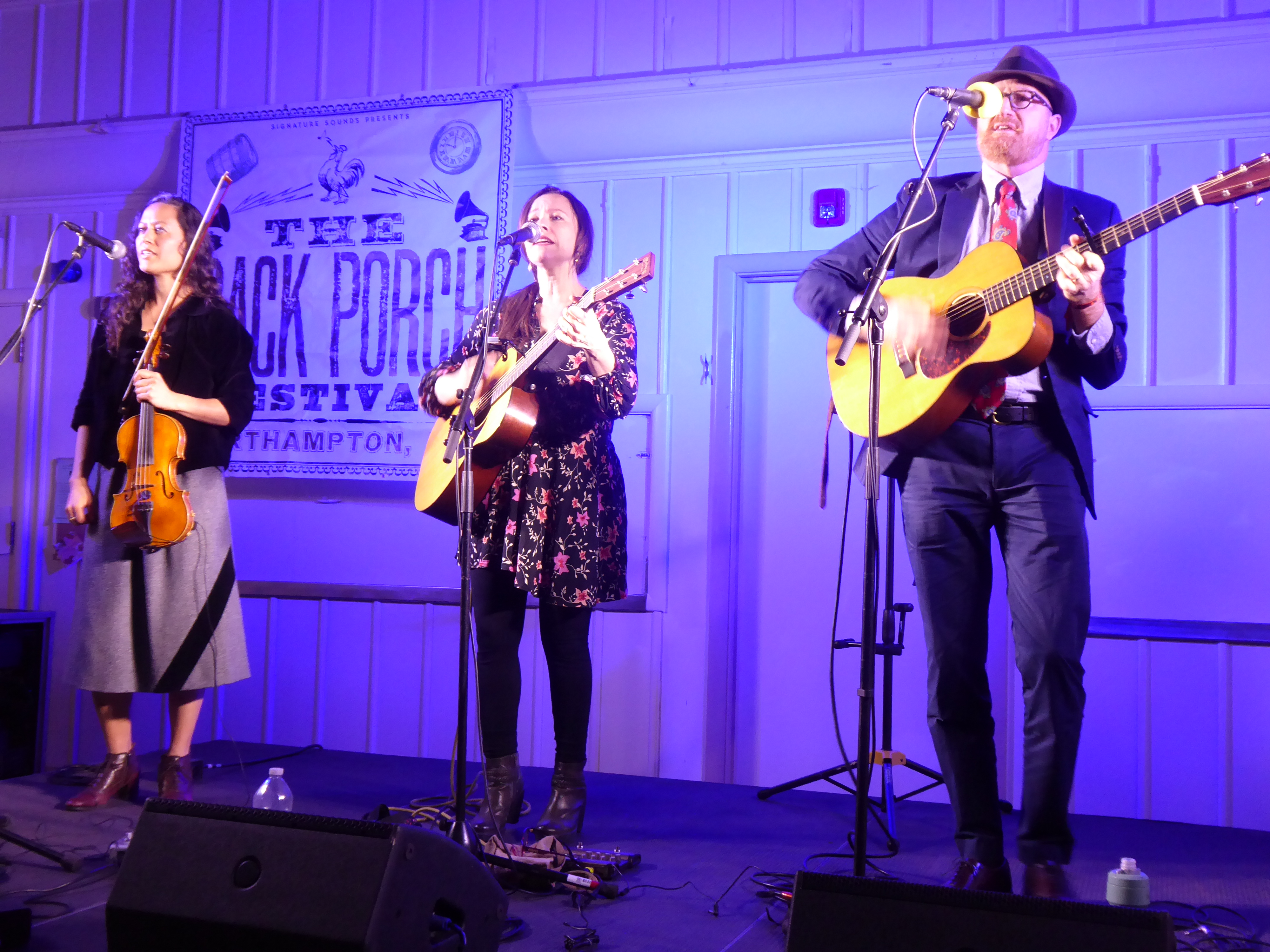
It was a cold weekend but you could ignore that because the music was so warming. The Back Porch Festival 2024 took place March 15-17 at a variety of venues around downtown Northampton, Massachusetts. Weekend tickets to all but a few of the shows cost just $29. Compare that to the $11,040 price for entrance to just one Billy Joel show from the scalpers. It’s great when the bargain music is so darned good, much of it curated from the ranks of the excellent and local Signature Sounds label.

The first show was by The Mammals, basically the husband-and-wife team of Michael Merenda and Ruthie Ungar, with band. This is the group that puts on their own music event, the Hoot, at the Ashokan Center in New York. They are a group that tours relentlessly, with both members writing prolifically and excelling on their instruments (guitar and banjo for him, fiddle for her).

Klezmer music wild in the streets of Northampton. (Jim Motavalli photo)

Highlights included Merenda’s “If You Could Hear Me Now” (from the Nonet album), a gentle song sung by Ruthie with a Dylan “Boots of Spanish Leather” vibe; their Woody Guthrie song, “My New York City”; and “The Hangman’s Reel,” a fiery fiddle duet with Rose Newton. They also did Ruthie’s dad’s “Ashokan Farewell” the Ken Burns Civil War theme, the song that “put me through college,” she said.

Newton is the leader of Rose and the Bros, based in Ithaca, New York. They’re a good-time zydeco band, made into something more than that with Newton’s singing, songwriting and fiddle, plus a crack, well-rehearsed band. They do covers (Michael Hurley’s “Blue Driver” among them) and originals from Newton and Paul Martin, the group’s farmer/guitarist. Martin also got to shine on the group’s singular jam tune, “Blue Thrush,” which reminded me of some of the workouts you’d hear during the 60s in San Francisco. The band got them dancing. Here’s that one on video:

From there it was over to Brattleboro, Vermont-based Low Lilly, two guitars and a fiddle, two women and one man (Liz Simmons, Flynn Cohen and new member on fiddle, Natalie Padilla). Cohen does the guitar solos. They all sang. I liked it. “All This Time” was a standout tune, and their new album, Angels in the Wreckage, was produced by Dirk Powell.

The Low Lily with new member Natalie Padilla (left) on fiddle. (Jim Motavalli photo)

Martha Scanlon is a very gifted singer/songwriter, dating back to her days with the Reeltime Travelers. She placed two songs into the Cold Mountain soundtrack but since then has kept a relatively low profile. In Northampton she was joined by longtime musical partner Jon Neufeld, an accomplished guitarist. They’re out of folk/country but their latest project is a covers album featuring songs by, get this, Radiohead, English Beat, Beyonce and Tom Petty. I would have loved to hear her “Hallelulah” (not the Leonard Cohen song).

Martha Scanlon (left) with Jon Neufeld and special guest Kris Delmhorst. (Jim Motavalli photo)

The peril of festivals like this is missing half of one show because you want to see the beginning of another. That happened when I rushed out to hear Rani Arbo and Daisy Mayhem, a group that doesn’t play around often enough these days. It was good to hear “Big Old Life” again, and their take on “Hear Jerusalem Moan.”

I’ve only recently discovered the music of Lisa Bastoni, who’s originally from Norwalk, Connecticut (Calf Pasture Beach gets a nod) but now lives (and works as an art teacher) in Massachusetts. She’s a great, great songwriter who captures the small moments of daily life with the veracity of a John Updike or Richard Ford. “Cheap Wine” is a standout on her latest album. Her neighbors cut down some lovely trees, installed an above-ground pool, and gave her “waterfront property.”

It was either that song or another one that contains the line, “Just because there’s a ladder doesn’t mean you have to climb.”

Viv and Riley harmonizing. (Jim Motavalli photo)

Viv (Leva) and Riley (Calcagno), a married couple from North Carolina (Viv is folk royalty down there) did one of the strongest sets of the weekend. She’s got a crystalline voice and writes wonderful songs, and he is a hugely accomplished multi-instrumentalist. He could also be a standup comic. This is from his “Is It All Over?:

Do you think they’ll ship us off
To the mines on Mars
And make us work there?
If they do, will the towns have bars
And amusement stars
And a Warby Parker?

And finally there was Peter Case, a blues-influenced raconteur of the old, beat school. He told wonderful stories and occasionally played a wry song or two. The Case show was held in Signature Sounds’ Parlor Room, the best place I know to hear music in Northampton. It’s right near the defunct Iron Horse, which is reopening under the Parlor Room Collective’s direction in May. That’s heartening. But the capital campaign continues.

Before leaving Northampton on Sunday morning we visited Signature Sounds “Back Porch Radio Live” at Progression Brewing. That gave us a chance to go away happy with the Deep River Ramblers (above) and the great and wonderfully manic, full-of-life Steve Poltz. “Quarantine Blues” is folk rap at its finest.

Roseanna Vitro Swings

Of course, just about everything at Mark Morganelli’s Jazz Forum in Tarrytown swings. He’s been promoting jazz both in Westchester and New York City for decades. I plan to make a habit of stopping by to see the jazz singers he promotes. Roseanna Vitro has been part of his shows since the early 1980s, soon after she relocated to New York from her native Hot Springs, Arkansas. She’d originally wanted to be a blues singer, but lacked a distinctive scream. her idols back then were Lightning Hopkins, Johnny Winter, Bonnie Raitt and Tracy Nelson. I love that she recorded Boz Scaggs’ “I’ll be Long Gone,” which Nelson recorded.

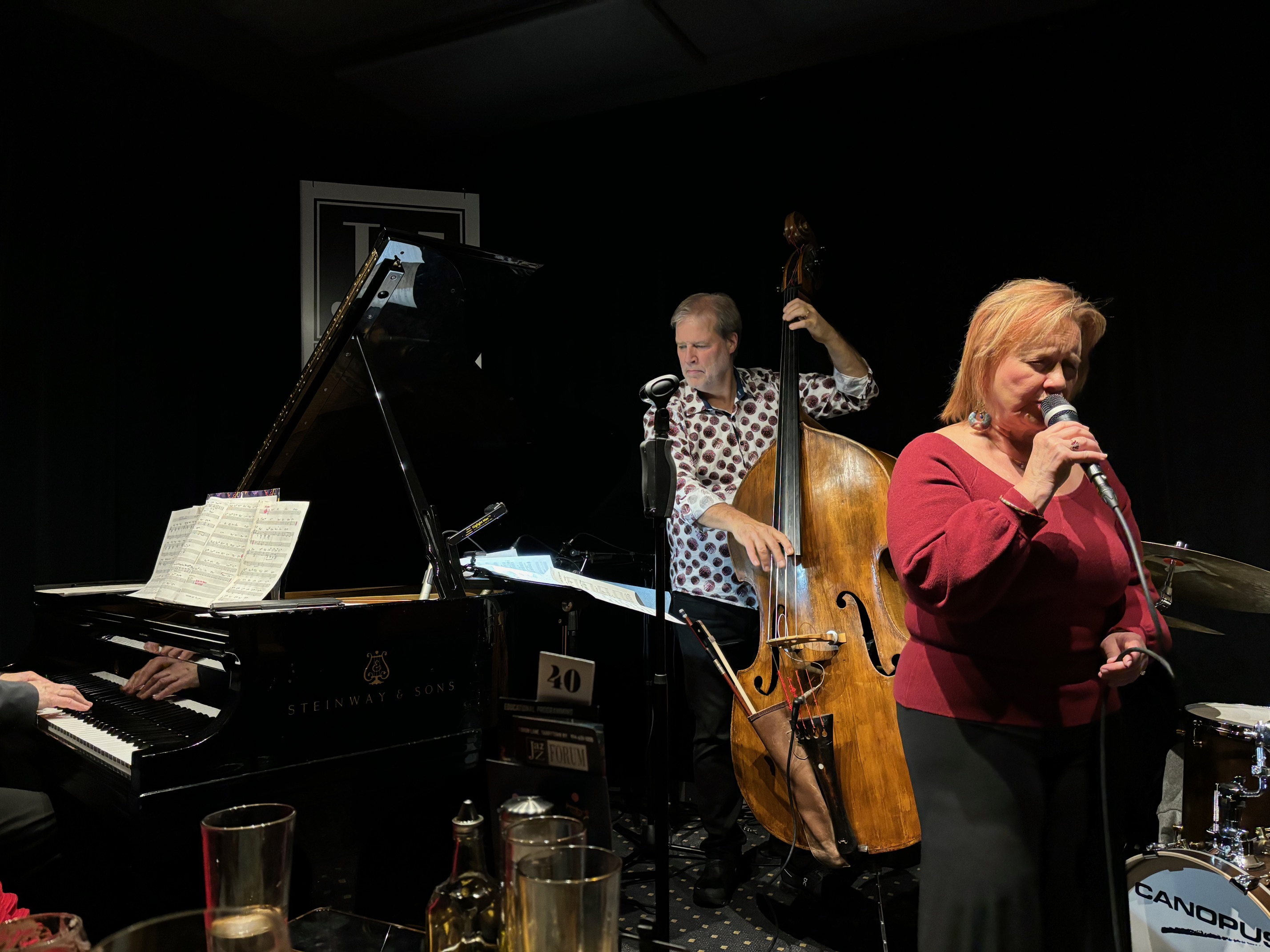
Roseanna Vitro, vocals, performed with Tim Horner, drums, Allen Farnum, piano, and Dean Johnson, bass. (Jim Motavalli photo)

But it was jazz that clicked. Maybe it had something to do with Vitro rooming with the great pianist Fred Hersch when she came to New York. It’s plain she has big ears, and finds good songs wherever they live. Here she is on video, performing the late Kenny Rankin’s “In the Name of Love.” Rankin moved back and forth between pop and jazz his whole life, but took to singing standards, as Vitro does, late in life.

It was a nice gig, celebrating Valentine’s Day, in part because of strong support. Pianist Allen Farnum was on fire, and Dean Johnson (bass) and Tim Horner (drums) more than kept up with him. The standards included “But Beautiful” and, a personal favorite, “Crazy, He Calls Me.” A card on our table offered special cocktails for Valentine’s Day, and also the lyrics to “Crazy, He Calls Me.” The Sigman/Russell song goes back to 1949, and was memorably recorded that year by Billie Holiday. Here’s a bit of the lyrics:

“I say I’ll move the mountains/And I’ll move the mountains/f he wants them out of the way/Crazy he calls me/Sure, I’m crazy/Crazy in love, I say.”

Michelle Lordi Live From the Jazz Cellar

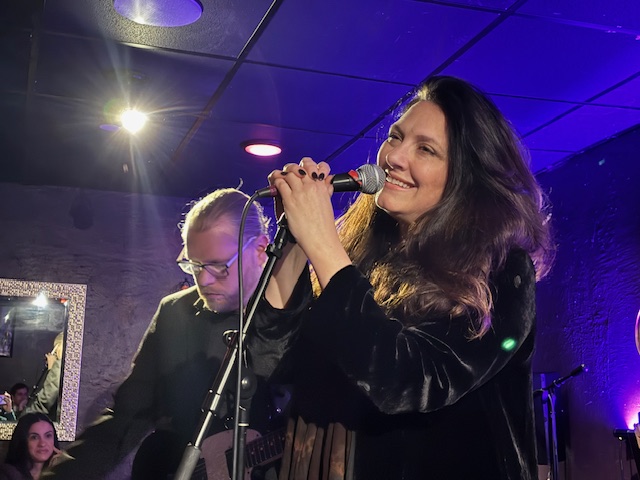
Michelle Lordi in flight at Maureen’s in Nyack. (Jim Motavalli photo)

Maureen’s Jazz Cellar in Nyack, New York is indeed down a flight of steps, opening up to a cozy space with pretty good sight lines and—despite “jazz” in the title—many pictures of Jerry Garcia. It seems the place is pleasantly schizophrenic, supporting both jazz and Americana/bluegrass. Maureen Budway, the club’s namesake, was a jazz singer who passed in 2015; the club is under the direction of her brother and musical collaborator, pianist David Budway.

We were at Maureen’s, for the first time, to see jazz singer Michelle Lordi, who just released the lovely and challenging album Two Moons. David Budway was to have played the piano, but he was reported out with a cold. Ian Macauley, who’s performed with Clark Terry, John Legend and Joe Lovano, was on guitar. Tim Horner was on drums, and Matt Parrish, Lordi’s partner, on bass. The stage was set.

Lordi with guitarist Ian Macauley. (Jim Motavalli photo)

Based in Philadelphia, Lordi is a singer in constant development. Early recordings are quite nice but conventional—singing standards with in-the-tradition bands she sounds lovely but not who’s-that arresting. On the alt-country jazz of Break Up with the Sound (2019) and now on Two Moons, she’s evolved into something that’s entirely her own. Both albums are deeply experimental in their instrumentation without ever losing the essential groove.

And Lordi makes the albums enthralling with her cool, expressive vocals and increasingly strong songwriting. She has lovely microphone technique, and uses held notes judiciously.

Bassist Matt Parrish helps shape Lordi’s sound. (Jim Motavalli photo)

In Nyack, performed a few songs from Two Moons (“Blue Moon,” “Close Your Eyes,” “Never Break”), “Red House Blues” and “Poor Bird” from Break Up, and other material—including a bit of Jobim and Legrand, plus one of the saddest songs ever, Hank Williams’ “I’m So Lonesome I Could Cry,” and “a great song by a jerk,” Ryan Adams’ “When the Stars Go Blue.” The band by itself played “Beautiful Love,” which was evidently the love theme from The Mummy (as played by the Victor Young Orchestra in 1931).

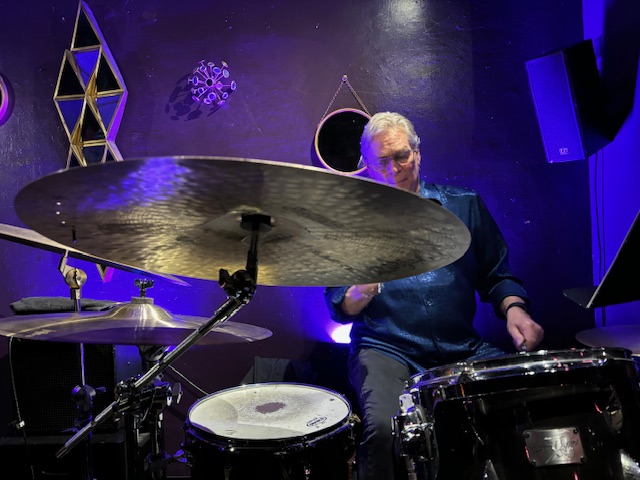
Only Parrish, who teaches at Princeton and tours with the venerable Houston Person, was on both Two Moons and the gig in Nyack. He’s key to Lordi’s evolving conception, very upfront, propulsive and insistent—playing a bass made in 1850. Parrish played on and produced the big-band album Dream a Little Dream as well as Break Up with the Sound, and co-produced Two Moons. Horner, with a huge jazz resume, is a great man with the brushes and very sensitive and nuanced in accompanying Lordi (who, by the way, also teaches at Princeton–contemporary voice/jazz).

Drummer Tim Horner. (Jim Motavalli photo)

Macauley is a bebopper with an edge, also a fine colorist—essential in Lordi’s music. She does great work with guitarists. Macauley’s volume was a bit low, but from what we could hear he did fine.

Other musicians need to hear Lordi’s compositions, which get better the more you hear them. “Red House Blues,” one of several songs she does about her dreams, was incredibly atmospheric—in the club and on record. And as for “Poor Bird,” judge for yourself—here it is on video from Nyack:

After the house turned over at Maureen’s, a bluegrass trio came on featuring Arthur Toufayan and Gregg Terlizzi of Particle Theory—guitar, fiddle and mandolin. Very nice, with a definite nod to the music Jerry Garcia made with mandolin player David Grisman, and with the Dead, too. “Shady Grove,” “Jack a Roe,” “Deep Ellum Blues,” “Swing Low, Sweet Chariot” and “Roll On, Buddy” (a/k/a “Nine Pound Hammer”), all delivered very competently.

Jack a Roe” is an example of a trad song that Garcia made his own—it’s just one of many old songs about women dressing as men to be close to the soldiers or sailors they love. The fact that the Dead had roots in bluegrass and jug band music is why they tower over the jam bands that came after them. Check out Donna the Buffalo for another example of sweet jamming that’s built on the tradition.

Upcoming from Lordi, in addition to club dates you should catch, is a live album with Xavier Davis on piano and Randy Napoleon, and an album with saxophonist Houston Person.

Catherine Russell at the Swing Cat’s Ball–in Westchester

My wife and I rang in the new year at the Jazz Forum in Tarrytown, New York with the incomparable jazz singer Catherine Russell. It became 2024 during the performance, but we were transported back to a simpler era when the Great American Songbook produced hits, and blues was the entertainment at South Side Chicago clubs.

Catherine Russell brings in New Year’s Eve with guitarist Matt Munisteri and bassist Tal Ronen. (Jim Motavalli photo)

We were issued party hats and beads, and there was a countdown, but the main attraction was Russell and her great band. I was intrigued by guitarist Matt Munisteri, who also backs singer Kat Edmondson. He was fine on the swing stuff, but really shone on blues—of which there was an abundance. Ben Paterson (piano) and Tal Ronen (bass) acquitted themselves well. The amiable Ronen has played with another fine singer, Tamar Korn.

Russell has the pleasant habit of introducing songs with the author’s name(s). That’s how I know that New Orleans R&B artist Earl King wrote “Let the Good Times Roll,” and that vocalist Al Hibbler recorded “After the Lights Go Down Low.” Hibbler got to number 15 with Phil Belmonte, Allen White and Leroy C. Lovett’s composition circa 1956. “Shiny Stockings” is from the pen of horn man Frank Foster. None of that matters to the enjoyment of a contemporary Catherine Russell concert—she just sings great songs, but from a far more elegantly curated repertoire than the average jazz singer. And she’s a practically flawless singer, never missing a note, never failing to put the tune over.

Guitarist Matt Munisteri is equally at home in swing and blues. He also accompanies Kat Edmonson. (Jim Motavalli photo)

The brilliance of seeing Russell is that even if the sound was off you could enjoy her performance. She’s a very physical performer, celebrating the song as much with her mobile face as with her voice. And you learn about a lot of tunes! She went through Steve Allen’s “Cool Yule,” Irving Berlin’s 1938 “Change Partners,” Hoagie Carmichael’s 1937 “The Nearness of You” and a lot more. I hadn’t heard King Oliver’s 1926 “Doctor Jazz” in a while.

And then, of course, there was her dad’s “At the Swing Cat’s Ball.” Luis Russell was a noted bandleader, as well as Louis Armstrong’s musical director, and a bunch of his performances were recently pulled out of a closet by his daughter and released on a Dot Time album.

Catherine Russell with bassist Tal Ronen. (Jim Motavalli photo)

It’s a colorful family. Russell’s mother, Carline Ray, an excellent singer as well as a bassist and guitarist (International Sweethearts of Rhythm, Mary Lou Williams and Sy Oliver), told her, “Child, you’ve got enough mouth for another row of teeth.” Both parents imbued their daughter with a great love for a century of great American music. Russell is both an historian and a peerless interpreter.

I’ll be back at the Jazz Forum for the great vocalist Roseanna Vitro, who’s entertaining on Valentine’s Day, February 14.

The Devil and Werner Herzog

Every Man for Himself and God Against All by Werner Herzog (Penguin Press)

By Jim Motavalli

If even half of Werner Herzog’s memoir is true, we’re lucky he made it to his current 81. He describes miraculous survivals all over the world—shooting untamed rapids, a bow-and-arrow attack from an uncontacted tribe, smuggling adventures on the U.S.-Mexican border, close encounters with the wildman actor Klaus Kinski—that are great fun to read, even if their total veracity is in doubt.

Of course, enough of this is well-documented—including the author’s hardscrabble upbringing in postwar Germany, the eating of his own shoes in a bet with filmmaker Les Blank, and the arduous path to completing Fitzcarraldo and Aguirre: The Wrath of God—that the wilder stories seem at least characteristic. Kinski and Herzog were well-matched.

Herzog’s droll, deadpan German-accented voice is familiar from his documentaries. Click on his thoughts vis-à-vis the stupidity of chickens. This book is perhaps best enjoyed in the audio version. The book was written in German and ably translated by Michael Hoffman, though Herzog (who lives in Los Angeles) reads it in English.

Herzog’s films are wildly disparate, but they all grow out of Herzog’s fascination with mankind in extremis, and people who stubbornly refuse to conform to society’s expectations.

Much of the director’s time must be spent trying to get his many films financed, but that material doesn’t make it into the book. The director is (or at least sees himself as) a man of action, and it’s no wonder he became a close friend of the similarly peripatetic Bruce Chatwin (whose novel The Viceroy of Ouidah he made as the film Cobra Verde).

 As he tells it, Herzog had zero training as a filmmaker. He just started doing it, directing his first short, Herakles, in 1961. Since then, he’s produced documentaries, features and filmed operas in a steady stream, sometimes two a year. He’s still at it, with the volcanic The Fire Within (2022).

I’ve never seen a bad Herzog film, but I realize from the filmography thoughtfully provided at the end of the book that most of his work is unseen by me. I hope to remedy that, with the help of streaming services.

Herzog the author is very much like Herzog the director—curious, droll, sardonic, funny. He’s a bit of a German fatalist, though hardly a typical German. Like Fassbinder, he’s an internationalist, whose most famous films are set in France (Cave of Forgotten Dreams), Alaska (Grizzly Man), Australia (Where Green Ants Dream) and South America (Aguirre, Fitzcarraldo, Ten Thousand Years Older).  

Most autobiographies feature younger, idealized cover photographs of their author. Herzog chooses to portray himself as he really is now, grizzled like his grizzly man, uncombed, and appearing to be in the midst of confronting something distasteful.

The 15th Annual Brooklyn Folk Festival Celebrates Folkways

Two of the Down Hill Strugglers, Eli Smith (left) and Jackson Lynch. (Jim Motavalli photo)

BROOKLYN, NY—Folkways Records was founded in 1948 by Moses Asch and Marian Distler, a pair of serial record company founders who’d previously led Asch, Disc and Cub. It was Folkways that endured, and it was Folkways that issued, in 1952, the Anthology of American Folk Music, produced by Harry Smith (whose 100th birthday it would be).

You have to consider the times. In 1952 the only way you could hear America’s recorded legacy, especially the groundbreaking blues, country and folk records recorded in the 1920s, was on scratchy 78s. Reissues were rare. Putting a treasury of old music onto three long-playing records had a profound impact on the generation of folkies, many of them urban, who clustered around New York in the early 1960s, Bob Dylan certainly included.

The 15th annual Brooklyn Folk Festival, held at St. Ann’s Church in Brooklyn Heights, celebrated 75 years of Folkways, still very much with us and signing up artists as Smithsonian Folkways. Asch’s estate sold the label to the Smithsonian in 1987, a deal negotiated by Ralph Rinzler.

Sometime in the late 70s, before the sale, I visited Folkways to see if they needed any radio promotional help. I remember talking to Asch in a cluttered office. He was genial, as long as I didn’t mind getting paid in records. That’s how I got my Uncle Dave Macon album, complete with dimples baked into the bad pressing. And I think I got some Folkways on the air, too.

So it was as an actual former employee of Folkways that I joined the celebration, which turned out to be great fun. In a panel discussion, festival organizer Eli Smith (a mainstay of the Down Hill Strugglers, too) was joined by author Elijah Wald and Peter Siegel, the latter an engineer and producer at Folkways responsible for albums by Hazel and Alice, Doc Watson, Joseph Spence and many more.

For Hazel (Dickens) and Alice (Gerrard)’s first album, Siegel said he was paid $75, $37.50 of which he got in advance to buy a ticket to Washington, D.C and enough Scotch tape to record the group on his reel to reel. When he came back, he got the other $37.50. Not only was Siegel at the festival, so was Alice Gerrard, now 89 and still in good voice.  

Brooklyn’ folk fest is run by the Red Hook-based Jalopy Theatre, which has grown to encompass a performance space, a record label and a music school. Many of the festival performers have records on the label, including the Down Hill Strugglers, who played first with some songs from the Anthology. Jackson Lynch continues to astonish on fiddle, as they made their way through tunes like “When First unto This Country” and “Cumberland Gap.” Walker Shepherd is a switch hitter who sometimes joins Lynch on fiddle, and Smith moves from guitar to banjo. They’re urban old-time musicians, just like the pioneering New Lost City Ramblers.  

I didn’t know that Woody Guthrie played the fiddle, but apparently he not only played it but wrote music for it. The Strugglers ventured into his “Cowboy Waltz.”

Peggy Seeger, a Folkways stalwart along with her brother Mike (a folklorist and member of the New Lost City Ramblers), was one of several still-vigorous veterans who played the festival. She’s 88. Also appearing was Rambling Jack Elliot (92), Ed Sanders of the Fugs (84) and poets Anne Waldman (78) and (by phone) Sonia Sanchez (89).

Seeger, accompanied by her son Calum McColl on guitar and vocals, appeared on video from her home in England. She is an adept interpreter of old songs, and proved it with “The Wagoner’s Lad” and “Dink’s Song.” But she also offered some originals, one of them a clever ditty about automated phone answering systems. And she didn’t forget her late husband’s “The First Time Ever I Saw Your Face,” written for her.

Ed Sanders, the link between the beats and the hippies. (Jim Motavalli photo)

The Fugs, featuring Sanders, hit the nostalgia button with “Slum Goddess of the Lower East Side,” “CIA Man” and “Kill for Peace,” the latter by the legendary Tuli Kupferberg. The Fugs were always sort of ramshackle, and they still are. A moment of order came with the song from the guitarist Steven Taylor, “God Bless Johnny Cash.” Taylor said he showed a draft to Sanders, who said the song was “prolix.” Maybe it’s been shortened since.  

Charlie Parr proved very accomplished on his National steel guitar. His songs, mostly about down and outs, were intermittently successful. “I Ain’t Dead Yet” was a highlight.

Dom Flemons, “Freight Train” and “Cannonball Blues” medley. (Jim Motavalli photo)

And then came Dom Flemons, who had heard just that morning that his new album Traveling Wildfire had been nominated for a Grammy. Flemons, a former member of the Carolina Chocolate Drops with Rhiannon Giddens, is a delightful solo performer, and starting to branch out a bit.

Wildfire is his own songs, some with a country feel such as the very romantic “Slow Dance.” Traditionalists could delight in his ornamented guitar medley of “Freight Train” and “Cannonball Blues.” And he didn’t forget the black cowboys, the subject of his last Grammy-nominated album. Did you know that Reverend Gary Davis had a cowboy song, “Saddle it Around”?

A great way to start Saturday morning was Ken Schatz leading the audience in sea chanties. The pews were full of his fellow acolytes, and he called them up one by one to sing lead, with the rest of us joining on the choruses. I was thrilled to hear “Cape Cod Girls,” previously encountered only on Patrick Sky’s second album, A Harvest of Gentle Clang.

The Harry Smith Frolic folks, getting through the Anthology of American Folk Music. (Jim Motavalli photo)

Kyle Tigges, with a full band of fiddle, bass and piano, offered easygoing songs. He’s one to watch. And I really loved a performance by members of the Harry Smith Frolic. This is an event, held in Massachusetts annually, that each year attempts to get through one volume of the Anthology, helped by anyone in the audience who can sing (or is willing to attempt to do so). Four of the frolickers showed up at the festival and banged out such Anthology numbers as “The Brilliancy Medley,” “I Wish I Were a Mole in the Ground,” “Indian War Whoop” and “The Mountaineer’s Courtship.” The latter is a novelty number from the Stoneman Family, and the kicker is that the rube getting hitched already has six kids.

And then there was David Johansen. The former New York Doll made two wholly unexpected albums as David Johansen and the Harry Smiths, and they are a revelation. He sounds utterly authentic, Charlie Poole’s cousin, and fully inhabits the old songs. On stage with two guitarists, he still looked like a rocker, skinny in striped pants, but as soon as he opened his mouth the Old Weird America came crawling out. Quite wonderful. “Old Dog Blue,” “Casey Jones,” “Single Girl, Married Girl,” “Delia.”

Johansen barely talked, but he did say, “This is a wonderful event. It’s so much fun to play these songs. It’s a constant source of rejuvenation for me.” Fans of Buster Poindexter or the Dolls can catch him in a different context, such as Personality Crisis, the recent Martin Scorsese documentary.

Wyndham Baird was a repeat visitor, and a somewhat low-key performer who offers beautifully sung and sturdily constructed cover songs, from Dylan (“License to Kill”), Ian Tyson (“The French Girl”) and Roscoe Holcomb (“Trouble in Mind”).

Nora Brown, contemplating the past. (Jim Motavalli photo)

The young banjoist Nora Brown was in a slightly downbeat mood, having recently contracted a cold and sprained her ankle. She opened with “Morphine.” It’s always great to hear both her interpretations and her descriptions of where the songs came from. “Copper Kettle,” an immediate postwar song by Albert Frank Beddoe and recorded by Bob Dylan on Self Portrait, was typically splendid. Nora was joined by fiddle player Stephanie Coleman, and the pair recently made an EP together. Brown was on several stages over the weekend; the musicians love to play with her.

Brown sometimes sits in with multi-instrumentalist Jake Blount; as he pointed out, they “like the same songs.” In Brooklyn Blount was subdued but also pissed-off and electrifying as he tells stories of slavery and African-American life, often through the lens of old songs. He’s a ferocious fiddle player—sometime using it to generate a drone, with electronic effects—and just as good on banjo and guitar.

Jake Blount, fiddle drones. (Jim Motavalli photo)

“I’ve Heard of a City Called Heaven” comes from the singing of Jean Ritchie, and Blount did it brilliantly. “Hard Times” via Skip James was also imaginatively reinvented.

Alice Gerrard (center) with Tatiana Hargreaves (left and Reed Stutz (right). Missed the bass player’s name! (Jim Motavalli photo)

Alice Gerrard lives in North Carolina now, and brought some musicians up from there, including Reed Stutz and Tatiana Hargreaves. Sad songs (“The One I Love is Gone,” via Bill Monroe) funny songs (“How Can I Keep from Fishing?”) and serious ones (“The Coal Miner’s Blues”) were all offered and treated with respect.

I unfortunately had to miss Sunday and Rambling Jack Elliot, among others, but what I did get was two intense days and nights of roots music.  

See more of what’s going on at Brooklynfolkfest.com and Jalopytheatre.org. The same folks put on the Washington Square Folk Festival, the Brooklyn International Folk Festival and Roots ‘n Ruckus Fest.