At the fifth running of the Turtle Invitational September 21 in the back country of Bedford, New York, Nancy Tanner stood near her decidedly unconventional ride: An ultra-cute 1991 Nissan Figaro, a decidedly retro Japanese car powered by a one-liter turbo four. They were never sold in the U.S. (and just 20,073 were made), but now these oddballs can be imported as used cars that are more than 25 years old.
Nancy Tanner with her rare-in-America Nissan Figaro. (Jim Motavalli photo)
“My husband and I saw one outside London’s Claridge’s in 2004,” said Tanner, a resident of Tuxedo, New York. “We were very taken with the car. As soon as we could, we bought three and sold two.” The family owns six cars, which is probably not atypical for the people exhibiting at the Invitational, which is growing rapidly and now rivals (or exceeds) the nearby Greenwich Concours in size.
The Invitational, the brainchild and labor of love of money manager Philip Richter (on whose horse-country property it resides), has room for all branches of the collector car hobby. “To make it unique, we’re just giving awards to cars with interesting and meaningful histories,” Richter said.
Chuck Schoendorf with his latest acquisition, a 1953 Chrysler New Yorker T&C. (Jim Motavalli photo)
Chuck Schoendorf, who owns no less than three original Cunningham cars (of the 27 made), brought his latest acquisition, a two-tone 1953 Chrysler New Yorker Town & Country station wagon.
“It’s powered by a Chrysler ‘Fireball’ Hemi, which is the link to the Cunninghams,” Schoendorf said. “An interesting feature is the reptile-pattern vinyl upholstery. By 1953 Chrysler was no longer using wood bodies for the T&C, but the wagons had wood paneling in the beds. Just 1,399 New Yorker T&C wagons were built in 1953.”
Yes, that’s nine Ferrari Dinos. (Jim Motavalli photo)
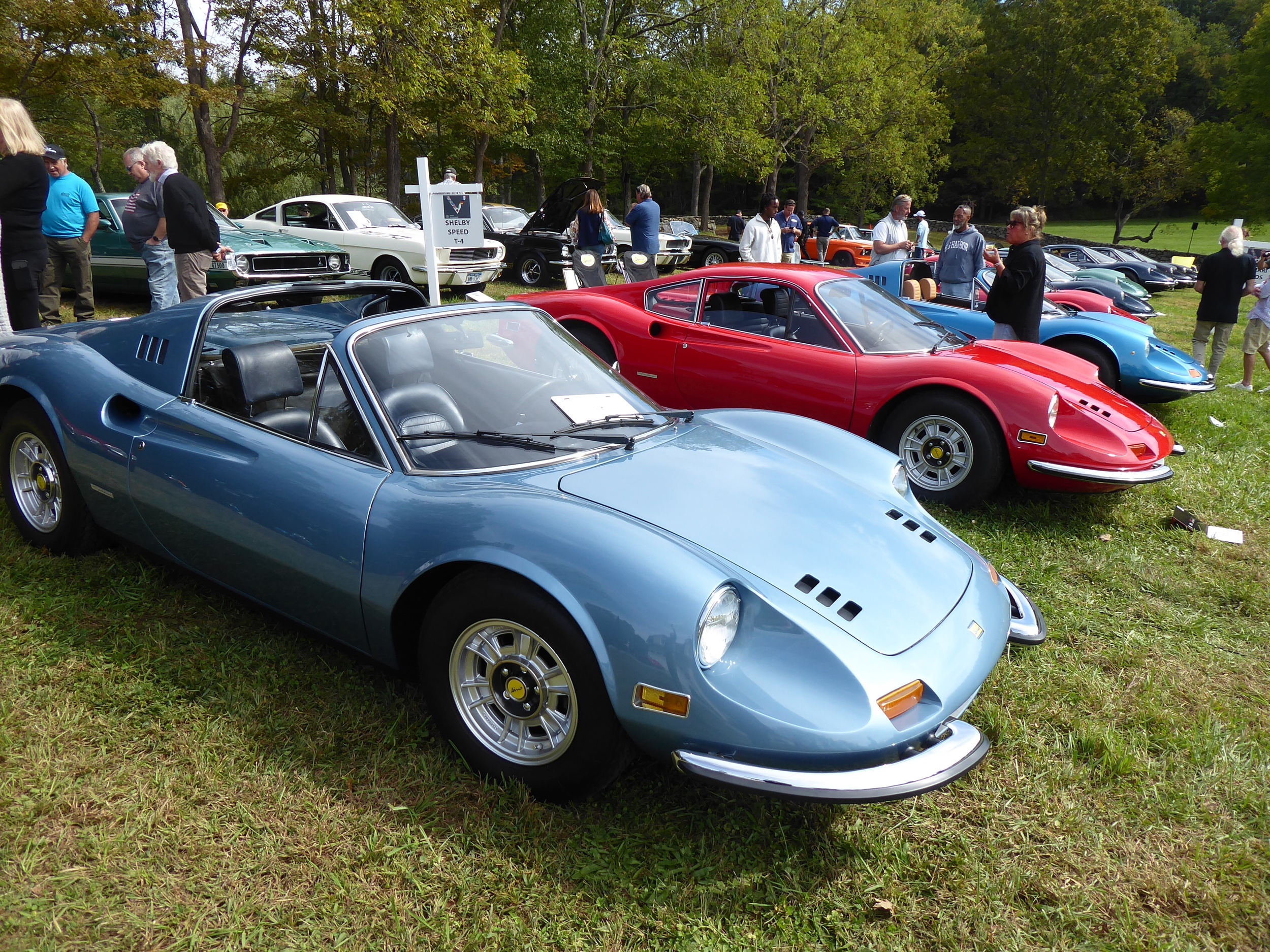
Good things came in multiples at the Turtle. There were nine Ferrari Dinos, and only 2,295 were built. “It’s a choose-your-color situation,” said one bemused observer.
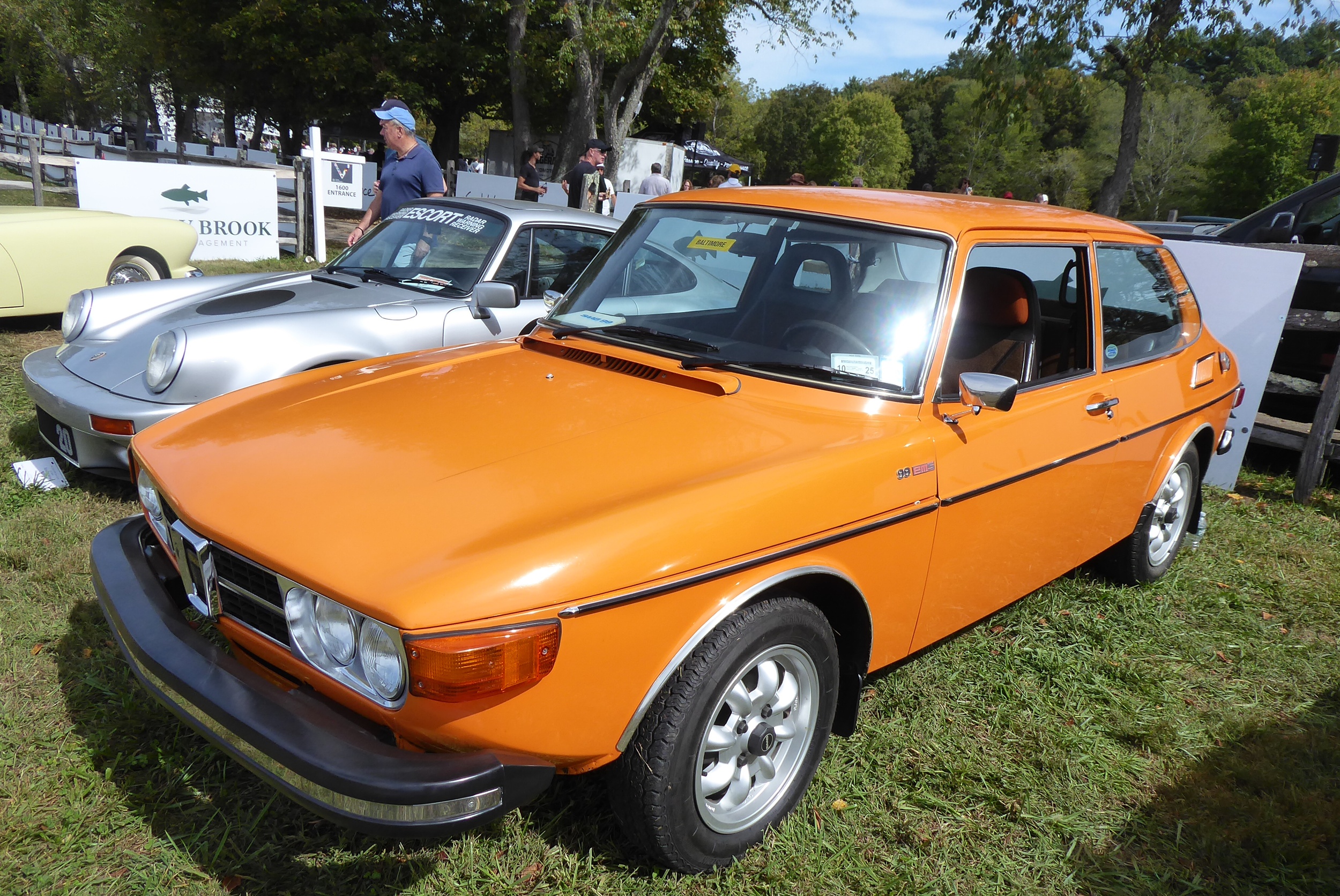
The only Saab was this very clean 1974 99 EMS. (Jim Motavalli photo)
How often do you see not one but two 1965 Ferrari 275 GTBs in yellow (one had gray leather, the other black)? Next to them was a similar Daytona. A father said to his two pre-pubescent sons, “What kind of car is this, boys? That’s right, a Daytona—they came with special Daytona seats.” Was that three Jaguar SS 100s, one of them quite beat-up with Australian New South Wales registration?
This Jaguar Mark VII is much traveled, Florida, Rhode Island and New York recently. (Jim Motavalli photo)
American cars were in a minority, though Parker Rouf’s 1955 Packard Caribbean convertible was spectacular. Of course, there were lots of stand-alones. A 1953 Jaguar Mark VII in muted gray with an engine upgrade to XK120 M spec is owned by Rick Doucette, but before that it was the property of former Audrain Auto Museum CEO Donald Osborne, who’d bought it for a bargain price at the Amelia Island auction in Florida.
The BMW 507, one of the most beautiful cars ever, owned since 1977. Why would he sell it? (Jim Motavalli photo)
BMW powered several cars with its early 1950s V-8, and two of them were on display—a gorgeous red 507 convertible (one of 252) owned by Jeff McAllister of nearby Ridgefield, Connecticut since 1977; and a more pedestrian (but still lovely) 503 coupe. Also from BMW were a row of 2002/1600 models, including a rare Cabriolet. The sole Saab was a 1974 99 EMS, orange with brown/orange cloth seats.
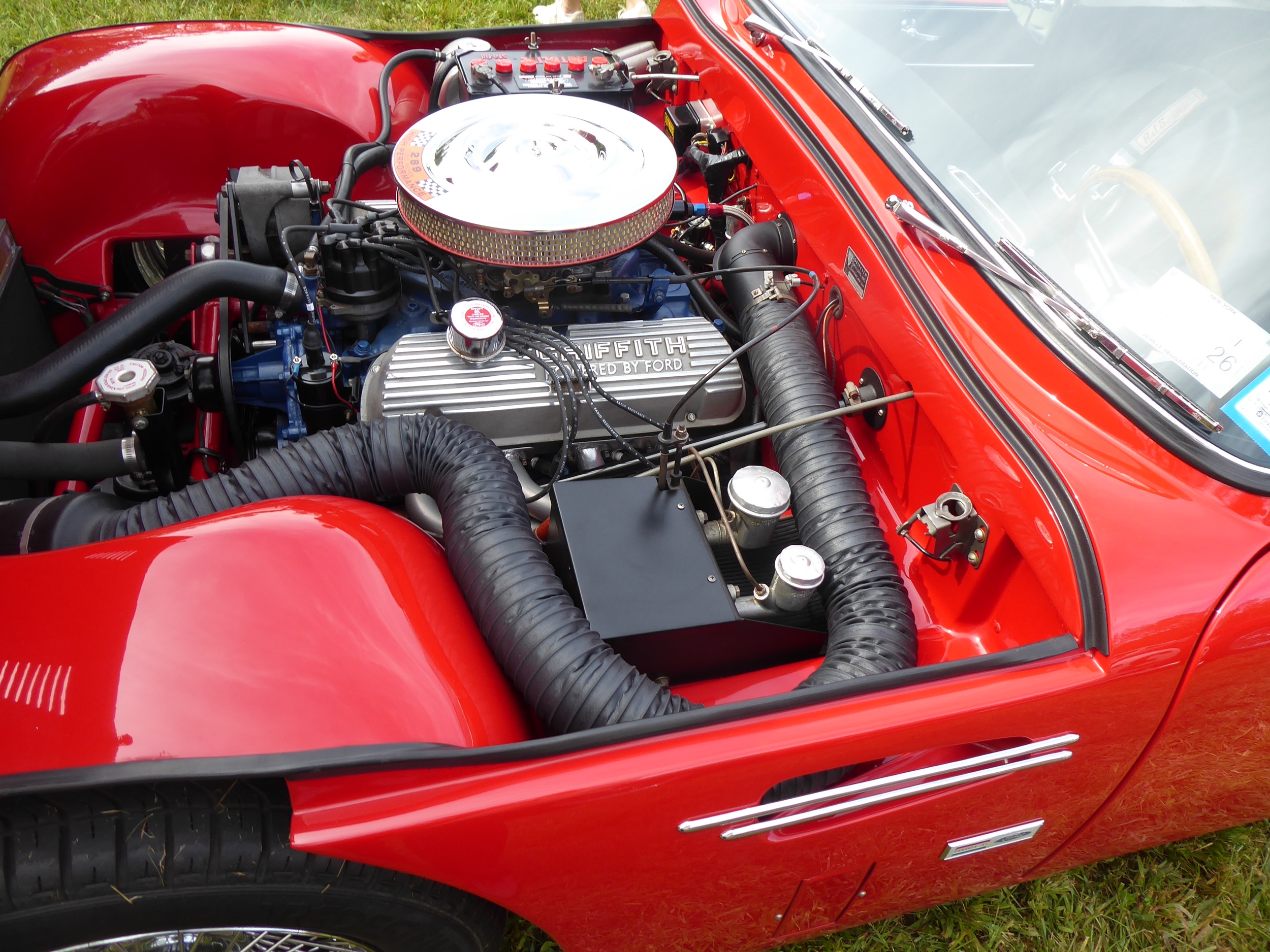
A Ford 289 V-8 squeezed into a tiny British TVR. The Cobra wasn’t alone. (Jim Motavalli photo)
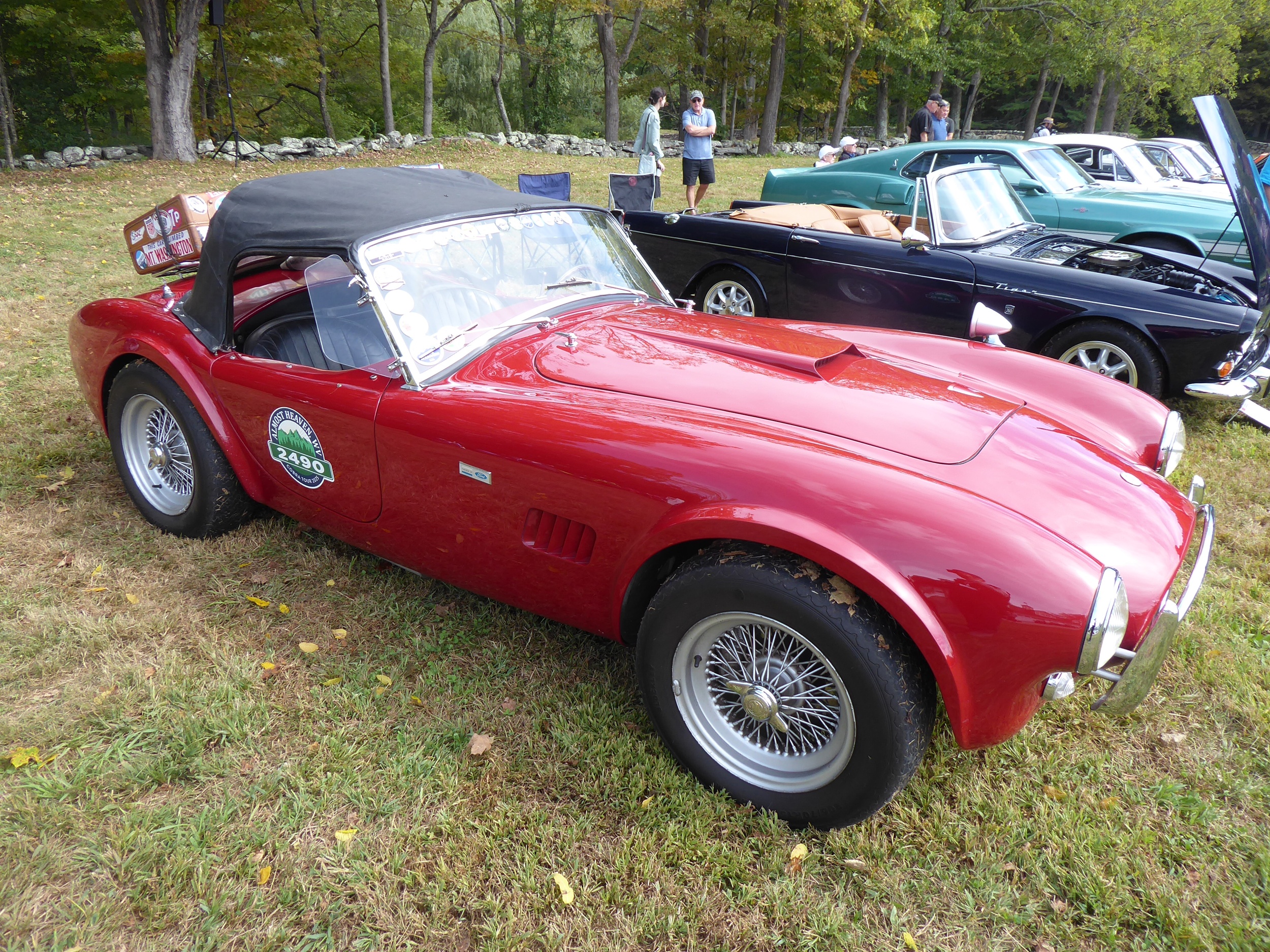
There was an orange McLaren F1—how many of those can there be?—and a potent 1966 Sunbeam Tiger, stolen and stripped in Denver, whose current owner said he’d “decked the head, twice.” Honored guest and TV barn finder Tom Connor brought his much-traveled Shelby Cobra CSX 490. It survived a bear attack at one point (according to its license plate frame).
Tom Connor’s long-owned Cobra is no garage queen. (Jim Motavalli photo)
Kin to these was a supposedly hard-to-handle 289-Ford-powered 1965 TVR Griffith, and a Chrysler-powered 1964 Bristol 408 with lots of British wood-and-leather ambience.
The very British Bristol 408 had Chrysler power. (Jim Motavalli photo)
Lucky Turtle attendees also enjoyed a free box lunch, free coffee and cider, tubs of apples and boxes of donuts. This was a nice touch to a low-key, friendly event.
I am occasionally sent products for review, and some of them are really cool and innovative. I’m leaving out the units that turned out to be flimsy or not worthy of your time, but here are some I quite liked.
CoverSeal Car Cover. I now own three collector-class cars, with the purchase of a 2006 Saab 9-5 SportCombi station wagon with an ultra-rare stick shift. It replaces my Mercedes 300TE wagon, which was similarly forced to sit outside because my 1993 Saab 900 Turbo convertible and 1999 Mazda Miata (both also manuals) have pride of place in the two-car garage.
I bought a cover for the Benz, but it was always getting blown off by the hefty winds we have around my part of Connecticut. But now I’m using a CoverSeal ($305) that should defeat that problem. It has a 360-degree weighted bottom that allows it to stay in place even when the winds are at 40 mph. Forget about tying the cover down with bungee cords or trying to secure it with cinder blocks.
The cover is also designed to guard against rodent damage, which is something else I’ve experienced. My Saab 900 had its old dash wiring completely stripped away by the little rodents, despite several traps and alleged mouse-repelling products. The idea is that the mice “will travel around the cover, realize there is no entry point, and move on in search of a more convenient shelter.”
We’ll see long-term if these notably smart so-and-sos are deterred. The bottom edge of the cover sits on the ground, but that’s OK because the 10-mil tarp is waterproof and doesn’t mind communing with the earth. The covers are loose fitting, which allows them to be blown around by the wind, displacing pooling water. Because they’re loose, they don’t need the mirror pockets that can be annoying to fit. The only color is silver, because it reflects 90 percent of sunlight.
The cover, which comes with a carrying bag, is a bit pricey, starting at $305. But if it keeps out water and rodents—and doesn’t blow off—it should prove its worth. CoverSeal was designed by collector Ken Huening, who tried garlic oil, dryer sheets and peppermint spray to keep out the little beasts. Huening was nonetheless hit with rat damage twice, to the tune of $20,000—they didn’t care about my little bag of rat-repellent seeds, either.
Etenwolf Vortex S6 Tire Inflator/Air Compressor. I wouldn’t use it to paint a car, but the Vortex S6 (there’s also an S7 model) is very handy to have around. I just used it to inflate tires on two bicycles, an e-bike, a plethora of pool rafts and floats, and a Saab that’s been sitting around. The 15,600-milliamp-hour unit is easily adjustable between car, bike, inflatables. It can be used as a portable charger for electronics, though you may have smaller power banks for that.
The S6 is best if you prize portability. The S7 has more power, with a faster inflation time and a bigger battery. Got a truck with oversized tires? The S7 is best for that duty.
On the S6, the two included hoses (one detachable) covered all the use cases I needed. There’s a built-in 1,000-lumen LED light, and on-board storage for the tips you’d otherwise lose. The Etenwolf seems solidly constructed. There’s a 90-day guarantee.
This small, not heavy unit is much easier to use and more efficient than the portable compressor I bought at the hardware store. I see it for $89.99.
TOPDON TopScan OBD2 Scanner Bluetooth. Versions of this product have been around for a while, but now it is more capable, and marked down as low as $51.29 at Amazon. The unit does quite a lot, considering its tiny size (like a cigarette pack). Just plug it into the OBD2 port and, after easy 5.0 Bluetooth pairing, the car owner can send commands from his or her cellphone directly to the car’s ECU to track down pesky problems. It also provides guidance for fixing what ails the vehicle. For some of the premium features, you need a subscription, which is a bit pricey.
Obviously, the scanner can read fault codes that are otherwise mysterious, and it can clear them, too. It can also, a mind blower for me, access factory technical bulletins. And measure speed performance before it breaks into a sweat. There are multiple display modes for the data, including charts, dials and just the raw numbers. The software will get regular updates. The unit is compatible with Android and IOS.
Mothers California Gold Ceramic line. I’m not really the concours type—if you see a dusty classic driving past, it’s probably me. I like one-step processes. This set came in a big white bucket with three products in it: Ceramic Wash and Wax. Ceramic Paint Correction, and Ceramic Spray Wax, each $17.99. The sudsy wash & wax is very hydrophobic, which means that it results in a finish that beads water. It’s easy to use and good at getting a shine out of faded paint. The product simply sprays on and then gets carefully wiped out, leaving a long-lasting ceramic layer. I applied it to three cars: a 2014 Toyota Prius V, a 1999 Mazda Miata and a 1993 Saab 900 Turbo. The results were quite pleasing, with not a lot of elbow grease.
The paint correction product goes after small scratches and scrapes, water spots, swirling, and other minor flaws. I applied it by hand to the Prius V and KOed a lot of minor imperfections. Little pock marks that looked permanent whisked away. The spray wax is for aprés-wash. Again, it just sprays on and gets wiped off, leaving a shiny ceramic surface that beads water. The package also included yellow microfiber towels and a wash mitt that proved useful.
Fenderx Teufel Rockster Air 2 Portable Bluetooth Speaker. Whoa, yes, this big Fender, offered in partnership with German company Teufel, is portable—it has three handles, doesn’t it? But the 31-pound unit is on the heavy side of what can be reasonably carried.
But all was forgiven when I hooked it up to both a CD player and the music on my phone. It’s got deep bass, crisp trebles and tons of volume. It runs on house current, 12-volt power supplies or for 58 hours on batteries.
The Fender x Teufel is incredibly versatile. You can attach a guitar through the instrument input and blow the neighbor’s minds. You can play phone music, or attach any old-school music-making component (CD player, turntable, cassette, eight-track player) through the quarter-inch aux stereo jack. Need a PA system? There’s a microphone input.
While the Fender x Teufel isn’t strictly a car product, it can run on your car’s 12-volt system and sit on the front seat with you. Or just use those long-life batteries. If you own a classic and don’t want to replace the tinny AM radio that came with it, this Fender can be used and leave no marks.
I told a friend I was going to hear some ragtime, and he said, “What, banjos and straw hats? Why would you want to listen to that corny stuff?” I tried to explain that ragtime is in at the foundation of jazz, and you need to understand the musical roots. But I wasn’t getting through.
Terry Waldo and the Gotham City Band play ragtime and nothing but, and they’ve made it work in New York with regular gigs at Zinc Bar (where I saw them August 7, part of an ongoing first Wednesday gig) and quite frequently at Arthur’s Tavern, both downtown. It’s possible for the music to sound remote when heard on a scratchy recording from 1915, but live it’s an absolute delight.
Waldo, a protégé of the great Eubie Blake, is an historian as well as a ragtime pianist. He is the author of This is Ragtime, the definitive treatment, most recently republished in a 2009 Jazz at Lincoln Center Library Edition. In addition to making 70 albums of ragtime and traditional jazz, he hosted an NPR show that is now available in podcast form on Waldo’s website.
At Zinc, the band was Jim Fryer on trombone, Daniel Glass on drums, Dan Pearson on clarinet and alto sax, and Konstantin Gevondyan on trumpet. All of them are master ragtime players, and both Pearson and Govindan (as well as Waldo) did some singing. They work together a lot, and finished each other’s sentences.
I asked for—and got—an opening of “Maple Leaf Rag.” A cliched choice, I know, but I wanted to hear it. It opened with Terry solo, and he played it with a lot of flourishes that I don’t always hear in renditions of this classic Scott Joplin tune. Then the band kicked in, expanding the palette. I didn’t realize, until Terry told me, that Joplin taught banjo and that early versions of his rags were often heard that way. But no banjo on stage, and no bass either. Acoustic basses were tough to record with early sound equipment, so sometimes a tuba replaced it.
Ragtime, at least the way these guys perform it, has plenty of hot solos, but the other horns feel free to chime in as support. “Oh By Jingo” is from 1919 (Albert Von Tilzer and Lew Brown, featured in the show Linger Longer Letty, and was a big Tin Pan Alley hit. David Bowie was inspired by it, and Hugh Laurie did a version. Waldo sang the novelty song with some vigor. Here, on video, is a Jelly Roll Morton song they did, called “Froggy Moore Rag”:
Next was W.C. Handy’s “Memphis Blues” from 1910, with Fryer singing. It has a great line about the trombone player moaning like “a sinner on Revival Day.” Fryer recalls the great Jack Teagarden, but the latter was bluesier.
Gevondyan was wonderful, chasing Louis Armstrong on trumpet and masterfully employing his cup mute. He sang “Sugar Blues” from 1919 (Clarence Williams/Lucy Fletcher) and didn’t sound anything like Louis, but still very nice. Glass should be cited, too, for his mastery of the snare.
Pearson sounded more in-period on his clarinet, but he was vastly entertaining on his more modern alto, too.
“Let’s Pray Against Somebody” is a Waldo original targeting religious hypocrisy, and reminiscent of the Fugs’ “Kill for Peace.” Or maybe Mark Twain’s “War Prayer,” which also points out the flip side of our heartfelt entreaties: “Help us to tear their soldiers to bloody shreds with our shells; help us to cover their smiling fields with the pale forms of their patriot dead.”
And so it went, through Jelly Roll Morton’s “Why?,” Kid Ory’s “Ory’s Creole Trombone,” a headlong “Shake it and Break It” via Kid Oliver, “My Melancholy Baby,” and more. They dredged up a crazy old song called “Minnie the Mermaid,” written by Bud DeSylvia in 1923. It wasn’t all that bad, containing the line, “Down among the corals, I lost my morals.”
It was a great night out in New York City. Don’t judge a whole genre until you hear it live, I say.
The Vanquish Volante complements the coupe in driving dynamics, but adds wind in the driver’s hair
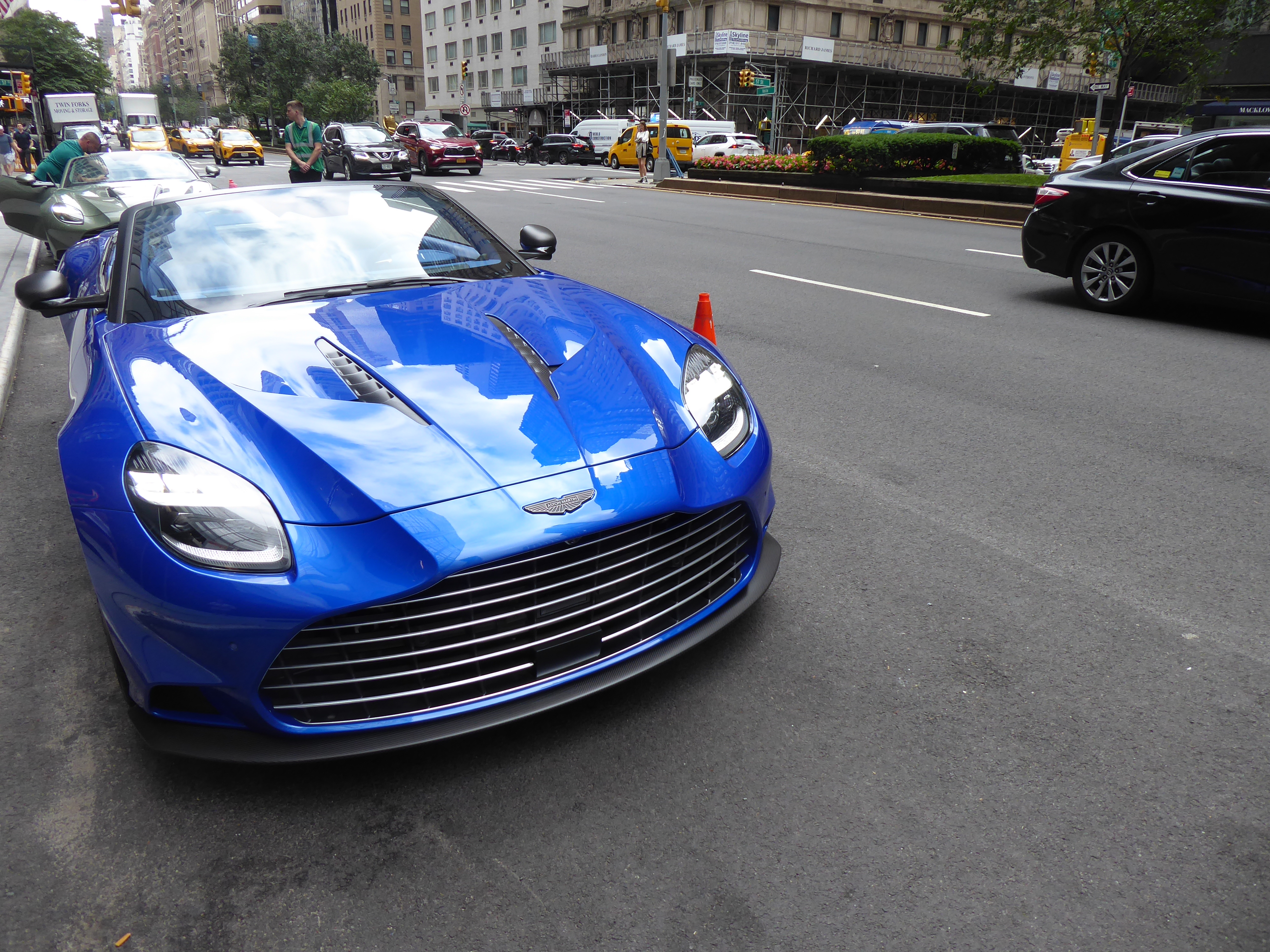
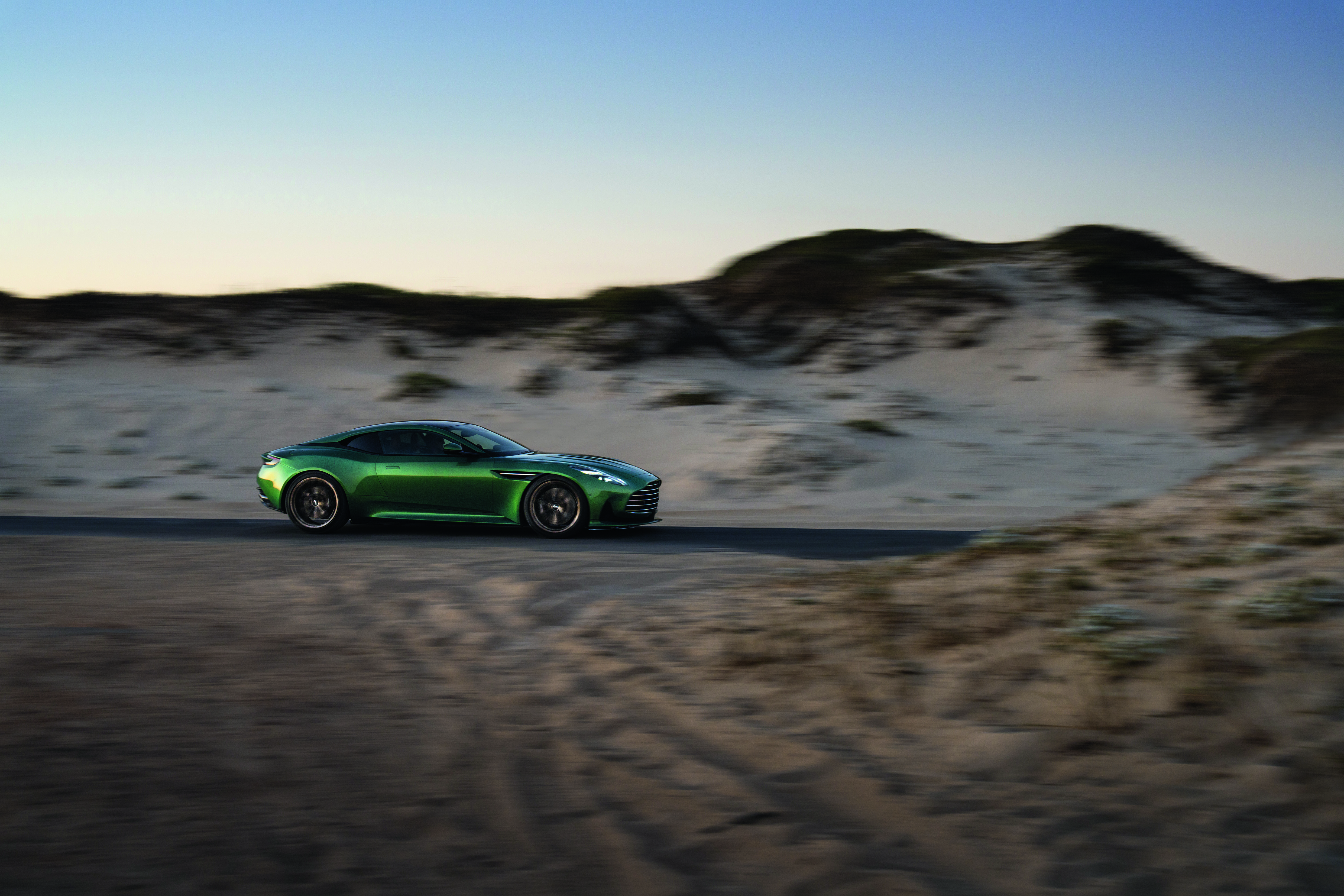
The price for the 2026 Vanquish Volante convertible was kind of an afterthought during the presentation at Aston Martin’s New York Q showroom July 15, but it certainly woke up the assembled media—$483,000 plus $5,000 destination. It will be on sale in early 2026.
Supercar buyers pay for the stats, and the very pretty new flagship V-12 convertible certainly has them—a top speed of 214 miles per hour, zero to 60 mph in 3.3 seconds, an all-new in-house twin-turbo 5.2-liter V-12 engine offering 824 brake horsepower and 738 pound-feet of torque. The company has some superlatives to offer: The Vanquish Volante is “the world’s most powerful front-engine convertible” and “the fastest, most powerful, open top series production Aston Martin to date.”
According to Simon Newton, director of vehicle performance at Aston Martin Lagonda, the new Vanquish Volante (which was developed alongside the similarly powered Vanquish coupe in the lineup) is 15 percent more powerful than its predecessor, the DBS Volante, and offers 11 percent more torque. The power of the new V-12 (developed without Mercedes/AMG input) reaches the ground through an eight-speed ZF gearbox with paddle shifters and five drive modes, GT, Sport, Sport+, Wet and Individual.
Carbon ceramic brakes are standard on the Vanquish Volante, and help with weight reduction. They should be powerful, but on the highway stopping distances seemed longer than expected.
The aim in developing the convertible, Newton said, was “to ensure that the driving experience was in no way diluted—it had to drive just like the coupe.” And that included adding lateral stiffness to the bonded aluminum structure, which is complemented by carbon-fiber body panels. The structural stiffness is the same for the open or closed Vanquish. The convertible weighs 4,144 pounds, just 200 more than the coupe.
The Vanquish Volante is also both bigger and wider than the DBS, with an especially wide grin from that traditional Aston DB-style shark grille (cue as far back as the DBR1 racer of 1956). Newton emphasized that a great deal of engineering went into getting the soft top to fold flat, without an unsightly hump on the rear deck. The downside is that the folded top eats into trunk space.
The top goes down in 14 seconds and closes in 16. With the top up, rear vision isn’t all it could be—the rear window is small. The car’s low-profile top makes it look like headroom would be an issue, but this did not prove to be the case on the road. It’s an attractive car, top up or down.
Inside the Volante feels roomy, with a very similar interior layout to the Vanquish coupe. The driver looks at a digital 10.25-inch display, which is complemented by a similarly sized center-stack touchscreen. Bowers & Wilkins does the audio, with 15 speakers. Sports seats are standard, but carbon-fiber performance variants are available (though these are certainly not race cars). A fair amount of customization is, of course, available—and saddle leather fitted luggage sets can be added. Asked about options, Morgan Theys Carrasco, the company’s Americas spokeswoman, said the possibilities are practically unlimited. Because of this, the one you buy may pencil out at more than the aforementioned $483,000. Some of the test cars had bottom lines above $600,000.
Driving a powerful more-than-$400,000 Sage Green sports car on the streets of New York is always an adventure. Other supercars have proven a handful in such situations but the Volante is docile at low speeds. Once the George Washington Bridge was crossed and the Palisades Parkway entered in New Jersey, the car came into its own, offering effortless surges of power while remaining surprisingly quiet and squeak-free in GT mode. Wind noise wasn’t bad with the top down, either. Switching up to Sport and Sport+ increased the urgency of the engine note and stiffened the suspension.
Open roads gave an opportunity to open the car up, and it remained eager to any speed that was desired. The best thing about driving the Volante was the very direct, precisely weighted steering. The driver soon learns that the most minute adjustments are possible. The suspension was expectedly stiff, making the horrible city roads a bit bouncy, but glass smooth on the rural byways.
The job of a car writer inevitably sounds glamorous, especially when you inform your interlocutor that the day included driving an Aston Martin convertible and eating a gourmet lunch. The appeal is undeniable, causing many to exclaim, “That’s the greatest job in the world!” And maybe it is. It also sounds fairly easy to most people, and they often add, “I could do that job!” And maybe they could. But like telling jokes on stage or conducting an orchestra, it’s harder than it looks. At least I tell myself that.
The Volante was delivered safely back to base, complementing the cleaner example on the showroom floor. The estimate is that 40 percent of Vanquish production will be Volante convertibles.
Theys Carrasco said that CEO Adrian Hallmark is keen on growing Aston Martin as a performance brand and returning the company to profitability by the end of 2025. Part of the strategy is opening new Q outlets around the world, with a new location in Japan and one in London by the end of the year.
The over-1,000-horsepower Valhalla plug-in hybrid supercar (zero to 62 in 2.5 seconds) is coming in the second half of this year, which could help the Aston Martin bottom line. Production is limited to 999 units.
We are at a pivot point in the auto industry, with both the electric and self-driving revolutions somewhat stalled, and Trump tariffs making it difficult for consumers to know what they should do. There’s a brief window when it’s still possible to get the $7,500 federal income tax credit when buying a made-in-U.S.A. EV, but it’s going away September 30. In the meantime, automakers are still churning out new EV models—I’m at a Subaru EV rollout as I write this
So, let’s delve into what’s new in my garage, electric or otherwise.
2025 Audi Q4 e-tron Prestige and 2025 Audi SQ6 e-tron Prestige. Audi’s electrics didn’t do well in the second quarter of 2025, and the Q4 e-tron was down 48.7 percent year over year, from 2,430 in 2024 to 1,247 in 2025. But it sure sold better than the A6 e-tron, with just 179 sold.
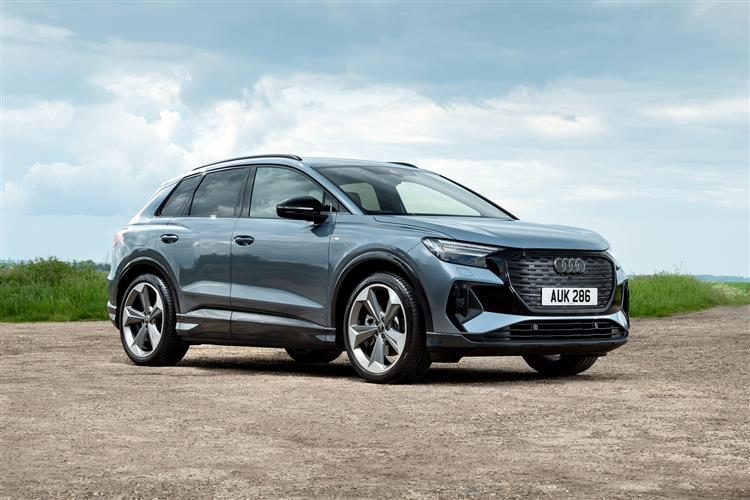
The Q4 in this guise is a compact electric SUV with 335 horsepower from its electric motor and up to 332 miles of range. The starting price in this Prestige edition of $63,095. It’s fairly pricey, and even the cheapest Q4 is over $51,000. I suspect it’s price that’s holding this model back, because it’s a quite decent small EV otherwise, with quality materials (leather and wood are standard) and a nice driving experience. There is 26 cubic feet behind the rear seats, and 54 feet with those seats down.
The SQ6 e-tron is built on the same platform as the Q6 e-tron (3,716 sold in the second quarter) but with a dual-motor set-up that offers as much as 510 horsepower. While the car was great fun to drive (with 3.8 seconds to 60), the added pep sacrifices range—up to 46 miles. The Prestige is $80,595. The range is 275 miles, not exceptional, but it is somewhat mitigated by fast 270-kilowatt charging.
2025 Lexus LX 700h Overtrail. Lexus is on a roll among the Japanese luxury brands, especially compared to Nissan’s Infiniti. But the LX 700h isn’t set up to float my boat. It’s a hybrid from the leader in that technology, but fuel economy in this big boat isn’t the goal. It has a combined EPA rating of only 20 mph, which is just marginally better than its non-hybrid counterpart. Hybrid tech belongs in light, aerodynamic cars—it’s kind of wasted in this luxurious 6,283-pound seven-passenger SUV.
It’s impossible to hate cars like this, because they’re so cosseting to drive. But they don’t pass a lot of gas stations. The car as tested was $118,010, which buys a powerful 457 horsepower from a 3.4-liter twin-turbo V-6 coupled to a 10-speed automatic. It can tow 8,000 pounds.
Every possible luxury feature was present, all of them standard, from leather-trimmed seating to heated steering wheel, a cool box and an auto door closer. It’s kind of the equivalent of an off-road 1959 Cadillac. Which does have its appeal.
2025 Toyota Land Cruiser and 2025 Toyota 4Runner TRD Sport. More Toyotas. The company covers every possible American niche, even those that must be mystifying in the home market.
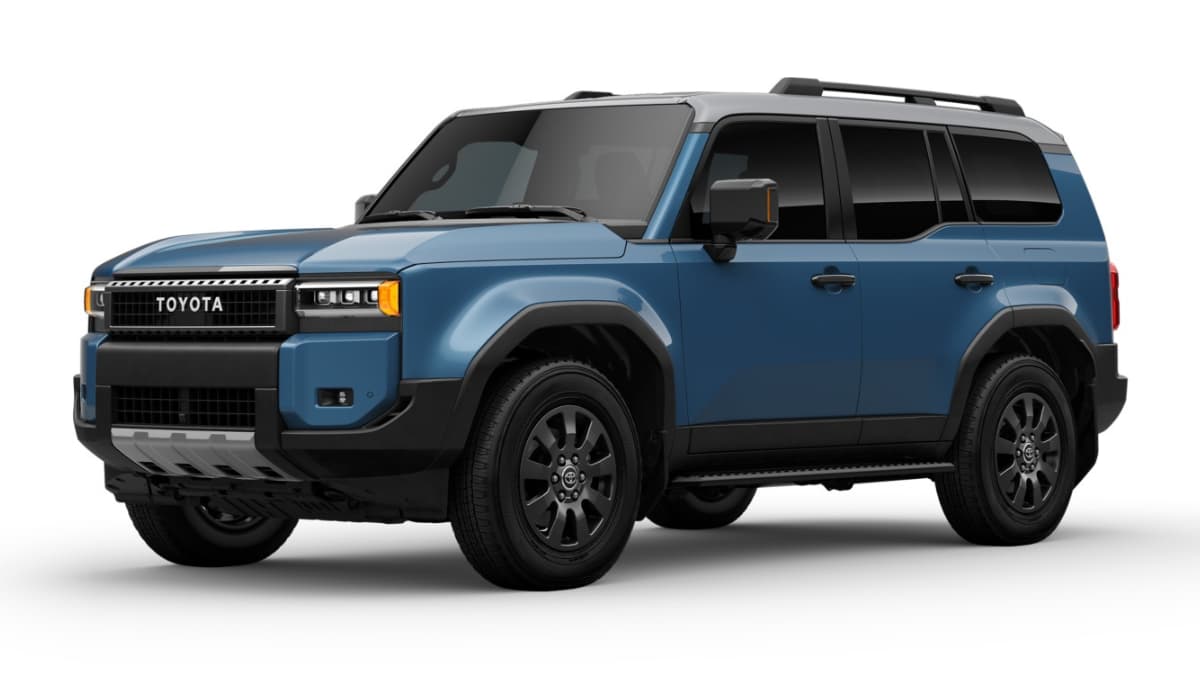
The Land Cruiser starts at $58,195, and Toyota is to be commended to making it a hybrid instead of a gas-guzzling V-8. The turbo 2.4-liter four gets two electric motors, which combine to make an impressive 326 horsepower. The setup is shared with the popular Tacoma truck. The two motors yield all-wheel drive, and the car has an eight-speed automatic.
Again, this is a hybrid that’s far from a fuel champ, making 23 mpg combined. If you like rugged 4WD vehicles then the Land Cruiser has always been a sensible choice, and it bristles with trail gear. But if you really don’t go off-road much you shuld consider something more oriented to pavement.
The Tacoma is also parent to the sixth-generation 2025 4Runner TRD Sport I tested in Wind Chill Pearl. It has a similar 2.4-liter turbo engine, but makes 278 horsepower with 317 pound-feet of torque. An eight-speed automatic is attached. With this combination, fuel economy is even worse than the Land Cruiser, at 21 mpg combined.
As tested, the 4Runner TRD Sport was $49,725 (barely up from its $49,250 MSRP). The only option was premium paint. The 4Runner has been generally reliable.
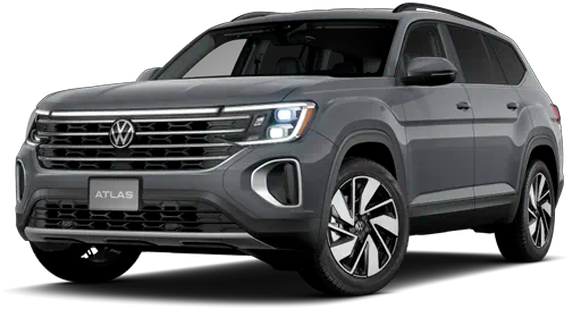
2025 Volkswagen Atlas SEL Premium R-Line. The Atlas as tested (and built in Mexico) was $55,325. This is the highest trim, and it comes with all-wheel drive. The powertrain in all versions is a 269-horsepower in-line four with an eight-speed automatic. The 7.3-second zero to 60 time is not impressive. The three-row Atlas offers very good cargo space, though, and it feels well-built. But despite the four-cylinder engine, fuel economy is nothing to write home about, coming in at 20 mpg I the city and 27 on the highway, and with the AWD that everyone seems to want it drops to 19 city and 24 highway. At this price, any number of other automakers’ models are competitive.
2025 Hyundai Tucson Limited AWD. The Tucson is Hyundai’s bestseller, and it’s offered with a 2.5-liter direct-injected four-cylinder engine with 187 horsepower and 178 pound-feet of torque, coupled to an eight-speed automatic.
Go hybrid and the 1.6-liter turbo gas engine produces 178 horsepower and 195 pound-feet, but the hybrid system takes it up to 231 total horsepower. The hybrid has a 47.7-kilowatt electric motor and a 1.49-kilowatt-hour battery, with a six-speed transmission. And then there’s a plug-in hybrid variant, with a more powerful 72-kilowatt motor, 268 horsepower and 258 pound-feet. The hybrid battery is 13.8 kilowatt-hours.
All this choice is very welcome, and it’s what smart automakers do, along with frequent upgrades. The current generation of Tucson was introduced in 2024. Prices start at $28,075.
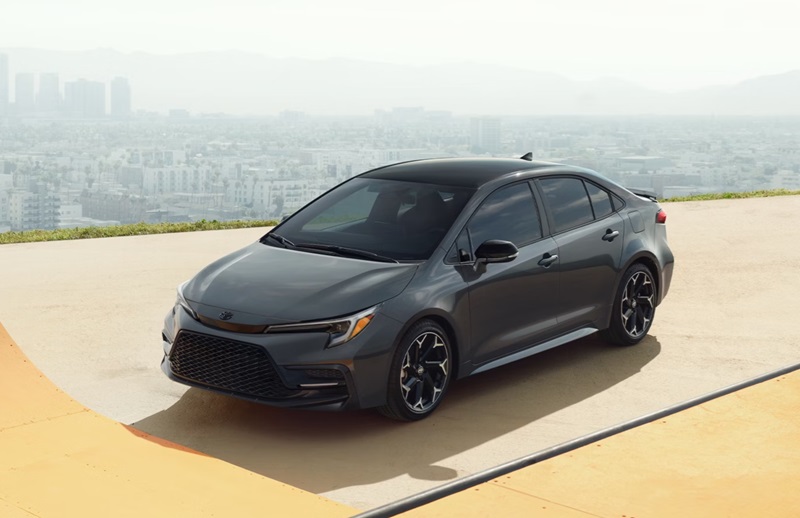
2025 Toyota Corolla FX. This is the gold standard of Toyotas for me, as my first job was preparing Corollas for sale at a Toyota dealer. The outlet’s big brand was Dodge, but today it’s an all-Toyota enterprise. That’s progress! As tested, it was $29,289, a very reasonable price for an automobile in 2025. It’s a hot hatch, with 169 horsepower and stellar 31.39 mpg fuel economy. The two-liter four offered plenty of passing power. I was actually quite taken with the latest incarnation of the Corolla, and would gladly have kept this one over in the Motavalli garage.
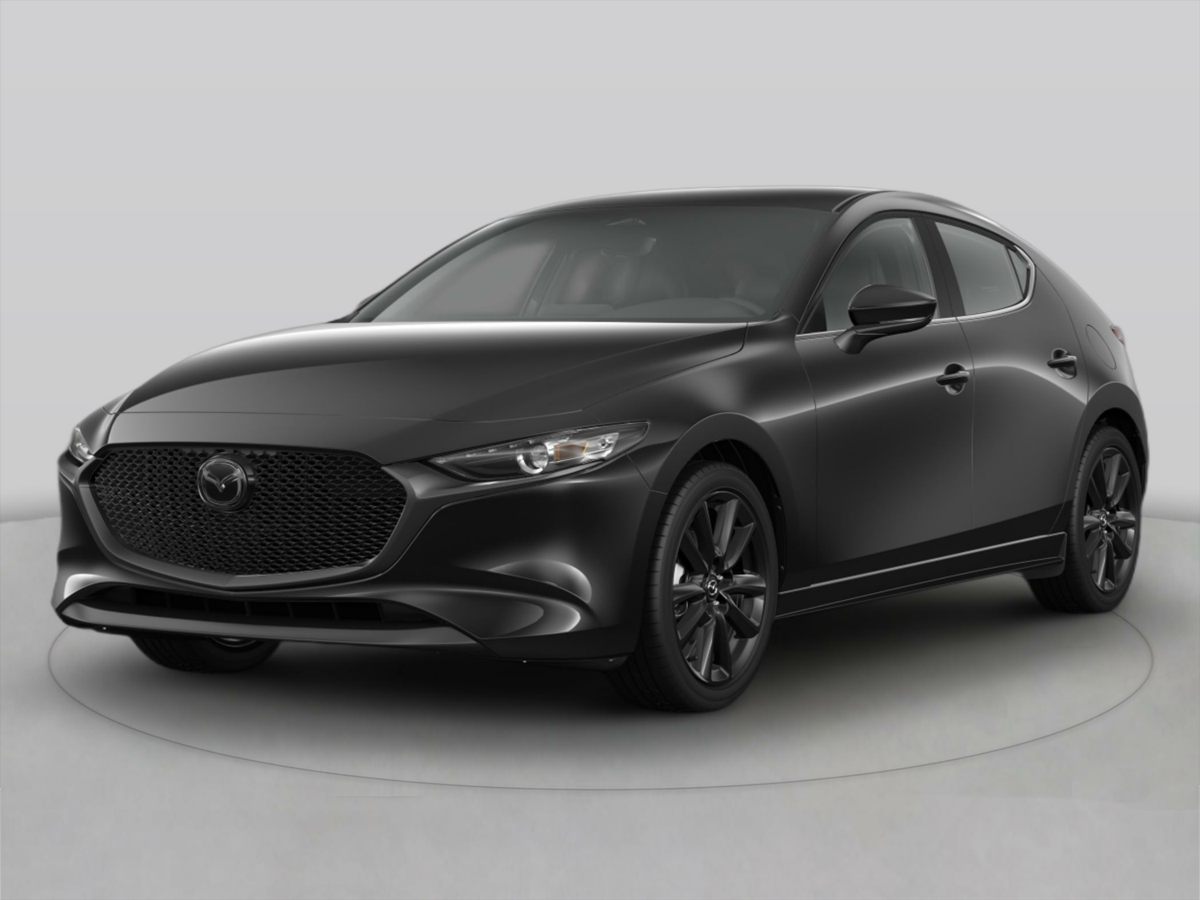
I wish there were more cars available like the simple and straightforward 2025 Mazda3 2.5S Carbon Edition AWD I tested this week. For a bottom line of $31,095 it’s possible to buy a relatively sporty all-wheel drive sedan that does just about everything you want a car to do.
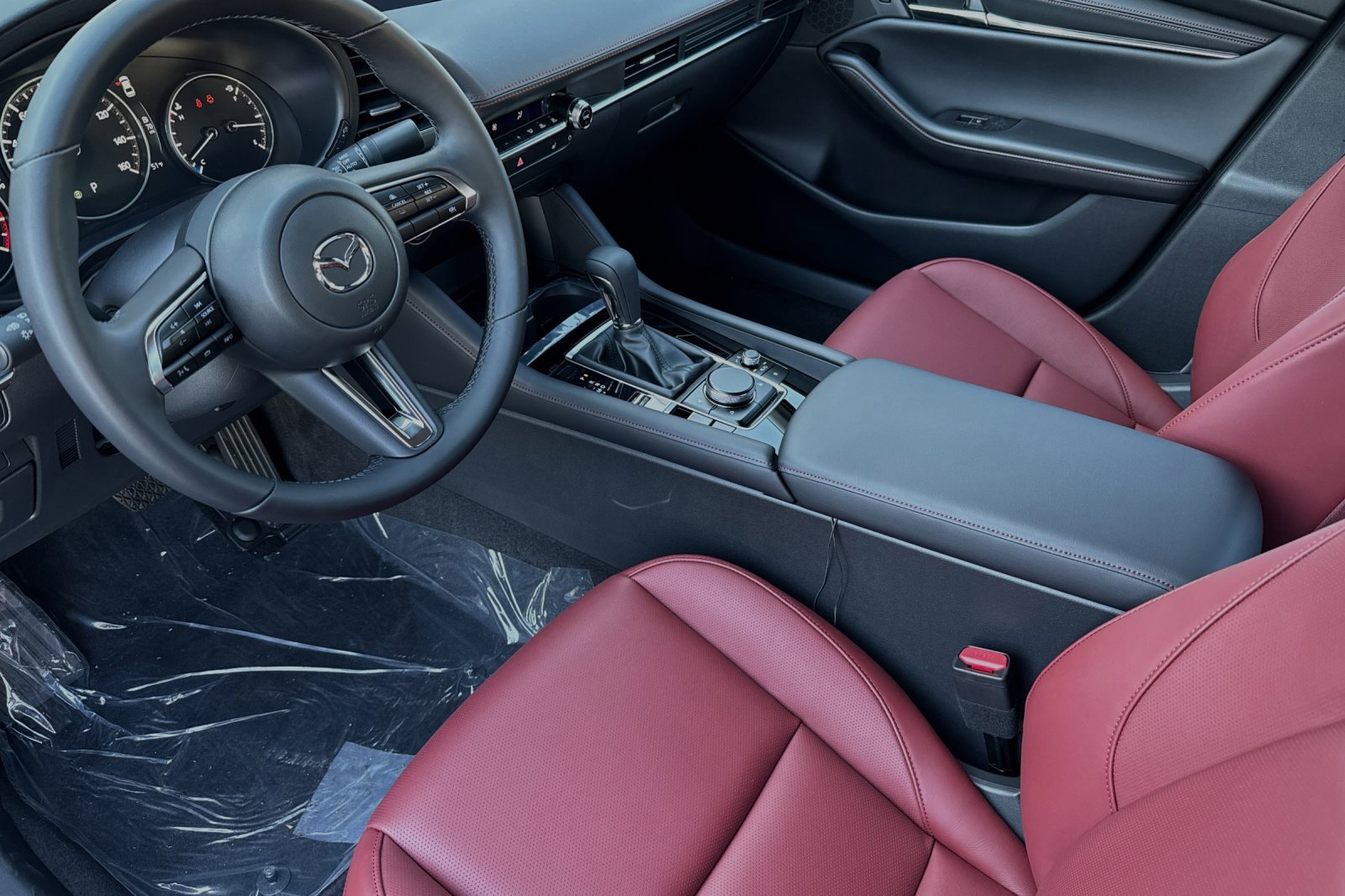
At first, I was taken aback by the Mazda having a conventional gauge set complemented by a smallish center-mounted 8.8-inch non-touchscreen display. Navigating GPS, Apple CarPlay and other functions was via a rotating dial on the console. It seemed annoying, but was actually easy to use. If you owned it, getting around would soon be second nature.
The mid-pack Carbon Edition comes with AWD and a 191-horsepower (and 186 pound-feet) Skyactiv 2.5-liter four-cylinder engine. Buyers can opt for the Carbon Turbo trim, which sells for $33,595 and ups the ante to 250 horsepower. That might be a good upgrade, because with the standard engine the car is adequate but not terribly exciting to drive. But the standard’s 30 mpg combined (35 mpg on the highway) is nice.
The interior of the Carbon featured very comfortable red leather seats (standard) and features high-quality materials, redolent of a more expensive vehicle. As Car and Driver put it, “The Mazda 3 is a mainstream compact sedan that punches above its weight. It can almost pass for a premium-class compact, as its top trim levels boast elegantly furnished interiors lined with materials that exude a sense of luxury that rivals like the Hyundai Elantra and Honda Civic just cannot equal.”
Everything about this Mazda3 was just uncomplicated and convenient. It’s actually a car I’d consider buying, and I never say that. It was easy to park, had good road manners and plenty of storage as well as legroom, looked reasonable enough, and was economical in use and likely to be reliable. There’s a hatchback available that gives it more of a crossover look, but the view to the rear isn’t great. In my opinion, the sedan is the one to have.
Please note that the Mazda3 is assembled at a plant in Salamanca, Mexico and has only 10 percent U.S. or Canadian content. Fifteen percent is via Japan. So, this lovely vehicle is a tariff target, but of course it’s complicated. The tariff would be 25 percent, but under Trump’s revised guidelines from March if the car meets specific U.S.-Mexico-Canada agreement requirements that’s likely to go down to 15 percent. Anyway, the pricing is subject to change.
The auto industry is heading through hairpin turns with no brakes, as the Trump auto tariffs seemingly change daily. We are now told that imports from England, which were in the worst possible position in terms of U.S. production, are now in the catbird seat because of a U.S.-U.K. trade deal. Now the first 100,000 imports per year (meaning, almost all of them from Great Britain) will have only a 10 percent tariff). Meanwhile, Chinese tariffs are paused for 90 days, but cars still face 25 percent duty. By the time you read this it could all be different. It makes it difficult, indeed, for automakers who just want stability. But the new cars keep coming out, and I keep reviewing them.
Lexus NX 350 F Sport AWD and Lexus UX 300h AWD. Lexus’ NX family includes two cars with gas engines, one hybrid drivetrain, and one plug-in hybrid. This relatively small crossover tested in sporty 350 F Sport guise (above) had the optional 2.4-liter turbocharged inline four-cylinder engine with 275 horsepower and 317 pound-feet of torque, connected to an eight-speed automatic. F Sport includes a more performance-oriented suspension tune, a 14-inch touchscreen and upgraded climate control, but you still have to pay extra for a big sunroof, heating in the rear seats, and the top-grade audio. The car was quite nice without an enormous wow factor, and the 28 miles per gallon on the highway was appreciated. Premium fuel is a “recommendation.”
The UX 300h AWD subcompact luxury crossover is more my speed, as it’s powered by the state-of-the-art Prius drivetrain, the Atkinson-Cycle two-liter four with two or three electric motors (the latter, as in the tester, if you want AWD). For 2025, there’s an extra 15 horsepower. With two motors expect 43 mpg combined, and with three a very minor loss at 42 mpg. Zero to 60 is less than eight seconds. The starting price: just under $40,000.
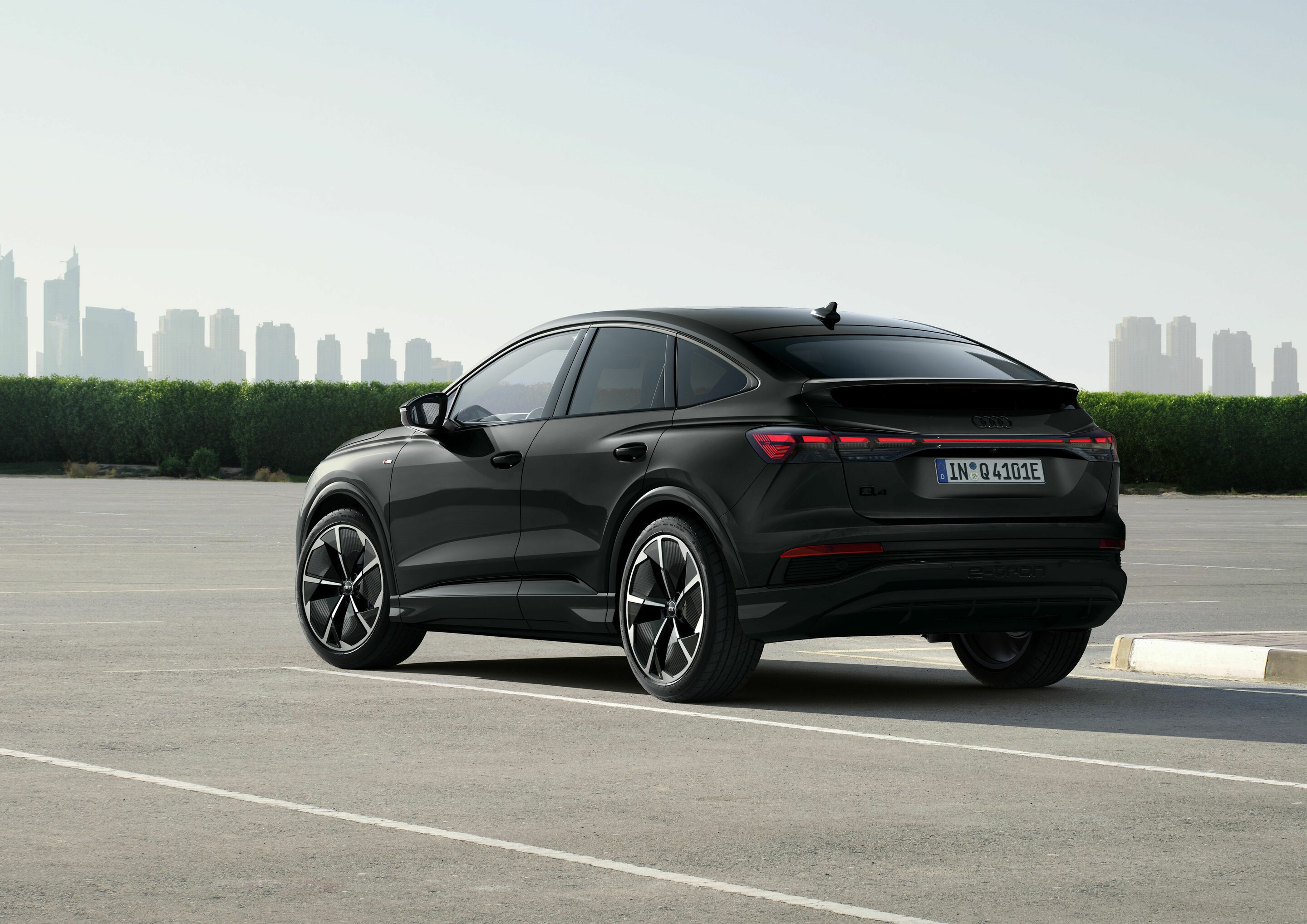
Audi Q4 e-tron Prestige. The Prestige (above) is near the top of the Q4’s model line, starting around $63,000. That buys a powerful electric crossover with 335 horsepower and a so-so range of 258 miles. These days, 300 miles is a safer number. As is often the case, this e-tron emphasizes performance over range, and it can reach 60 in five seconds. The car is quiet, and its cabin very tastefully appointed with quality materials. A more aggressively styled Sportback version is available.
Genesis GV60 Performance AWD. The trio of Hyundai, Kia and Genesis have been acing the EV market, and Genesis’ GV60 is a compelling SUV choice up against cars like the Audi Q4 above. Genesis offers the luxury approach to electric motoring, and up to 295 miles of range, as well as 483 horsepower (from Boost Mode) in this Performance trim. The cabin is utterly stylish, with twin 12-inch screens and a science fiction shifter that’s hugely cool and also very functional. But it’s a $71,000 car. Lesser trims might work just as well for your needs, though no versions are cheap—prices start at $53,800 for the Standard model (with a single motor and 225 horsepower).
Hyundai Elantra N and Santa Fe XRT 2.5T AWD. Sport sedans have been an endangered species, but they’re starting to come back. Hyundai’s Elantra N (above) has much to recommend it, including looking the business with its blackout trim, rear wing, diffuser, and contrasting color stripes. The N Line is a different car. The N is the real deal, with 286 horsepower, a stiff suspension and either a six-speed manual or an optional automatic. Other cars in this class include the Honda Civic Type R and the Toyota GR Corolla. There’s even a turbo Mazda 3 out there.
The current version of the Santa Fe is one of the most sharply styled SUVs on the market, and the performance matches the looks. You might want to investigate the hybrid version, but the tester had the2.5-liter turbo four, producing 277 horsepower and getting it to 60 mph, through an eight-speed dual-clutch transmission, in just over six seconds.
The redesign puts the Santa Fe into the third-row category, and both legroom and cargo area have grown. The interior refresh was done quite well, with a modernist designer feel. Both the second and third row fold flat. With all three rows engaged, the Santa Fe has 14.6 cubic feet of storage out back. The tested XRT AWD version isn’t the best for fuel economy—19 in the city and 26 on the highway. In just rear-wheel drive form it can get 29 on the highway. The XRT starts at $42,425, mid-pack in a lineup that starts with the SE at $35,775.
For a price in the same ballpark, you can buy the hybrid version of the Santa Fe, which uses a turbo 1.6-liter four and an e-motor to produce 232 horsepower. I’d get that one, because the fuel economy goes to 36 mpg city and 35 mpg highway without much of a performance sacrifice. The SEL version starts at $39,275.
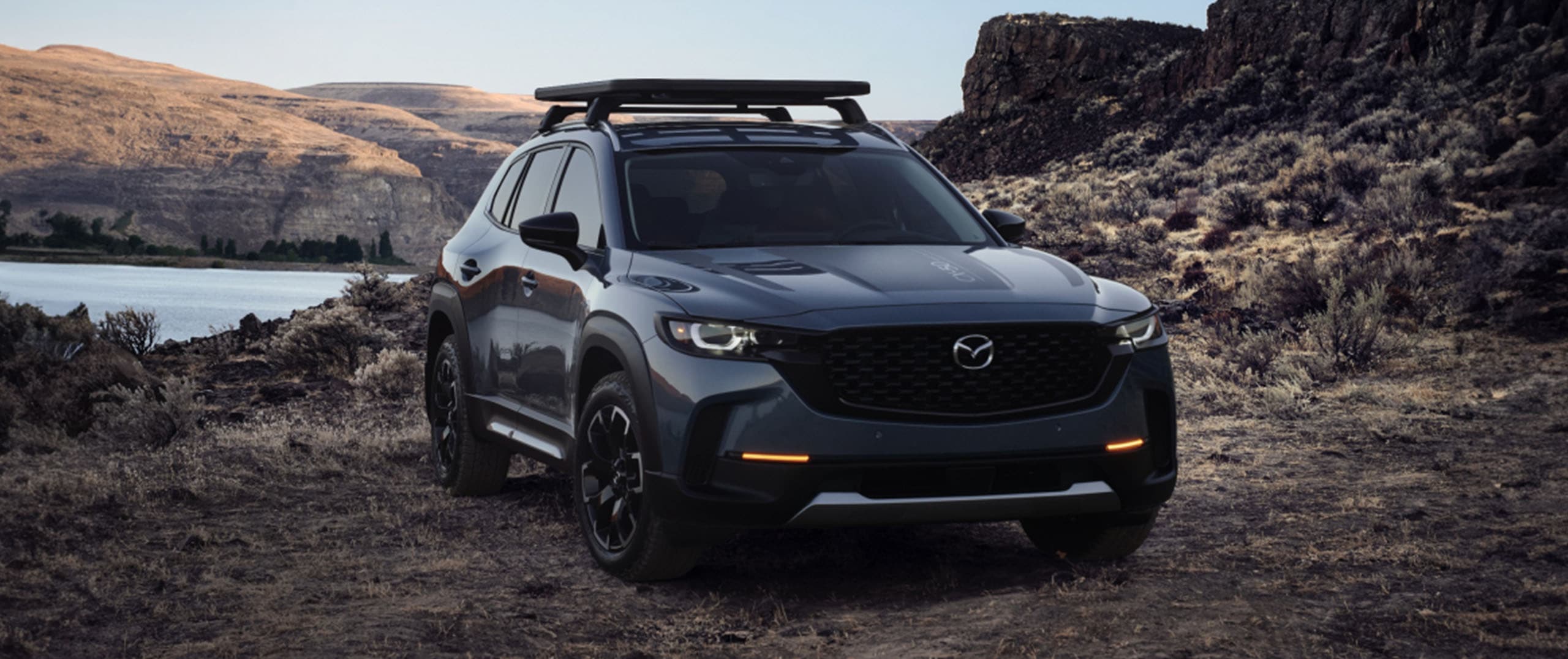
Mazda CX-50 Turbo Meridian Edition. As tested, $42,070, the CX-50 was a well-equipped and nice-handling crossover that in Meridian trim (above) comes with a sunroof and heated leather seats. All CX-50s are AWD. The base four puts out 187 horsepower, but that jumps to 256 in the turbo four that’s standard in the Meridian. This version also includes upgraded towing to 3,500 pounds. The tested car was impressively equipped for the money, and the only optional extra was $450 for gray metallic paint.
Mazda builds a hybrid version of the CX-50, using a powertrain that’s also in the Toyota RAV4. The 2.5-liter four uses three e-motors, producing a combined 219 horsepower. If you can live with 7.5 seconds to 60, it’s the better option, with 38 mpg combined and not much sacrifice in terms of drivability. Pricing starts at $35,840.
Volvo S60 Recharge eAWD Ultimate Dark and Volvo XC60 T8 AWD Polestar Engineered. The plug-in hybrid drivetrain is proving very popular with consumers—who are still cautious about going full electric. In the S60 Recharge, Volvo offers a comfortable sedan with a two-liter four-cylinder engine, an electric motor and a relatively big 18.8-kilowatt-hour battery that together generates 455 horsepower and 523 pound-feet of torque. The big battery enables 41 miles of travel on just electric power. That leads to a combined hybrid mode fuel economy of 31 mpg. And at least until Congress repeals the $7,500 federal income tax credit for EVs (which it seems intent on doing), this one is eligible.
Consumers won’t be dissatisfied with this very comfortable, safe, nicely appointed sedan, which in T8 form can reach 60 mph in an impressive 4.3 seconds. The big issue is the price, since the base Core version of the S60 Recharge is $53,295. And the T8 Ultra Black top trim is just shy of $60,000.
The XC60 T8 AWD Polestar Engineered (above) starts at a whopping $76,545. If you must have an SUV, this is a good plug-in hybrid alternative, with 35 miles of electric range. The XC60 and 90 carry a lot of safety tech and are relatively heavy cars, and this one perhaps needs its 455 horsepower to give good performance. This one won’t get the federal rebate, even if it’s available, but it could qualify for local incentives.
I had some stuff to move, and for that the 2024 Toyota Tacoma Trailhunter Double Cab came in handy. Trucks like this are proof that the Japanese can build work vehicles that give the impression they were born in Texas. I’ve never owned a truck, but I love to borrow them.
Cruising the neighborhood in the $324,000 DB12 coupe, a sinuous supercar.
By Jim Motavalli
A thick coating of helicopter seeds from a maple tree couldn’t hide the sinuous lines of the Liquid Crimson Aston Martin DB12, a successful and more aerodynamic updating of the basic Aston shape that’s been extant since the DB2 of 1950 to 1953. It modernizes the DB11 with touches of the DBS.
These cars start at $245,000, but the tester’s options bumped it to $324,700. The DB12 grand tourer debuted in May of 2023, and compared to the DB11 it has bigger grille in the distinctive Aston shape, LED headlights and wider track width. The redesigned interior sports Aston’s ownb infotainment system, which supports wireless Android Auto and Apple CarPlay.
The DB12’s four-liter twin-turbo V-8 engine produces a massive 671 horsepower with 590 pound-feet of torque and makes outrageous go-fast noise. The DB11 offered a mere 528 horsepower and 513 pound-feet from the same basic powerplant, with the increase attributable to modifying the camshaft profile, optimizing the compression ratio and deploying bigger turbochargers.
AM discontinued the 5.2-liter V-12 that was available on the DB11. There’s also a DB12 convertible called the Volante, released just after the coupe, and it can raise or lower its top in 16 seconds or less at speeds up to 31 mph. The DB12 reaches 60 miles per hour in 3.6 seconds, and the Volante in 3.7.
On the road, these figures will not be doubted. The DB12’s acceleration is fearsome and relentless. But driving the car in suburbia can be an exercise in frustration, since there are so few opportunities to really get it excited. Even on the highway the rest of the traffic isn’t moving fast enough. The 12 feels like a caged lion in school zones, and the ride—meant for flat-out cornering—is quite stiff in some modes.
The 12’s chassis is seven percent stiffer, the anti-roll bars have been hardened, and the shocks upgraded. But the driver can choose between GT, Sport, Sport+, Wet and Individual. The first one is the default and the most comfortable in everyday driving. Sport+, that’s for the track.
Boarding the DB12 requires dropping into it, dictated by the low stance. The driver and passenger sit cozily on hand-stitched quilted red leather (via a $15,200 option), with the bolstering needed to stay in place. There’s a back seat (the car is a “2+2”) but it’s for small kids and parcels.
The initial driving position was low, too, but corrected by raising the seat height. The driver looks at a clear digital dash display, which is complemented by a 10.3-inch center screen. The system worked well until it didn’t—the screen froze temporarily. But the $10,000 15-speaker Bowers & Wilkins audio sounded excellent, and AM is to be congratulated for providing physical controls (via knurled rollers).
The driver can let the eight-speed automatic transmission do the work, but AM provides a really good paddle-shifting system with near-instantaneous responses. The paddles turn with the wheel, which makes using them a bit awkward during cornering. The $14,400 carbon ceramic brakes, which shed 60 pounds over the standard issue, were massively reassuring.
Supercar fuel economy is usually worse—the DB12 gets 22 mpg on the highway, and 15 in town. But that doesn’t stop these cars from being driven. On a recent trip to Miami, I saw a group of British-registered Aston Martins going all the way back to the DB6 that were on the Mayfair to Miami trip, (see below) arriving at the latter in time for the recent F1 race.
This isn’t likely to be its owners’ only car, and some kind of big SUV will do the family’s heavy lifting. But despite its intent as an international grand tourer, the DB12 is fairly docile for a supercar and reacts predictably. It doesn’t require a driving school degree for a trip to the mall. It attracts attention like nobody’s business, though, so be careful of drivers not concentrating on the road.
Cars imported from Britain were subject to President Trump’s 25 percent import tariffs, but the just-concluded U.S.-U.K. trade deal offers some relief for luxury carmakers such as Jaguar Land Rover, Rolls-Royce and Aston Martin that don’t have U.S. production. According to the White House, under the new rules, the first 100,000 British vehicles into the U.S. in any year will pay 10 percent, and any after that are subject to 25 percent rates. The latter figure won’t be reached too often—in 2024, U.K. manufacturers sent 102,000 vehicles to America. The big numbers are in cars from Japan, Korea and Europe.
Electrification is still moving full speed ahead—in the truck sector. The pace of plugging in cars has slowed, but manufacturers are still seeing opportunity in offering new battery and fuel-cell trucks, and that’s what ACT Expo (held in Anaheim, California March April 28 to May 1) is all about.
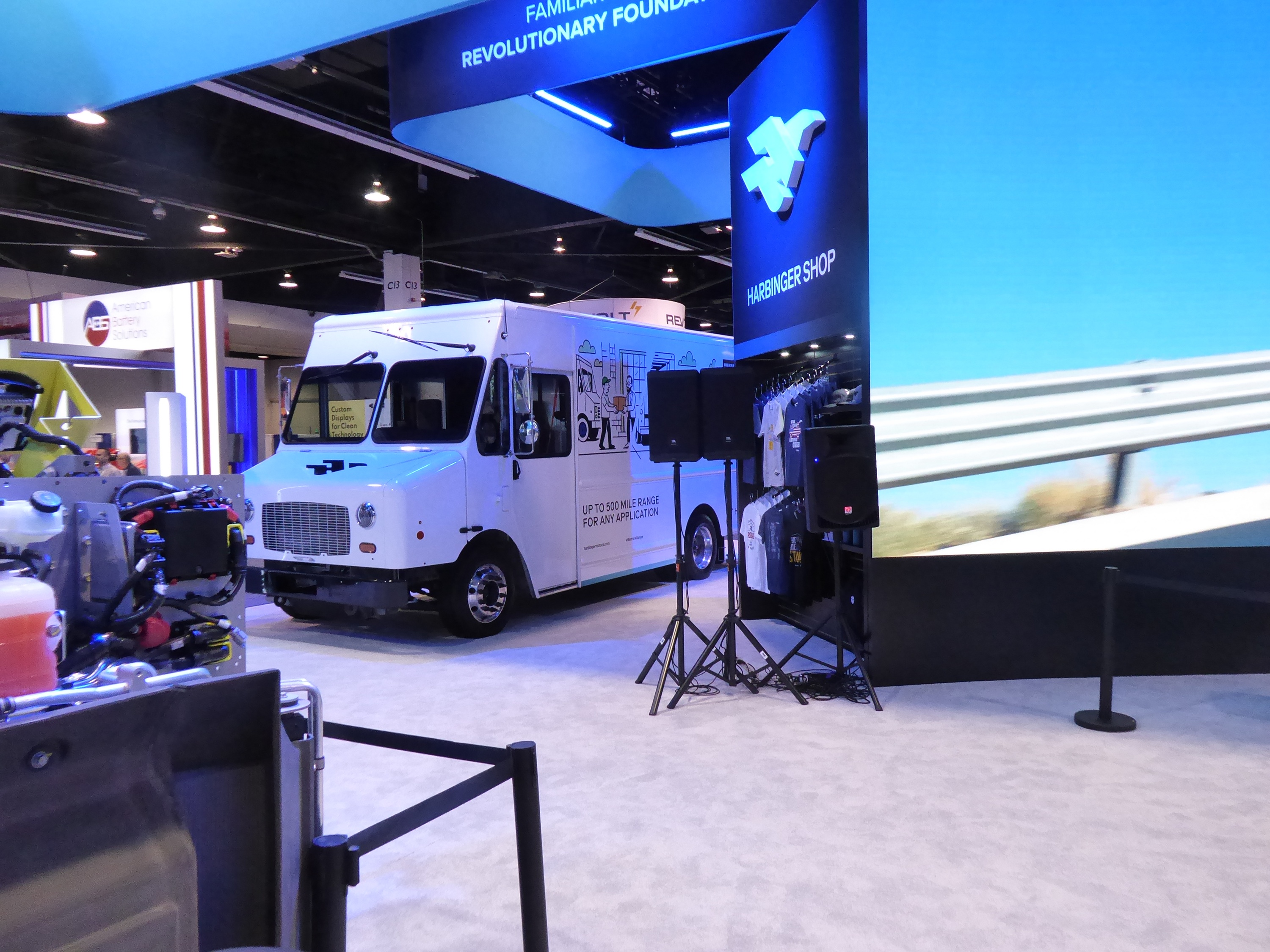
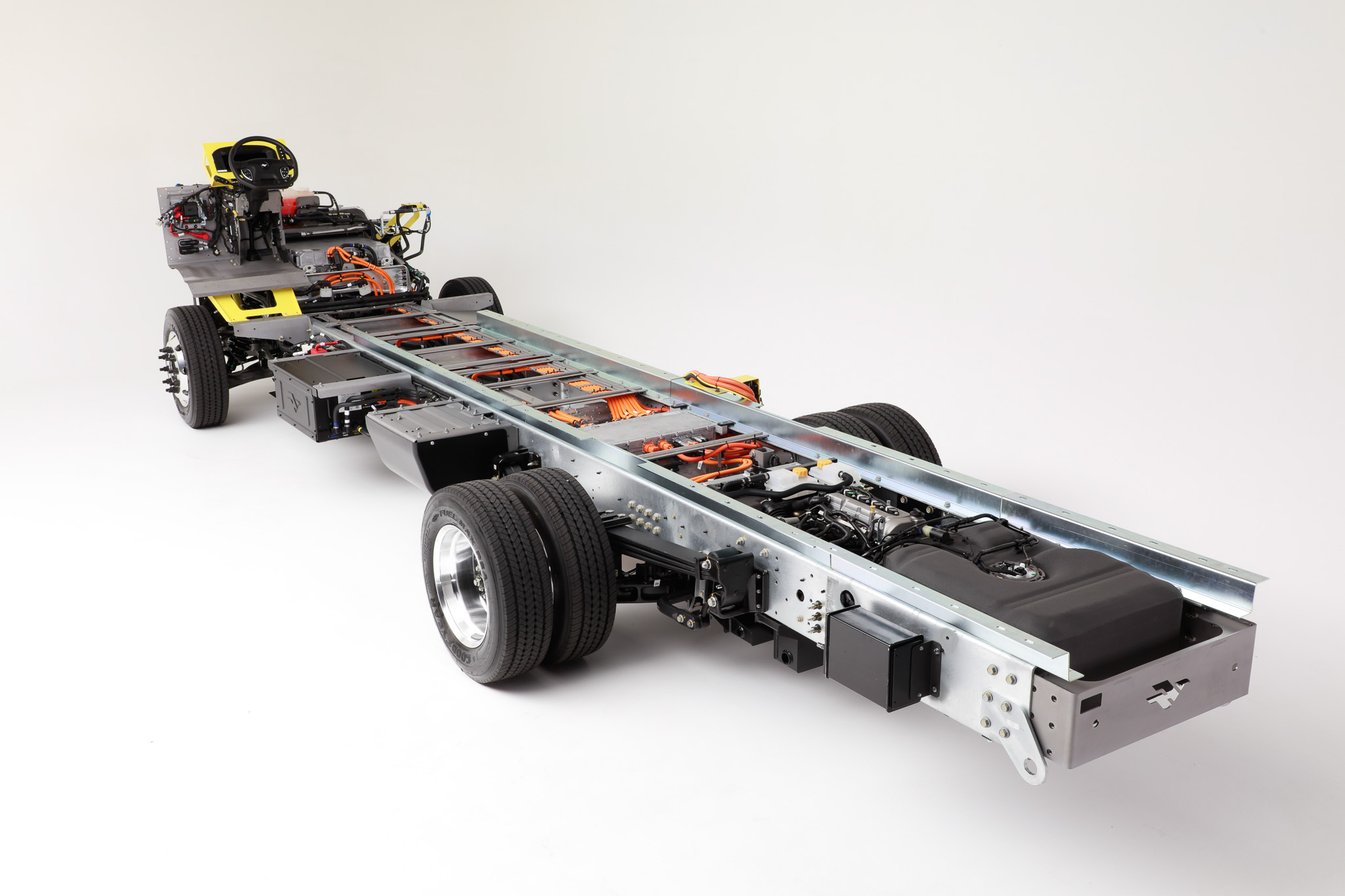
The Harbinger stand, with a delivery truck on its new $100,000 made-in-USA chassis. (Jim Motavalli photo)
The case is strongest in the smaller trucks that work locally and handle the “last mile,” but ACT also included some new tractors to pull the big trailers. Range is limited, though, and electric power is challenging in any kind of long-haul situation. That’s why the trucks are often put into service at ports moving cargo relatively short distances.
Joe Adams, chief engineer at Kenworth, showed the T680E and T880E cabs. “You’re looking at five years of development and 325,000 test miles with 46 units in Europe and North America,” he said.
Kenworth has been operating zero-emission Class 8 trucks at the Port of Los Angeles since 2021, but those have hydrogen power developed in conjunction with Toyota North America. Shell provided the fueling stations.
The T680E delivers 375 to 470 horsepower continuous and up to 605 horsepower peak, with 1,850 pound-feet of torque. The LFP battery packs are variable with the largest a 500-kilowatt-hour (kWh) pack offering 200-plus miles on a charge and up to 82,000 pounds of payload. It can charge to 90 percent in two hours, using a 350-kilowatt charger. It’s now available for orders in North America, with delivers to begin later this year.
The T880E, a Class 8 cab, can carry up to 675 kWh of batteries and travel up to 250 miles on a charge. It also has 350-kilowatt charging, and both trucks offer regenerative braking, a new EV-friendly 15-inch digital dash configuration, and LED lighting. Adams described a 168 percent fuel-economy improvement over diesel, but it’s a bit apples and oranges.
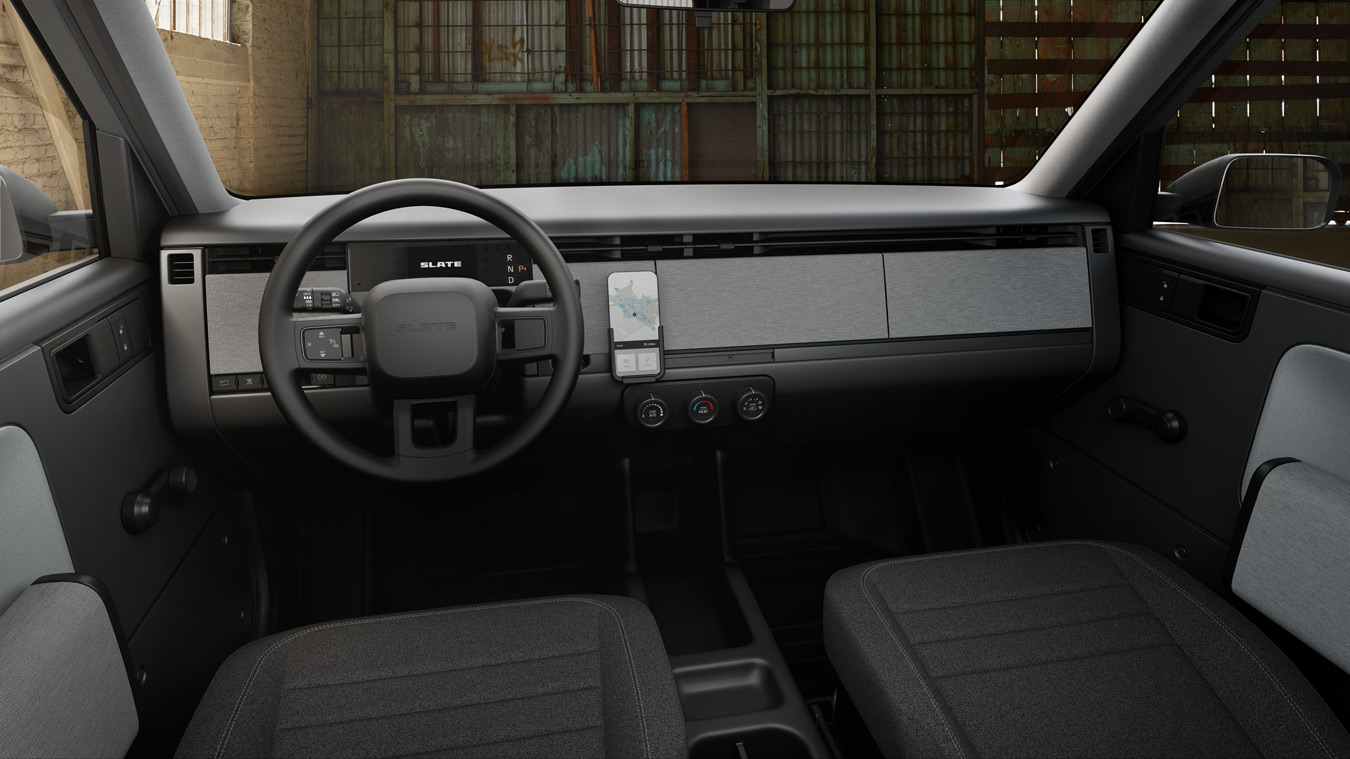
The Slate truck puts efficiency at the forefront. (Slate Auto photo)
There were a couple of important start-ups at ACT Expo. Slate Auto showed its bare-bones $25,000 electric pickup, with 150-mile range from the basic battery and no frills—roll-up windows, no radio (use your phone for music via USB). Jeff Bezos of Amazon is a backer. The truck is no looker, but its low cost and readily apparent utility (carrying capacity is 1,400 pounds) will give it charm.
The Slate truck converts to an SUV. (Slate photo)
Costs were kept down by using basic parts (like taillight lenses and door handles the same right and left); combining the motor, inverter and reduction gearbox into one assembly); and avoiding the paint booth. The polypropylene composite panels are all a uniform gray. This is the way Henry Ford made Model Ts—which got progressively cheaper, not more expensive.
The Slate truck is a two-seat electric pickup, but a kit is available that turns it into a five-seat SUV. It can become a cargo van, too. The basic battery pack is 52.7 kWh but the optional 84.3-kWh pack takes the range to 250 miles. At Level 2, the Slate charges to 100 percent in under five hours; at Level 3 DC fast charging 20 to 80 percent is achieved in under 30 minutes.
The Slate is just what the market needs, but there was another affordable solution there from Harbinger, a fast-moving medium-duty electric chassis provider whose home base was 20 minutes from the Anaheim Convention Center.
CEO John Harris said his company is vertically integrated and produces most of the truck’s components in-house. That means it barely registers on the tariff scale. The chassis costs approximately $100,000, and Harris claims to have 5,000 orders for it—worth an estimated $500 million. “We started fresh and designed something altogether new and made in the U.S.,” Harris said.
Harbinger’s EV chassis for medium-duty trucks uses batteries in modules that add 40 miles of range each. (Harbinger photo)
Panasonic Energy is the cell provider, supplying from a plant in Kansas. Before that plant opens, however, the batteries will be shipped from Japan. They’ll be mounted using a modular design in 35-kWh packs, with each one the customer orders adding 40 miles of range.
The company is agnostic as to who builds the bodies, but think simple panel vans and box trucks for last-mile deliver. Some 100 have been built so far. Harbinger’s plant can build 2,000 truck chassis annually. “We will build capacity as we need it,” Harbinger said.
Harbinger has an advantage in the marketplace—as long as the tariffs from the mercurial Mr. Trump stay in place. Customers are Bimbo Bakeries, THOR Industries (an RV maker), ETHERO Truck + Energy, and Bruckner’s Truck.
Canada-based Cellcentric is working with Volvo and Daimler Truck on fuel-cell trucks in a 50-50 joint venture. According to Nicholas Loughlan, the chief technical officer, the company can produce trucks with 650-mile range that can compete with 13-liter diesels on a total cost of ownership basis.
The Cellcentric NextGen system produces 350 kilowatts and more than 500 horsepower while weighing around 1,100 pounds.
“If we want to decarbonize, we need to get bigger,” Loughlan said. “The current green electric industry won’t cut it. We need hydrogen.” He showed diagrams of truck stop parking lots, and opined that if they were all using battery power the power draw would be “equivalent to half of Disneyland” [just down the road from the convention center].
Cellcentric builds fuel cells in a joint operation with Daimler Truck and Volvo. (Cellcentric photo)
Hydrogen power hasn’t worked out well for passenger cars, largely because there’s little fueling available outside California. But as a replacement to diesel trucks it can work with a network of refueling along major highways/truck routes. Loughlan noted that commercial trucking “is very diverse, and there are many applications where fuel cells work. There’s no payload issues, and we offer torque until you die.”
The big priority, Loughlan said, is to reduce the cost of hydrogen produced in the U.S. He noted the potential for making renewable hydrogen from abundant solar resources. Cellcentric says its system will work and achieve the stated range with both liquid and gaseous hydrogen, though the latter will have a more elaborate storage system. The issue with liquid is keeping it cold enough—hydrogen liquefies at -423 Fahrenheit.
There are big hurdles to be sure, but battery and fuel-cell trucks are moving much closer to cost parity with diesel than they ever have been before.
The first New York Auto Show in 1900 drew 160 cars from 69 countries, and—just like today—electric cars were featured. Of course, they were also touting steam back then, and it was unclear which technology would win out. The Trump administration seems determined to turn the clock back to when internal-combustion was king, but an emerging consensus at the 2025 edition of the show (now with International in the title) was that electrification will still win out, albeit on a somewhat longer timeline.
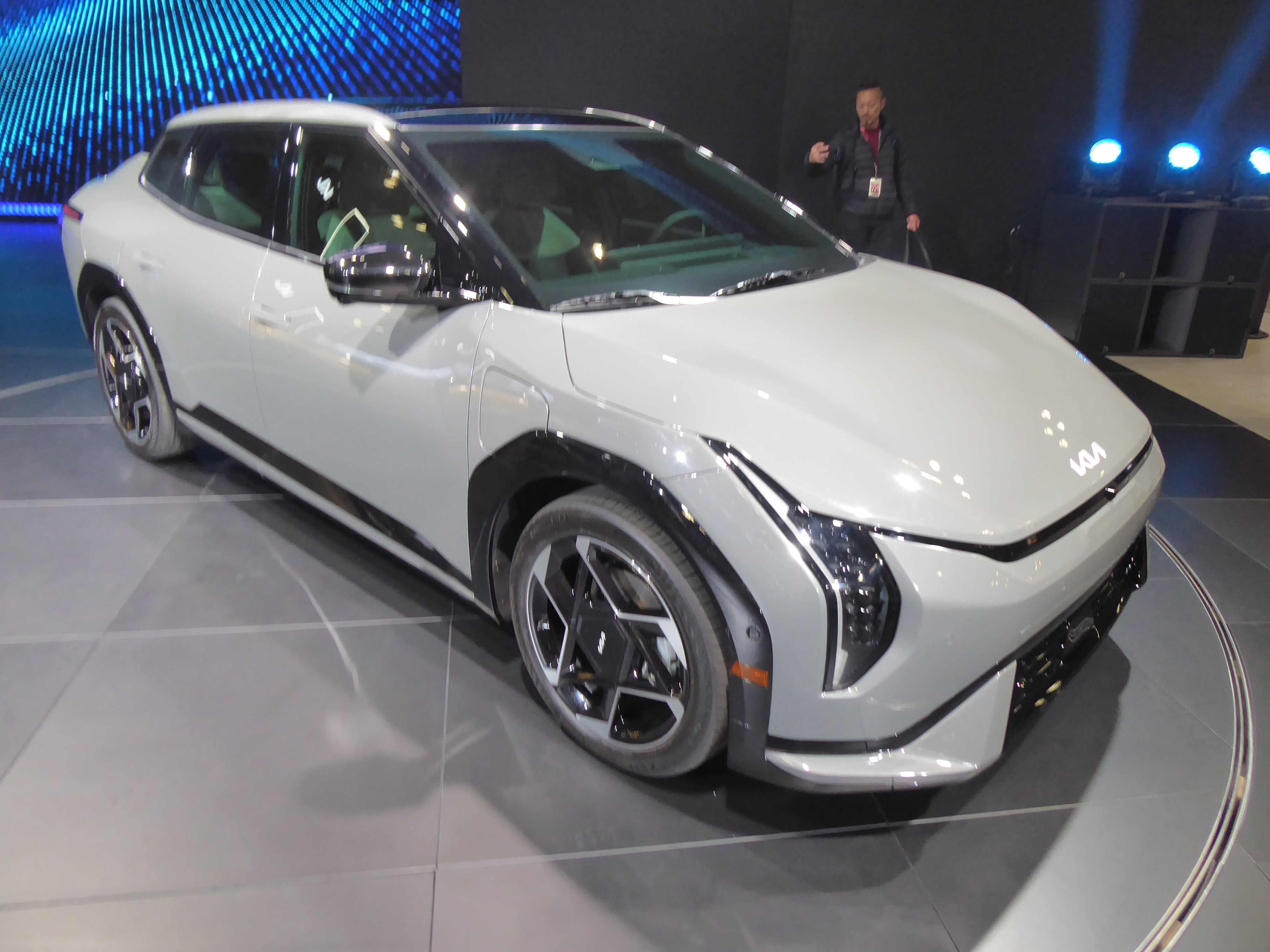
The unusual design of the Kia EV4 somehow works.
The most exciting new car in a severely limited round of press conferences (barely half a day for the important ones) was the Kia EV4. The Korean automaker is having a banner year, with what Eric Watson, a vice president for customer relations, said was the company’s best-ever quarter. Sales of EVs were up 22 percent. Part of the surge can be attributed to consumers buying cars before the tariffs kick in.
The EV4 will be built in South Korea.
According to Mike Stanton, president of the National Automobile Dealers Association (NADA) at the “Evaluating the Shifting EV Landscape” forum, “We have three million vehicles sitting on dealers’ lots that are tariff-free. Now is the time to buy,” he said, adding that it’s a particularly good time to buy an EV. Why? Because the federal $7,500 income tax credit may go away if Trump gets his way.
The Kia EV4 will be built at the Autoland Gwangmyeong EVO Plant in South Korea. Uh-oh, 25 percent tariffs. But the company is definitely looking into building it in the U.S. The Kia plant in West Point, Georgia already builds EVs—the EV6 and 9. No price was announced in New York, though the company repeatedly called it “affordable.” The current ballpark figure is a starting MSRP of $35,000 to $40,000 for the cheaper Light model. With the tax credit, could you snare one of these for $27,500? Don’t count on it.
NADA’s Mike Stanton says, “Buy now!”
The EV4 styling was interesting and distinctive, a sedan with a few SUV cues, a low nose and a tall tail. It didn’t look particularly aerodynamic, but (thanks in part to full underbody covers) it is—with a drag coefficient of 0.23. There will be two battery sizes, 58.3 and 81.4 kilowatt-hours (standard in the Wind and GT-Line versions), with the latter providing up to 330 miles of range. With the smaller battery in the Light car, expect 235 miles.
Other features include standard 17-inch wheels (19-inchers are available), a 30-inch combined display, heated seats and wheel and 64-color ambient cabin lighting. The iPedal 3.0 regenerative braking now works in reverse. The EV4 can go from a 10 to 80 percent charge in 29 minutes, and includes a Tesla-type NACS charger. It should be in showrooms early next year, but the price point will depend on what happens with the auto tariffs.
Kia’s EV3 won World Car of the Year at the show, so the company is flying high with a pretty comprehensive EV lineup. It’s big-gun EV9 will now be available in a Nightfall Edition that mostly adds blackout trim. The little K4 (starting at $21,990) is now available in a hatchback version with 22 cubic feet of rear storage (or 59.3 with the back seats down) that’s 11 inches shorter than the sedan. Americans have hated the useful hatch format for some reason, but is it coming back? The K4 is built at the company’s Pesquería plant in Nuevo León, Mexico.
Across the hall, Hyundai Motor President and CEO José Muñoz (in office 100 days) noted that his Inster also was an award winner earlier—World Electric Car of the Year. Range is up to 229 miles, but we can’t ink a contract on an Inster because it’s sold only in Korea, Japan and Europe. Hyundai’s group is number two in EV sales in the U.S., and the company has invested $12.6 billion in a Georgia auto plant. Muñoz promised 100,000 U.S. jobs by 2028 and 21 new EVs globally by 2030.
The Hyundai Palisade is bigger and snazzier.
The three-row Hyundai Palisade moved 110,000 units last year, and the new one unveiled in New York is bigger and somewhat flashier, with a longer wheelbase and distinctive stacked light bars (topped by the head- and taillights) front and rear. A neat design touch, as pointed out by design chief SangYup Lee, is the brushed-aluminum D-pillar extending into the luggage rack.
A neat feature is a built-in dashcam recorder so you can show the post-accident tape to your insurance adjustor.
A hybrid Palisade version delivering up to 34 mpg is welcome. It uses a 2.5-liter turbo with two electric motors to deliver 329 horsepower and 330 pound-feet of torque. Making its world premiere was an XRT PRO version of the Palisade with an inch of extra ground clearance and off-road cues.
Genesis’ concept anticipates cars unashamed to eschew grilles.
Genesis didn’t do a press conference, but the night before it had shown its new and pretty big X Gran Equator Concept. Not exactly lovely, the squared-off concept showed what might happen when automakers give up on trying to give EVs grilles. (I know, the Tesla Model 3 took that step, but that nose has never worked for me either). The interior showed more innovative design than the exterior.
Subaru, which was late to EVs, had so much to say it actually had two press conferences. At the first one, it showed a new version of Solterra, its first-ever EV. The 2026 model will have 285-mile range (up 25 percent) thanks to a 74.7-kilowatt-hour battery pack. With a NACS port, it can visit 15,000 Tesla Supercharger sites.
Thumbs up at Subaru over the new Solterra.
In AWD form the new Solterra puts out 338 horsepower, up from 215. It can reach 60 mph in less than five seconds. The styling is somewhat anonymous, but OK, and the on-board tech has been beefed up. There is 8.3 inches of ground clearance. Pricing might be affected by the inconvenient truth that the new Solterra is built at the same Japanese plant that produces the similar Toyota BZ4X EV.
The new 2026 Trailseeker, again with some similarities to the Toyota, has a high greenhouse and an orientation to going off the road. It’s also made in Japan, but this time at a Subaru factory. Range is more than 260 miles. I found it amusing when Subaru said from the stage that the Trailseeker’s cladding “sets it apart from everything else on the road.” Actually, it makes it resemble everything else on the road.
With the larger pack (74.7 kWh), the Trailseeker is good for 260 miles, 25 more than the Solterra. The XRT version has a larger 84 kWh battery and thus more range. There’s plenty of power in the Trailseeker with 375 horsepower, and zero to 60 takes only 4.3 seconds. The NACS port can charge at 150 kilowatts, and there’s towing of up to 3,500 pounds—though it will cut into range.
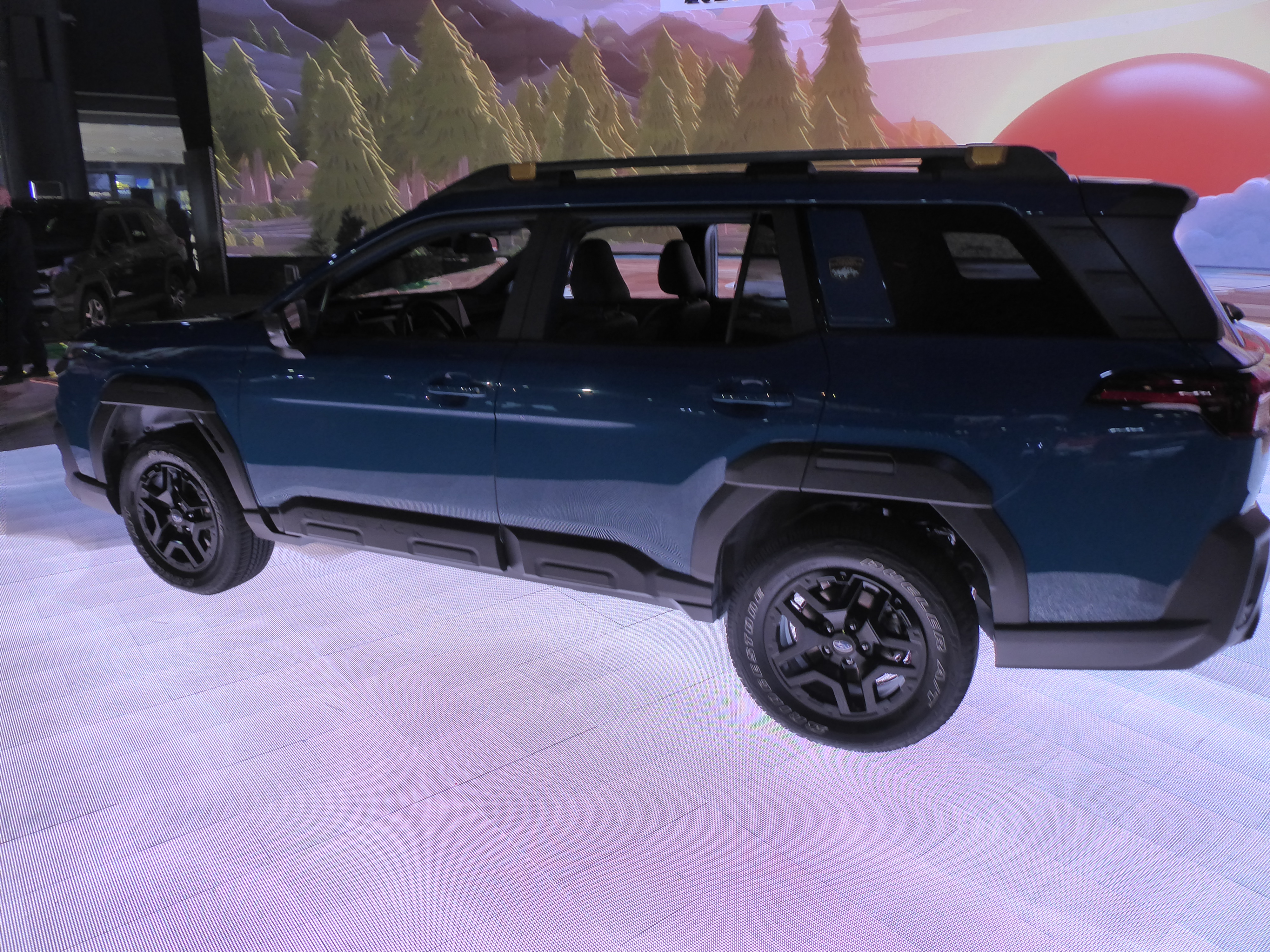
A surreal shot of the new Outback.
Later on, Subaru unveiled the new 2026 Outback, which has abandoned all reference to the Legacy station wagon that birthed it 30 years ago, and is now cladding-happy and boxy. It’s also two inches taller and one inch wider.
An incredible three million Outbacks have been sold in the U.S., more than any other of the company’s models. And 96 percent of the Outbacks sold here in the last 10 years are still on the road. That pattern should continue. Interior and cargo space are up in the new Outback, as is ground clearance (8.7 inches in the standard model, 9.5 in the more outdoor-friendly Wilderness version).
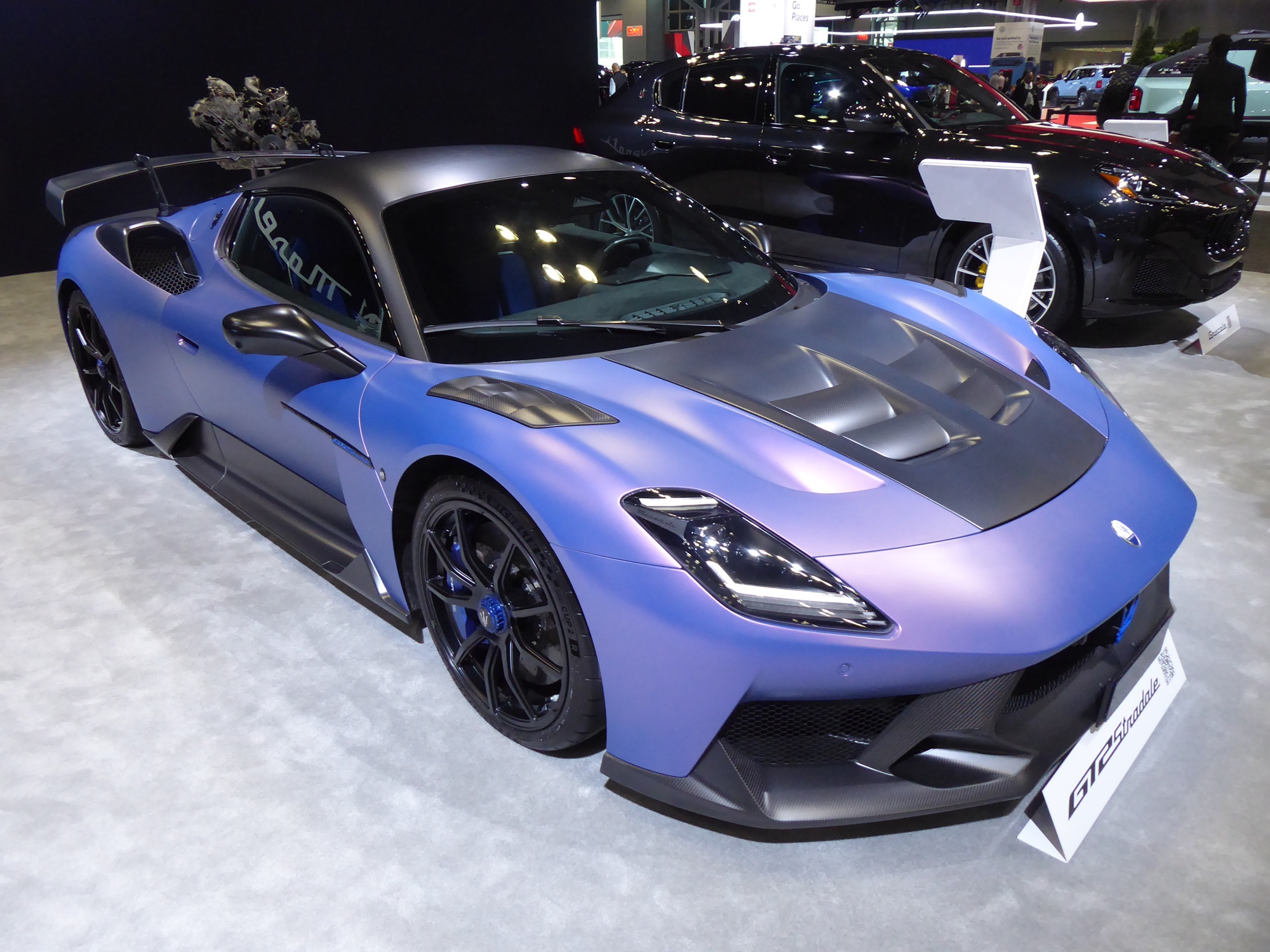
Maserati introduced the GT2 Stradale, a “barely legal” version of the MC20 with track aspirations.
Maserati was in New York with the limited-edition GT2 Stradale, a track-and-road-ready iteration of the MC20 that offers a 10-horsepower boost for its V-6 Nettuno power plant. So that equates to 631 horsepower, 201 mph and zero to 60 in 2.8 seconds. The car on display looked the business in matte blue.
Andrew Evans, the product specialist, called the new performance edition “barely legal,” meaning it’s only just registerable as a slightly civilized version of Maserati’s GT2 race cars that compete in European series. They’re built on the same assembly line. Only 914 of the GT2 Stradales will be built. The number is a homage to 1914, the year Maserati launched. But then why not make 1,914 of them? That may be more than the market can bear. The order book is open.
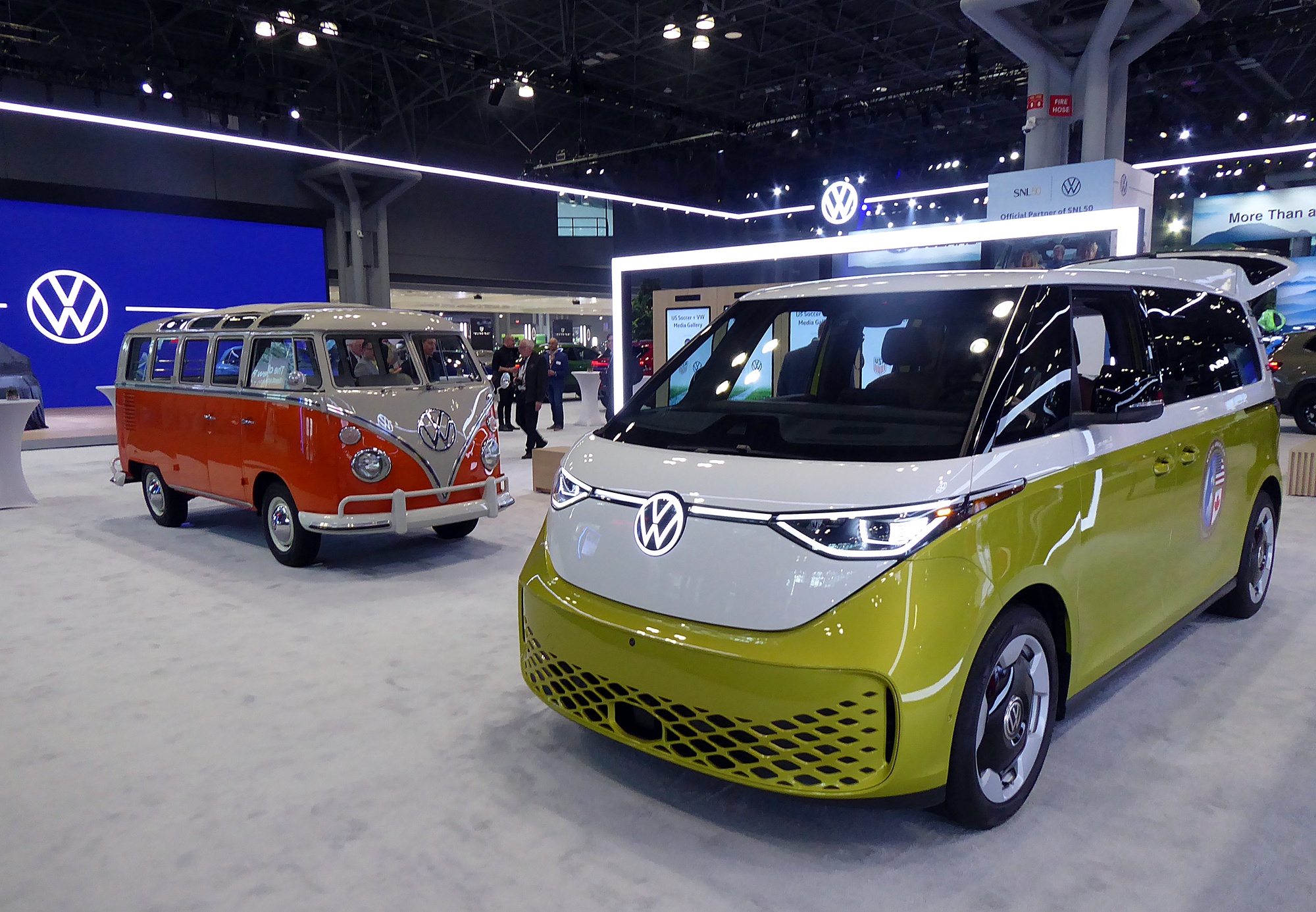
The Volkswagen ID.Buzz won World Design of the Year. The company’s press event at NYIAS revealed the 2026 Volkswagen Tiguan SEL R-Line Turbo.
The VW ID.Buzz, with its Microbus ancestor behind, was an award winner at World Car.
Although it wasn’t debuting there, Lucid seemed to be doing land-office business introducing consumers to its new Gravity SUV—an enhanced Air in every way.
Look at all that chrome on the 1958 Buick Limited, with 1955 Packard Caribbean (one of 276 convertibles) behind.
Out in the Crystal Palace, NYIAS paid homage to its history with a display of cars from each decade of its existence since 1900. I liked the earliest, a 1909 Cadillac 30, and the latest, a 2022 Porsche 911 GT3 RS. In between there were milestones such as a 1963 “split-window” Corvette and a 1956 Mercedes-Benz 300SL Gullwing. Collector Bob Kerekes brought a trio of top-end 1950s American convertibles—1958 Buick Limited, 1957 Cadillac Eldorado Biarritz and 1955 Packard Caribbean (one of 276).



























 Territorial Imperatives