
“We’re proud to be part of a global organization, but our mission is to develop products that are appropriate for our region,” said Paul Thomas, president of Bosch in North America. The world’s largest auto supplier, based in Germany, has indeed developed tech tailored for U.S. car buyers, and displayed it at the Bosch Mobility Experience at the company’s proving grounds in Flat Rock outside Detroit. September 10. It was a behind-the-wheel demonstration, with much visceral impact.

The driver can place the trailer precisely on the screen, then the tech takes over steering. (Bosch photo)
Perhaps most relevant to American buyers—who do like to tow—was the Anywhere parking trailer, which enables pinpoint location. On the HMI display, the driver moves a shaded box to the exact location desired (also setting the vehicle’s orientation), then pushes a button and the car takes over steering functions (though the driver still uses the accelerator). The tech can also be used to precisely align a truck with a trailer hitch, without using another person as a guide. This might frustrate dedicated haulers who’ve perfected their technique over decades of trial and error, but it’s a godsend to occasional towers. Anywhere is not on cars and trucks yet, but it’s coming soon.
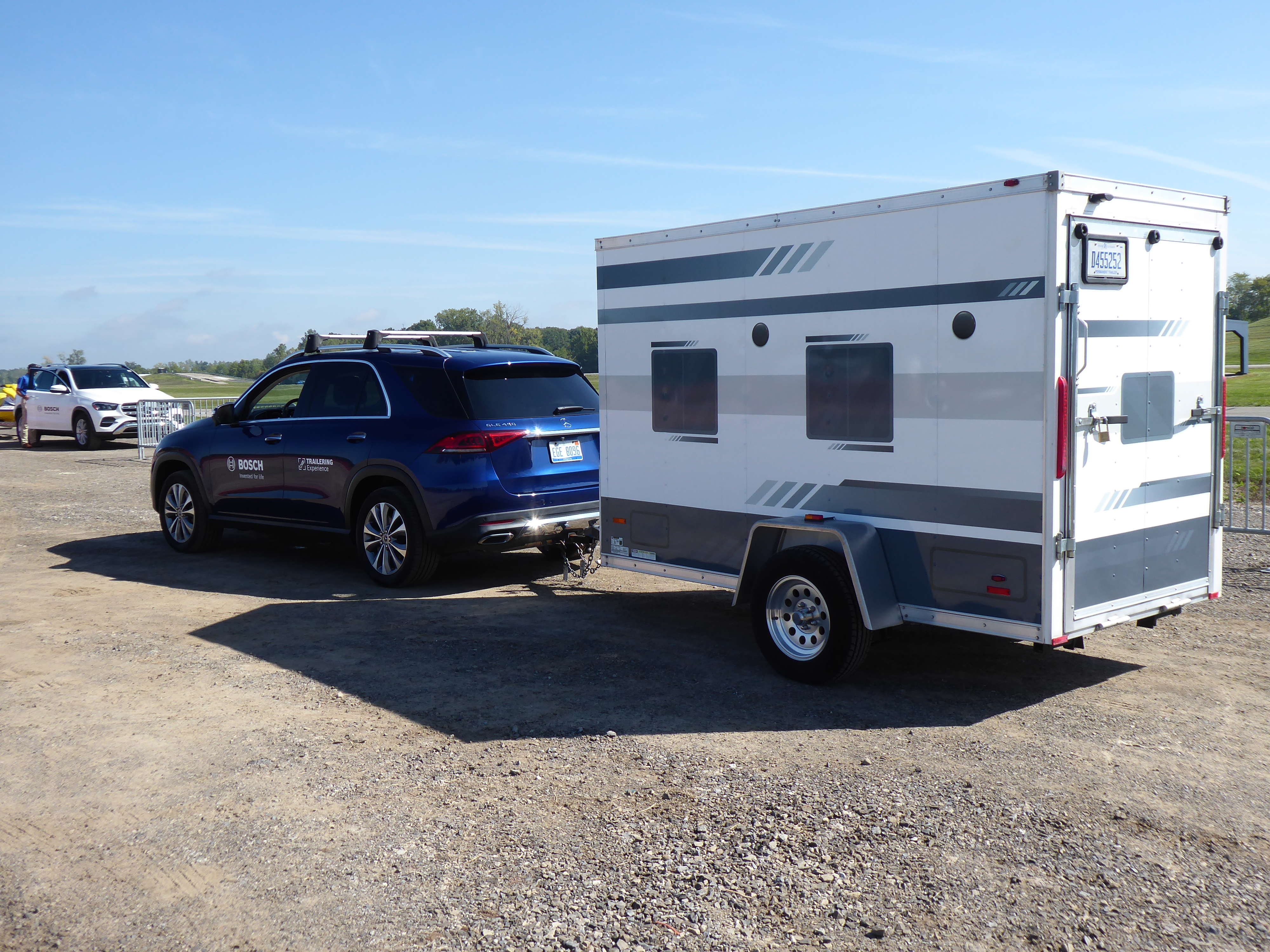
You can park this rig…anywhere. (Jim Motavalli photo)
Bosch also demonstrated how its technology can be used to accurately keep a trailer (with a jet ski on board) moving straight when backed up, or aimed on a desired angle.

Bosch partnered with Linamar on e-axles that hold its electric motors front and rear. This one-off Ram truck demonstrated the technology. (Bosch photo)
Bosch is partnered with Canada-based Linamar on rigid electrified axles, which were demonstrated on a one-of-a-kind Ram 2500 Laramie electric truck. Bosch motors were integrated into both axles front and rear to deliver four-wheel drive, 11,200 pound-feet of torque and 750 kilowatts of peak power. They wouldn’t let us drive, but the truck certainly did a fine job around the steeply banked test track. Ram is obviously using its own solutions for electric trucks, but this one could be ready-made for other automakers.
Bosch has pioneered ABS braking for e-bikes, and this was the first time it was publicly shown in the U.S. The company is a major supplier to e-bike brands, providing motors and battery packs, displays and controllers. Bosch components have been seen on many European brands, and I’ve recently tested Bosch on-board in e-bikes made by the Dutch Gazelle and German Riese & Müller companies. In Flat Rock, Bosch had two e-bikes from R&M equipped with second-generation ABS, including a cargo-type designed to carry two kids forward of the driver that proved tricky to master.

Bosch on-board bikes included two from Riese & Muller. (Jim Motavalli photo)
The ABS pulled the bikes up quickly, but a Bosch spokeswoman said that the systems have been slow to acquire customers in the U.S., possibly because of the cost. “We take the long view,” she said. According to AAA, in the U.S. e-bikes have only eight percent of the bike market, but in Europe it’s more than 30 percent. E-bikes are good business because they account for more revenue per unit than standard bicycles. According to Circana, they were responsible for 63 percent of the growth in sales between 2019 and 2023.
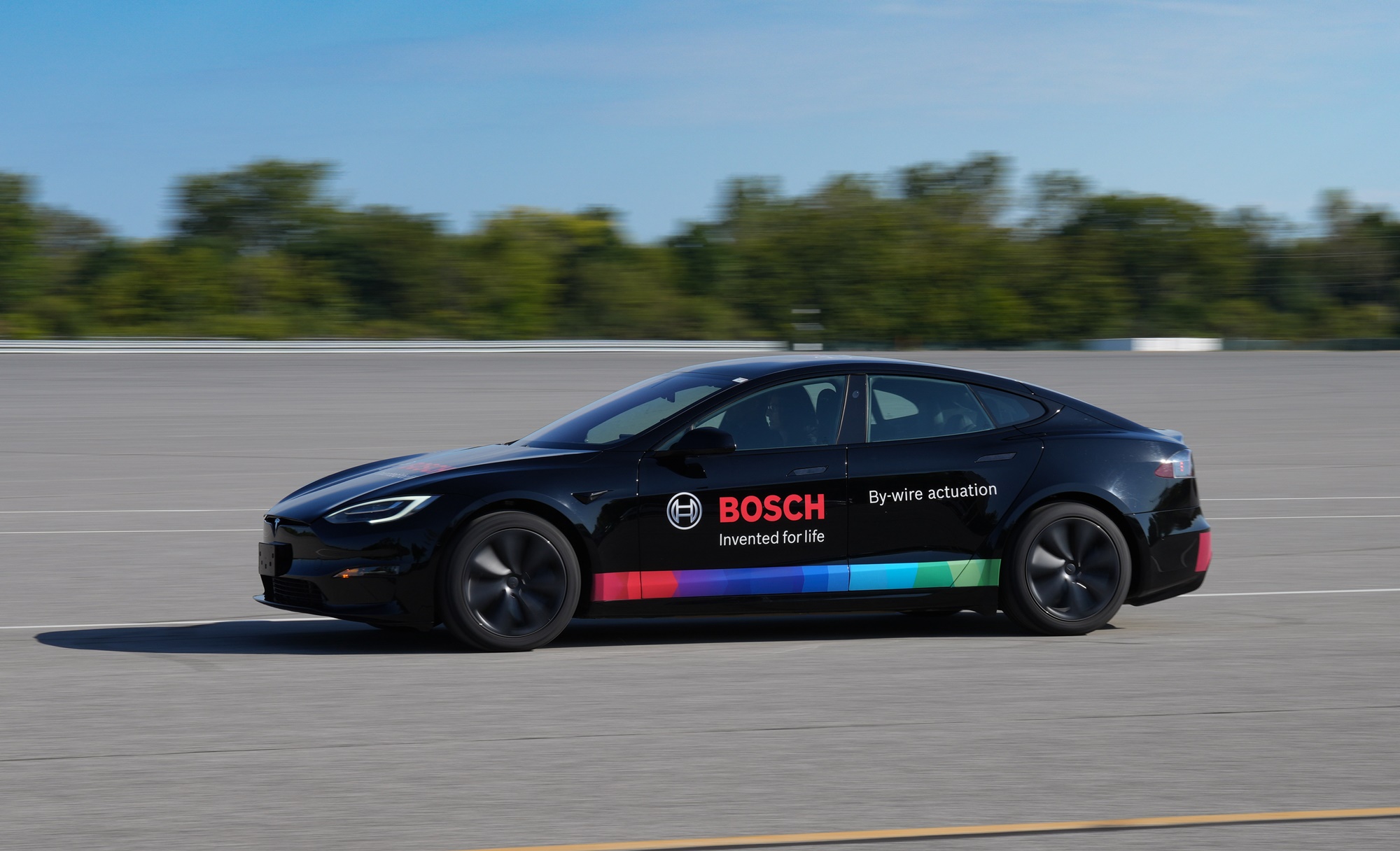
Testing brake-by-wire–with no physical connection from master cylinder to calipers. (Bosch photo)
In a Tesla Model S, we tested brake-by-wire technology with no physical connection from the pedal to the pads. At first, the fact that the pedal doesn’t have much “give” seemed like an obstacle but in practice it didn’t matter at all. The driver could sense the immediate response from foot pressure on the car’s braking. People who try it—including me—love it, and it will be incorporated into production vehicles for the 2026 model year.
A Lucid Air EV was the test vehicle for a test of steering by wire through a water obstacle. The vehicle management detects wet pavement and reduces braking distance—even for drivers with one hand clutching a cup of coffee. Without the assistance, we flew all over the place.
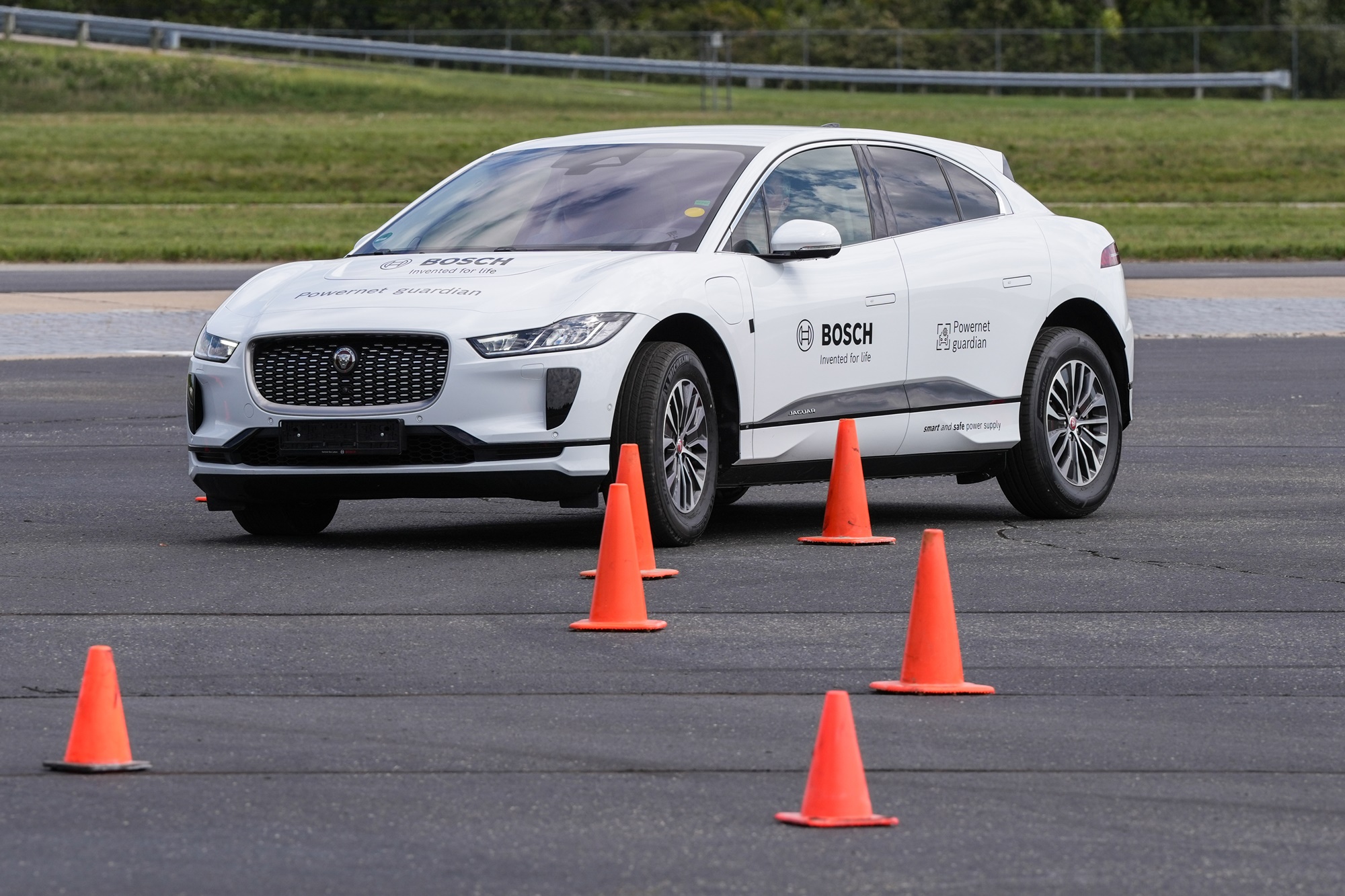
Powernet Guardian takes over if you lose steering assist. (Bosch photo)
The Powernet Guardian demonstration was certainly vivid. It’s a solution for an emergency I’ve actually experienced (in a Chevy Bolt EV)—the sudden loss of power-assisted steering. I drove down a narrow track and suddenly felt complete loss of steering control, sending cones flying. I would have had manual steering, but only with extreme effort. With Powernet engaged, I felt no loss of control, though the screen in front of me went blank. They gave me the blown fuse as a souvenir.
Bosch is moving heavily into the software-defined vehicle, and I talked to Eric Cesa, vice president of ETAS, a Bosch subsidiary that does software and cybersecurity solutions. “People expect their cars to offer the same level of usable technology as their homes,” he said. “They expect a seamless experience.” And because cars typically have a four- or five-year development cycle, their on-board technology can be out of date before the car is sold. That’s why over-the-air updates are so critical to cars going forward, he said. Tesla is now issuing as many as 200 such updates annually, and some automakers are using fewer development vehicles because their on-road performance an be simulated.
 Territorial Imperatives