
The premise was simple enough: My wife and I would drive a Genesis GV70 Electrified equipped with Michelin’s new CrossClimate2 all-season tires from New York City to Washington, D.C., stopping at Michelin-rated hotels and restaurants. Not a bad way to spend a weekend, right?
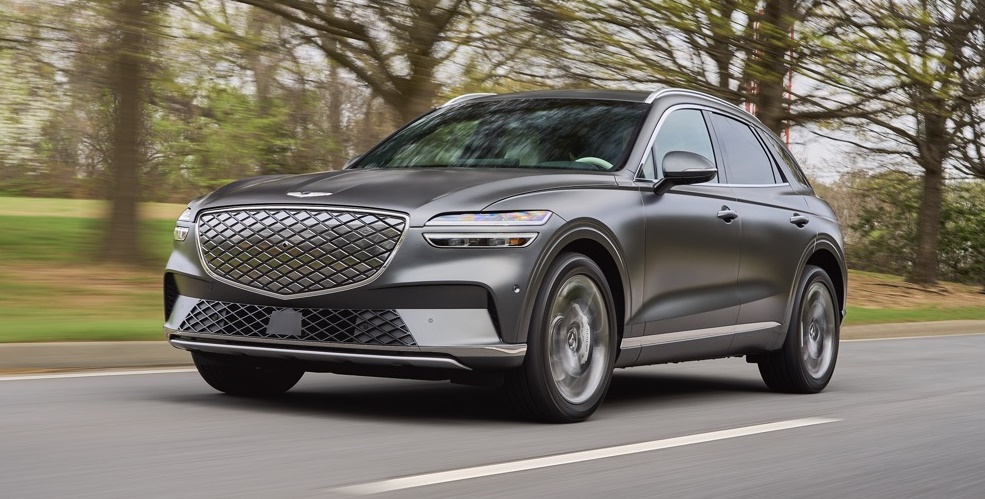
The Genesis GV70 Electrified was our steed for Michelin’s long-distance East Coast EV trip. (Genesis photo)
It proved to be quite an adventure December 6 to 8. The car, a big, luxurious and roomy SUV, arrived with approximately 170 miles of range. That was no problem for the first leg of the trip, 50 miles from Connecticut to the two-key Michelin Nine Orchard Hotel (a former bank, and quite opulent) in the Dimes Square neighborhood near Chinatown on the Lower East Side of Manhattan. When you’re driving an EV you notice other ones, and we couldn’t miss a CyberTruck ahead of us, and a Chevy Bolt too. We passed several rest areas, noting that the chargers there were often fully engaged.

A comfortable place to be. (Genesis photo)
The Delancey and Essex Municipal Garage was a 10-minute walk to the hotel, and it had EV charging. Luckily, one bay was free, and the cord reached. It was 240-volt Level Two, but that wasn’t a problem because we were leaving the car for the night. We loaded the EVConnect app and were charged in the morning, with a $5.05 bill, plus $50 for the parking.

Dinner that night was at chef Dan Barber’s Family Meal at Blue Hill, with one Michelin star. This is the urban outpost of Blue Hill at Stone Barns, a farm-to-table enterprise in Tarrytown, New York. Many of the featured fresh vegetables come from the farm.

The second course at Family Meal at Blue Hill.
The four-course menu was set, without choices (except for allergies), but we were delighted with those selections. After a mushroom soup featuring apples, chestnuts and lovage, the second course may have been our favorite: a trio of yellowfin tuna, mackerel, and lobster dishes. The Barber wheat flatbread (made from grain grown especially for the restaurant) and the salad of brassicas with Morton lentils, sesame and sunflower impressed us as well. There were four wines, and an apple aperitif. We left in a not-your-average-Thanksgiving food coma.

After breakfast under the vaulted ceiling of the former bank lobby, we collected the car with 217 miles showing.

The vaulted ceiling at 9 Orchard. It’s a former bank.
It’s four hours to DC from New York, through New Jersey, Delaware and Maryland. We wanted to make it as far as we could, so stopped at the Chesapeake rest area in Maryland with only 50 miles of range left.

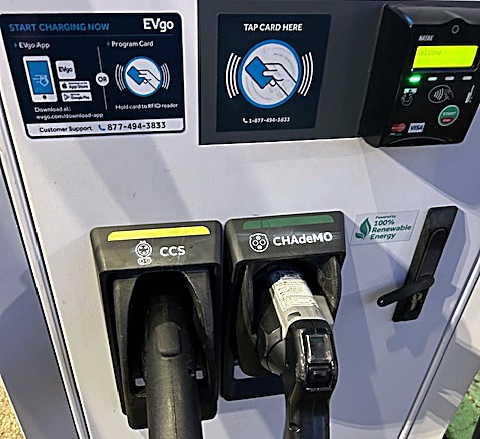
The Combined Charging System (CCS) chargers said Electric Vehicle Institute on them, and only one of four was occupied. At 47 kilowatts, it took about an hour to charge. We got coffee.
Our arrival into the wharf area of Washington, DC SW coincided with a boat parade on the Potomac, apparently a major attraction because it was vehicle gridlock and wall-to-wall people. It took 15 minutes to make a left turn. The self-parking garage had EV charging, one space remained, and the cord stretched. The charging, Level 2 (again, fine for overnight), was free, but the parking cost $60 for one night.

The Pendry hotel (with one Michelin key) in the popular Wharf shopping area along the river was hopping with life, but we had to move quickly to make our reservation at Rania, a highly inventive one-Michelin star Indian restaurant off Pennsylvania Avenue.

The walk, in the kind of chill that only the canyons of DC can generate, took us right through the historic Mall, with the Washington Monument on one side and the Capitol building on the other.
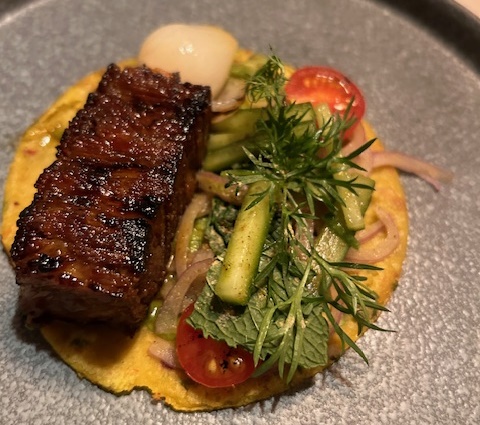
Again, it was a four-course menu, with two choices for each course. We love Indian food and found Rania’s approach to be really creative. Our favorite flavors were there, but the dishes featured many nouvelle cuisine innovations (so the menu told us). We ordered so we could sample everything. Some of our favorites included: shiso leaf chaat with white pea ragda and sorrel chutney, lamb belly kebab with chickpea cheela and kashumber; and the red pepper makhani that accompanied Tandoori squab. My wife chose her favorite Kingfisher beer, and I opted for Sauvignon Blanc to wash things down.

We made a quick stop in Alexandria, Virginia to meet a friend in the morning, and hit the highway with a full charge. Our thinking was to get to New Jersey for lunch and a quick charge before heading home to Connecticut. This is where the plans went awry.
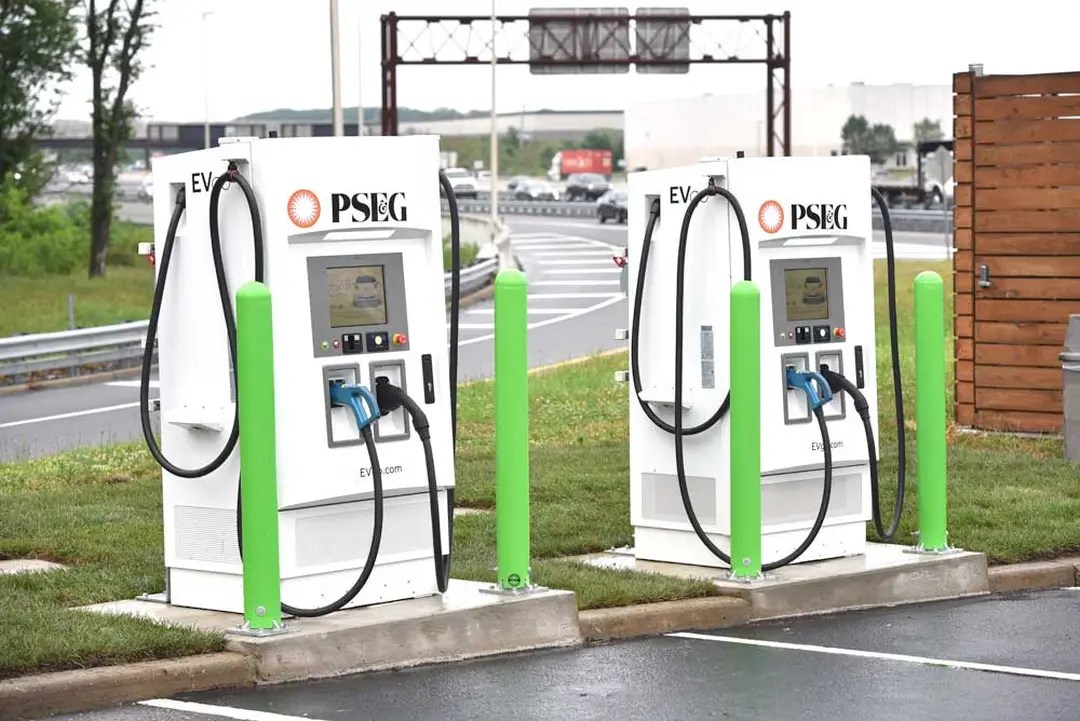
At the Joyce Kilmer rest area on the Jersey Turnpike, the CCS fast chargers were out of order. PlugShare informed us, “The chargers at this location are being removed as part of EVgo ReNew, a comprehensive maintenance program in which we are working to replace, upgrade, or in some cases retire stations over the coming year to enhance charger availability and build range confidence. We apologize for any inconvenience.” This was devastating news.
At the James Fenimore Cooper service area in Mount Laurel Township, the off-line CCS chargers had a very forbidding wire fence around them. But there were a multitude of available Tesla chargers, and we had a Lectron adapter that supposedly would allow us to use them. Unfortunately, the Tesla app refused to acknowledge that there were Superchargers nearby, and the charge was a no-go. Scanning the PlugShare app revealed not only that the other CCSs on the Turnpike were disabled, but that a lot of people were seething about it. Tesla drivers had no problem at all.
Teslas use the North American Charging Standard (NACS) plugs. A Genesis spokeswoman told me, “Our EVs will come standard with a NACS port starting with the 2026 model year. They will also have available CCS adapters.”
But that’s then. Our only choice in December 2024 was to get off the highway. In an odd coincidence, the nearest charger was at an office park where my wife once worked. It was five miles away. The ChargePoint charger there had a Chevy Bolt connected, but there were two wands and we connected the other one and got a charge going. Alas, it was Level 2 with an 11-hour charge time, and since we only had 50 miles of range at that point it wasn’t really a solution.
The app revealed that the Quaker Bridge Mall 10 miles away supposedly had two free Electrify America (EA) CCS chargers. It had them, all right, but not free. There were four, one was out of order, and three cars (Hyundai Ioniq 5, VW ID.4, Mustang Mach E) were waiting for the three that were working. There were EVgo chargers, too, but also with long lines.
It was going to be a long night. We waited in our car, not wanting to lose our place, and 45 minutes later we got our chance at one of the EA stations. The charge was fast, at 197 kilowatts, and we were delivered 67 kilowatt-hours of electricity in about 35 minutes, yielding a 97 percent charge and more than 250 miles of range. The catch was the price—56 cents per kilowatt-hour, resulting in a bill of $40.06. Wow, that’s like paying at the gas station. But we really wanted to get back on the road, so it was worth it.
A spokesman for the New Jersey Turnpike Authority, who preferred not to give his name, explained that the service areas are run by Apple Green, which had a contract until last January with EVgo to provide CCS charging. “But Apple Green decided it wanted to put in its own Level Three chargers and infrastructure, and that’s in the process now. We’re trying to get those chargers up!” He said that other states have issues too, adding that he encountered “40 Teslas lined up” at available chargers on a drive up the New York State Thruway.
We arrived back home at around 8:30 p.m., more than two hours later than we’d anticipated. Both the car and those CrossClimate2 tires, designed for SUVs, did well. The tires are “engineered EV-ready,” and while their wet braking and snow traction merits didn’t get tested, their reported longevity is appreciated. Some low-rolling resistance tires that are original equipment on EVs haven’t performed well, especially in terms of lifespan and grip in the wet. Consumer Reports recently rated the CrossClimate2 first among all-season SUV tires and projected that the 18-inchers would last 95,000 miles at a cost of 26.7 cents per mile. The Michelins were very quiet in operation, as was the car itself.
The Genesis Electrified GV70 is a contender among larger EVs, though the $75,750 bottom line for the 2025 model tested was a bit daunting. A $4,800 prestige package (Nappa leather, suede headliner, heated second row, heated steering wheel, Lexicon stereo) added $6,800 of that.
Some 483 horsepower is on tap via twin 160-kilowatt motors. Big as it is, The GV70 can sprint to 60 mph in 3.8 seconds. That was great for passing trucks, and overall the EV handled very well for a big vehicle. The GV70’s battery holds 77.4-kilowatt-hours. A few more miles of range wouldn’t have made much of a difference in the problems we encountered in New Jersey.
There are a few EVs, such as the Lucid Air Grand Touring (512 miles of range) that could have made the whole trip without stopping, but most EVs are around 300 and would need to stop at least once. And that’s where the peril lies. The highway charging network has made great strides in the last few years but—unlike the menus at Michelin-starred restaurants—it’s not a glorious experience yet.
 Territorial Imperatives