
Electrification is still moving full speed ahead—in the truck sector. The pace of plugging in cars has slowed, but manufacturers are still seeing opportunity in offering new battery and fuel-cell trucks, and that’s what ACT Expo (held in Anaheim, California March April 28 to May 1) is all about.
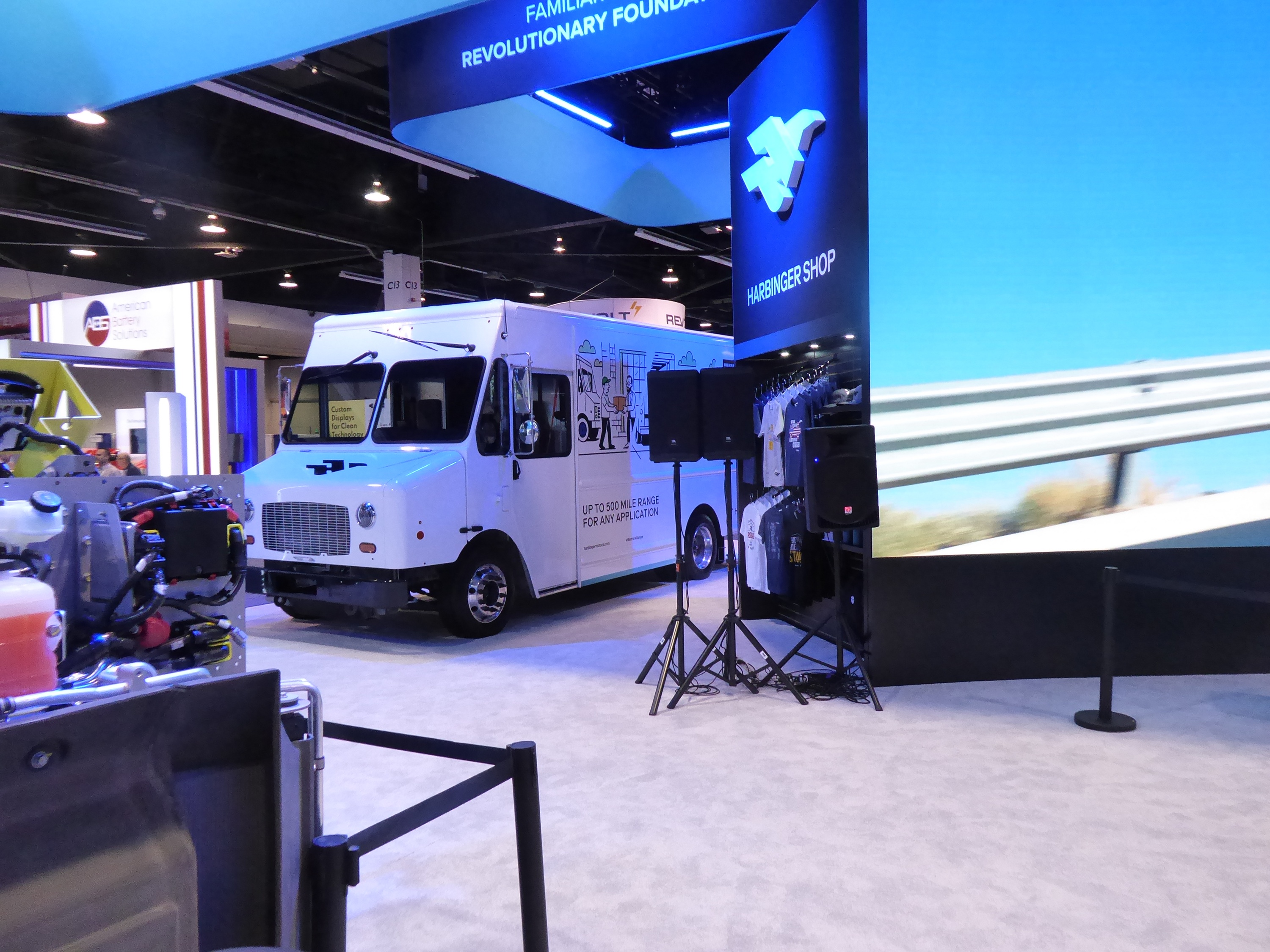
The Harbinger stand, with a delivery truck on its new $100,000 made-in-USA chassis. (Jim Motavalli photo)
The case is strongest in the smaller trucks that work locally and handle the “last mile,” but ACT also included some new tractors to pull the big trailers. Range is limited, though, and electric power is challenging in any kind of long-haul situation. That’s why the trucks are often put into service at ports moving cargo relatively short distances.
Joe Adams, chief engineer at Kenworth, showed the T680E and T880E cabs. “You’re looking at five years of development and 325,000 test miles with 46 units in Europe and North America,” he said.
Kenworth has been operating zero-emission Class 8 trucks at the Port of Los Angeles since 2021, but those have hydrogen power developed in conjunction with Toyota North America. Shell provided the fueling stations.
The T680E delivers 375 to 470 horsepower continuous and up to 605 horsepower peak, with 1,850 pound-feet of torque. The LFP battery packs are variable with the largest a 500-kilowatt-hour (kWh) pack offering 200-plus miles on a charge and up to 82,000 pounds of payload. It can charge to 90 percent in two hours, using a 350-kilowatt charger. It’s now available for orders in North America, with delivers to begin later this year.
The T880E, a Class 8 cab, can carry up to 675 kWh of batteries and travel up to 250 miles on a charge. It also has 350-kilowatt charging, and both trucks offer regenerative braking, a new EV-friendly 15-inch digital dash configuration, and LED lighting. Adams described a 168 percent fuel-economy improvement over diesel, but it’s a bit apples and oranges.

The Slate truck puts efficiency at the forefront. (Slate Auto photo)
There were a couple of important start-ups at ACT Expo. Slate Auto showed its bare-bones $25,000 electric pickup, with 150-mile range from the basic battery and no frills—roll-up windows, no radio (use your phone for music via USB). Jeff Bezos of Amazon is a backer. The truck is no looker, but its low cost and readily apparent utility (carrying capacity is 1,400 pounds) will give it charm.

The Slate truck converts to an SUV. (Slate photo)
Costs were kept down by using basic parts (like taillight lenses and door handles the same right and left); combining the motor, inverter and reduction gearbox into one assembly); and avoiding the paint booth. The polypropylene composite panels are all a uniform gray. This is the way Henry Ford made Model Ts—which got progressively cheaper, not more expensive.
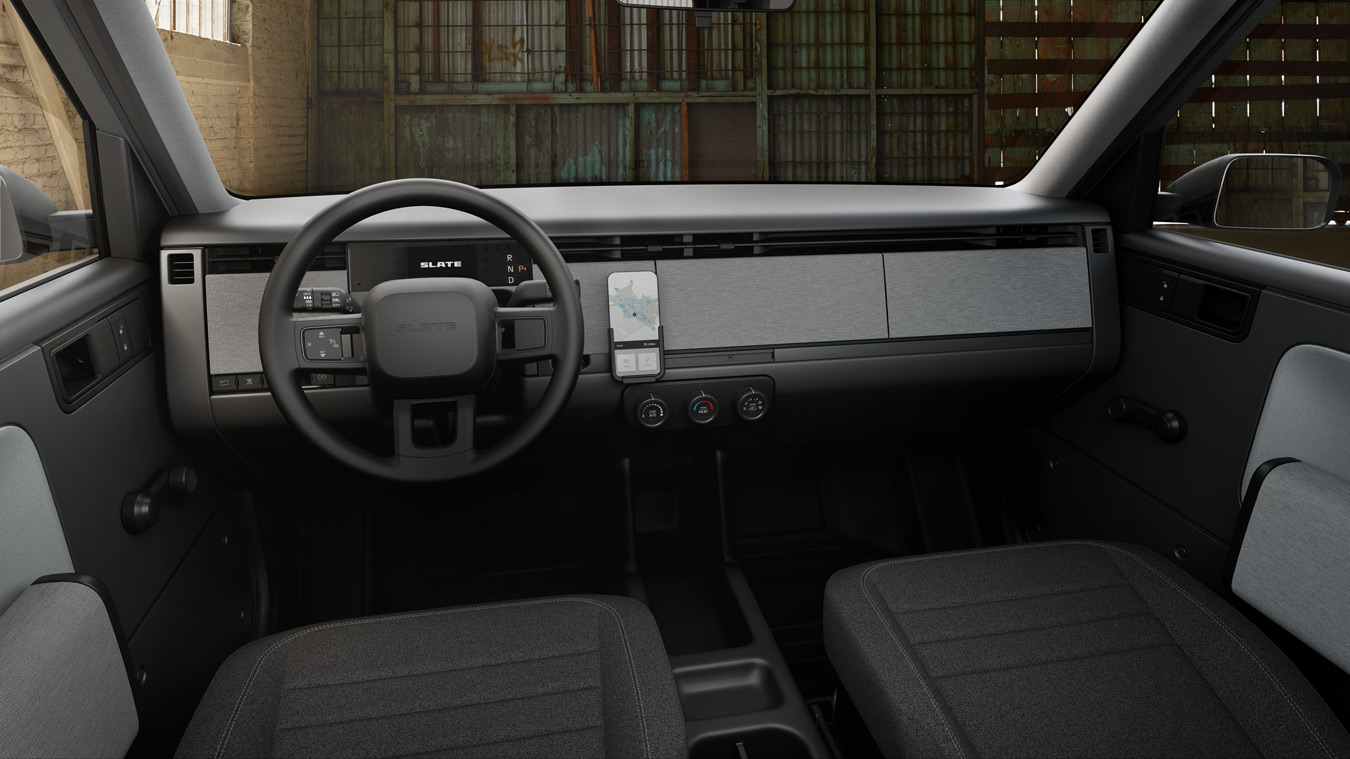
The Slate truck is a two-seat electric pickup, but a kit is available that turns it into a five-seat SUV. It can become a cargo van, too. The basic battery pack is 52.7 kWh but the optional 84.3-kWh pack takes the range to 250 miles. At Level 2, the Slate charges to 100 percent in under five hours; at Level 3 DC fast charging 20 to 80 percent is achieved in under 30 minutes.
The Slate is just what the market needs, but there was another affordable solution there from Harbinger, a fast-moving medium-duty electric chassis provider whose home base was 20 minutes from the Anaheim Convention Center.
CEO John Harris said his company is vertically integrated and produces most of the truck’s components in-house. That means it barely registers on the tariff scale. The chassis costs approximately $100,000, and Harris claims to have 5,000 orders for it—worth an estimated $500 million. “We started fresh and designed something altogether new and made in the U.S.,” Harris said.
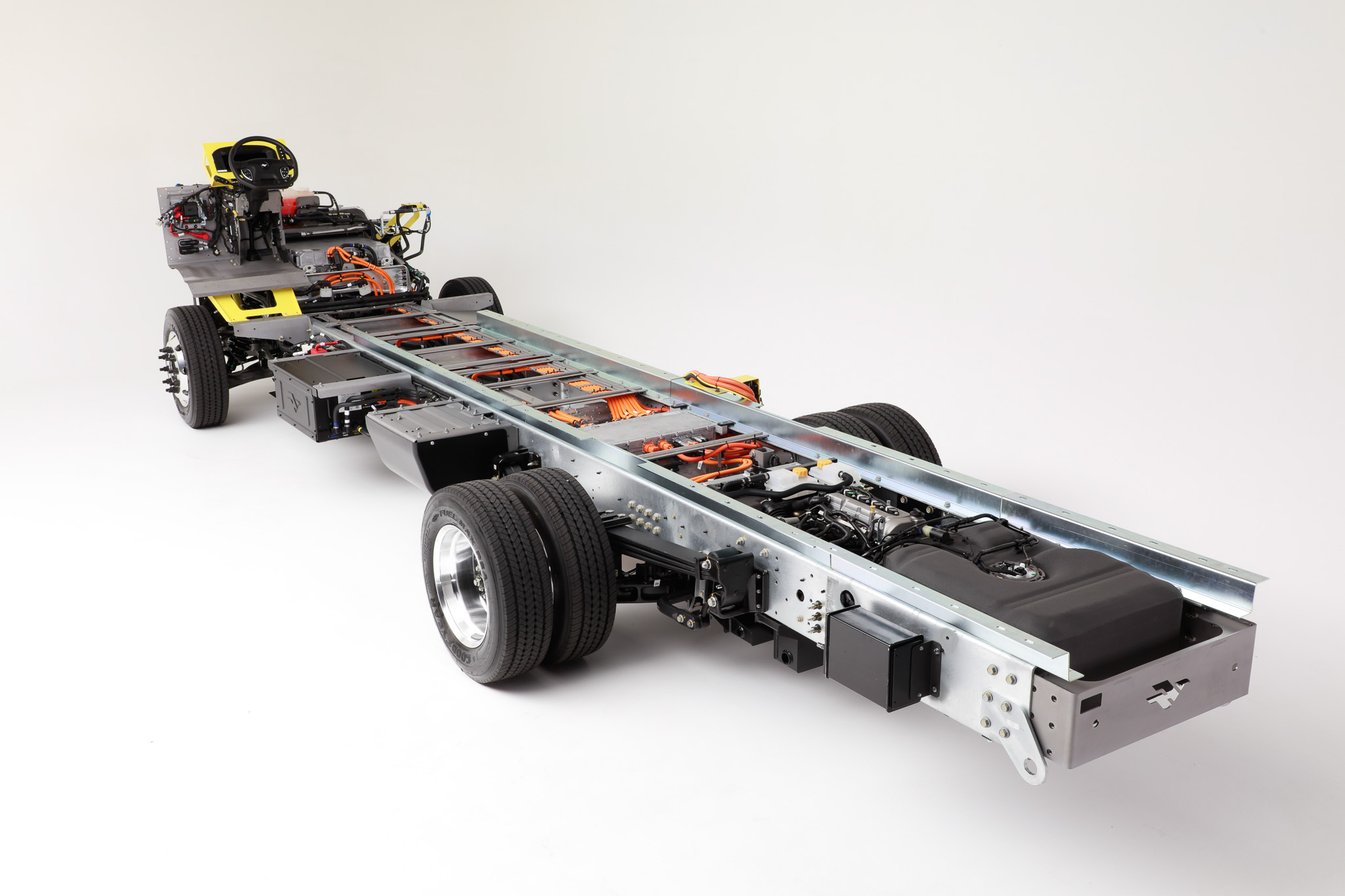
Harbinger’s EV chassis for medium-duty trucks uses batteries in modules that add 40 miles of range each. (Harbinger photo)
Panasonic Energy is the cell provider, supplying from a plant in Kansas. Before that plant opens, however, the batteries will be shipped from Japan. They’ll be mounted using a modular design in 35-kWh packs, with each one the customer orders adding 40 miles of range.
The company is agnostic as to who builds the bodies, but think simple panel vans and box trucks for last-mile deliver. Some 100 have been built so far. Harbinger’s plant can build 2,000 truck chassis annually. “We will build capacity as we need it,” Harbinger said.
Harbinger has an advantage in the marketplace—as long as the tariffs from the mercurial Mr. Trump stay in place. Customers are Bimbo Bakeries, THOR Industries (an RV maker), ETHERO Truck + Energy, and Bruckner’s Truck.
Canada-based Cellcentric is working with Volvo and Daimler Truck on fuel-cell trucks in a 50-50 joint venture. According to Nicholas Loughlan, the chief technical officer, the company can produce trucks with 650-mile range that can compete with 13-liter diesels on a total cost of ownership basis.
The Cellcentric NextGen system produces 350 kilowatts and more than 500 horsepower while weighing around 1,100 pounds.
“If we want to decarbonize, we need to get bigger,” Loughlan said. “The current green electric industry won’t cut it. We need hydrogen.” He showed diagrams of truck stop parking lots, and opined that if they were all using battery power the power draw would be “equivalent to half of Disneyland” [just down the road from the convention center].

Cellcentric builds fuel cells in a joint operation with Daimler Truck and Volvo. (Cellcentric photo)
Hydrogen power hasn’t worked out well for passenger cars, largely because there’s little fueling available outside California. But as a replacement to diesel trucks it can work with a network of refueling along major highways/truck routes. Loughlan noted that commercial trucking “is very diverse, and there are many applications where fuel cells work. There’s no payload issues, and we offer torque until you die.”
The big priority, Loughlan said, is to reduce the cost of hydrogen produced in the U.S. He noted the potential for making renewable hydrogen from abundant solar resources. Cellcentric says its system will work and achieve the stated range with both liquid and gaseous hydrogen, though the latter will have a more elaborate storage system. The issue with liquid is keeping it cold enough—hydrogen liquefies at -423 Fahrenheit.
There are big hurdles to be sure, but battery and fuel-cell trucks are moving much closer to cost parity with diesel than they ever have been before.
 Territorial Imperatives