
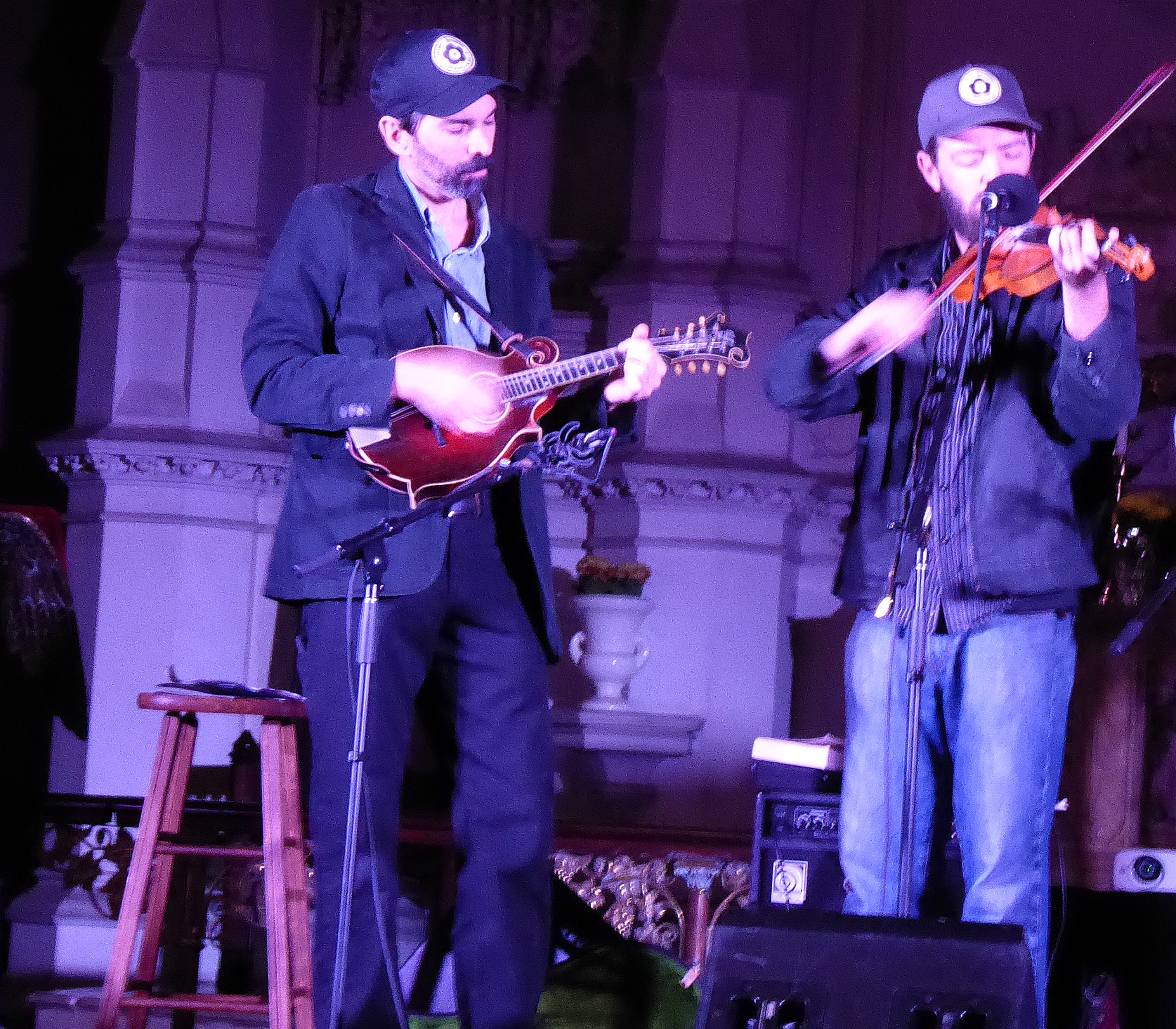
Two of the Down Hill Strugglers, Eli Smith (left) and Jackson Lynch. (Jim Motavalli photo)
BROOKLYN, NY—Folkways Records was founded in 1948 by Moses Asch and Marian Distler, a pair of serial record company founders who’d previously led Asch, Disc and Cub. It was Folkways that endured, and it was Folkways that issued, in 1952, the Anthology of American Folk Music, produced by Harry Smith (whose 100th birthday it would be).
You have to consider the times. In 1952 the only way you could hear America’s recorded legacy, especially the groundbreaking blues, country and folk records recorded in the 1920s, was on scratchy 78s. Reissues were rare. Putting a treasury of old music onto three long-playing records had a profound impact on the generation of folkies, many of them urban, who clustered around New York in the early 1960s, Bob Dylan certainly included.
The 15th annual Brooklyn Folk Festival, held at St. Ann’s Church in Brooklyn Heights, celebrated 75 years of Folkways, still very much with us and signing up artists as Smithsonian Folkways. Asch’s estate sold the label to the Smithsonian in 1987, a deal negotiated by Ralph Rinzler.
Sometime in the late 70s, before the sale, I visited Folkways to see if they needed any radio promotional help. I remember talking to Asch in a cluttered office. He was genial, as long as I didn’t mind getting paid in records. That’s how I got my Uncle Dave Macon album, complete with dimples baked into the bad pressing. And I think I got some Folkways on the air, too.
So it was as an actual former employee of Folkways that I joined the celebration, which turned out to be great fun. In a panel discussion, festival organizer Eli Smith (a mainstay of the Down Hill Strugglers, too) was joined by author Elijah Wald and Peter Siegel, the latter an engineer and producer at Folkways responsible for albums by Hazel and Alice, Doc Watson, Joseph Spence and many more.
For Hazel (Dickens) and Alice (Gerrard)’s first album, Siegel said he was paid $75, $37.50 of which he got in advance to buy a ticket to Washington, D.C and enough Scotch tape to record the group on his reel to reel. When he came back, he got the other $37.50. Not only was Siegel at the festival, so was Alice Gerrard, now 89 and still in good voice.
Brooklyn’ folk fest is run by the Red Hook-based Jalopy Theatre, which has grown to encompass a performance space, a record label and a music school. Many of the festival performers have records on the label, including the Down Hill Strugglers, who played first with some songs from the Anthology. Jackson Lynch continues to astonish on fiddle, as they made their way through tunes like “When First unto This Country” and “Cumberland Gap.” Walker Shepherd is a switch hitter who sometimes joins Lynch on fiddle, and Smith moves from guitar to banjo. They’re urban old-time musicians, just like the pioneering New Lost City Ramblers.
I didn’t know that Woody Guthrie played the fiddle, but apparently he not only played it but wrote music for it. The Strugglers ventured into his “Cowboy Waltz.”
Peggy Seeger, a Folkways stalwart along with her brother Mike (a folklorist and member of the New Lost City Ramblers), was one of several still-vigorous veterans who played the festival. She’s 88. Also appearing was Rambling Jack Elliot (92), Ed Sanders of the Fugs (84) and poets Anne Waldman (78) and (by phone) Sonia Sanchez (89).
Seeger, accompanied by her son Calum McColl on guitar and vocals, appeared on video from her home in England. She is an adept interpreter of old songs, and proved it with “The Wagoner’s Lad” and “Dink’s Song.” But she also offered some originals, one of them a clever ditty about automated phone answering systems. And she didn’t forget her late husband’s “The First Time Ever I Saw Your Face,” written for her.
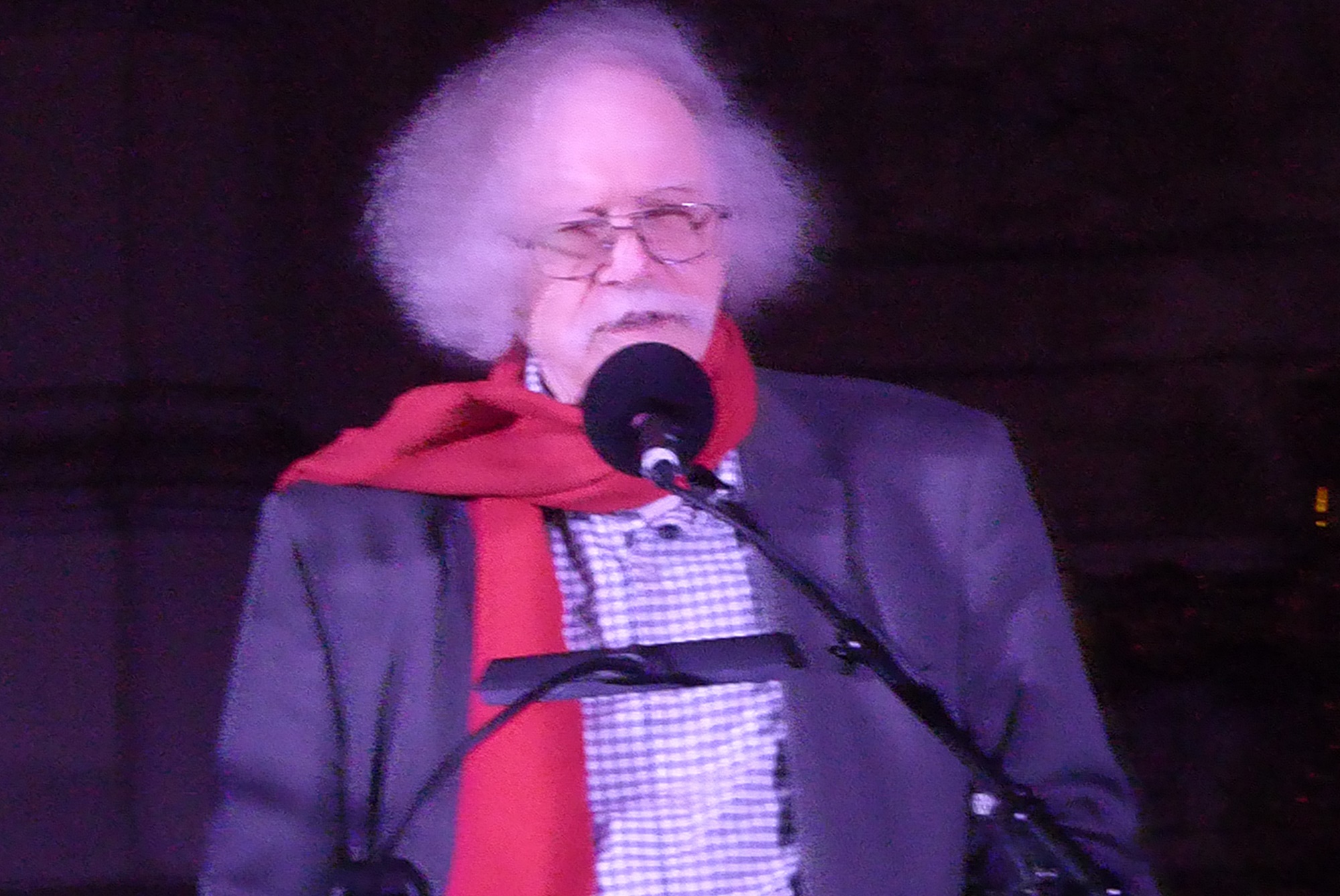
Ed Sanders, the link between the beats and the hippies. (Jim Motavalli photo)
The Fugs, featuring Sanders, hit the nostalgia button with “Slum Goddess of the Lower East Side,” “CIA Man” and “Kill for Peace,” the latter by the legendary Tuli Kupferberg. The Fugs were always sort of ramshackle, and they still are. A moment of order came with the song from the guitarist Steven Taylor, “God Bless Johnny Cash.” Taylor said he showed a draft to Sanders, who said the song was “prolix.” Maybe it’s been shortened since.
Charlie Parr proved very accomplished on his National steel guitar. His songs, mostly about down and outs, were intermittently successful. “I Ain’t Dead Yet” was a highlight.

Dom Flemons, “Freight Train” and “Cannonball Blues” medley. (Jim Motavalli photo)
And then came Dom Flemons, who had heard just that morning that his new album Traveling Wildfire had been nominated for a Grammy. Flemons, a former member of the Carolina Chocolate Drops with Rhiannon Giddens, is a delightful solo performer, and starting to branch out a bit.
Wildfire is his own songs, some with a country feel such as the very romantic “Slow Dance.” Traditionalists could delight in his ornamented guitar medley of “Freight Train” and “Cannonball Blues.” And he didn’t forget the black cowboys, the subject of his last Grammy-nominated album. Did you know that Reverend Gary Davis had a cowboy song, “Saddle it Around”?
A great way to start Saturday morning was Ken Schatz leading the audience in sea chanties. The pews were full of his fellow acolytes, and he called them up one by one to sing lead, with the rest of us joining on the choruses. I was thrilled to hear “Cape Cod Girls,” previously encountered only on Patrick Sky’s second album, A Harvest of Gentle Clang.
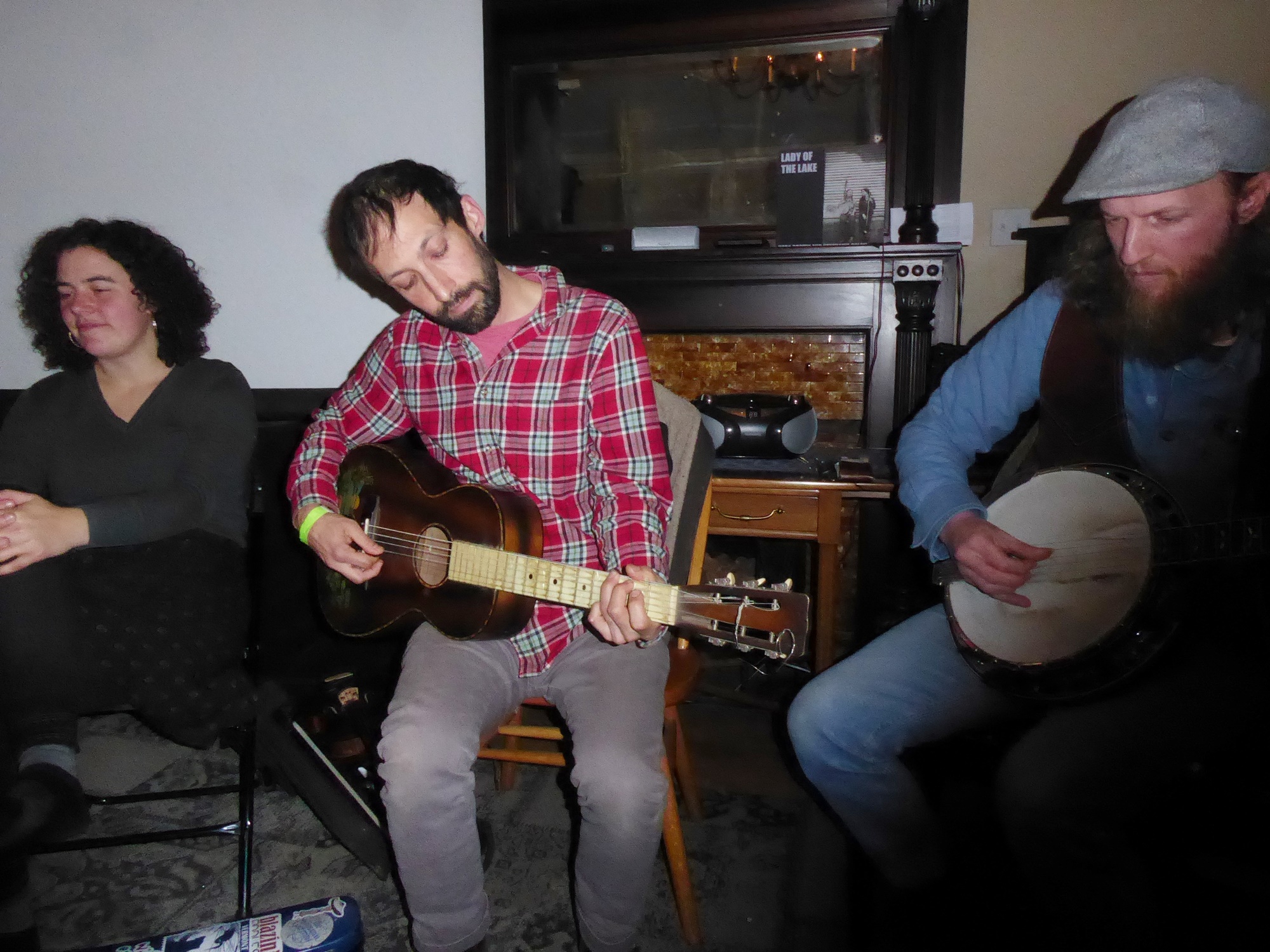
The Harry Smith Frolic folks, getting through the Anthology of American Folk Music. (Jim Motavalli photo)
Kyle Tigges, with a full band of fiddle, bass and piano, offered easygoing songs. He’s one to watch. And I really loved a performance by members of the Harry Smith Frolic. This is an event, held in Massachusetts annually, that each year attempts to get through one volume of the Anthology, helped by anyone in the audience who can sing (or is willing to attempt to do so). Four of the frolickers showed up at the festival and banged out such Anthology numbers as “The Brilliancy Medley,” “I Wish I Were a Mole in the Ground,” “Indian War Whoop” and “The Mountaineer’s Courtship.” The latter is a novelty number from the Stoneman Family, and the kicker is that the rube getting hitched already has six kids.
And then there was David Johansen. The former New York Doll made two wholly unexpected albums as David Johansen and the Harry Smiths, and they are a revelation. He sounds utterly authentic, Charlie Poole’s cousin, and fully inhabits the old songs. On stage with two guitarists, he still looked like a rocker, skinny in striped pants, but as soon as he opened his mouth the Old Weird America came crawling out. Quite wonderful. “Old Dog Blue,” “Casey Jones,” “Single Girl, Married Girl,” “Delia.”
Johansen barely talked, but he did say, “This is a wonderful event. It’s so much fun to play these songs. It’s a constant source of rejuvenation for me.” Fans of Buster Poindexter or the Dolls can catch him in a different context, such as Personality Crisis, the recent Martin Scorsese documentary.
Wyndham Baird was a repeat visitor, and a somewhat low-key performer who offers beautifully sung and sturdily constructed cover songs, from Dylan (“License to Kill”), Ian Tyson (“The French Girl”) and Roscoe Holcomb (“Trouble in Mind”).
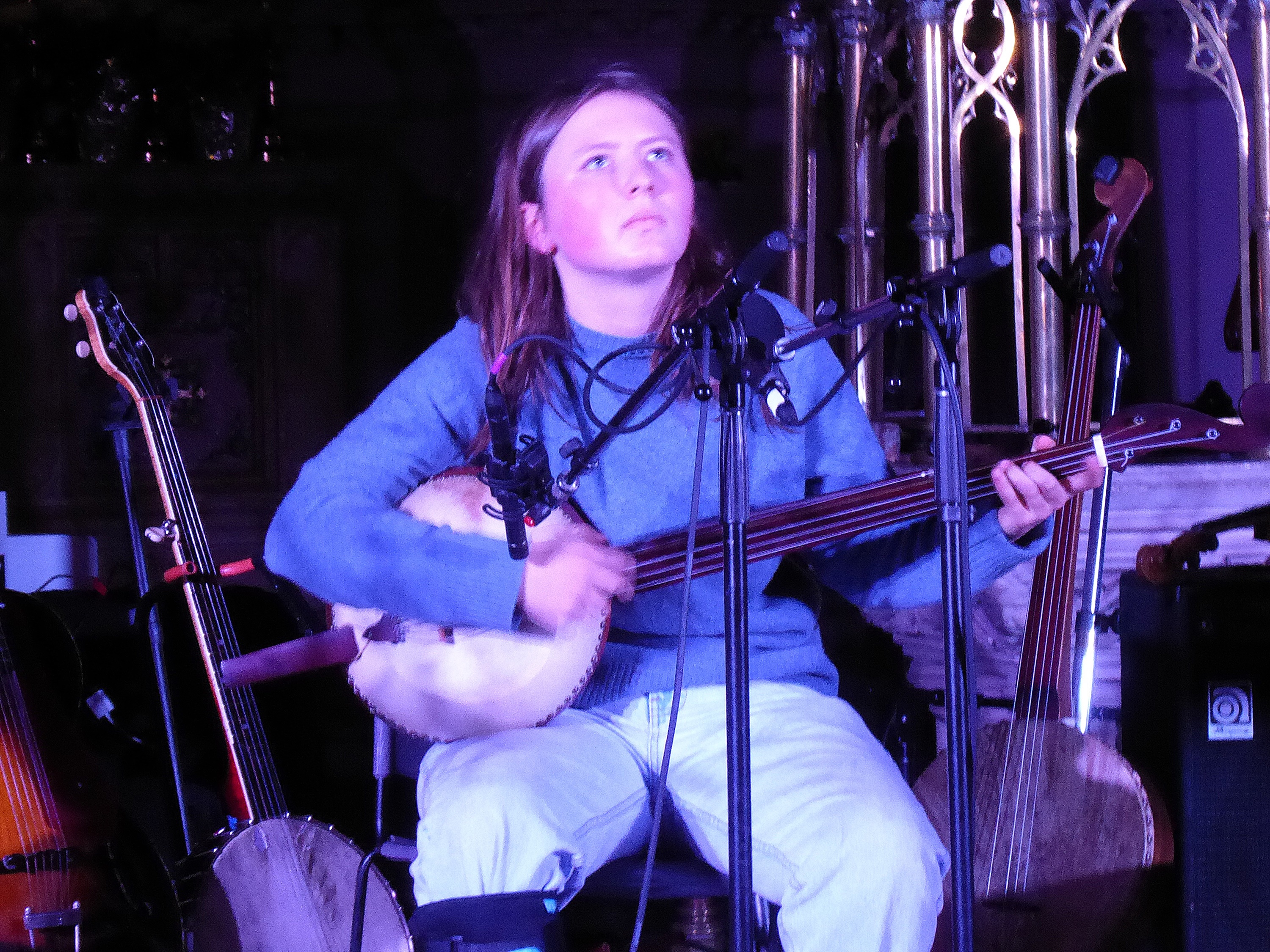
Nora Brown, contemplating the past. (Jim Motavalli photo)
The young banjoist Nora Brown was in a slightly downbeat mood, having recently contracted a cold and sprained her ankle. She opened with “Morphine.” It’s always great to hear both her interpretations and her descriptions of where the songs came from. “Copper Kettle,” an immediate postwar song by Albert Frank Beddoe and recorded by Bob Dylan on Self Portrait, was typically splendid. Nora was joined by fiddle player Stephanie Coleman, and the pair recently made an EP together. Brown was on several stages over the weekend; the musicians love to play with her.
Brown sometimes sits in with multi-instrumentalist Jake Blount; as he pointed out, they “like the same songs.” In Brooklyn Blount was subdued but also pissed-off and electrifying as he tells stories of slavery and African-American life, often through the lens of old songs. He’s a ferocious fiddle player—sometime using it to generate a drone, with electronic effects—and just as good on banjo and guitar.
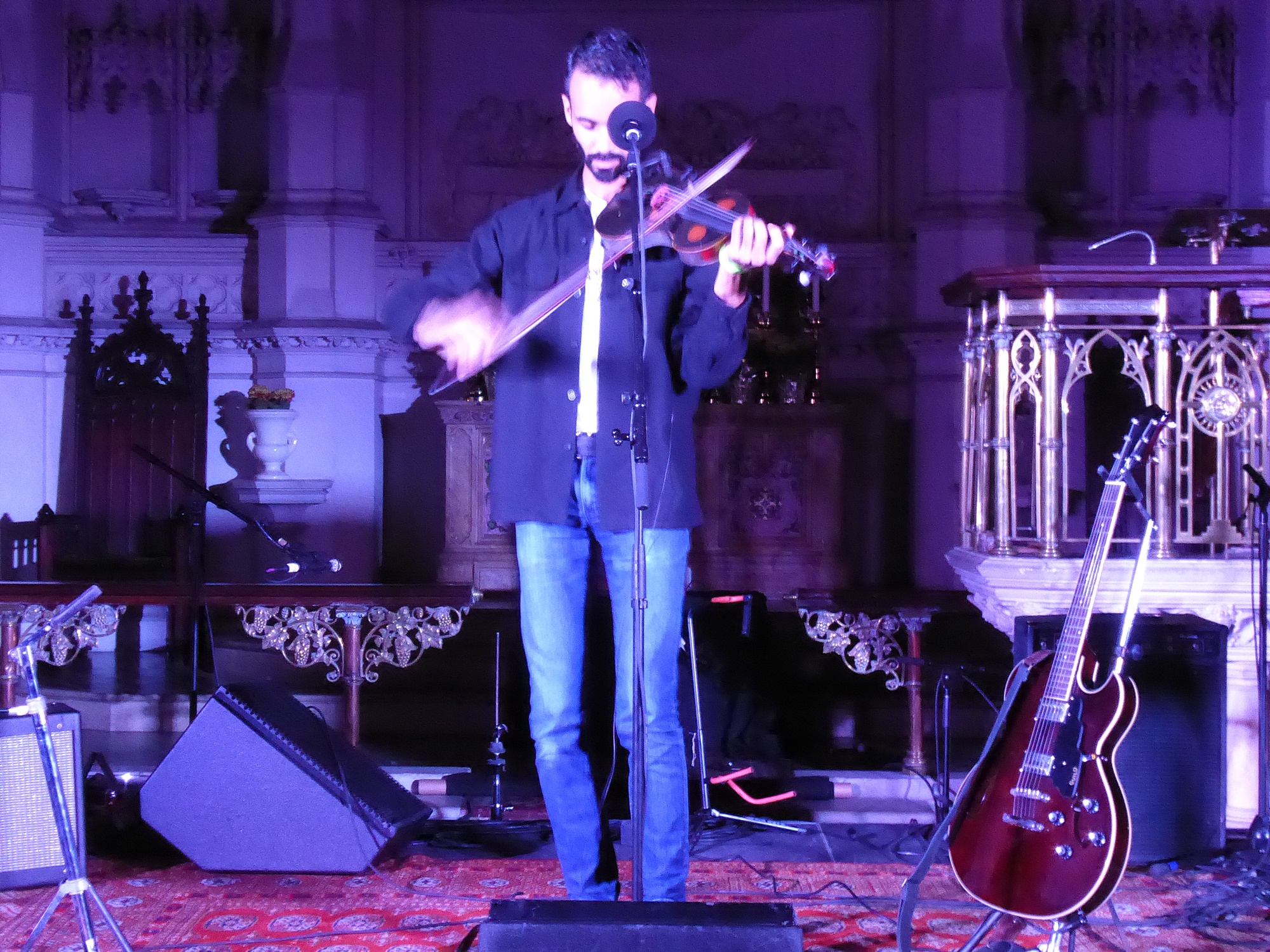
Jake Blount, fiddle drones. (Jim Motavalli photo)
“I’ve Heard of a City Called Heaven” comes from the singing of Jean Ritchie, and Blount did it brilliantly. “Hard Times” via Skip James was also imaginatively reinvented.
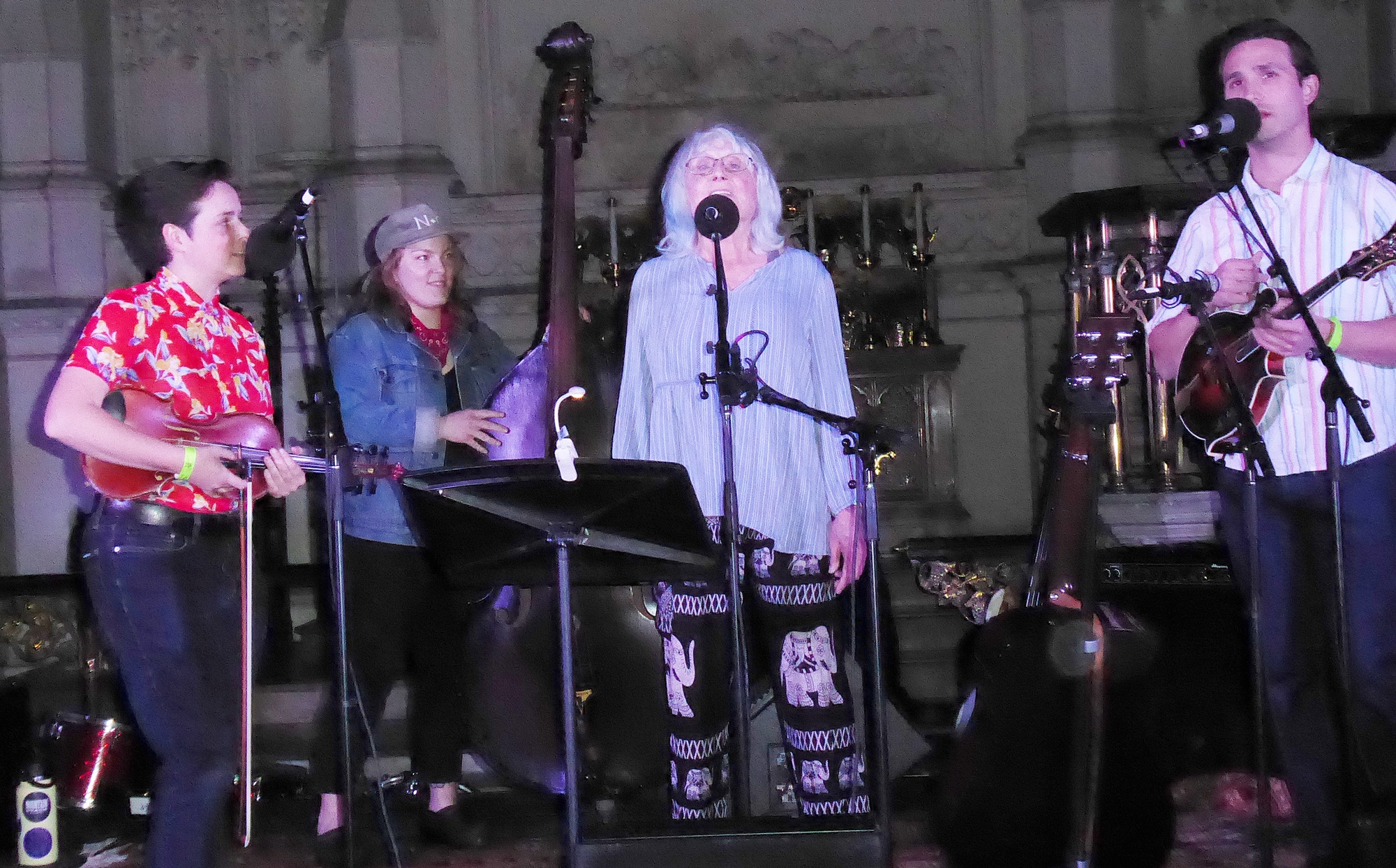
Alice Gerrard (center) with Tatiana Hargreaves (left and Reed Stutz (right). Missed the bass player’s name! (Jim Motavalli photo)
Alice Gerrard lives in North Carolina now, and brought some musicians up from there, including Reed Stutz and Tatiana Hargreaves. Sad songs (“The One I Love is Gone,” via Bill Monroe) funny songs (“How Can I Keep from Fishing?”) and serious ones (“The Coal Miner’s Blues”) were all offered and treated with respect.
I unfortunately had to miss Sunday and Rambling Jack Elliot, among others, but what I did get was two intense days and nights of roots music.
See more of what’s going on at Brooklynfolkfest.com and Jalopytheatre.org. The same folks put on the Washington Square Folk Festival, the Brooklyn International Folk Festival and Roots ‘n Ruckus Fest.
 Territorial Imperatives