
Cruising the neighborhood in the $324,000 DB12 coupe, a sinuous supercar.
By Jim Motavalli
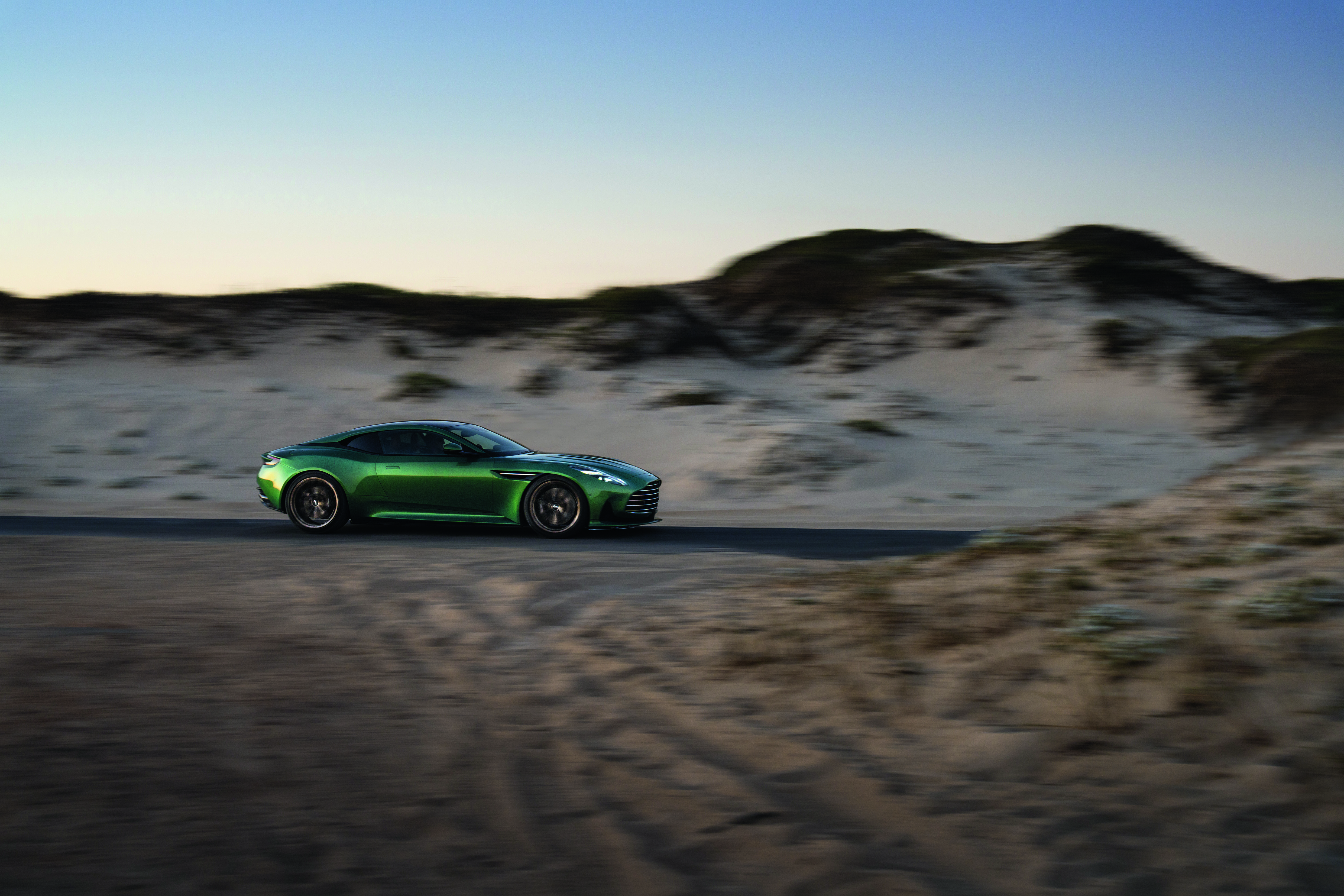
A thick coating of helicopter seeds from a maple tree couldn’t hide the sinuous lines of the Liquid Crimson Aston Martin DB12, a successful and more aerodynamic updating of the basic Aston shape that’s been extant since the DB2 of 1950 to 1953. It modernizes the DB11 with touches of the DBS.

These cars start at $245,000, but the tester’s options bumped it to $324,700. The DB12 grand tourer debuted in May of 2023, and compared to the DB11 it has bigger grille in the distinctive Aston shape, LED headlights and wider track width. The redesigned interior sports Aston’s ownb infotainment system, which supports wireless Android Auto and Apple CarPlay.
The DB12’s four-liter twin-turbo V-8 engine produces a massive 671 horsepower with 590 pound-feet of torque and makes outrageous go-fast noise. The DB11 offered a mere 528 horsepower and 513 pound-feet from the same basic powerplant, with the increase attributable to modifying the camshaft profile, optimizing the compression ratio and deploying bigger turbochargers.
AM discontinued the 5.2-liter V-12 that was available on the DB11. There’s also a DB12 convertible called the Volante, released just after the coupe, and it can raise or lower its top in 16 seconds or less at speeds up to 31 mph. The DB12 reaches 60 miles per hour in 3.6 seconds, and the Volante in 3.7.

On the road, these figures will not be doubted. The DB12’s acceleration is fearsome and relentless. But driving the car in suburbia can be an exercise in frustration, since there are so few opportunities to really get it excited. Even on the highway the rest of the traffic isn’t moving fast enough. The 12 feels like a caged lion in school zones, and the ride—meant for flat-out cornering—is quite stiff in some modes.
The 12’s chassis is seven percent stiffer, the anti-roll bars have been hardened, and the shocks upgraded. But the driver can choose between GT, Sport, Sport+, Wet and Individual. The first one is the default and the most comfortable in everyday driving. Sport+, that’s for the track.
Boarding the DB12 requires dropping into it, dictated by the low stance. The driver and passenger sit cozily on hand-stitched quilted red leather (via a $15,200 option), with the bolstering needed to stay in place. There’s a back seat (the car is a “2+2”) but it’s for small kids and parcels.
The initial driving position was low, too, but corrected by raising the seat height. The driver looks at a clear digital dash display, which is complemented by a 10.3-inch center screen. The system worked well until it didn’t—the screen froze temporarily. But the $10,000 15-speaker Bowers & Wilkins audio sounded excellent, and AM is to be congratulated for providing physical controls (via knurled rollers).
The driver can let the eight-speed automatic transmission do the work, but AM provides a really good paddle-shifting system with near-instantaneous responses. The paddles turn with the wheel, which makes using them a bit awkward during cornering. The $14,400 carbon ceramic brakes, which shed 60 pounds over the standard issue, were massively reassuring.
Supercar fuel economy is usually worse—the DB12 gets 22 mpg on the highway, and 15 in town. But that doesn’t stop these cars from being driven. On a recent trip to Miami, I saw a group of British-registered Aston Martins going all the way back to the DB6 that were on the Mayfair to Miami trip, (see below) arriving at the latter in time for the recent F1 race.

This isn’t likely to be its owners’ only car, and some kind of big SUV will do the family’s heavy lifting. But despite its intent as an international grand tourer, the DB12 is fairly docile for a supercar and reacts predictably. It doesn’t require a driving school degree for a trip to the mall. It attracts attention like nobody’s business, though, so be careful of drivers not concentrating on the road.
Cars imported from Britain were subject to President Trump’s 25 percent import tariffs, but the just-concluded U.S.-U.K. trade deal offers some relief for luxury carmakers such as Jaguar Land Rover, Rolls-Royce and Aston Martin that don’t have U.S. production. According to the White House, under the new rules, the first 100,000 British vehicles into the U.S. in any year will pay 10 percent, and any after that are subject to 25 percent rates. The latter figure won’t be reached too often—in 2024, U.K. manufacturers sent 102,000 vehicles to America. The big numbers are in cars from Japan, Korea and Europe.
 Territorial Imperatives
hi Jim good morning! I LOVE this cool review and am forwarding it to others! great job! John