
The Consumer Electronics Show (CES) can be a stressful whirlwind, and it’s hard to tear oneself away from the crowded show floor for outside activities, but an invitation to drive some Chinese cars at Las Vegas Motor Speedway could not be ignored.
And these were cars from Geely, a Chinese giant that has in its orbit Volvo, Polestar, Zeekr, Proton, the venerable English brand Lotus, the Geely brand itself and Lynk & Co. The auto journalists have already driven the Volvos and Polestars, sold in the U.S., but actual chances to drive models headed for the Chinese domestic market and a burgeoning international audience (Europe, Southeast Asia, Latin America, the Caribbean, Australia, the Middle East, Africa) are rare in the U.S., a/k/a, land of tariffs.
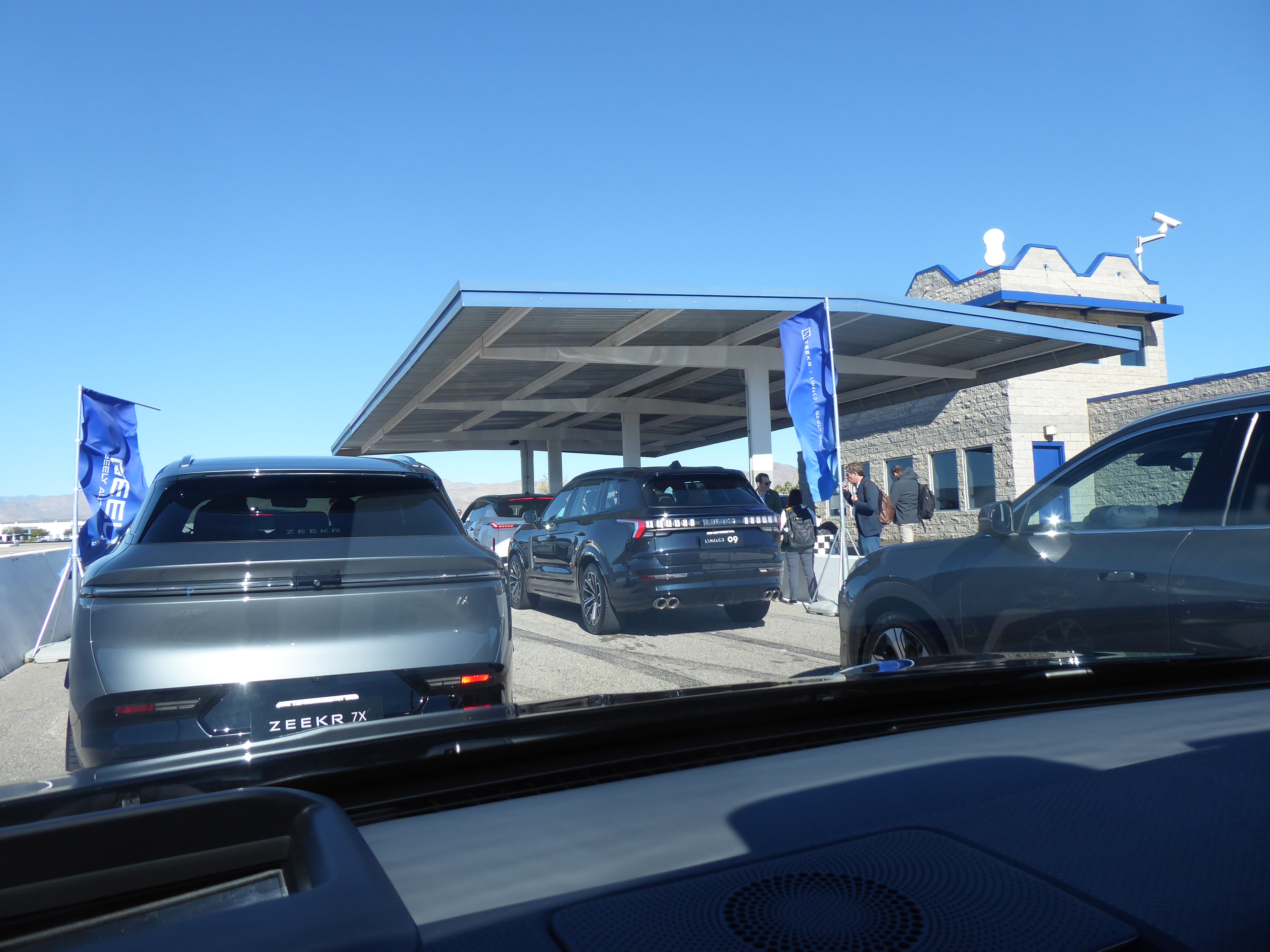
The media swarms the Geely cars. (Jim Motavalli photo)
There were nine Geely cars on the track, and I drove three of them, representative of the platform agnosticism (and EV favoritism) in China today: a battery EV, a plug-in hybrid, and a gas car. My Autoweek colleague Mark Vaughn said about the cars on the track, “They were all just fine. Panel gaps, fit and finish, materials, acceleration, steering, and braking were like just about any car sold here now.”
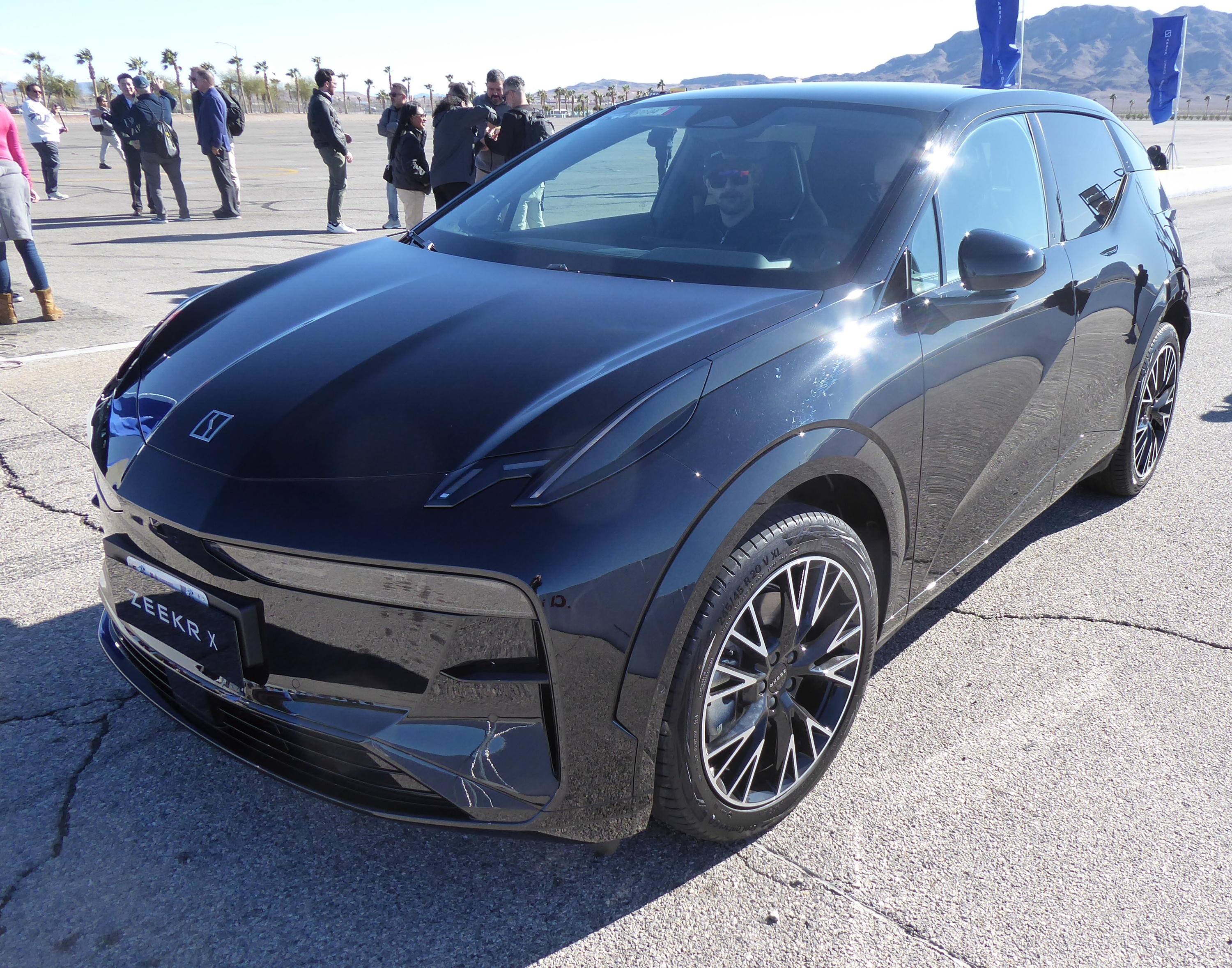
The Zeekr X punches out 428 horsepower with dual motors. (Jim Motavalli photo)
The battery car was a Zeekr X two-motor AWD. Zeekr was a standout at CES last year. This year, with few U.S. brands in evidence amid even more Chinese cars, Zeekr still stands out. The X in dual-motor form (Privilege) is a compact SUV with a punch: 428 horsepower, 400 pound-feet of torque, with a 66-kilowatt-hour CATL battery yielding 273 miles of range (a bit anemic). It can reach zero to 62 mph in 3.8 seconds, and there’s nothing anemic about that.
The Chinese have been betting heavily on auto driving, infotainment and on-board safety, and the X has a Qualcomm Snapdragon 8155 chip and, for ADAS, the G-Pilot system with LiDAR sensors. There’s an AR head-up display. In single motor form (ME) is has 272 horsepower and a 5.6-second zero-to-62 time. There is 150-kilowatt fast charging, which means a 10 to 80 percent charge in around 30 minutes.
The X came out in China circa 2023, and sales have been modest there: 8,692 last year, 13,316 in 2024 and 22,372 in 2023. The price is rather eye-opening: The Zeekr X starts around $21,000 after subsidies in China for an entry RWD version with a 49-kilowatt-hour battery. Even a top-trim car like the X I drove is only around $30,000. An export-to-North-America X would be a lot more without the Chinese subsidies, but we would still find it a bargain.
And believe me, the X is definitely a sign of a maturing auto industry in China. It felt like a mature EV, with excellent road manners (very quiet), fast acceleration and good handling, including in evasive maneuvers around the test track. The interior was nice enough, though Chinese automakers need to get the details right. I saw a supposed “brushed aluminum” console that looked like, and was, cheap plastic.

The Lynk & Co. 08 comes in many forms, and is on the road in Europe. (Jim Motavalli photo)
The Lynk & Co. 08, also from 2023, is a mid-sized crossover plug-in hybrid with a combined 345 horsepower and 258 pound-feet of torque from a 1.5-liter turbo engine and two electric motors. The 124-mile battery EV range was impressive, via a 39.6-kilowatt-hour battery. Lynk & Co. is a brand that Geely is trying to establish in Europe, and the company recently entered the Czech Republic, Austria and Switzerland, making 25 markets there. The 08 was launched in Europe last June.
The 08 was impressive on the road, with 4.6-second zero to 60 times, but marred by some hesitation in the drivetrain on rapid acceleration. Interior finish was very good. Drivers of this rig, despite the performance aspects, can expect 42.8 mpg on a U.S. scale.
It’s interesting the price differences on the 08. Europeans pay a hefty $57,000 for a loaded version of the car, but in the Chinese market it starts around $25,600. The European model undoubtedly starts off in a higher trim, but still. Even in twin-motor deluxe form the 08 is only around $36,000 in China.

Geely’s own Starray GF+ offers 218 horsepower and a seven-speed dual-clutch transmission. (Jim Motavalli photo)
And finally, I sampled a Geely-branded Starray GF+. This ICE car had a two-liter turbo four under the hood, with 218 horsepower and 240 pound-feet of torque. The seven-speed dual-clutch transmission was a modern touch. Colleague Mark noted slow two-second downshifts, and it was certainly no ball of fire. But definitely adequate as a fuel-sipping commuter car. There are two screens, a 10.25-inch digital cluster, and a 13.2-inch horizontal center screen.
But this is only one variant of the (popular in China) Starray—there are also diesel and PHEV variants, and a 1.5-liter turbo entry model. AWD is an option in some markets. For some reason, the Starray is called the Boyue L for export models. Overseas, there is no less than four variants of the Boyue.
Get this, the Starray in China starts at $14,000 to $16,000, with higher trims only $20,000.
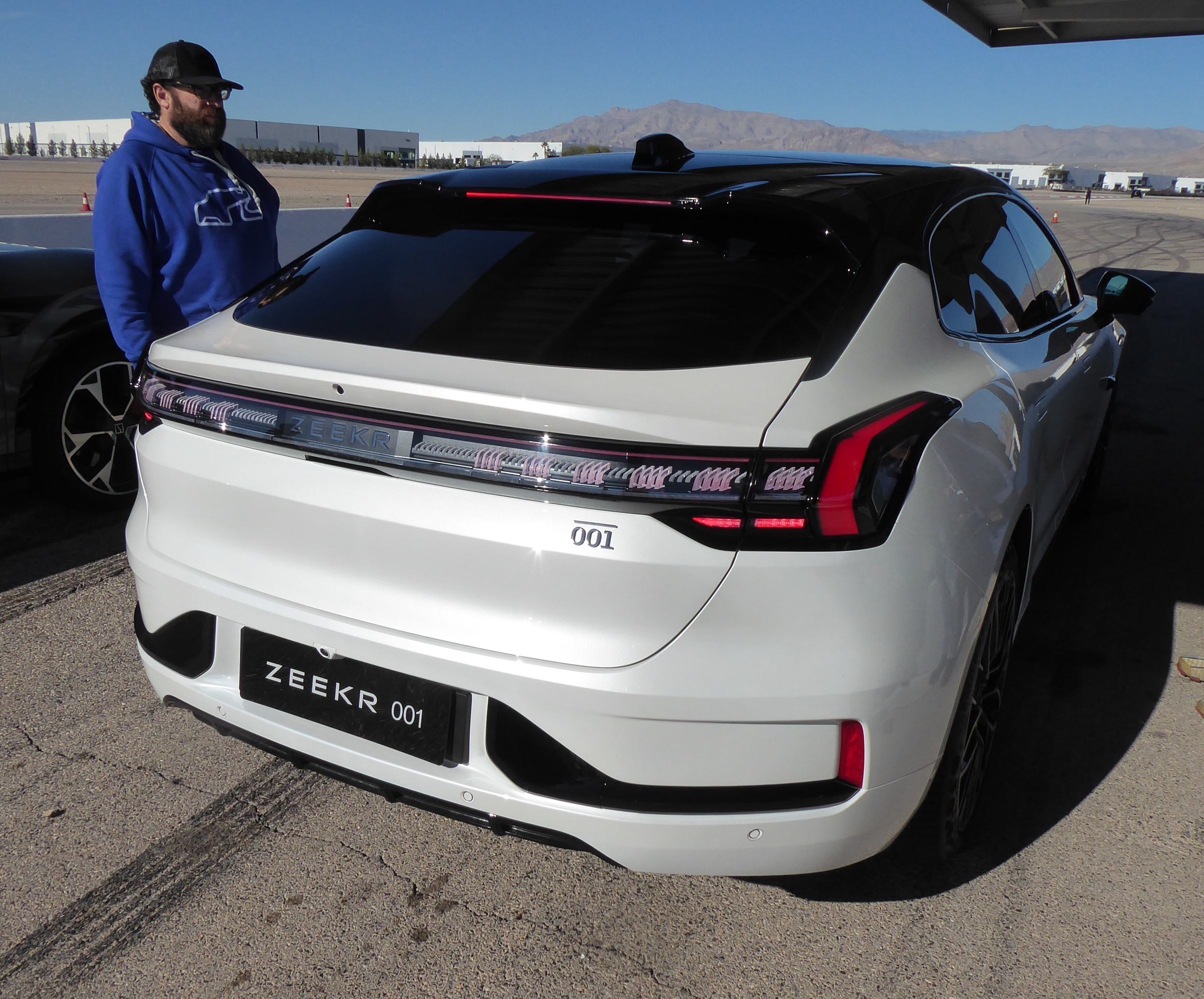
The Zeekr 001 is a road rocket. (Jim Motavalli photo)
I didn’t get to drive the vaunted Zeekr 001 EV because every other journalist was grabbing the keys, but colleague Vaughn said it was the best of the bunch, with up to 536 horsepower from twin electric motors. “Zero to 62 mph is listed at 3.8 seconds—very good for a vehicle that weighs 6,281 pounds. And it held on with minimal body roll in corners,” he said. Range is up to 384 miles by Chinese measurement, and the price of a base model AWD is an affordable $38,000. If you want even more, there’s the ultra-fast 001 FR, a cool $100,000 in China.
the 001 FR, that stickers for about $100,000 in China, so when you add a 100% tariff, the FR gets costly. But the AWD I drove had performance to burn and—let’s assume a $70,000 price tag?—would only cost somewhere near what a Hyundai Ioniq 9 costs and a lot less than a Lucid Gravity.
The bottom line is that Chinese cars are here (well, waiting at the border). They’re getting better, they’re remarkably affordable, and the only thing holding them back from a challenging position in the American market is Mr. Trump’s tariffs. Also, of course, they’re eating our lunch on EVs.
 Territorial Imperatives
hi Jim great report! thank you! I’ll pass this around. (as I often do with your newsletters!) JOhn