
This past weekend, a death in the family sent me 300 miles south, to Reston, Virginia. The luck of the test-car draw got us into a Volvo E30 Twin Motor Cross Country Ultra for that epic trip.
It’s a small Volvo EV with a relatively big price, $52,975 as tested, but to be fair this particular version is about as rich as it gets with the EX30. And on top of the trim there was $4,000 in extras, including the 18-inch all-terrain five-spoke wheels. And the bottom line is still within shooting distance of the average price Americans pay for a car.
Volvo is owned by China’s Geely, and the parts for this car were made in China, with assembly in Ghent, Belgium. For the record, with the exception of some minor trim pieces there’s nothing sub-standard about the build quality of these Volvos. The Scandinavian modern feel is intact, with very comfortable cloth seats. The latter was important because we traveled, three up, for five to six hours each way. The car is way fast, with 422 horsepower. “Whoa!” we said.
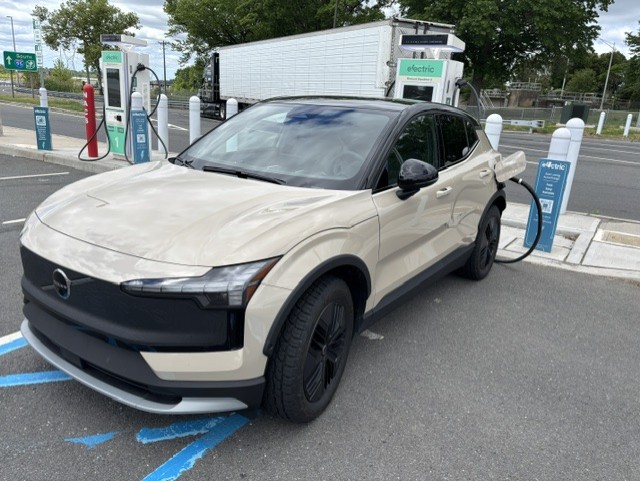
On paper the EX30 twin motor has 253 miles of range, and the single-motor version 261, but I’m guessing the gap would be greater in the real world. If you’re buying an EV, think really hard about whether you need the extra cost and reduced range of AWD. The single motor produces “only” 263 horsepower, so there is the performance difference to consider.
On a previous trip we had charging hassles on the New Jersey Turnpike, but that situation is cleared up now. AppleGreen’s chargers (see photo above) worked fine once we spent 10 minutes figuring out how they worked.
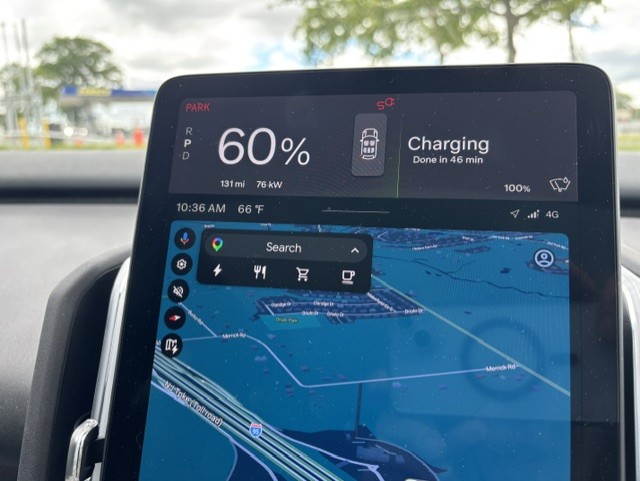
The rub is charge times. We opted to try and “top off,” the car relatively early. Bad strategy. With the car already two-thirds full the rate never got over 80 kilowatts on a fast charger (see below), and before we reached 75 percent it had dipped down between 35 and 40 kilowatts. This is the nature of the beast. If you want faster charges, wait until you’re below 50 percent. But in this case, reality meant a 50-minute wait, which was made more comfortable with coffee and scones from Starbucks.
We stopped once more on the way down, again with a fairly slow charge. And our hotel in Reston (Homewood Suites) had two EV chargers! One was out of order (actually never fully installed), but the other one was free. Now we were in the 240-volt Level Two world, which meant an eight-hour charge to full. I insisted we leave the nearly depleted Volvo where it was and turn my daughter’s Rogue into a clown car. I didn’t want to lose the space.
I felt vindicated when the car was fully charged in the morning, because we had a lot of work for it to do. It shuttled people back and forth all day, proving its very possible to live with an EV.
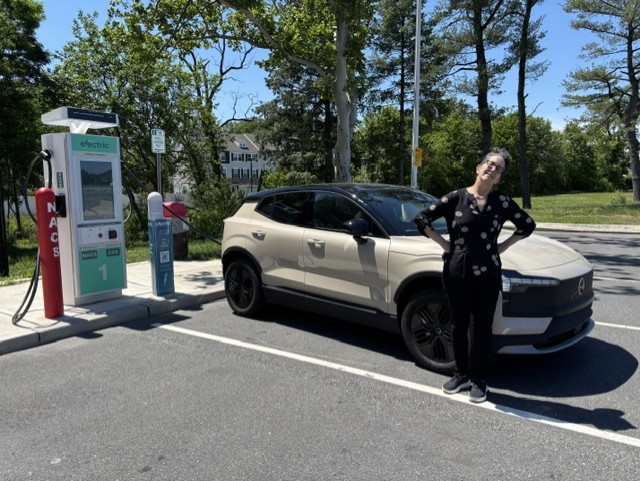
On the way back we were more charge-smart and only stopped once with the battery around 30 percent down. Now we saw some real fast charging, and were 100 percent full up before lunch was over. It was startling. We arrived home with about a 38 percent charge.
Around home I managed to cop a free charge at the local library—fortunate, since the single charger there is usually occupied. And I also tried out the 110-volt charger that comes with the car. Volvo’s cable (stored under the floor) is rather thick and awkward to use, and it doesn’t get you much—three to four miles per hour. I had a couple of false starts getting it to charge.
All in all, our long-distance trip, about 600 miles in total, worked out fairly well in the Volvo. Nobody was seriously inconvenienced, and the car was a pleasant—and quiet—place to be for a long haul. Connecting to Apple CarPlay proved a hit-and-miss affair, but we got by with the radio when we had to.

