Music From the Grassroots, and Some Live Shows

Tara Nevins had to think about it. “Yes,” she said, “it really is true that we’ve been doing Grassroots for 31 years.” Nevins is one of two front people in Donna the Buffalo, the un-characterizable rock band influenced by old-time country that calls Ithaca/Trumansburg, New York home.

Tara Nevins of Donna the Buffalo: To the accordion, add fiddle and washboard.

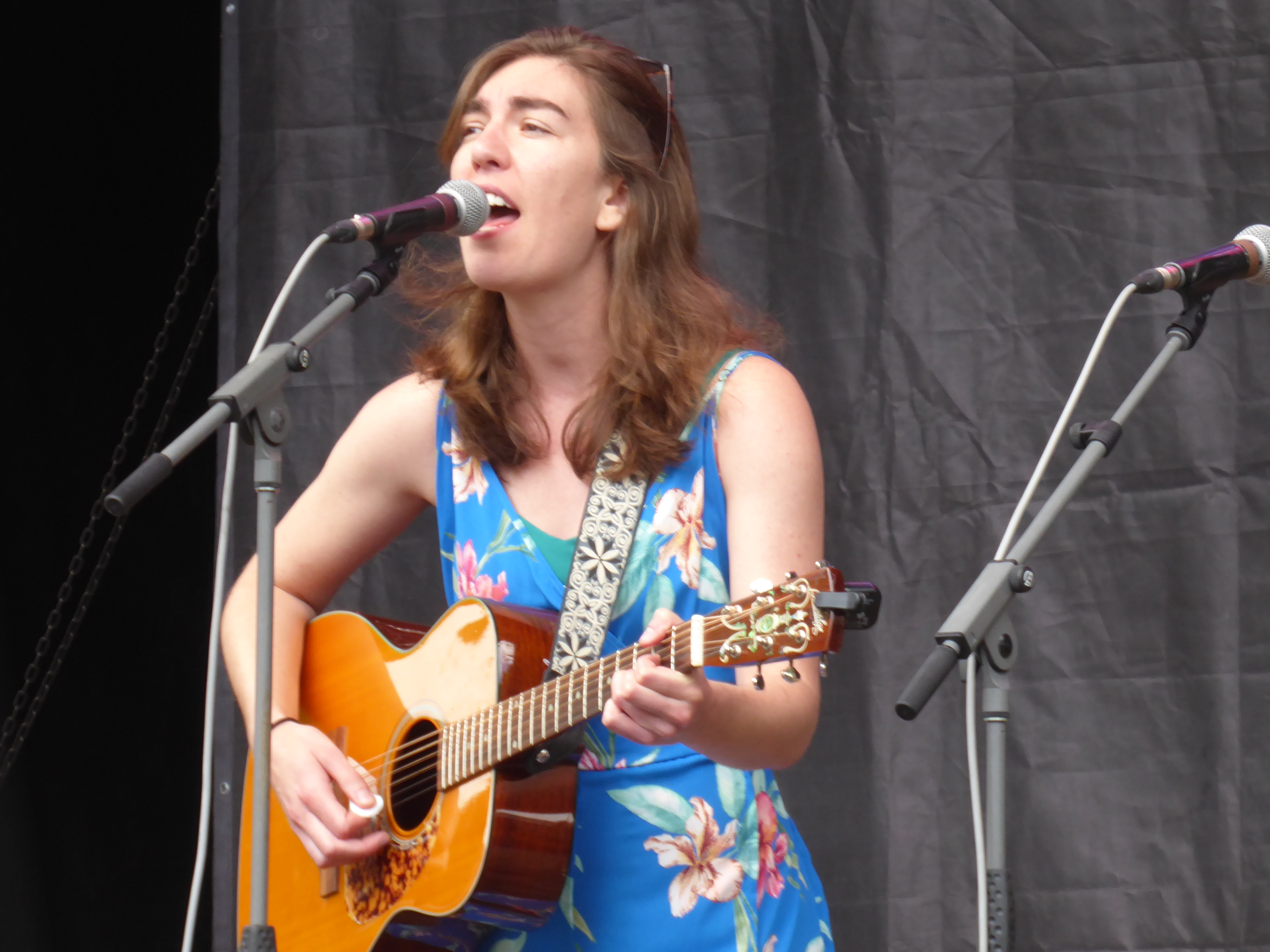
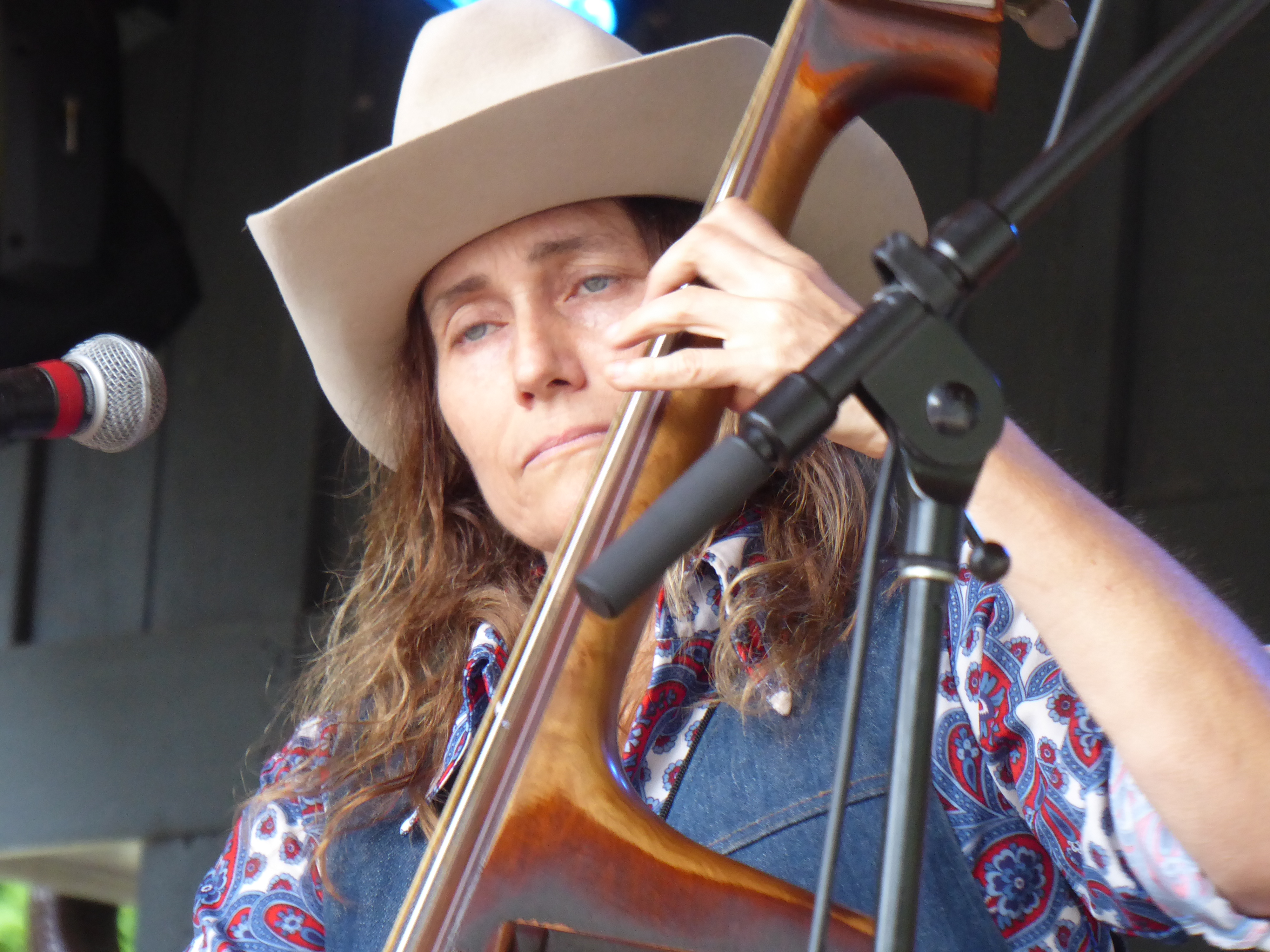
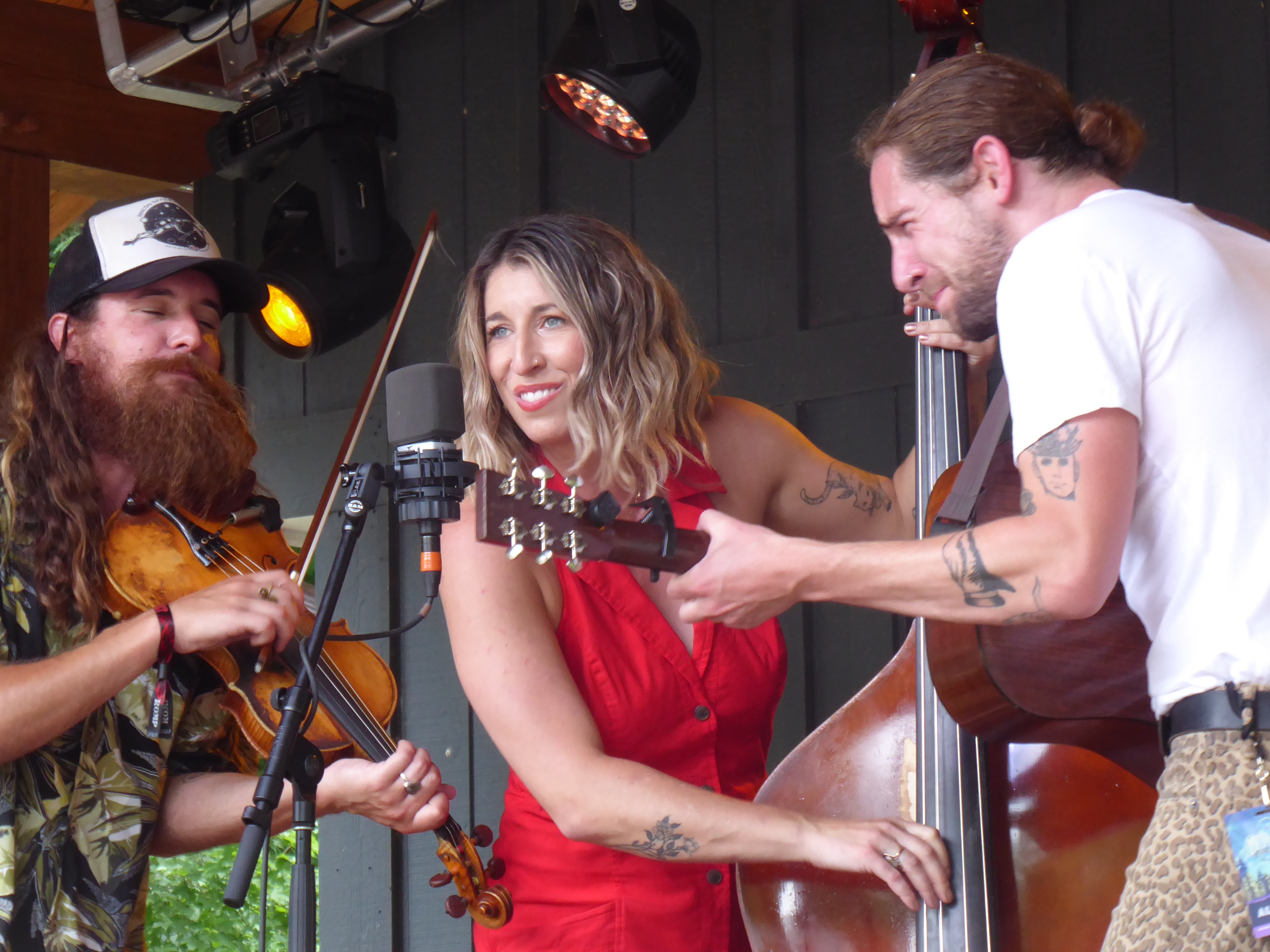
The Finger Lakes Grassroots Festival of Music and Dance starts today in Trumansburg, July 20, and runs through July 23. There are four days of event, four stages and more than 80 bands. What characterizes Grassroots is not a focus on big stars, though there are a few of those, but a celebration of the wide net that is Americana. At Grassroots, you guy expecting to hear a lot of music from performers new to you.

The names are Donna itself, Watchhouse, the Mavericks, Dirk Powell Band, Rising Appalachia, Jim Lauderdale, the Pine Leaf Boys, Keith Frank and Walter Mouton. They’re all great, but I’m also looking forward to seeing Vivian Leva and Riley Calcagno (now trading just as Viv and Riley), and the Cajun band Rose and the Bros, plus Rose’s other band, Richie and Rosie with former Donna keyboard player Richie Stearns.

But I love the names of some of the forthcoming acts: the Original Dead Sea Squirrels, Giant Panda Guerrilla Dub Squad, Ithaca Underground, the Grady Girls, Vicious Fishes, the Rollin’ Rust, the Flying Clouds of South Carolina. You can’t lose with acts like these.

Caught Live

I saw two shows as part of Concerts on the Hill at Christ Church, Easton, Connecticut. A duo called Anchor Amber includes my friend Dan Tressler, the sometimes-elusive folk savant of Fairfield County. Dan is adept on fiddle (he briefly taught my daughter) guitar and mandolin, and he’s a really great singer as well as a songwriter of some distinction.
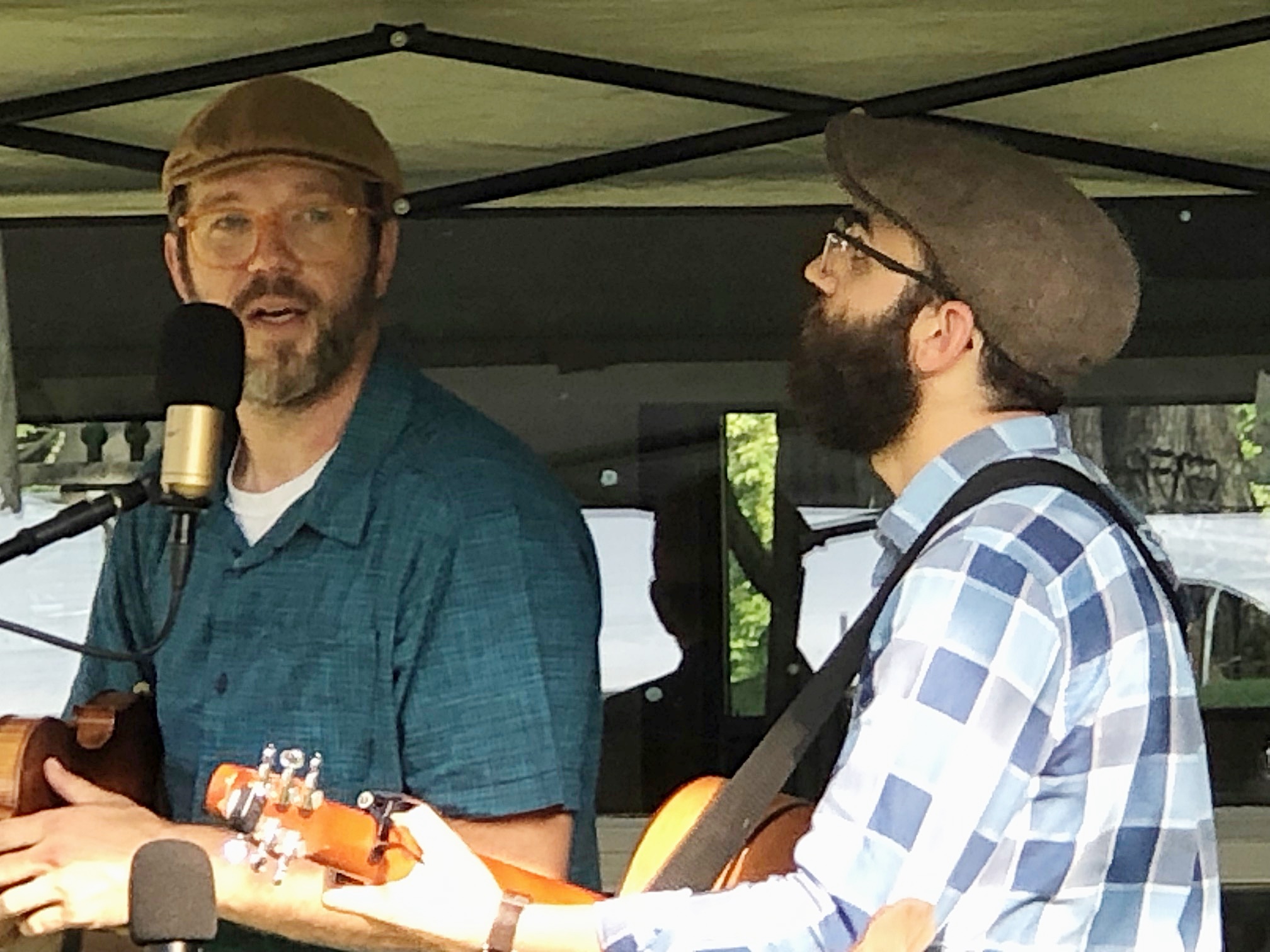
Amber Anchor, with Dan Tressler (left) and Jeff Smith. (Jim Motavalli photo)

Amber Anchor on July 2 consisted of Tressler and Jeff Smith, also a multi-instrumentalist (including on dobro) and singer. They came out with the vibrant “Lazy John,” fiddle and banjo. They were very entertaining, sailing through Iris Dement’s “Let the Mystery Be,” Tom Waits’ “Come on Up to the House,” Randy Travis’ “Digging up Bones,” and standards like Irving Mills’ “Straighten Up and Fly Right,” Hank Williams’ “Hey Good Lookin’” and Jesse Fuller’s “San Francisco Bay Blues.” They closed with “Amazing Grace.” I could listen to bands like this all night and, in fact, did.

Hitch and the Giddyup played July 17, after being rained out July 16. Vocalist/guitarist Dan Carlucci is a sometimes collaborator with the other Dan. Hitch is a full old-time/bluegrass band, featuring all great musicians, Pete Kaufman on banjo, David Kaye on mandolin, Bobby Csugie on bass and some lead vocals, and Kenny Owens on drums.

Hitch and the Giddyup, on the hill. (Jim Motavalli photo)

Together, these folks created some real rave-ups. Carlucci’s vocal mike got drowned out now and then, but the band was in fine fettle. Carlucci sailed through two broken strings, and offered some really sweet picking. Kaufman is a really great banjo player and composer, and Kaye’s fingers blurred on the mandolin. As with Amber Anchor, the bill was a mix of originals and covers. I loved their take on the Beatles’ “Dear Prudence,” about Mia Farrow’s sister during their sojourn in India. And John Hartford’s “Steam Powered Aeroplane” sure sounded great, and showcased the band’s prowess. Songs from Michael Martin Murphey, the Bottle Rockets, Steve Earle and the late Dave Hogan of the Rafterbats were heard. A song called “Meet Me at Mickey’s” made me want to investigate that Bridgeport canteen.

There are more Concerts on the Hill coming up.

I also checked out Charles Turner and Uptown Swing at the Levitt Pavilion on July 9. They’ve been there before, and wowed the place. Rain threatened (and indeed, arrived), cutting down attendance, but the band was undaunted and played most of their set.

Charles Turner (right) with one of the Swingettes, who were debuting that night. (Jim Motavalli photo)

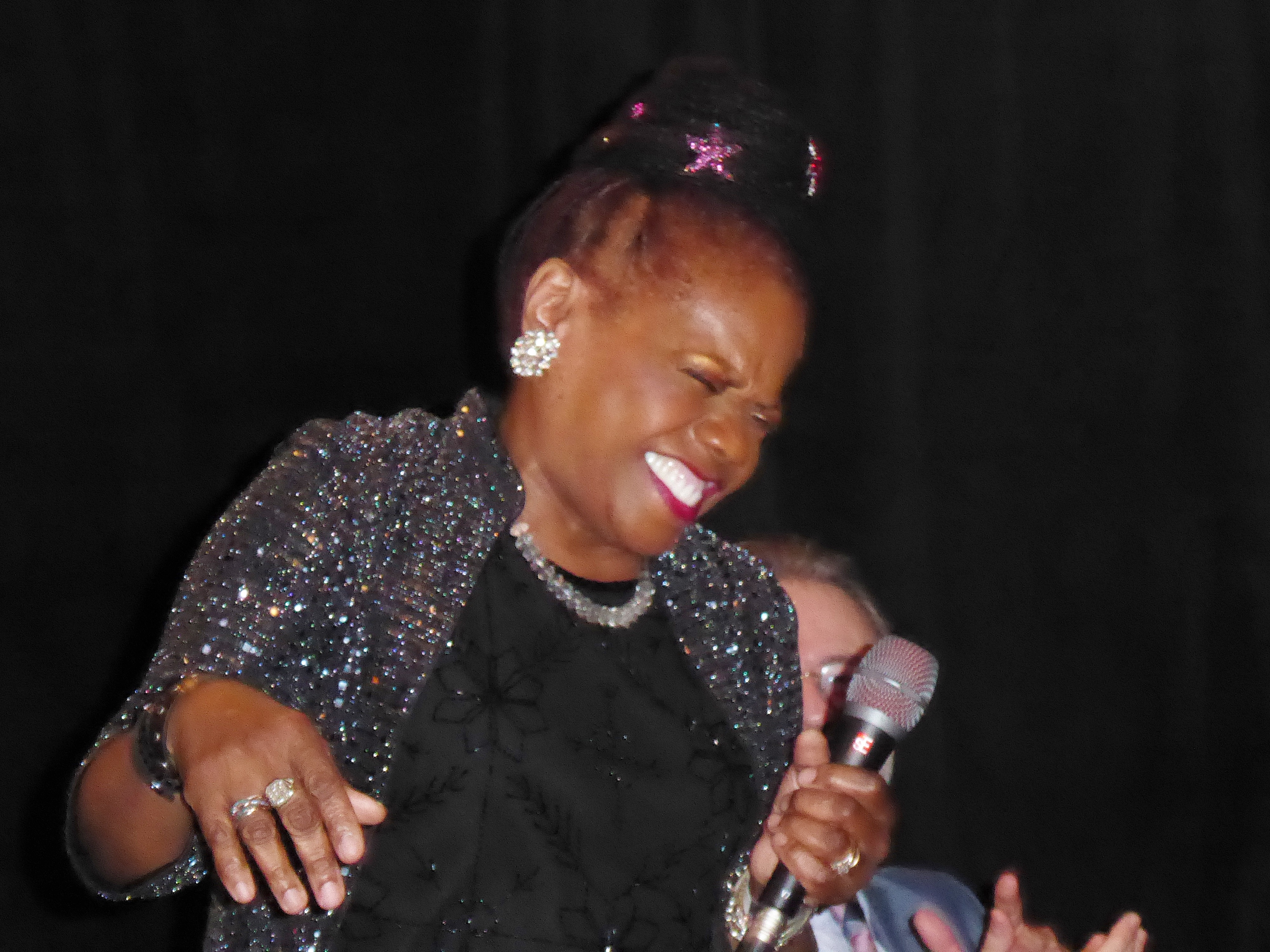
Turner is an energetic, muscular African-American jazz singer who includes his LGBGT identity in his act. He had a full band, featuring trombone, trumpet, a pair of dancers (“The Swingettes”), keyboards, bass and drums. They opened with “Fly Me to the Moon” (“How High the Moon” was later) for a straightforward take. Turner, who never stops moving, is a charismatic performer and fine resonant tenor vocalist who could also scat sing. He could easily anchor a musical—Broadway, are you listening?

Turner’s own “Bring Me to Fire Island” where “the scent of poppers is in the air” was a strong statement of identify, not to mention a really good jazz song. They moved through “Round Midnight,” “Sweet Georgia Brown” and other standards. I thought they were just fine (more Swingettes!), marred only by Turner’s tic of endlessly repeating a few words from the chorus of his songs as an excitement builder. It worked the first time. Check this band out if they’re playing near you, maybe on Fire Island.
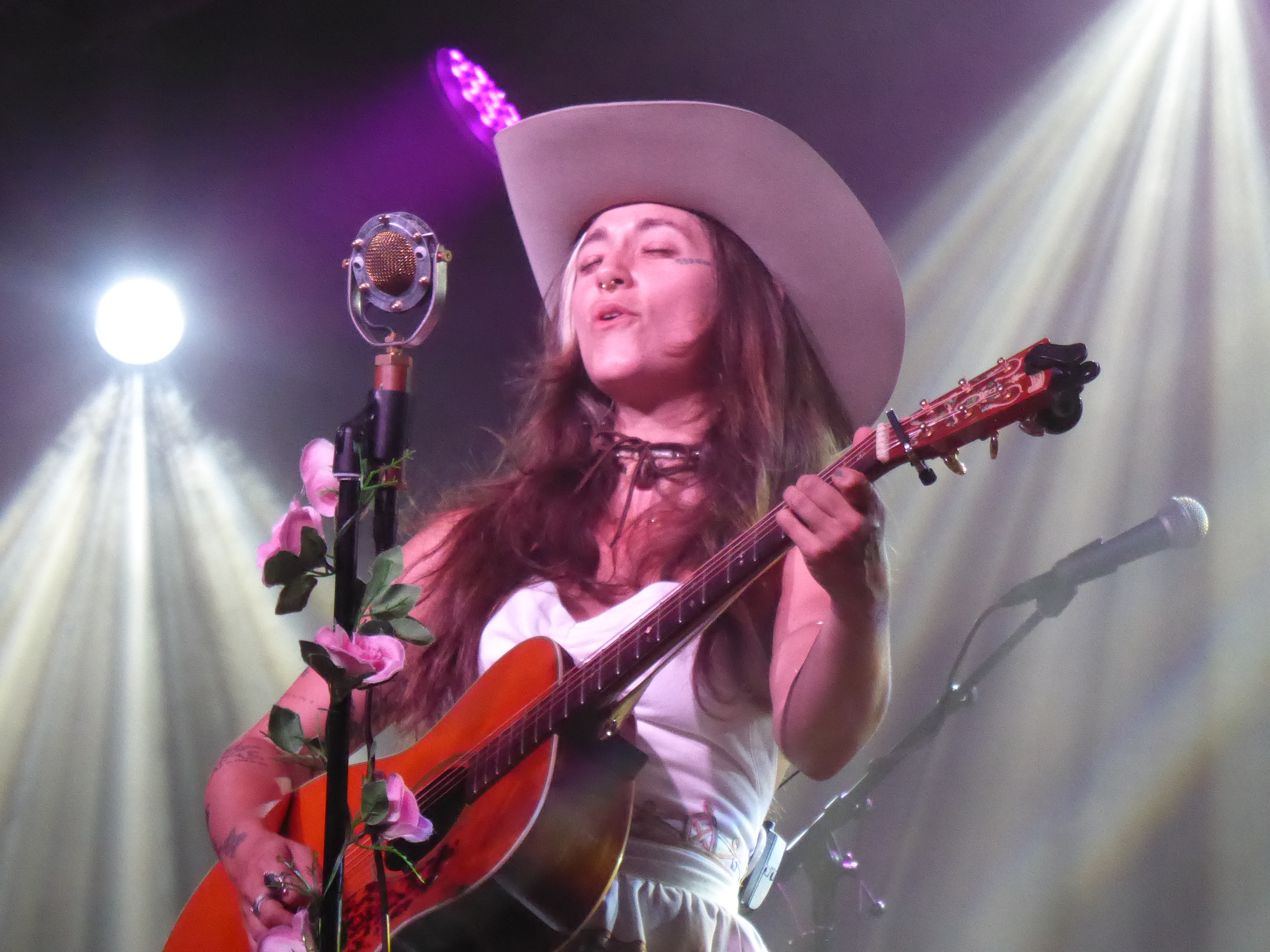
And the Rains Came: Red Wing 2023

Sierra Ferrell, in clover. (Jim Motavalli photo)

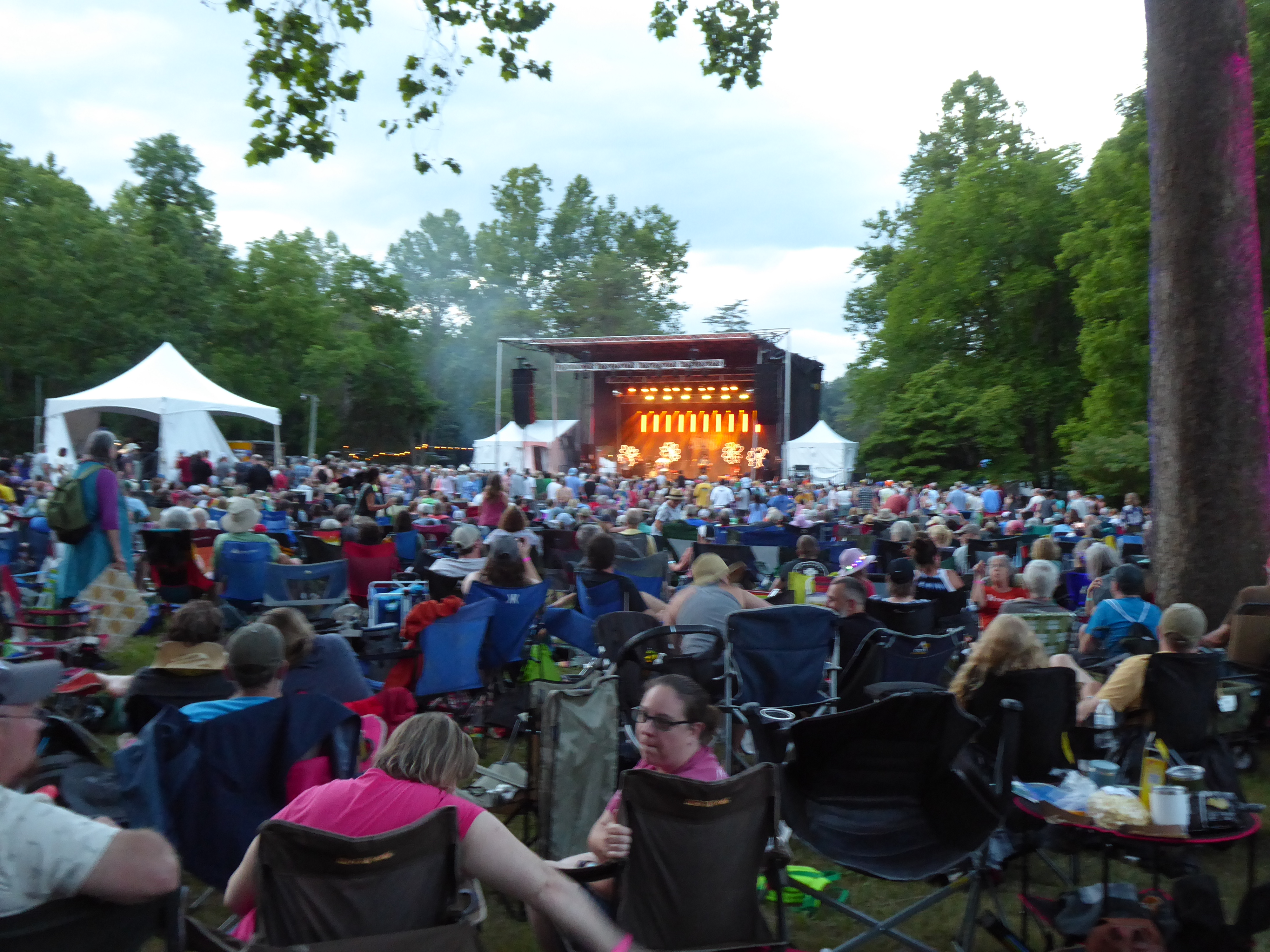
The heavens had their way with the 10th annual Red Wing Roots Festival in Mount Solon, Virginia, with thunder and lightning on Friday and Saturday June 23-24, causing site evacuations and a soggy parking lot. But the event was so well run that the evacuation was orderly, and alternative parking was quickly found. The bus drivers were amazingly stoked. The mud got covered in straw—it was like Woodstock ’69 (and I was there).

The Steel Wheels, from afar. (Jim Motavalli photo)

The Steel Wheels, an increasingly popular Americana band rooted in bluegrass and its antecedents, has run Red Wing since its inception, and they also open it. Among their many tricks, they turbocharge old-timey songs, including in this case “Jack of Diamonds” and “Cluck Old Hen.” The guitar/banjo/fiddle front line is very adaptable. The group boasts an abundance of vocal and instrumental prowess, including on a plethora of new originals. “Every secret is a station/Every whisper is a train,” that’s a good line. “Kitchen Girl,” an instrumental, pioneers a new category called “chamber grass.”

 Michaela Anne, not smoking. (Jim Motavalli photo)

Michaela Anne grew up in a military family, moving from post to post with a dad who was a submarine captain. At the age of 7, she became semi-famous with a song called “Hey Don’t Smoke.” These days, a number of her songs deal with that peripatetic youthful experience. She was the “new kid” a lot. The highly personal songs were good enough to get her signed to Yep Rock. James Paul Mitchell was on guitar.

Michaela Anne’s pick hit was the uptempo “If I Wanted Your Opinion, You’d Know It,” written with friend Mary Bragg. This is not a woman who welcomes unsolicited advice (including at the merch table) from men. Don’t say that her capo is in the wrong place.

The Larry Keel Experience sounded interesting but I only catch snatches, given the reality of only being able to visit one of five stages at any one time. But I was able to spend much more attention to A.J. Lee and Blue Summit. A.J. has a big voice, and all members of her young band can really play and sing. It was bluegrass, but also somehow not. “City of Glass” was a standout original, and they also did right by Rowland Salley’s “Killing the Blues” (a song that somehow works without any actual rhymes) and Bob Dylan’s “Meet Me in the Morning.” A favorite moment was when they suddenly switched to playing a more-than-competent swing tune, with jazzy solo spots for all the players.

Maya de Vitry just before the plug got pulled. (Jim Motavalli photo)

Portland, Oregon’s John Craigie teamed up with Maya de Vitry, about whom more later. He’s a self-effacing sort of guy who tells long, funny, relatable stories when he’s not playing songs that reminded me of Loudon Wainwright. “I was advised to come out and play all my hits, and as soon as I have any hits I’ll be happy to oblige,” he said. Craigie claimed to be paralyzingly shy, but it wasn’t apparent from his outgoing stage persona. “I Am California” was one of his better songs.

Melissa Carper: from the hills of Nebraska. (Jim Motavalli photo)

I quite enjoyed the set from Nebraska-born Melissa Carper. She has a from-the-hills voice reminiscent of Hazel Dickens, but her songs seem to incorporate a variety of influences, including honky-tonk and the Great American Songbook. She is old-fashioned in the best sense, and her music would play well at a 1962 concert in a VFW hall. Most of all, songs like “My Only Regret” have a welcome swing to them. Did I hear her right in saying she had a song on Star Trek? She ended with “Don’t Let the Aliens Take Him Away,” so maybe that was the one.

Reeb on the left, Caleb on the right. (Jim Motavalli photo)

The Caleb Klauder and Reeb Wilms Band serve up classic country songs that could have been written in the ‘50s but were instead likely penned last week. The pedal steel was helpful. Klauder is a fine mandolin player as well as singer. Wilms invokes her farm childhood very well in a song called “Same Old Heart.” Their tunes have swing in common with Carper—you could dance to the best of them. The Lil Smokies had energy and a jam band feel, and drew a hugely enthusiastic young crowd to the Roots Stage. Similar to them were Sam Burchfield and the Scoundrels and Goodnight Texas.

The big-voiced Miko Marks. (Jim Motavalli photo)

If you like big-voiced African-American folk/rock divas like Odetta and Mavis Staples, you’d love Miko Marks, born of a single mother in Flint, Michigan.  Her versions of Stephen Foster’s “Hard Times” and the Monroe Brothers’ “Long Journey Home” really connected. Marks took a long break from music but is now back at it, and things seem to be working for her.

The famous Natural Chimneys. (Jim Motavalli photo)

I only heard about 30 seconds of Old Crow Medicine Show, playing at around 8 p.m. Friday night, when the plug was pulled on them and the entire audience was sent off the site because of lightning nearby. Nobody got trampled; it was all very orderly, but the torrential rain turned the parking lot into solid mud. The later evening shows had to be canceled. Early Sunday the same thing happened again about five songs into an excellent solo set from May de Vitry. (You may know her from the Stray Birds, whose bass player, Charlie Minch, remains onboard). The storm turned out to be fleeting, and we only had to shelter under some wooden roofs for a short time.

Damn Tall Buildings in full cry. (Jim Motavalli photo)

On Saturday, the parking lot remained unusable but some alternatives were found and everyone got in. The first thing heard was Damn Tall Buildings, who put a lot of old-timey in their music (Bill Monroe’s “Uncle Pen”) but also Roy Orbison’s unkillable “Blue Bayou.” Sasha Dubyk is a fine singer, and Avery Montana has solid fiddle chops.

Palmyra plays “Shenandoah.”

Palmyra, formed at nearby James Madison University, was an interesting band. These long-haired guys seemed too young to be so depressed! “The older I get the more restless I get,” was one line. “When did I start losing my grip?” was another, and “I’m so damned lonely” a third.

Palmyra has a rough time on the road. (Jim Motavalli photo)

One of the two principal songwriters “had to be talked off a ledge.” But they rallied to perform an excellent version of “Shenandoah,” with local relevance.

Seeing Hubby Jenkins (above) is like having a black musical history lesson. He’s an amazing banjo player, opening with a fast improvisation with vocal interjections. He offered a long gospel medley (see below) and talked about the influence of the church and the coding inserted into the songs. Moving chronologically, he talked about the bizarre blackface minstrel tradition, which typically only accepted real African-American musicians if they performed with their faces blackened. And he talked about early recording figures like Ralph Peer (who waxed the country music session that gave us the Carter Family and Jimmie Rodgers) but who wanted black performers restricted to blues and jazz (so-called “race” records).

Jenkins played songs like “Little Log Cabin in the Lane”—essentially an older black person waxing nostalgic about slavery days—through huge layers of irony. The banjo is an African-American instrument, but it was wholly appropriated by white country musicians, and few recordings of black string bands were made. That legacy is now being recovered through musicians like Rhiannon Giddens and Hubby Jenkins.

Danny Knicely (center) with Chao Tian and an ace band. (Jim Motavalli photo)

For something entirely different there was the group led by old-timey musician Danny Knicely (an ace mandolin player), complemented by Chinese dulcimer player Chao Tian and group. It was really effective fusion music, with jazz, Americana and Asian music all blending into a very listenable mix. Transcendent, really.

The Honey Dewdrops. (Jim Motavalli photo)

The Honey Dewdrops, Kagey Parrish and Laura Wortman, make a fine noise. Wortman is a really strong songwriter with a lovely voice. Parrish can play anything with strings (especially electric guitar and mandolin) and has a high voice that he nonetheless uses to good advantage on songs like “When God Made Me (He Made a Rambling Man).” There’s a bit of Hank Williams in what he does. The duo harmonizes well.

Peter One: His group got bigger. (Jim Motavalli photo)

I’ve been enjoying the music of Peter One, from the Ivory Coast, on his new album. He came out solo, then was joined by two singers, a keyboard player and—amazingly enough—pedal steel. It worked just fine, singing in French and English. The pick hit is “Don’t Go Home.”

By then it was dark and time for Sierra Ferrell, who just gets better and better. She was first encountered on the Red Wing Roots Stage two years ago, and since then her career has taken off meteorically on the strength of constant touring and a superb first album.

Ferrell is a real character, one of our very best songwriters, and a snappy dresser, too. Check out her many flamboyant YouTube and Instagram postings. She was in a white backless number at Red Wing and her band was in black, and everyone wore hats. It’s hard to see how her set could have been improved. She tore through most of her first album, and previewed much of her soon-to-be-released second. “I Can Drive You Crazy” is a future classic. Her band is super-tight, both in its virtuoso-level playing and its coordinated movements. I knew Ferrell was a good guitarist, but she also offered some competent fiddle work.
And Ferrell is an absurdly charismatic leader, with a voice that cuts through like a buzzsaw. The audience was in her corner before the music started—many people knew all the words—but by the end of the long set they were ready to follow her anywhere. I was too. A fine collection could be made of her cover songs, including “Gum Tree Canoe,” a 19th century favorite, and Patsy Cline’s “I Fall to Pieces.” In her Red Wing set were the traditional “Don’t Let Your Deal Go Down,” John Anderson’s “Years” and the Beatles “Don’t Let Me Down.”

A lovely event, despite the thunder and rain, thanks to the hard-working and expert Red Wing staff.

Two Magical Nights: Bill Frisell and Samara Joy

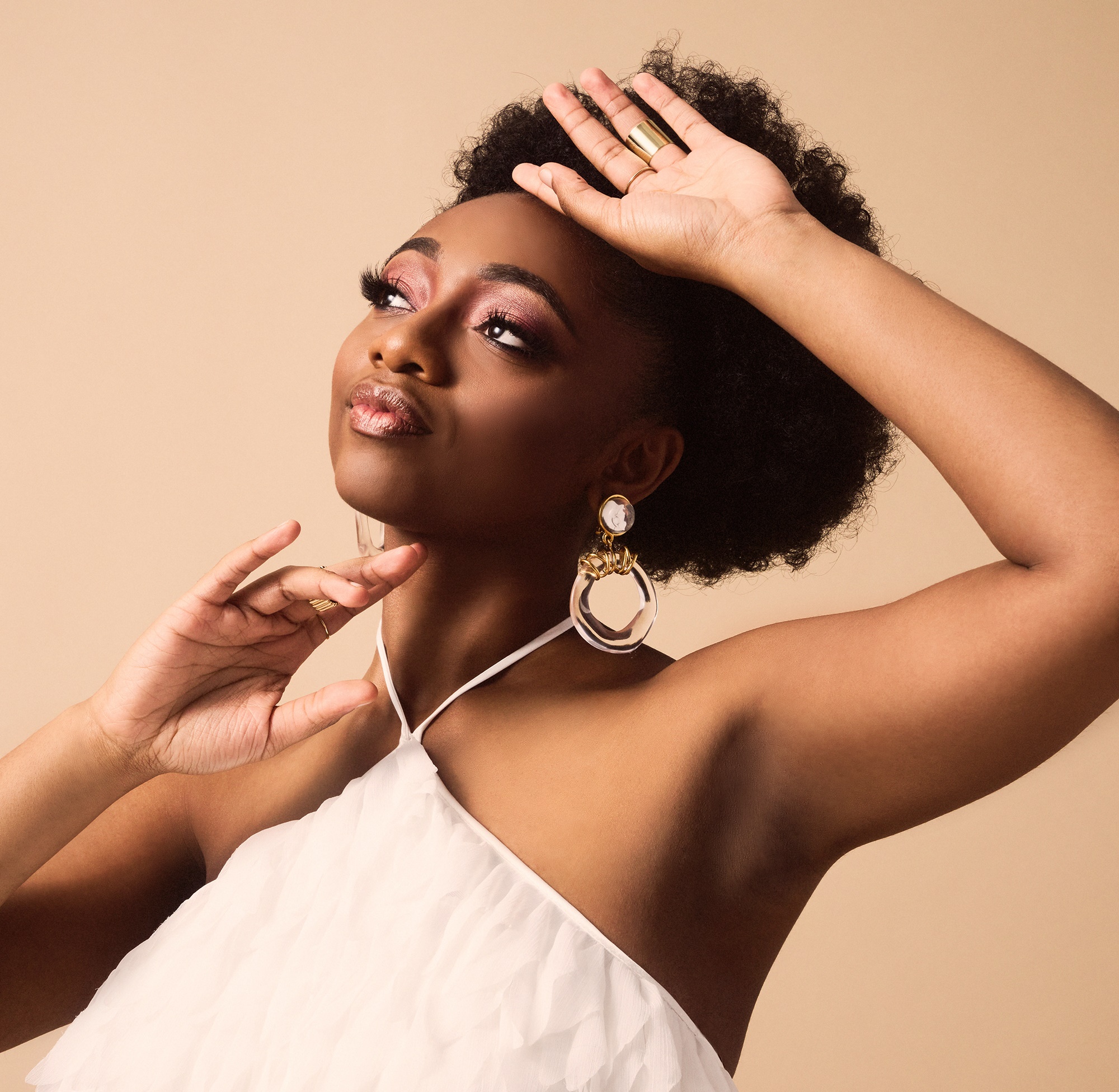
I saw jazz singer Samara Joy for the second time at the Levitt Pavilion in Westport, Connecticut on June 3, one night after seeing guitarist Bill Frisell at the Sacred Heart Community Theater in Fairfield, Connecticut–one town over. What an amazing one-two! They were both superb, in very different ways.

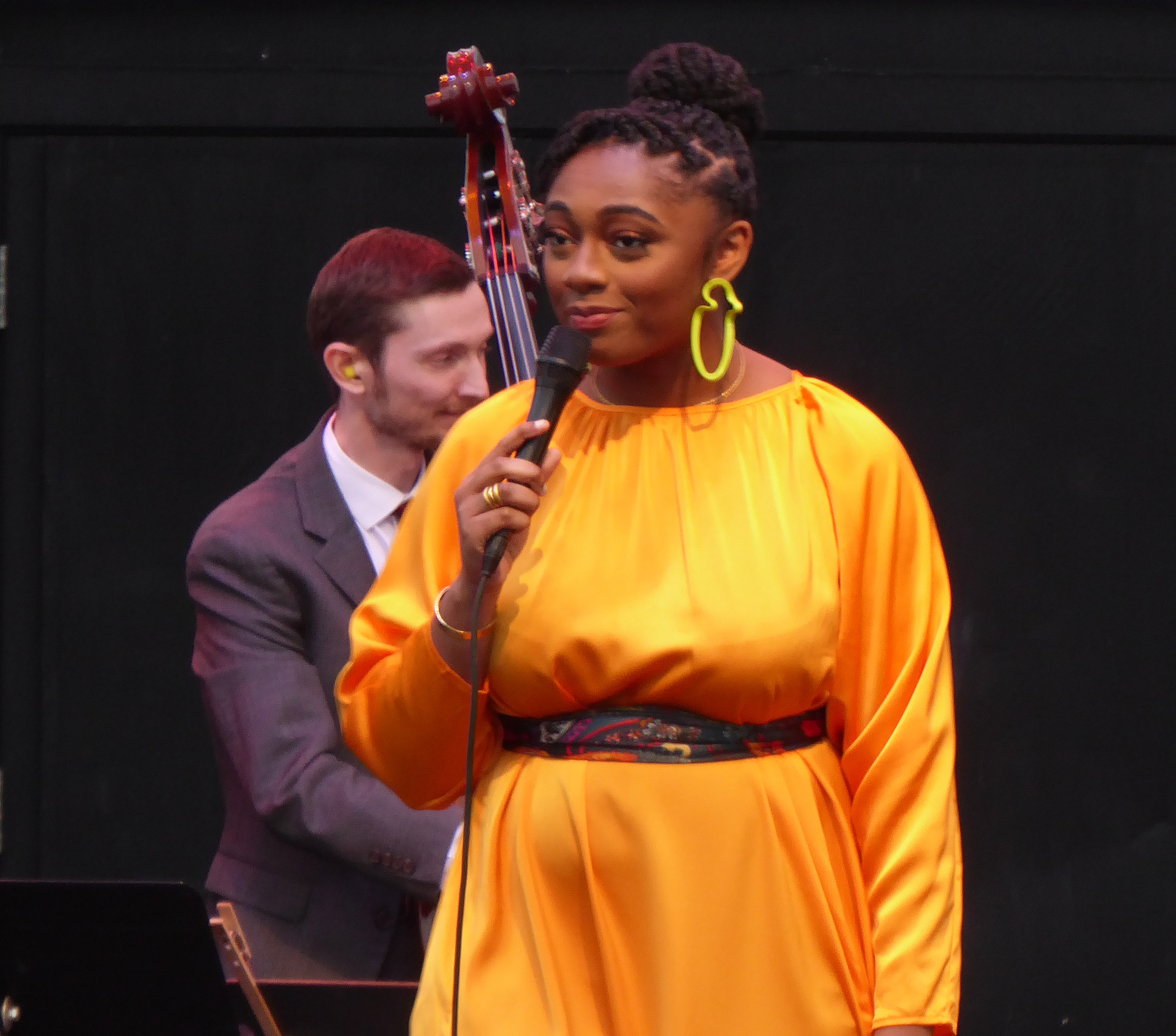
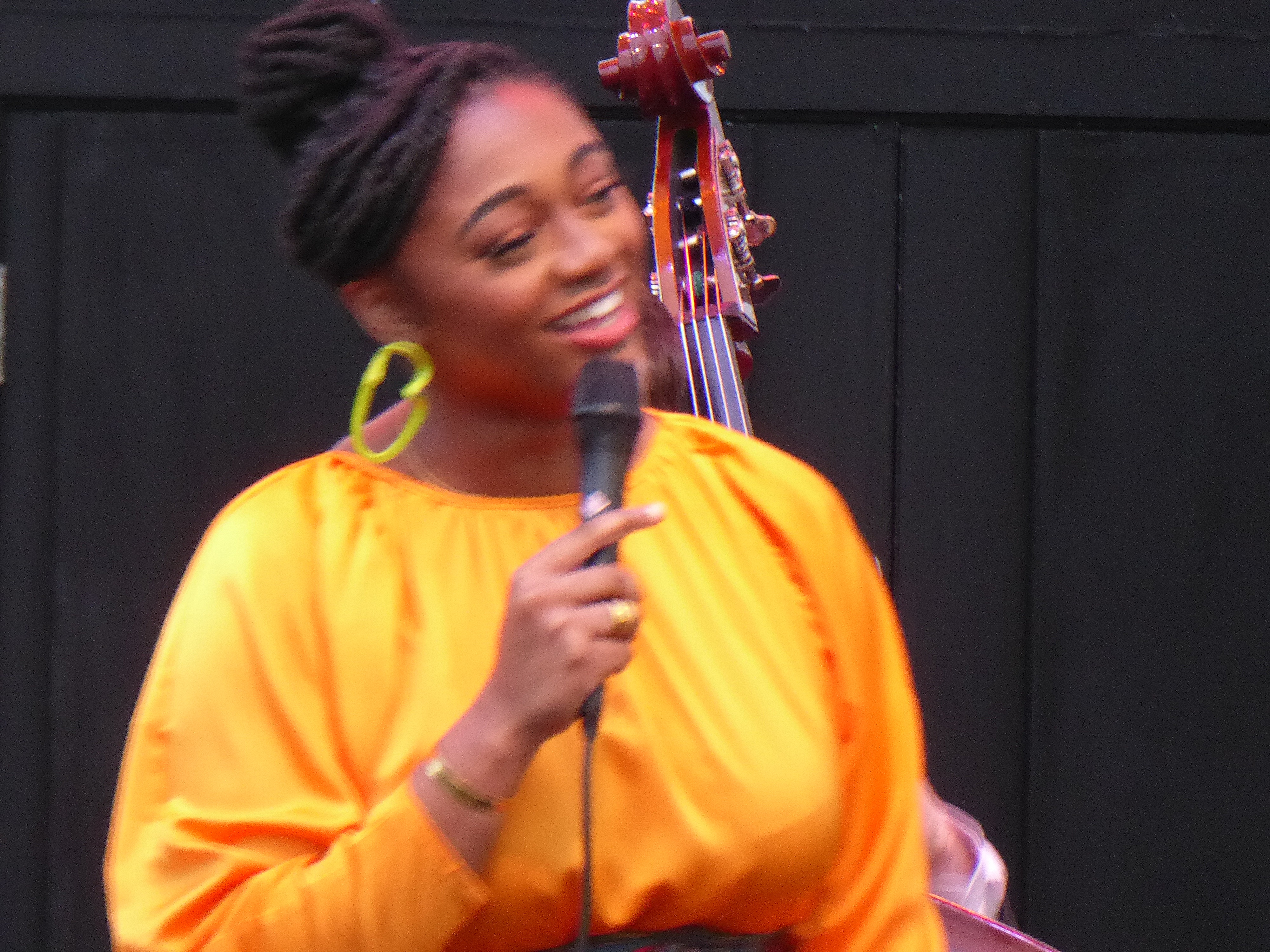
It was an uncharacteristically chilly night at the Levitt, which stages a full program of summer shows. The wind chill off the adjacent Saugatuck River made it feel even colder, and Joy—who was in an ebullient mood—acknowledged the heartiness of the audience. Her performance was unaffected, though she wore only a billowing bright orange stage dress. In fact, since I saw her at Queens College—before the two Grammys—she has only grown as an artist, and in Westport scat sang with abandon, held notes and in general exulted in the sheer power of her improvisatory voice.

With Luther Allison on piano, Evan Sherman on drums and Marty Jaffe on bass, she would have lifted the roof off the Pavilion—if it had one. On “No More Blues,” an Antonio Carlos Jobim/Jon Hendricks composition, she held on to the “S” in “Blues” until it screamed. She flawlessly essayed the Portuguese lyrics, too. Joy must be wearing out her copy of Inside Betty Carter because she frequently references songs from that superb 1964 outing, including in Westport “Beware My Heart.” Allison was very strong on this one. Jaffe was also great, though over-amplified through no fault of his own. Joy’s take: “Beeeeewaaaare my heart.”

The Billy Mays/Milt Raskin “Somewhere in the Night” she got from jazz singer Teri Thornton and her 1963 recording. As Joy noted it was the theme song for the popular TV show Naked City. Up next was Joy’s version of the ill-fated trumpet player Fats Navarro’s “Nostalgia,” with her lyrics to the trumpet solo. This is, of course, what Lambert, Hendricks and Ross used to do, and her roller-coaster treatment was up to their high standards. And then another Betty Carter song, “Tight Mr. Gentleman,” taken at a fast tempo as Betty was wont to do, with on-a-dime turnarounds and acapella sections.

Joy’s version of Monk’s “Round Midnight” included the Bernie Hanighen lyrics, of course. It was a brilliant version. She mentioned that Margo Guryan, little remembered today, wrote lyrics for many jazz standards. Among the musicians who benefited from her words were John Lewis, Ornette Coleman (“Lonely Woman”) and Arif Mardin. Of course, she also wrote “Sunday Morning,” a hit for Spanky and Our Gang. I love that Joy researches the songs she sings. She also finds relative obscurities such as another Monk song, “Worry Later.”

From the bestselling Linger Awhile (now in an expanded version) she sang Nancy Wilson’s “Guess Who I Saw Today,” which was written by Elisse Boyd and Murray Grand. The song reminds me of June Christy’s “Something Cool,” which is full of similar 1950s specificity. Wilson’s version is nice, but I have to say that Joy kills the thing.

Joy’s family was in the front row. Maybe that’s why she was so good. But I suspect she’s always going to be that good.

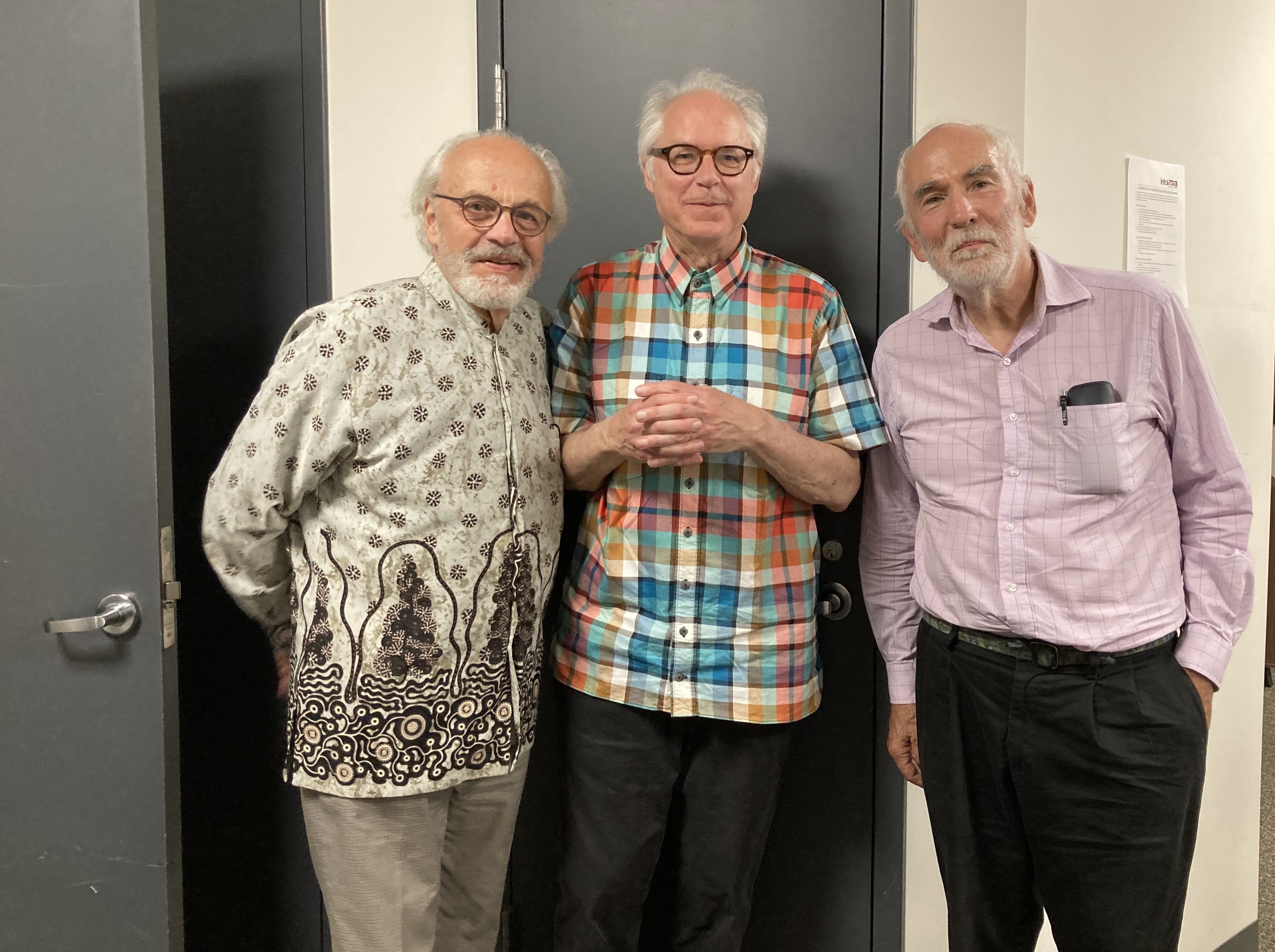
The author (right) with, at left, Joe Celli (WPKN programmer who presented Frisell in concert in downtown Bridgeport years ago) and the amazing Bill Frisell. (Jin Hi Kim photo)

For Frisell, I didn’t take any notes, I just let his beautiful music wash over me. So instead of offering a blow-by-blow of his trio show with Thomas Morgan and Rudy Royston, I offer these quotes from the WPKN interview I conducted with him a few days before the show.

Were you happy with the Phillip Watson biography Beautiful Dreamer?”

Happy, yes, it’s hard to describe what I feel about it. It’s so intense. Try to imagine someone going through your entire life, every moment. I spent a lot of time with him, he came to my house, he rummaged through my basement, he talked to so many people. And I spent so much time with him. But then he went away to write the book. I had no control over what it was. And then he came back and said, “Hey, Bill, it’s all done and I want you to read it all through.” It was one of the strangest and most intense thing ever. I would say he was very, very thorough and very careful. He wanted it all to be correct, and he did an incredible job.

Why no bass on the 2023 Blue Note release Four? The album features Gerald Clayton on piano, Gregory Tardy on sax and clarinet, and Johnathan Blake on drums.

I just wasn’t thinking about it. I was thinking about that combination of personalities together, and it was only later it dawned on me, “Oh, wait, there’s no bass.” I’d had a dream about playing with those specific people, the way their minds would work together. I spoke to Don Was, the president of Blue Note, and he said, “Wow, let’s do it,” and suddenly it became real. I had a moment of panic when I thought about getting a bass, but no, I stuck with the original idea.

I love the diversity of your music, and your embrace of Americana.

When I was in high school, I was so fired up about music and the way one thing would lead to another. I really loved Bob Dylan, and I loved James Brown, and I was listening to all this blues stuff. And then I went and heard Charles Lloyd’s band with Keith Jarrett on piano. So I bought a Keith Jarrett record and Charlie Haden’s on it and they’re playing a Bob Dylan song. It’s a continuous stream of music really.

A Saab-y Visit to Caffeine & Carburetors

NEW CANAAN, CONNECTICUT—Lawrence Allen is the retired head of the in-house publishing department at the Museum of Modern Art. He’s also a dedicated Saab guy, who bought his first one (an ’84 three-door, new) when he was 29 but likes to have only one at a time. The current car is a 1993 900 Commemorative Edition coupe, number 48 of 325, with a plaque to prove it.

Lawrence Allen’s 1993 Saab 900CE with Allen on the right and Tim O’Sullivan on the left. (Jim Motavalli photo)

The latest adventure started when a neighbor said to him, “If you love them so much, why don’t you get another one?” The car was tracked down online. Allen’s 900 CE is the nicest I’ve seen, with an uncracked dash top that he drove all the way to Delaware to obtain. The walnut-grain dash that was standard on the CE had to be remade—carefully.

The Saab started out as a California car, sold new by the dealership in Santa Monica for $33,085 (including $24 for the cassette holder still in place). The west coast setting preserved the body and remarkably didn’t dry out the tan leather seats, which are as original. “I’ve spent the last two years trying to simultaneously put it back together and to educate myself.” He cites the kindness of the Connecticut/Massachusetts/Rhode Island Saab community in getting the car to show condition.

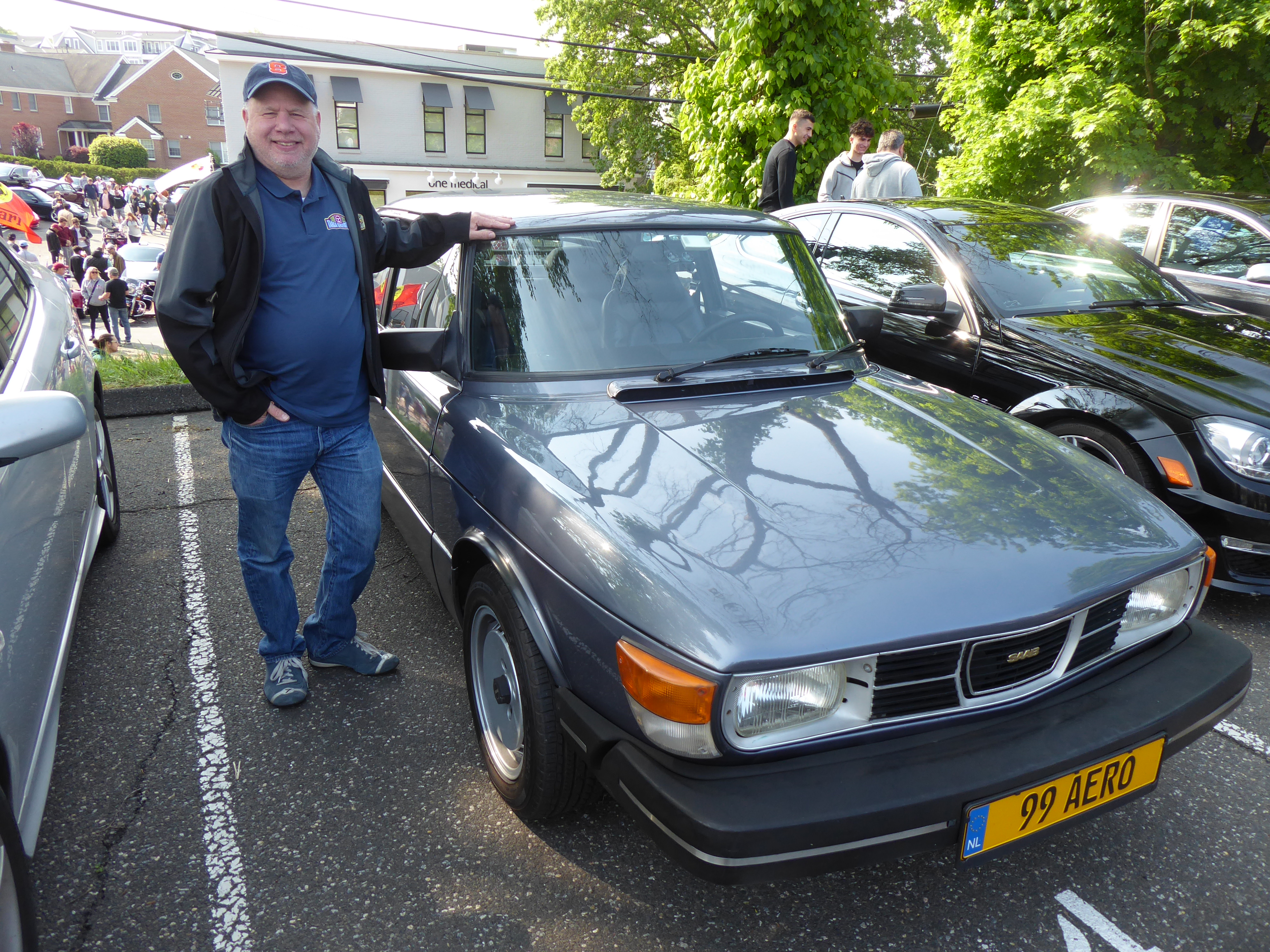
Lewis Eig with his “99 Aero” (actually a 1984 99 GL with a 16-valve conversion). (Jim Motavalli photo)

Allen was encountered May 21 on the ground at Caffeine and Carburetors, the truly wonderful and informal old car gathering in New Canaan, Connecticut. These cars and coffee events have caught on across the country—take a look, there’s probably one near you. In a parking lot around the corner I met Lewis Eig, who drove up from northern New Jersey in his 1984 eight-valve 99 GL, an import from the Netherlands, now converted to 16-valve turbo and wearing a fanciful “99 Aero” plate. Eig, whose father started him on Saabs, is a very hands-on guy who also restores Porsches—and plans vintage rallies.

“I’ve had 30 or more Saabs over the years,” Eig said. “I had a little side hustle through high school and college fixing them for cheap. Paid my way through school. Professors with Saabs would give me an easy A. And on my first job, my boss in Ridgefield, Connecticut had a 900 SPG that he couldn’t keep running. I’d bring it home every weekend to make it right. No doubt the Saab connection got me that job and kept me employed during the slow economy of the early 90s.” He regrets selling his silver two-stroke Sonett.

Tim O’Sullivan, a friendly Irishman met on the street, talked about his eight Saabs—and extensive history of working on them in and around Connecticut.

The RV8, rare in the U.S. (Jim Motavalli photo)

Walking around Caffeine & Carburetors is always a rush. The first car I ran into after Eig’s Saab 99 was a right-hand-drive MG RV8. You don’t see those every day. These cars were first conceived in 1998, after British Motor Heritage started building MGB bodies. The RV8 has a 3.9-liter Rover (a/k/a Buick) V-8 with 185 horsepower—about the same as the Saab 900 CE! Only 1,983 were built.

Yes, that is a Maxton! (Jim Motavalli photo)

A row of restored Schwinn bikes, made new again by Jim Cooper in Norwalk, Connecticut, was nice to see. How many 1992 Maxton Rollerblades have you seen? These cars, inspired by the Lotus 7, are fairly basic—and this one was #16 of 51. British cars abounded, including several original Minis and Mini Coopers, plus Austin-Healeys (a ragged but right 100), Triumphs and Jaguars (exquisite XK120s).

Minis abounded at Caffeine & Carburetors. (Jim Motavalli photo)

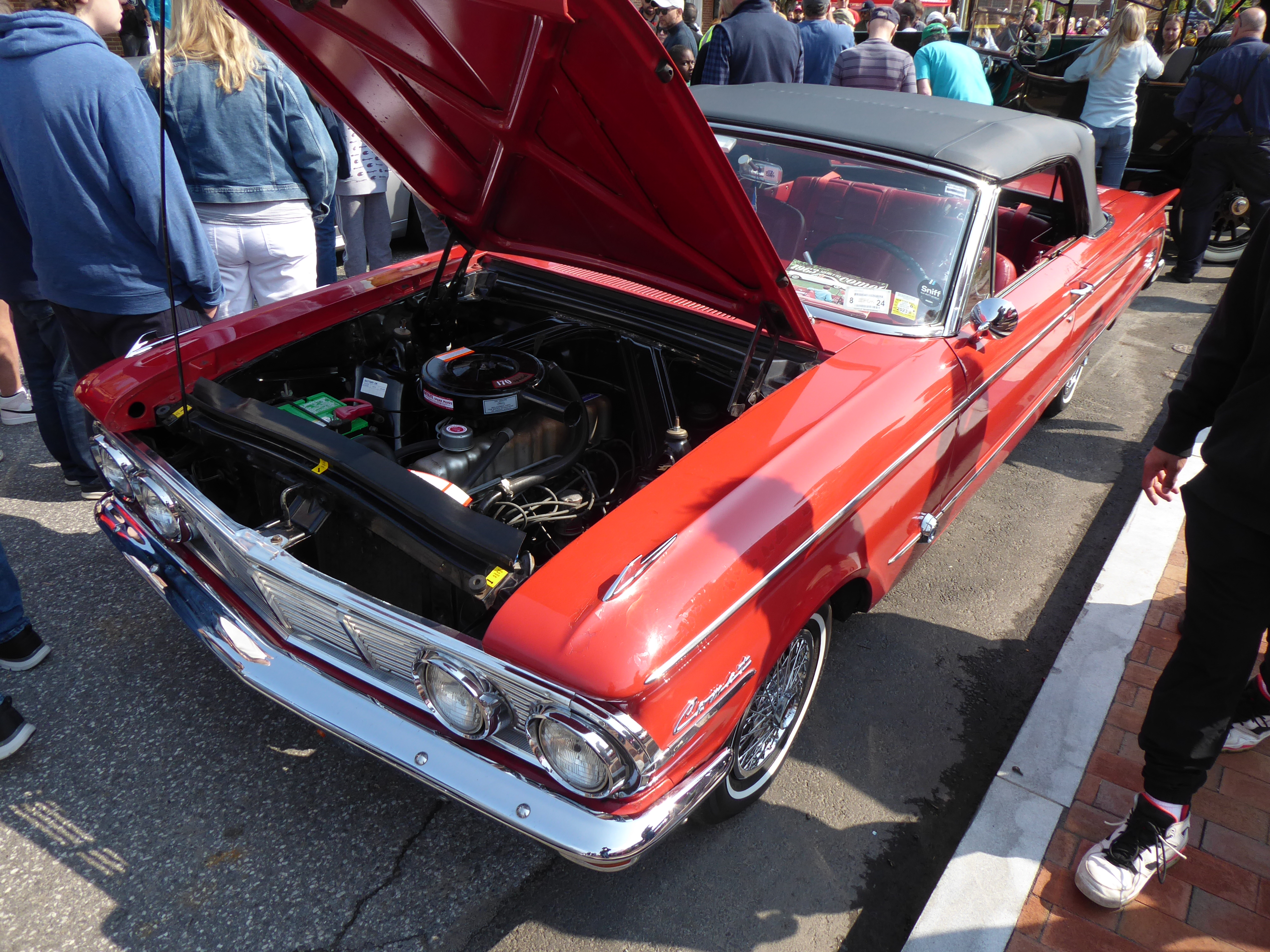
A beautiful red 1963 Mercury Comet S-22 convertible with bucket seats and a console reminded me of the 1964 Comet Caliente ragtop I used to own. I’ve had a lot of cars!

The 1963 Mercury Comet S-22 convertible was a “compact” in its day. (Jim Motavalli photo)

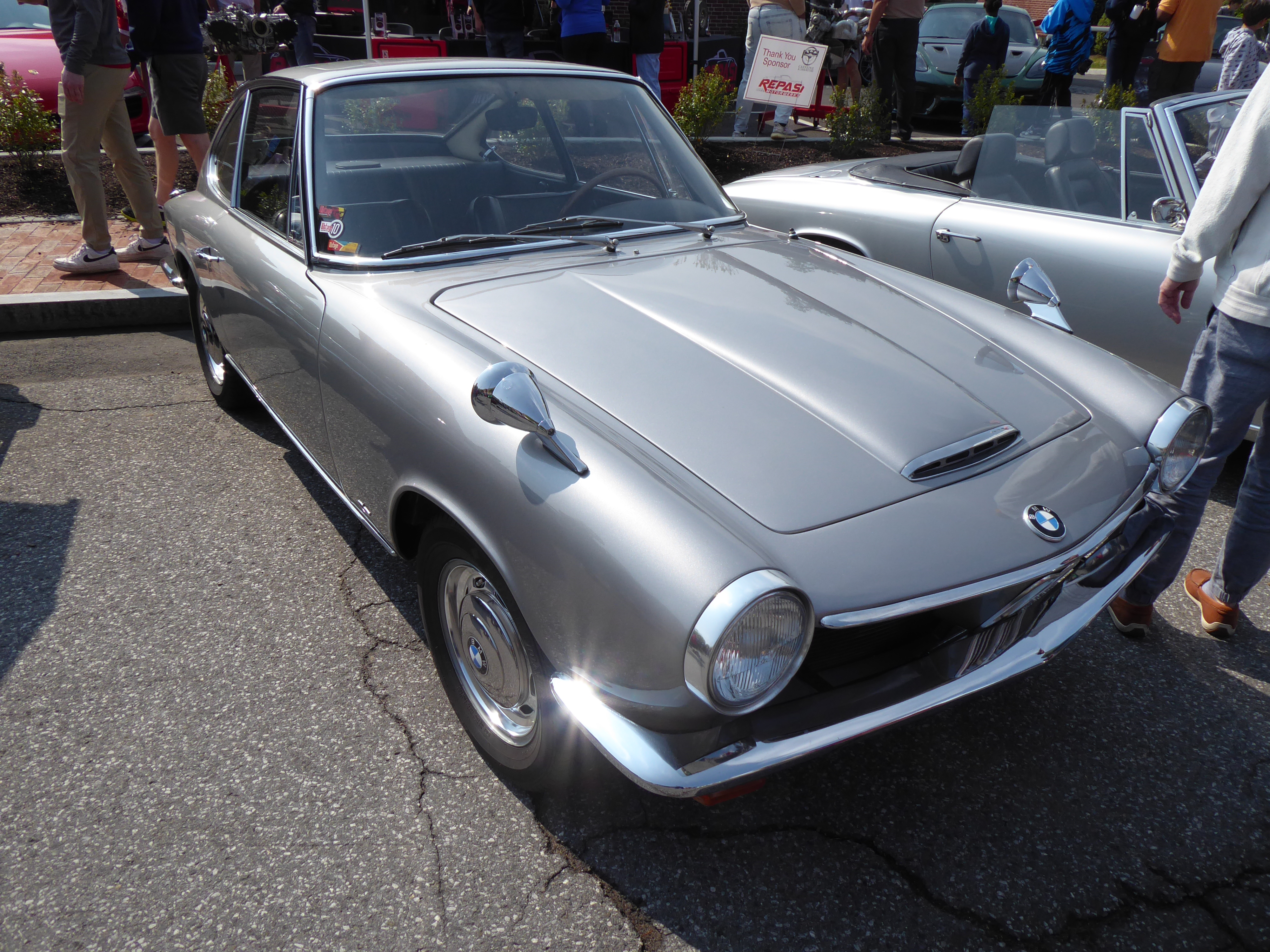
The graceful BMW 1600 GT was the direct precursor of the 1967 BMW 1600 that was my first foreign car—thanks, Aunt Katie!

The rare BMW 1600 GT led directly to the 1600 and 2002 models. (Jim Motavalli photo)

The 1600 GT was parked, appropriately, next to a Glas 1300 GT convertible—a truly rare car. This one was from before BMW acquired the Glas business and rebadged the cars. Glas produced 5,376 GTs, of which only 363 were the cabriolet. BMW then built a further 1,259.

The Jolly is minus its distinctive fringed top. (Jim Motavalli photo)

Three Fiat 500/600s in a row included the scarce surrey-top “Jolly” version for yacht-tender beach town use that have been doing quite well at auction. The bikini top is fringed, and the seats are rattan. Somebody recently paid $156,800 for one of these.

One of three Lucid Airs on the premises. (Jim Motavalli photo)

Lucid had a whole team, with jacketed staff and three Air cars, Grand Touring and Pure models. It was smart marketing—the New Canaan attendees, many of them with kids and dogs, could afford a Lucid Air electric car. “We wanted to get the car out there, to let people know what Lucid is,” said a genial fellow who wanted to be known only as Tim. Those Grand Touring cars will wow owners of Teslas—they have 516-mile range and 2.5-second zero to 60 times.

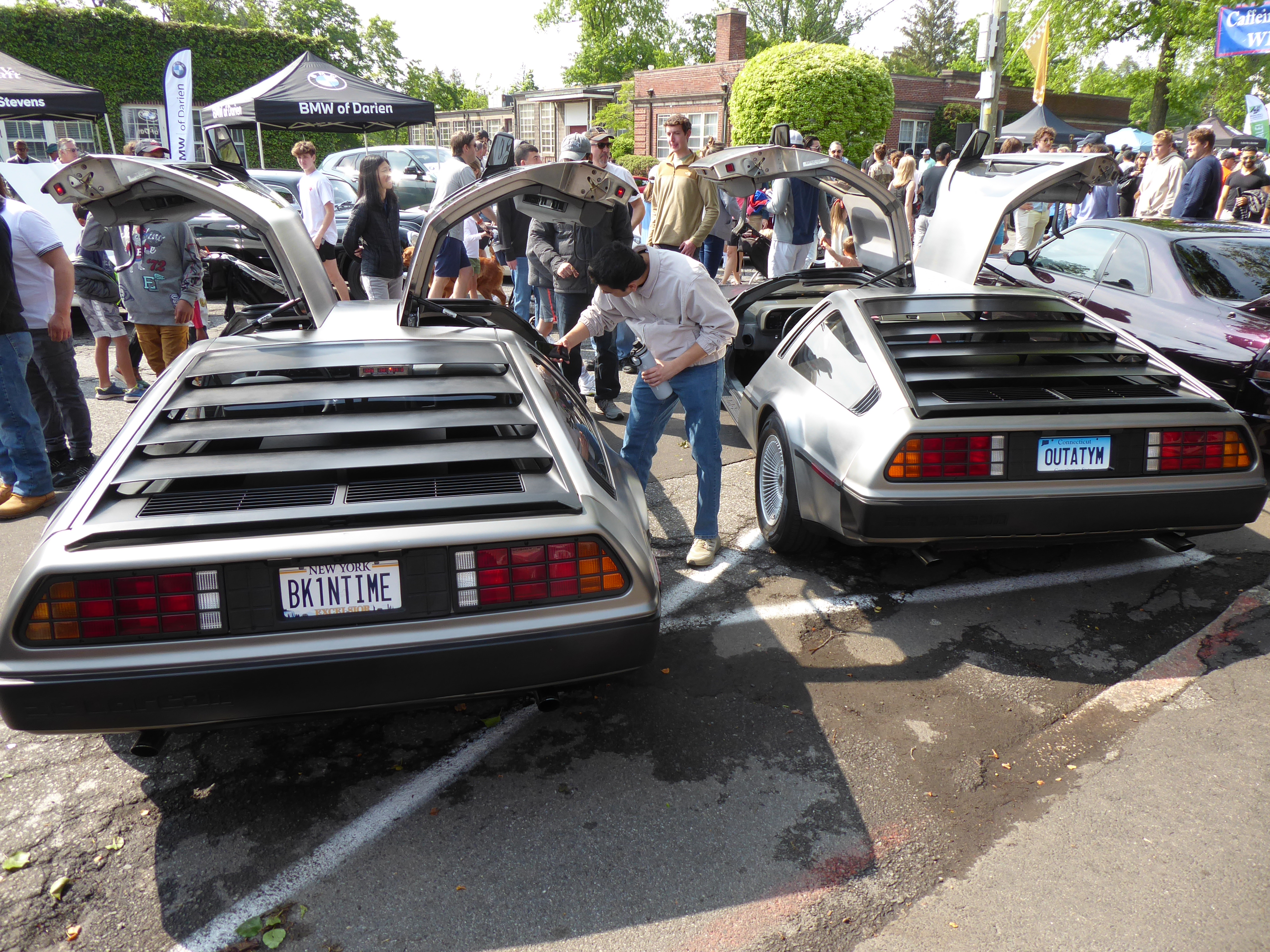
His and hers DeLoreans. (Jim Motavalli photo)

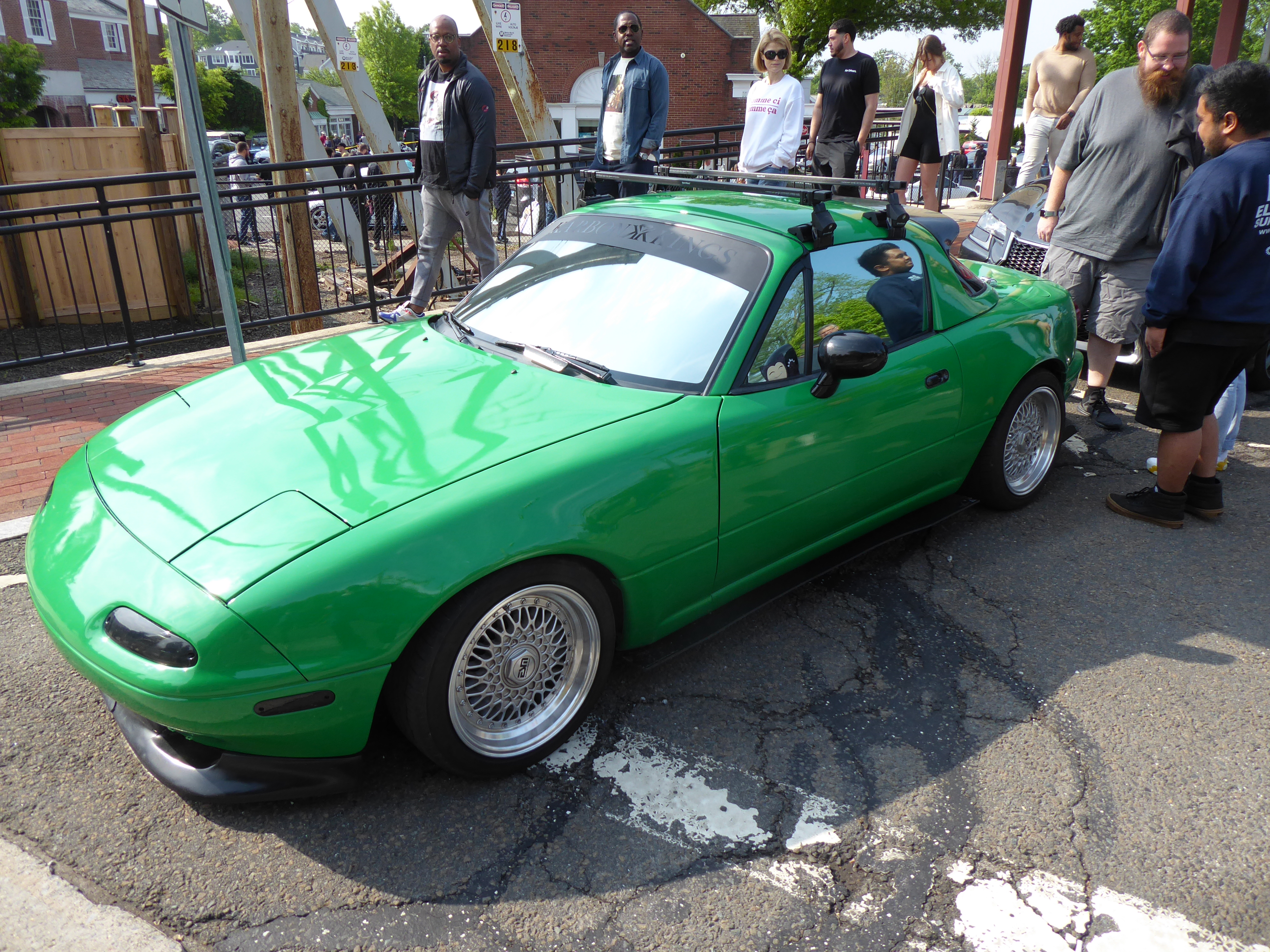
Other cool cars: a 1914 Cadillac, a stately Buick Electra 225 from maybe 1965, an Austin-Healey 3000 (for sale) definitely from 1965, a lowered and customized bright green Mazda Miata, a his-and-her pair of DeLoreans, fleets of Porsches—really, a lot of Porsches!

Would I do this to my own Miata? No, but it’s cool anyway. (Jim Motavalli photo)

The next Caffeine & Carburetors is September 17. Listen for the sharp commentary from former radio DJ Peter Bush. He’s very well informed!

The Gotham Jazz Festival Celebrates the Early Days

The Down Town Association building on Pine Street in lower Manhattan dates to 1887, and the club to 1859. The three-story space is mere steps from Wall Street and the wood-paneled, Persian carpeted first-floor lounge, with its comfortable couches, retains its air of a quiet, men-only getaway for the traders. Well, maybe it wasn’t men only back in the day, but even today the men’s room is much bigger than the women’s room.

Bria Skonberg in full cry. (Jim Motavalli photo)

It’s an appropriate location, then, for the Gotham Jazz Festival, which was back in 2023 after a four-year absence. The festival is a truly wonderful event, celebrating the early years of the music, especially the 1920s and 1930s. All three of the producers—Molly Ryan (vocalist), Bria Skonberg (trumpet and vocals) and Patrick Soluri (drummer, composer)—are performers themselves and the more than 100 musicians performing were also a big part of the appreciative audience.

Soluri’s Prohibition Productions puts on 120 shows a year around the city, and the experience shows. Spread across the floors were dozens of performances, all with excellent sound and enthusiastic audiences.

Many of the musicians performed in multiple bands, including Dalton Ridenhour, who was playing sprightly solo stride piano in the first-floor lounge when we arrived, then turned up later with the epochal Mike Davis and the New Wonders.

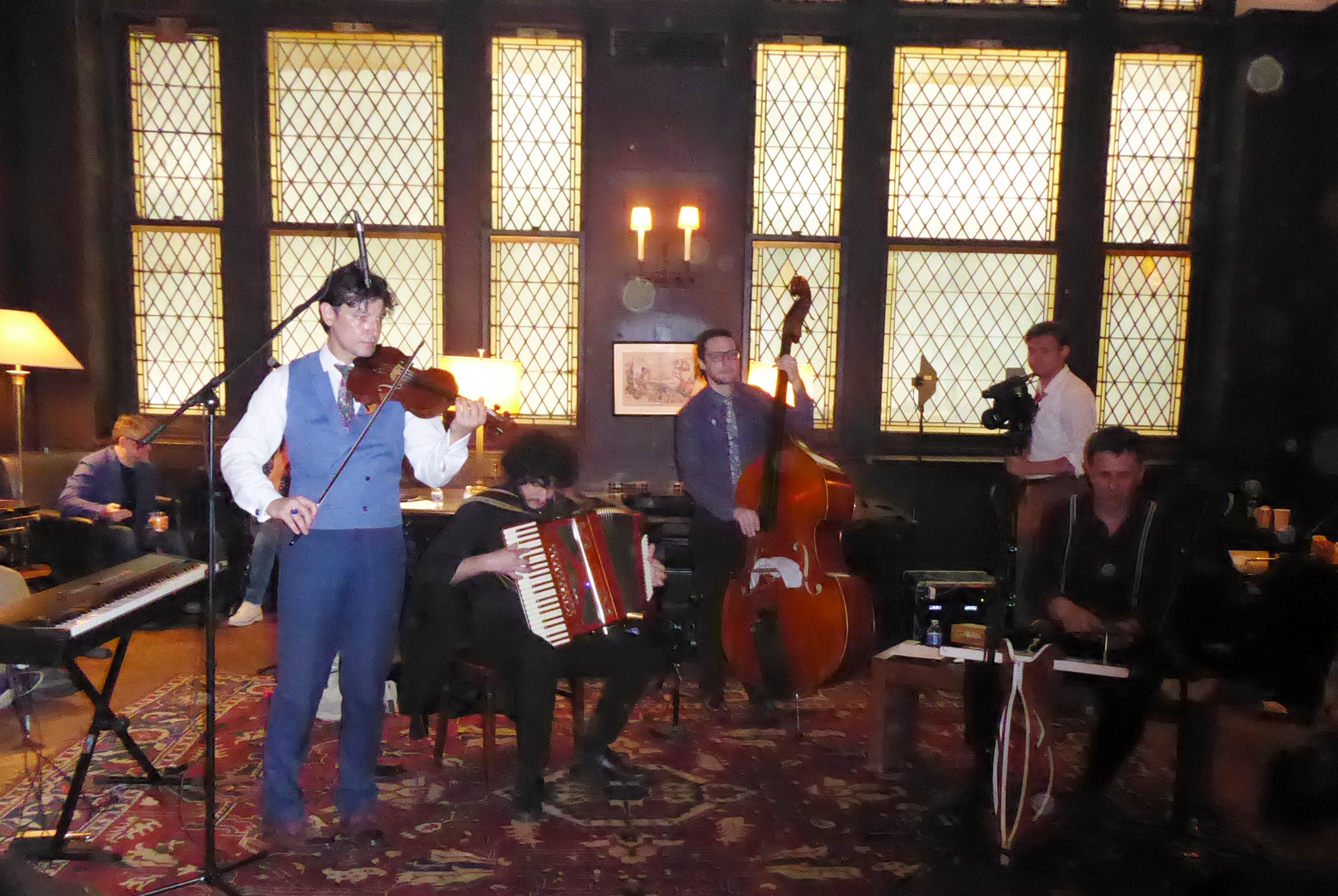
Our Band with Sasha Papernik and Justin Poindexter. Plus bass player Jared Engel! (Jim Motavalli photo)

Our Band is Justin Poindexter on guitar and Sasha Papernik on accordion, and they both sing and write songs that reflect ultra-wide listening. Poindexter is also in Saluri’s Hot Toddies.

The repertoire ranged from Brazilian and Romanian songs to the ancient “Lay Me Down a Pallet on Your Floor” to Leonard Cohen’s “Dance Me to the End of Love.” They added gypsy flavor to the latter, and it’s a reminder of how flexible are the Bard of Montreal’s songs. Check out the tribute to Cohen that works wonders with jazz band backing.

Upstairs there were performances by students of the New York Hot Jazz Camp that Skonberg and Ryan run. They didn’t sound like students. The Barrow Street Basement Jazz Band (named after their rehearsal space) was in fine form with seven pieces plus vocalist Gia Maulbeck (also an actress and director). More will be heard from her.

The Free Lunch Jazz Band had three talented women in the front line, something not seen much back when this music was new. Women were “thrushes” and “canaries” and not players. It took World War II for women to be allowed on the bandstand—see the Sweethearts of Rhythm.

The Trad-gedy Jazz Band was lovely, and included hot solos from Danielle Westbrook on trumpet and Casey Thomas-Burns on trombone. Ezra Martinez Mara channeled Willie “The Lion” Smith on piano. Or maybe it was Eubie Blake. Vocalist Rich Markow came out to vocalize on “Singing the Blues (Until My Baby Comes Home).” This was one of several bands that, true to the period, used tuba instead of bass—banjos were also much in evidence.

Nine of the students got scholarships this year, Skonberg said. Bravo.

Stephane Seva Swing Ondule 4tet from France essay “Jitterbug Waltz.” (Jim Motavalli photo)

The Stephane Seva Swing Ondule 4tet from France used violin, accordion, bass and a very peculiar persuasion setup. Their swing had a strong Gallic flavor. Fats Waller’s “Jitterbug Waltz” was the best.

By far the most authentic 1920s Jazz I heard was Mike Davis and the New Wonders. Davis, who plays trumpet, sings in period style, writes the arrangements, and just looks the part, is a wunderkind.

Mike Davis (center, with old microphone) with the New Wonders. (Jim Motavalli photo)

Everything he played and sang felt true to the period. He’s obviously a huge Bix Beiderbecke fan, but that’s a pretty good role model. Everyone in the band is masterful on their instruments, including the trumpet, clarinet and trombone front line, and Ridenhour on piano. The latter is also in the awesome Lovestruck Balladeers, which is no less virtuous. What a double bill those two groups would make.

Although some of the bands playing added a modern gloss—strings of solos, not usual back then—Davis’ work is more closely the tight arrangements, played for dancing, that dominated the era. Davis is also adept at finding little-known tunes and polishing them up.

Finally, I saw the New York Hot Jazz Camp Faculty All Stars. Many of the players are well known and much-recorded figures on the old jazz scene, including Dan Levinson on sax and clarinet, Rossana Sportiello on piano, Cynthia Sayer on banjo and—a revelation—Ron Wilkins on trombone. Sportiello, no less good than Ridenhour, was decidedly more modern in approach—a touch of Bill Evans perhaps?

The New York Hot Jazz Camp faculty with, from left Cynthia Sayer, Dan Levinson, Bria Skonberg and Ron Wilkins. The unseen bassist is Tal Ronen and the drummer Kevin Dorn. (Jim Motavalli photo)

They were joined by star vocalist Catherine Russell, by Molly Ryan, and by Skonberg, who was in hot trumpet mode. She’s also a fine singer. If I had one regret for the day, it’s that I didn’t hear Skonberg vocalize.

The band started with what seemed like 10 minutes of “Limehouse Blues” and went right into “Fidgety Feet” (formerly “War Cloud”). “Buddy Bolden’s Blues,” with Skonberg using a mute and Levinson on tenor, was superb. Sportiello is a real find, playing very pretty on this one. His “Shoeshine Boy” solo was quite busy, out of Art Tatum maybe.

The serial solos never show up on record from that era, but time per song was quite limited on disc. Maybe they played that way live? We do know that Robert Johnson played the hits of the day at the juke joints, but never recorded them.

Catherine Russell, fully committed. (Jim Motavalli photo)

The roof really came off when Catherine Russell came out and took us through “St. Louis Blues,” “Hello Central, Give Me Dr. Jazz” (which I hadn’t heard in decades), and “A Kiss to Build a Dream On.” Russell, who I wrote about here, is fully committed to her performances and just has it all as a singer. Plus she’s a great music historian.

Catherine Russell with Molly Ryan on “Goody Goody.” (Jim Motavalli photo)

It was great to hear Cynthia Sayer’s banjo feature, “Linger Awhile,” which beautifully illustrated what the instrument could do in jazz—today we mostly think of it as a folk instrument. Sayer has a book/CD combo called You’re in the Band that lets you play along with the greats. Then organizer Molly Ryan came out and did “Goody Goody” with Russell, a lovely way to end the first half—a whole second program was coming up, but alas I had to leave.

In the second half, organizer Soluri’s Hot Toddies with Poindexter and the wonderful Queen Esther were going to perform, the great guitarist Frank Vignola (with Vinny Raniolo), Mimi and the Podd Brothers Trio, Miss Maybel, the Eyal Vilner Big Band, and on and on. What an event!

Gotham is online here. There’s always next year. And don’t forget the New York Hot Jazz Camp.

Noreen Mola is Old Fashioned–in the Nicest Possible Way

At La Zingara restaurant in Bethel, Connecticut, home to an ongoing jazz series, vocalist Noreen Mola kept the audience spellbound with a relentless program of material from the Great American Songbook. She sailed through “You’d Be So Nice to Come Home To,” “Almost Like Being in Love,” “Autumn Leaves,” “I Can’t Give You Anything but Love,” Ain’t Misbehavin,’” “No Moon at All” and a Dave Frishberg tongue-twister I hadn’t heard before, “A Little Taste.” She concluded the evening in rousing fashion with “Everyday I Have the Blues” and “Take the A Train.”

Mola, who has been an animal rights activist and a painter of pet portraits, came late to jazz singing, but it’s as if she has been doing it her whole life. She’s not a scatter like Ella Fitzgerald, or a daring experimenter messing with time and space like Betty Carter, but as a straight-ahead, swinging interpreter of the Songbook she’s as good as it gets. And a charismatic performer, too.

 Nearly all of Mola’s repertoire comes from that precious body of work created by mostly Jewish songwriters, working as teams (music and lyrics) in New York between about 1925 and 1950. They wrote for Broadway plays, for Hollywood, and—early on—for sheet music. These denizens of Tin Pan Alley didn’t realize they were creating songs that would stand the test of time and serve as the core of countless jazz and cabaret set lists, but that’s what happened. This sophisticated music is timeless, full of romantic yearning and fools either in love or wistful about the lack of it.

It happens that I’ve just been reading The B Sides by Ben Yagoda, which chronicles how Tin Pan Alley evolved, and how it all fell apart in the early 50s. It’s chief villain is the affable Mitch Miller, then A&R man for popular music at Columbia. Yagoda calls him “The Beard,” and there was a certain resemblance to cartoon depictions of the devil. Certainly, he was the nemesis of singers like Frank Sinatra, Tony Bennett and Rosemary Clooney, all of whom were made to sing novelty songs by The Beard.

The fact that they had the biggest hits of their career with this doggerel didn’t change their opinion. They didn’t Sing Along with Mitch. Miles Davis ran into Miller on a New York sidewalk years after their time at Columbia and said only, “Keep walking.” When Sinatra encountered him in Vegas, he said, “Get lost, creep.” Tony Bennett is too polite to really go after Miller in his autobiography, but he details the hitmaker’s attempts to get him to stop singing jazz.

Miller’s success with novelty material didn’t go unnoticed. So for a while, as Yagoda chronicles, the great songwriters—most of them still vigorous—couldn’t get arrested, in Hollywood or New York. Their response was to turn on the emerging rock and roll as music made by “cretinous goons” (Sinatra’s phrase). Their failure to see that rock and R&B could be great, too, is perhaps understandable. But Mitch wasn’t actually peddling rock and roll, just a kind of dumbed-down treacle that could be hummed in the supermarket.

Now the Songbook is enjoying a great renaissance, as even pop performers like Rod Stewart, Carly Simon, Boz Scaggs and Linda Ronstadt are embracing standards. Numerous albums drawing upon that bottomless well are released every week. And there’s a huge trove of undiscovered songs lurking in musicals that quickly opened and closed. Richard Rodgers, Yip Harburg, George and Ira Gershwin, Frank Loesser, Harold Arlen, Oscar Hammerstein II, Jule Styne, Hoagy Carmichael, Irving Berlin, Cole Porter, Jerome Kern, Johnny Mercer, they were all workaholics. Kudos to singers like John Pizzarelli and Catherine Russell for unearthing some of the hidden gems.

Back on the bandstand, Mola was nice enough to do my request, for “I’m Old Fashioned.” This wonderful old chestnut from 1942 has music by Jerome Kern and lyrics by Johnny Mercer. Rita Hayworth and Fred Astaire danced to it in the otherwise forgotten film You Were Never Lovelier. Hayworth couldn’t sing, so Nan Wynn dubbed the vocals.

Here’s Mercer on working with the older Kern: “We hit it off right away. I was in such awe of him, I think he must have sensed that. He was very kind to me, treated me more like a son than a collaborator. And when he thought I had a great lyric he said, ‘Eva, Eva, come down here,’ and he kissed me on the cheek and he said, ‘Eva, I want you to hear this lyric.’ Well, of course I was thrilled that he liked it that much, you know. ‘I’m Old Fashioned,’ that one was.” Today, collaborating as those songwriting teams did seems to be coming back. Musicians are talking about how they get energized by bouncing their ideas off someone else. There’s not a false line in “I’m Old Fashioned,” and maybe that’s because Mercer and Kern ditched each other’s bad ideas.

With Mola in her quartet were Bill Lance on piano (sounding a bit like Errol Garner crossed with Red Garland), the snappy drummer Dave Reynolds, and ace acoustic bassist Eric Van Laer. The Bethel Jazz Series is ongoing, with lots of interesting acts coming up. Thanks to producer Tom Carruthers for the oasis of jazz in Fairfield County.

Samara Joy, Jazz Singer, at Queens College

QUEENS, NEW YORK—To celebrate Martin Luther King, Jr. Day, Queens College put together a compelling program that combined a very to-the-point speech from Jelani Cobb, dean of the Columbia Journalism School and staff writer for The New Yorker, with a marvelous performance by the rising jazz singer of the moment, 24-year-old Samara Joy.

Cobb noted King’s famous quote, “The arc of the moral universe is long, but it bends toward justice,” but added that it doesn’t bend by itself—it takes a lot of hard work. He talked about attending the multi-cultural Jamaica High School (and playing on its firmly integrated baseball team), but also being called the “n” word on a Queens street, and living through the 1986 Howard Beach tragedy. Three African-American men were attacked by a group of white youths outside a Queens pizza parlor—resulting in the death of 23-year-old Michael Griffith. Spike Lee made a movie about it. Progress has been made, he said, but much remains to be done.

MLK’s important legacy was invoked by numerous speakers (including the Queens borough president and the speaker of the City Council), all before an intermission. Since tickets only cost $20, this was a rare occasion to see an affordable first-class jazz performance in an ideal venue. And this was no ordinary performer—Joy is on an escalator to musical stardom, records for Verve, appears on late night TV shows, and is soon off to Europe. She won the Sarah Vaughn International Jazz Vocal Competition in 2019, and was the Best New Artist for Jazz Times in 2021. The New Yorker says she “has all the goods to hold a room spellbound.”

And that’s just what she did at the Kupferberg Center for the Arts, with a trio featuring Luther Allison on piano and Evan Sherman on drums. Joy, who performed a program of mostly new (to her) songs, has range, taste, power, dynamic control, and lots and lots of drama. She is, simply, the most exciting jazz singer (of either gender) to appear in the last 20 years. Actually, should we go back further?

Watching Bronx-born Joy conjures an amalgam of the standard-singing mastery of Ella Fitzgerald and Sarah Vaughn with the more experimental bop vocalizing of Abbey Lincoln and Betty Carter. With the latter (and Cassandra Wilson), she shares an ultra-low bottom range and rapid-fire tempo changes.

Joy performed only two songs from her Verve album, Linger Awhile—which is mostly standards. Instead, the repertoire was representative of her recent listening. A singer who mostly listened to R&B in high school– Kendrick Lamar, Stevie Wonder and Luther Vandross—has spent the time since catching up on the history of jazz singing. She did two songs by Abbey Lincoln, “Straight Ahead” and “Retribution,” both from the classic 1961 Straight Ahead album; and “Tight,” from The Audience with Betty Carter (1980).  

I’ve listened to a lot of Monk, but never before encountered his 1959 “San Francisco Holiday,” which had lyrics put to it by Margo Guryan—a Queens native! Now it’s called “Worry Later.” Samara Joy could make it into a standard. From the album we got “Guess Who I Saw Today,” which is most often associated with Nancy Wilson, though Carmen McRae (another source for Joy) sang it first. A highlight was a version of Duke Ellington’s “Come Sunday” accompanied only by Allison’s piano. She concluded with a blues.

Like Lincoln, Joy is an actress who, as they used to say, “knows how to put a song across.” She radiates intense, well, joy, about just being on stage. She tells stories about the songs, introduces the musicians, points them out when they take an especially audacious solo, and switches seamlessly into vocalese. On the album, she sings a vocal version of Fats Navarro’s “Nostalgia (The Day I Knew).” Her study of the form, nodding to the greatness of Lambert, Hendricks and Ross, grew from school assignments. “Over time, it became a style that I’ve enjoyed exploring and playing around with,” she said.

There is no trajectory but up for this singer. Of course, she could realize there’s more money in R&B and ride that wave. Other jazz singers did it—Dee Dee Bridgewater (who later came back), Al Jarreau, Jean Carn (a/k/a Jean Carne). But let’s not stir things up. For now, Samara Joy is firmly committed to jazz. She loves jazz, and it loves her back.

The Brooklyn Folk Festival and the Black Rose of Texas Band, Shimmying Like My Sister Kate

NEW YORK CITY—What do the Black Rose of Texas band, playing at Dizzy’s Coca-Cola in Manhattan October 16, and the Brooklyn Folk Festival, October 21 to 23, have in common? How about the song “I Wish I Could Shimmy Like My Sister Kate”?

The Black Rose of Texas band at Dizzy’s Club Coca-Cola–with all the singers. (Jim Motavalli photo)

Officially, this song was written by Armand J. Piron and published in 1922. Louis Armstrong claimed he wrote it, sold it for $10 but never got the money. In any case, it was a big hit. Fats Waller did it, Dave Van Ronk, and even the Beatles (live in 1962).

Another thing these two events had in common is guitarist Justin Poindexter, who is in the Black Rose of Texas band and played pedal steel with Meg Farrell’s honky-tonk group in Brooklyn. Let’s see what went on at these two venues.

In Brooklyn, an absolute highlight was the last act encountered, the Lovestruck Balladeers, virtuosos who play ramped-up ragtime and other great old American styles, as well as global sounds “seldom heard beyond the walls of low-lit dance halls at the edge of the known world.”) Aaron Jonah Lewis is a phenomenon not to be missed on fiddle, but he’s also a master of very early banjo playing. The other band members are Jake Sanders (guitar), Dennis Lichtman (clarinet), Sean Cronin (bass) and Dalton Ridenhour (piano). Switching instruments is common. Lichtman also plays incredible mandolin and does a twin-fiddle thing with Lewis.

The Lovestruck Balladeers in full cry. (Jim Motavalli photo)

Words fail me in trying to describe how great this group is, but fortunately I shot some video. This is their version of Scott Joplin’s famous “Maple Leaf Rag”:

And here’s an original by the Lovestruck Balladeers:

Nora Brown, playing as she does often with fiddle player Stephanie Coleman, was in especially fine form in Brooklyn. At 15, she’s coming into her mature voice, and singing more confidently, and she continues to absorb tunes and banjo tricks from a wide variety of in-person influences. “Wild Bill Jones,” I don’t think I’ve heard her sing that before.

Nora Brown, with her new maturing voice. (Jim Motavalli photo)

“Rose Connelly,” a murder ballad if ever there was one, is also known as “Down in the Willow Garden,” and Brown gave it the proper drama. “Jenny, Put the Kettle On” was nearer to its original source and closer to the bone than versions by, say, Burl Ives. Brown and Coleman went all the way to the reaches of Quebec to meet members of the legendary Foghorn String Band. That’s dedication.

I liked Amethyst Kiah best singing covers. She has a rich, forceful singing voice, heard to good advantage on “Sugar,” a Tori Amos B-side. The highlight, though, was her take on “Trouble So Hard,” originally recorded by one Vera Hall in an Alan Lomax recording, then acquired by Moby for his hit album Play. But you need the whole song, not a sample.

Connecticut’s own Jacob Wysocki was a find on Saturday morning. He’s from a rural town called Norwich, and he appears to have done deep study on the Internet and the Cecil Sharp archives to arrive at his unique approach to old-time music. He’s a very good guitar player and singer, with added value from the pan pipes that, he told me, exist in every culture.

Wysocki, who looks sort of like a countercultural version of Michael J. Pollard, had a funny line of patter. He said his mother warned him to watch out, because they were stealing milk crates down at the Cumberland Farms in Norwich. To make his guitar sound like a snare drum, he inserted a folded Pokemon card under the strings. Altogether a unique performer and one to watch.

Bill Carney’s Jug Addicts had to start without their bass player, but he showed up later. The group performed a spirited version of “He’s in the Jailhouse Now.” That’s a really old song, and Jimmie Rodgers recorded it in 1928.

The Jug Addicts are blessed with a number of good singers, including the rub board player, who emulates the florid style of the 1920s or even earlier. They’re the group that played “Sister Kate,” and the old-timey feel made a good complement to multi-instrumentalist Clifton Davis. He also loves that era—and the piano music of Jelly Roll Morton, which he has transposed to the guitar. The San Diego resident also plays in string bands, including Skillet Licorice.

The late John Cohen, a mainstay of the New Lost City Ramblers, was a Renaissance Man who also took photographs, did field recordings, helped organize the legendary Friends of Old-Time Music shows that brought Roscoe Holcomb and others to New York, and, in his later years, played in the Downhill Strugglers with Jackson Lynch and festival organizer Eli Smith. So it was natural that there’d be a tribute to Cohen at this year’s festival. It was heartfelt, with many performers, including Smith, Lynch, Brown, Tim Eriksen, Peter K. Siegel, Brett Ratliff and others. Siegel, a fellow Friends organizer, said he’s worked with Cohen “on projects and off for half a century.”

Eriksen is a national folk treasure, even though he often played punk rock in his band Cordelia’s Dad. His is an early singing style, out of the shape notes and often unaccompanied—though he is a gifted guitar and fiddle player. Most affecting was “The Blackest Crow” and a long Irish ballad about a jolly tinker that somehow led to some Tuvan throat singing. He’s a historian, too, and told us about “The Great Disappointment” when William Miller’s prophesies about the end of the world in 1844 did not come true. Gabriel did not blow his horn, but at least Eriksen got a ballad out of it. Here’s a video of “Pumpkintown”:

The Ever-Lovin’ Jug Band, from Canada, is a male/female team that writes original songs in the jug tradition. Good songs too.

Minnie Heart has a vintage voice that reminds me of Maria Muldaur. “Oh Boy” was about getting really high. Here’s the video evidence:

Stillhouse Serenade was an interesting mix, sort of a jazz/folk combo. Material included a song from the jazzier side of Ray Charles repertoire and Ramsey Lewis’ “The In Crowd.” I wanted to hear the harmonica player, Trip Henderson, sing more. Guitarist Mary Olive Smith got to do a couple numbers, including Gillian Welch’s “Tear That Stillhouse Down.” Piano player Charles Giordano, a regular with Bruce Springsteen, was a treat to hear.

Stillhouse Serenade was an interesting folk/jazz mix. (Jim Motavalli photo)

The Lovestruck Balladeers I’ve already mentioned. They had a field day with some Scott Joplin rags, essayed some originals, and even tackled Erik Satie. And don’t let me forget Ukrainian Village Voices, who sounded stirringly Kyiv but are from the East Village, and the Ban Chinese Music Society, whose pipa player was amazing—and a good MC, too.

The Ban Chinese Music Society. (Jim Motavalli photo)

The Brooklyn Folk Festival is held at St. Ann’s Church in Brooklyn Heights, which opened in 1847. The self-taught artisan William Jay Bolton made the 54 stained-glass windows (one is lost). I hadn’t noticed before a brass plate in the floor of the aisle that read, “Thomas Messenger, To the Glory of God, 1883.”

Queen Esther fronts the Black Rose of Texas band. (Jim Motavalli photo)

Over to Dizzy’s Club in midtown Manhattan. The Black Rose of Texas band was set up for country swing, but was very eclectic, with great singers on hand. Queen Esther asked why she never saw people who looked like her in the old Gunsmoke reruns, although there were lots of African-Americans in the Wild West. (See my book, The Real Dirt on America’s Frontier Outlaws.)

The band with Poindexter on guitar included Minnie Jordan on fiddle, Jeff DeMaio on pedal steel, Jarrett Engel on bass and Steve Williams on drums, and together they tore in an instrumental named “Speedin’ West” that highlighted DeMaio’s steel guitar.

Poindexter, who has a fine tenor voice, sang a rousing version of his great-grandfather’s favorite song, Gene Autry’s “Back in the Saddle Again.” For “Time Changes Everything,” a Bob Wills favorite, DeMaio offered serviceable vocals.

Then it was time for the women. Queen Esther took us traveling down Sister Rosetta Tharpe’s “Lonesome Road.” She sounded great in front of a country band. Sister Tharpe, a mean guitarist, is said to have invented rock and roll—“Elvis copied her, Chuck Berry copied her,” Esther said—but she works in country, too.

Then out came the incomparable Kat Edmonson. She’s a jazz singer through and through, but for this show she donned cowboy duds and sang “Don’t Fence Me In.” But it’s OK because it was written by Cole Porter for a failed Broadway show, and that music is the essence of the Great American Songbook.

Esther’s version of Wanda Jackson’s “Big Iron Skillet” was a female empowerment anthem that echoed the late Loretta Lynn’s “Fist City.” Then out came Synead Cidney Nichols, the evening’s third singer, to rock out on “Cow Cow Boogie.” She’s new to me, comes to New York by way of Trinidad and Tobago, and will make her mark soon. She said she didn’t know much about cowboys, but on stage she got the gist.

“I Had Someone Else Before I Had You,” from 1946, was another great take from Kat Edmonson. She pointed out what I already knew, that bluegrass, jazz and blues all went into the country-swing mix, but then added that polka was in there, too. That I didn’t know.

And they did “Sister Kate,” “Tumbling Tumbleweeds” and “Stay a Little Longer” with the four singers in combinations, and another Wills feature, “Faded Love” (as an instrumental). Sad to say, after that it was over. Too short! This multi-colored country-swing thing in repertoire has some legs. Let’s hope Black Star gets together again.

A Balmy Caffeine and Carburetors

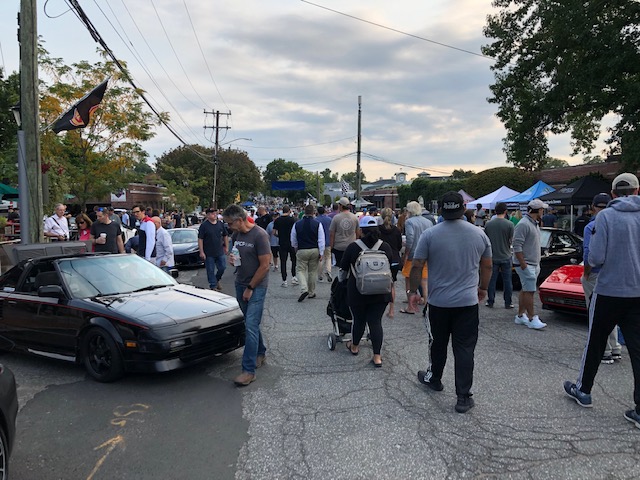
As MC Peter Bush, my partner in the WPKN Old Cars in the Driveway podcast, regularly puts it, nobody gets an award, and nobody is in charge–it’s the perfect formula for a successful auto show. Caffeine and Carburetors, in downtown New Canaan, Connecticut, brings together 1,400 or so cars of every possible description, from million-dollar supercars to handmade whimsy.

For instance, there was some kind of tacked-together car built on a Chrysler chassis for a Daughter of Bonnie and Clyde movie that was never released, McLarens. Rolls-Royces, Minis, art cars, a turqoise-and-white Metropolitan convertible with modern Mazda power, and anything else you could imagine. There are Porsche 911s for miles. Here’s a few highlights from the September 18, 2022 event:

This is a Ford GT, a descendant of the GT40 that famously won Le Mans. A guy standing next to it was telling the owner, “When I sold my Generation Five Viper….”
This Mercedes-Benz art car drew a lot of interest.
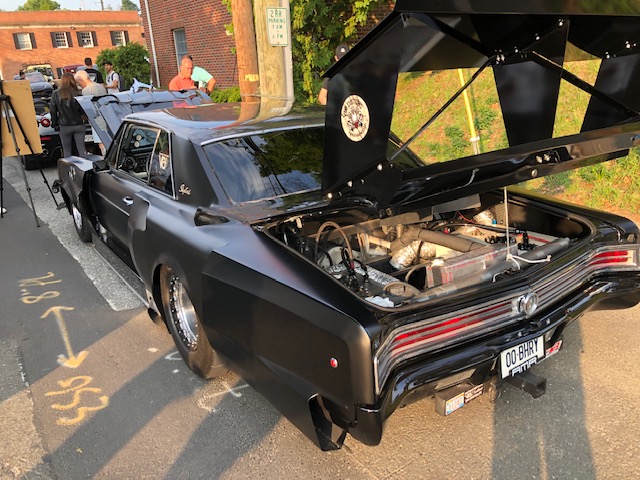
Parked next to the Benz was this over-the-top Buick Skylark. The owner has been working on it for 18 years–will it ever be finished?
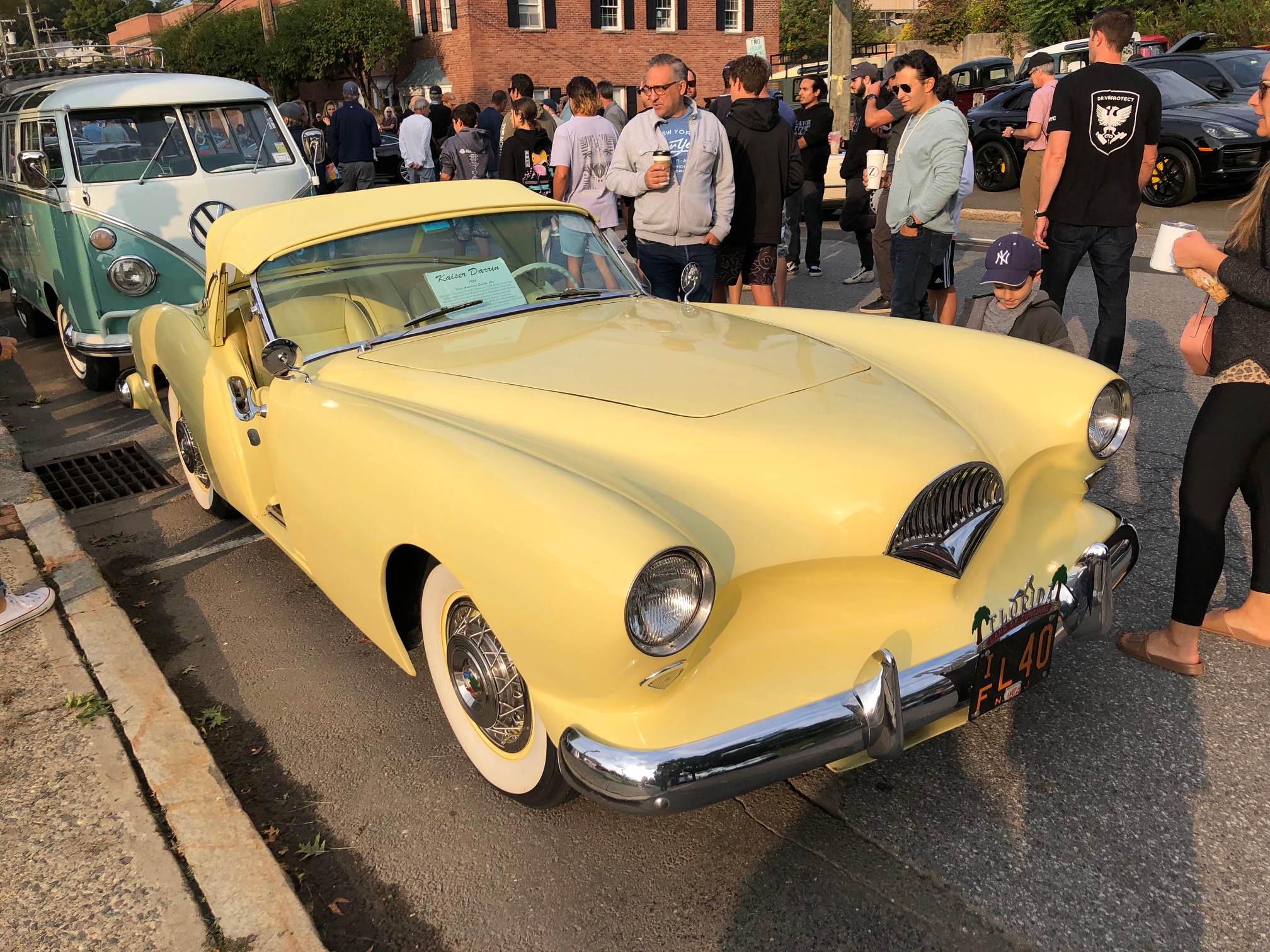
The Kaiser Darrin, with doors that slide into the bodywork, sold in tiny numbers and are rarely seen. This example was beautifully restored.
A gorgeous Maserati 3500 GT convertible fronts a pair of Rolls-Royces. (You can’t see the Corniche, but it’s there.)
This Morris Mini Cooper had such go-faster accoutrements as wire headlight covers, leather bonnet hold-downs, and Minilite wheels.
The 1963 Dodge Polara had 426-cubic-inch Ramcharger power. I owned a 1963 Dodge, too, but it had a Slant Six that was half the size.
The only Saab I saw was this very nice 99 GL.

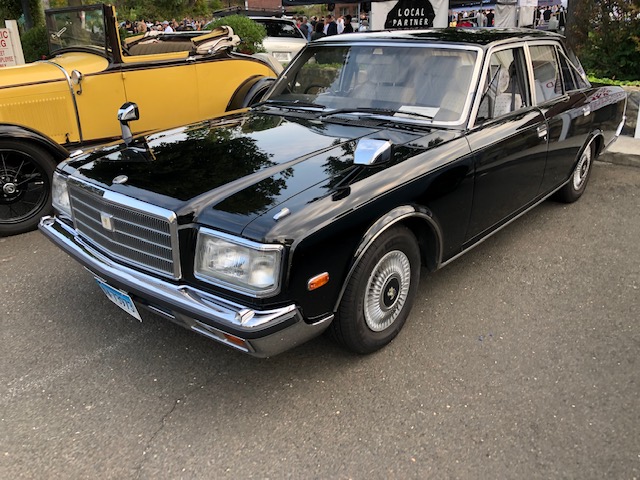
This is an ultra-rare Toyota Century, a Japanese-market-only executive car. They came with lace draperies for the seats.

This Valiant wagon from…1962? was on the move. The action starts early–and starts to break up early, too, around 10:30 a.m. or so.
The place was mobbed.

The next Caffeine and Carburetors is in Waveny Park in New Canaan, Connecticut October 23. It’s worth a trip from anywhere.

Upstate New York Meets New Orleans at Oldtone Lite 2022

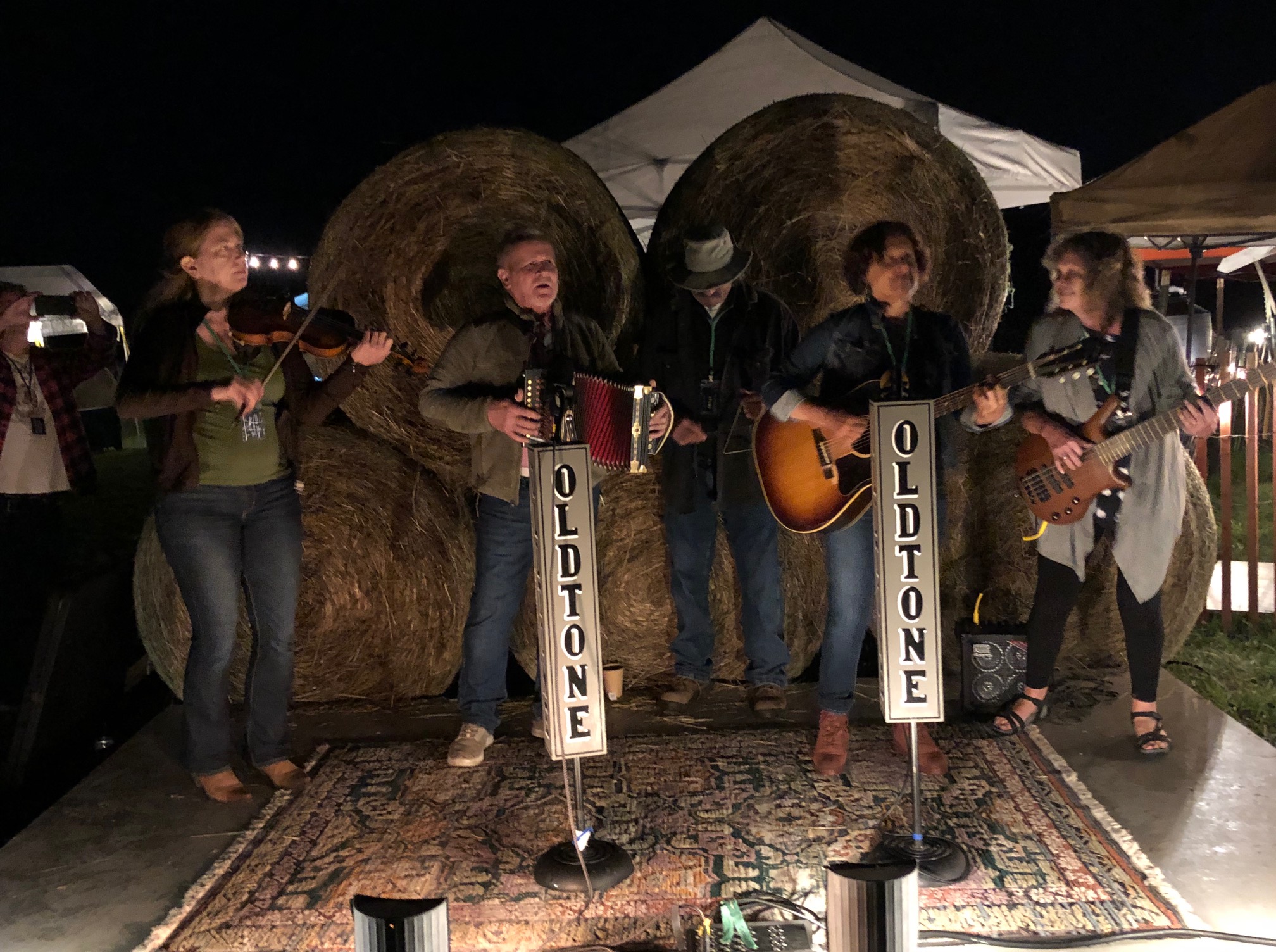
HILLSDALE, NEW YORK—Every music festival has its discoveries, and at Oldtone Lite in Hillsdale, New York—an elegiac end-of-season gathering—it was one JP Harris. He’s not a new artist, and I’d already heard his first old-time album—but live he was a revelation.

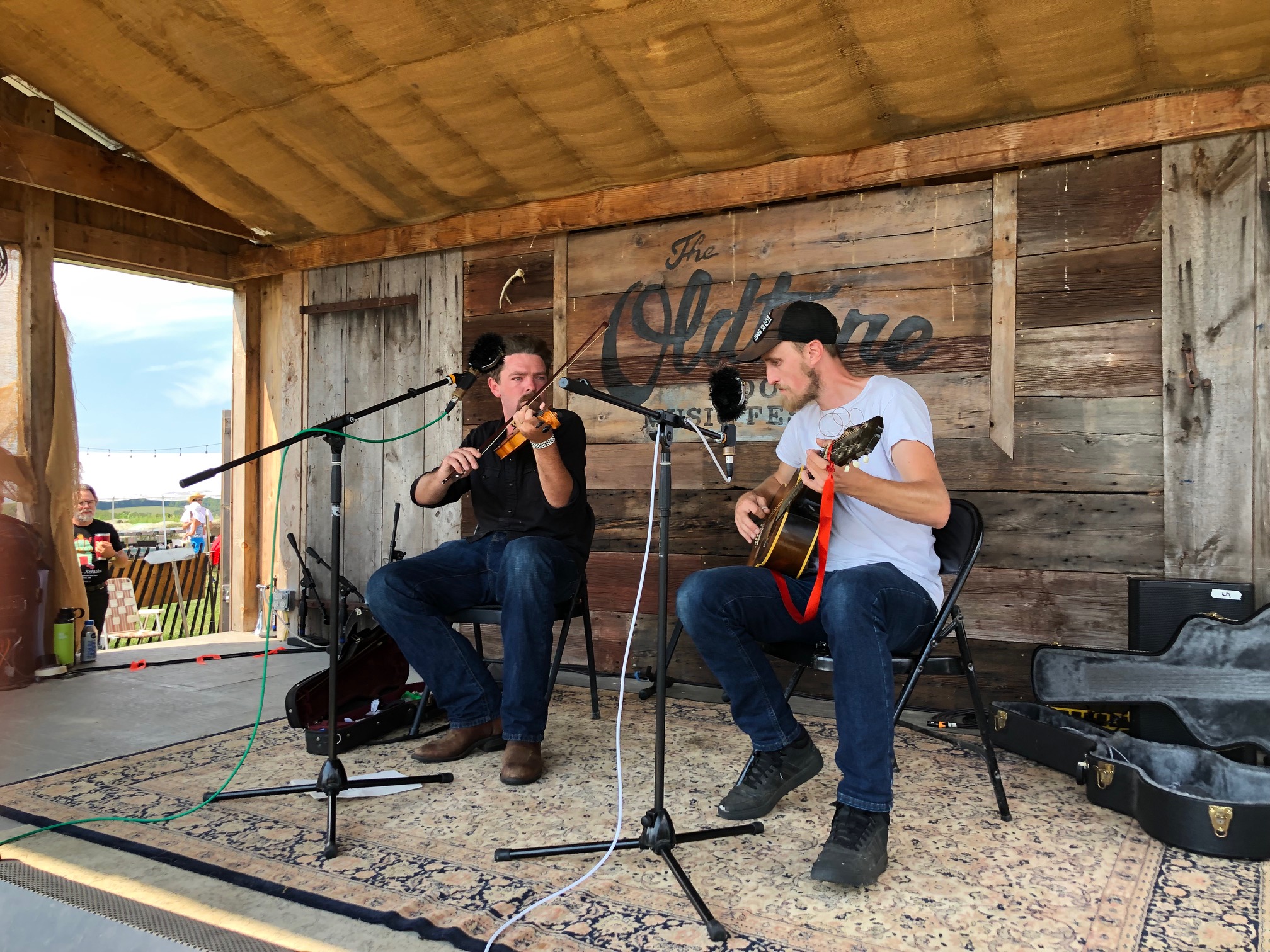
Sophie Wellington on fiddle and JP Harris on homemade banjo at Oldtone Lite. (Jim Motavalli photo)

Harris was billed as offering a honky-tonk set as the closer on Friday night. Before that I’d seen him and four banjos in a delightful duo with Sophie Wellington (fiddle and dancing). The repertoire was much of Harris’ Don’t You Marry No Railway Man album, which is mostly another duo with Chance McCoy (formerly of Old Crow Medicine Show).

Although Harris is relatively new to old-time, he’s already a master performer in the genre. He gets the blood and guts at the core of it. Old-time, at its best, is about as far from the cleaned-up college folk of the Kingston Trio and Burl Ives as you can get—it’s murder ballads, songs of tragedy, misfortune and hard times.

Wellington and Harris were magic together. Here’s proof:

Not convinced? Here’s more proof:

And even more:

I didn’t get any photos or video of Harris’ honky-tonk set, mainly because I was freezing. But also mesmerized. With an all-star band of fiddle, pedal steel, piano, guitar and bass, Harris, an Alabama native, ripped through a bunch of hard country music (the kind Merle Haggard, George Jones and Porter Waggoner used to play), most of it about drinking and lost love—and often the combination of the two. Harris, who will tour Europe next March, has made three fine albums in this vein. Especially check out I’ll Keep Calling.

Ferd! (Jim Motavalli photo)

Ferd, a beard-and-baseball-cap New Orleans band out the Hackensaw Boys featuring fiddler/vocalist/songwriter Ferd Moyse, played a rousing set, then came back and played on the between-set “Tweener Stage.” It’s a brilliant idea, because it means the music never lets up. But bathroom breaks are hard. “It’s All on Account of You” and “I Found My Own Today” were highlights of the Ferd set; at their best, they are reminiscent of the Holy Modal Rounders.  

The Bad Penny Pleasuremakers were good times personified. (Jim Motavalli photo)

The also New Orleans-based Bad Penny Pleasuremakers were simply wonderful, featuring Matt Bell and Joy Patterson of Roochie Toochie and the Ragtime Shepherd Kings—a perennial Oldtone favorite and at the earlier 2022 Oldtone show. Like Roochie Toochie, the emphasis is on early jazz—really early, like 1915 to 1920 early. This band isn’t quite as theatrical—no fezzes—but Patterson, also a fine singer, made great sounds on her little instruments. Highlights were “Nobody but My Baby” and a Jimmie Rodgers song, “Any Old Time.” How far back does “When My Dreamboat Comes Home” go? Apparently at least to a recording by Guy Lombardo in 1936.

Here are the Bad Pennies on video:

And again:

Also from New Orleans, and featuring some of the same musicians, was Tuba Skinny.

Tuba Skinny are New Orleans institutions, with more than 10 albums out. (Jim Motavalli photo)

Like the Pennies, the repertoire is trad jazz, Clarence Williams to King Oliver, but also jug band music, spirituals, country blues, string band music, ragtime, and New Orleans R&B. They are exemplars of the styles, and kudos to them for making the old 78s come alive. Here they are on video:

Moonshine Holler was heard in old-time duo and trio formats, playing ancient stuff like “Hop High the Ladies” and “Coming Across Texas.”

Moonshine Holler with Paula Bradley and Pete Killeen. (Jim Motavalli photo)

Leader Paula Bradley was an MVP at Oldtone, also playing piano in JP Harris’ country band. Like him, she’s a scholar of the old music, and will tell you just which 78 was scoured for the song she’s going to do. But like Harris she also plays the honky tonks. Accompanist Pete Killeen is a very versatile musician.

The Downhill Strugglers were Jackson Lynch and Walker Shepard. (Jim Motavalli photo)

Like the festival, it was Downhill Strugglers Lite, with banjo player Eli Smith missing—he was probably off organizing the upcoming Brooklyn Folk Festival, which is October 20 to 23 this year. Never mind, Walker Shepard and Jackson Lynch were fine as a duo, offering oldies like “Big Ball in Memphis,” “Short Life of Trouble,” “Old Aunt Betsy,” “Utah Carol.” The latter, which Marty Robbins also recorded, is a fine tale about a cowboy saving a ranch owner’s daughter from a cattle stampede. “It’s sad and action-packed,” Lynch said.

The Lucky Five were the Lucky Four. (Jim Motavalli photo)

The Lucky Five are another regular old-time jazz act at Oldtone, with the sound of Django Reinhardt and Stephane Grappelli as the base. Guitarist Kip Beacco is to be thanked as a main organizer of this peerless event. The Five were the Four at Oldtone, and not even on the bill, but they managed to get in a few numbers at the Tweener stage. Including this version of “Cuckoo,” captured on video:

Jesse Legé—another Oldtone regular—brought more of New Orleans to the Hillsdale stage, with the event’s only cajun music.

Jesse Lege and his mostly female band brought cajun music to the party. (Jim Motavalli photo)

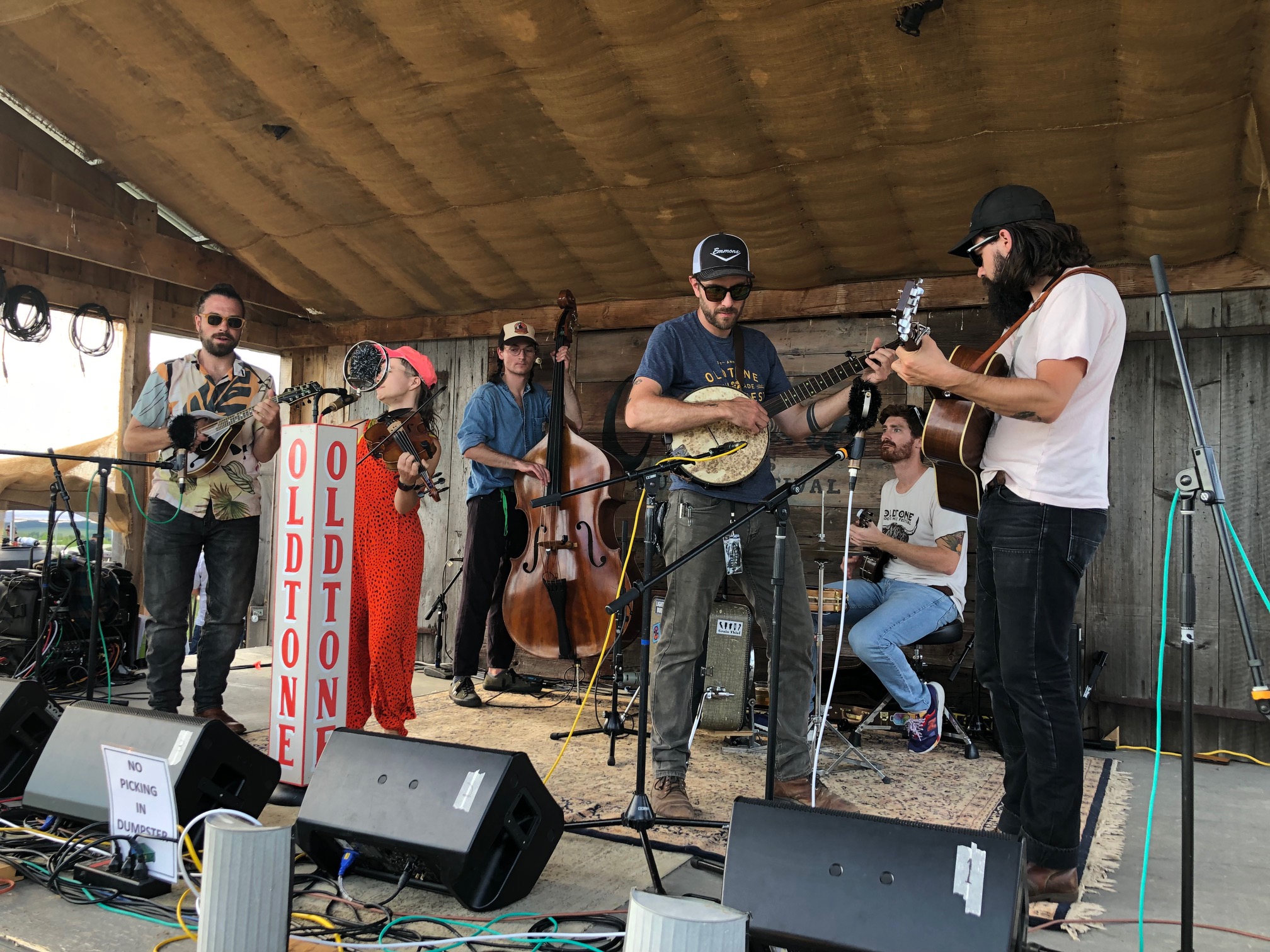
And then there was the uncharacterizable Dumpster Debbie, featuring fiddling savant Wellington.

Dumpster Debbie! (Jim Motavalli photo)

The Debbies don’t sing much: the fare is mostly fiddle-based instrumental material, but it moved out.

The Tom Petty Project rocked my local park in Fairfield, Connecticut. (Jim Motavalli photo)

After the show my wife and I returned to Connecticut, where an exuberant Lincoln Parkapalooza was in progress, featuring music on my neighbors’ porches and an evening performance by the Tom Petty Project. It’s all music, isn’t it?