Summer Jazz at Caramoor

KATONAH, NEW YORK—I’d previously been to Caramoor mostly for Americana events, so how would the sylvan glades take to the sounds of Coltrane, Monk and Miles? Just fine, as it turned out. Acoustic jazz is a natural sound, and it not only carried well when unamplified, but sounded right to the setting.

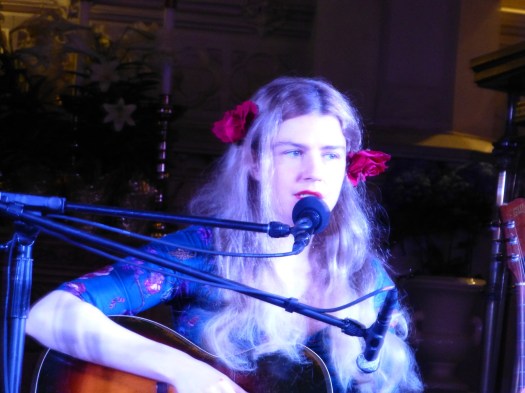
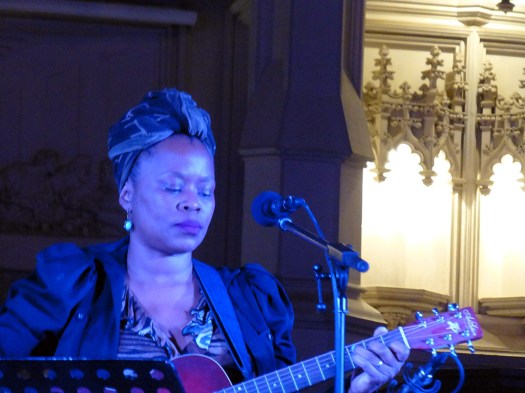
Camille Thurman

Camille Thurman heating it up, Coltrane-style. (Jim Motavalli photo)

The Caramoor jazz festival was produced in cooperation with Jazz at Lincoln Center, and was all the better for it. On the bill were a series of acts I was unfamiliar with, but many were nurtured at JALC, and now the talent is reaching a wider audience. Camille Thurman, Riley Mulherkar, Christian Sands, Zaccai Curtis, Michael Mwenso, these are the stars of tomorrow.

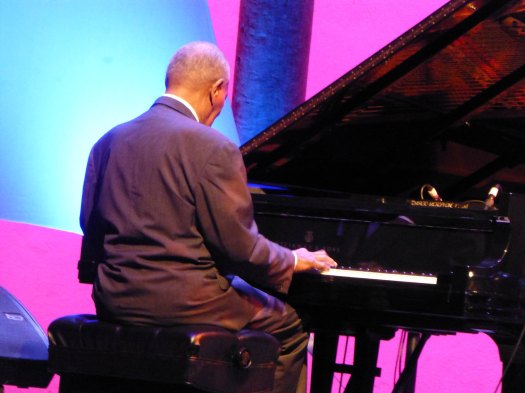
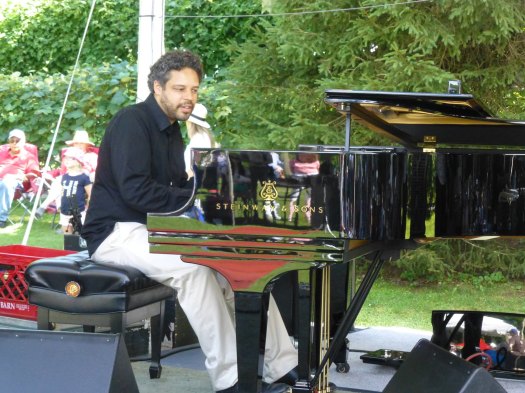
McCoy Tyner

Pianists play with their backs to the audience, so here’s a shot of the back of McCoy Tyner. (Jim Motavalli photo)

The two acts I did know, McCoy Tyner and Mary Halvorson, could not be more different, but are widely varying roots from the same tree. Tyner was John Coltrane’s pianist in the critical years from 1960 to 1965 (as a very informed talk by Seton Hawkins of JALC explained), and Halvorson is today’s most cutting-edge guitarist. The former briefly adorned the open-sided Venetian Theater; the latter appeared in a more intimate setting—the Sunken Garden glade, with bassist Stephan Crump.

Mary Halvorson

Mary Halvorson was heard in duet with bassist Stephan Crump.

The jazz setup is much the same as Americana—concurrent shows in the open air, some on stages, some in forest clearings, leading up to a more formal gala show in the evening. Luckily, the weather cooperated, as it always seems to do when I’m at Caramoor.

Michael Mwenso

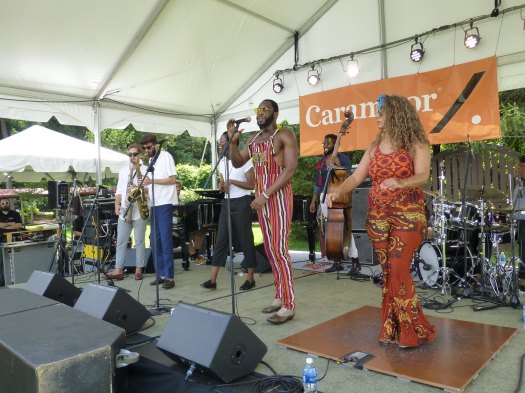
The muscular Michael Mwenso came with his own dancer. (Jim Motavalli photo)

Michael Mwenso and the Shakes offered the very muscular leader with an international cast from South Africa, Madagascar, France, Jamaica and London. An in-house dancer provided appeal, and the group boasted strong singers and players. The only thing they lacked was good material; my mind wandered a bit when the songs started to sound the same.

JALC

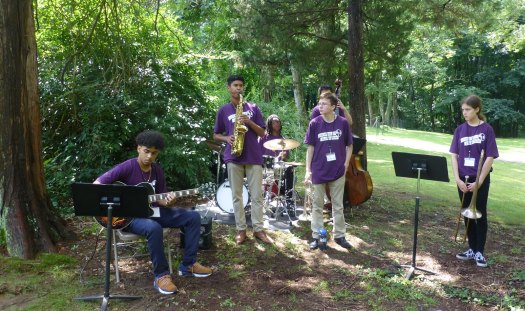
The JALC Youth Orchestra Ensemble serenaded early arrivals. (Jim Motavalli photo)

I wish I’d heard more of Camille Thurman, who was gigging with the Darrell Green Trio. She has a firm, Coltrane-derived tenor saxophone sound and a chocolatey voice somewhat reminiscent of Dee Dee Bridgewater or Jean. She’d sound good, as Dee Dee and Jean did, chanting about the creator on those 1970s spiritual jazz records.

trombone trio

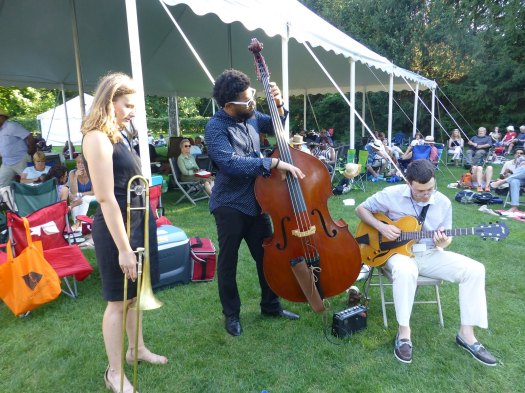
Spontaneous groups like this trombone trio enlivened the Caramoor grounds. (Jim Motavalli photo)

Halvorson and Crump were suitably challenging. The two, who have recorded together, essayed a pair of intense, rapidly shifting duets. If I’m not mistaken, they were called “Emerge” (by Crump) and “In Time You Yell” (by Halvorson). Her guitar was played through some effects pedals that bent the notes in appealing ways.

Riley Mulherkar

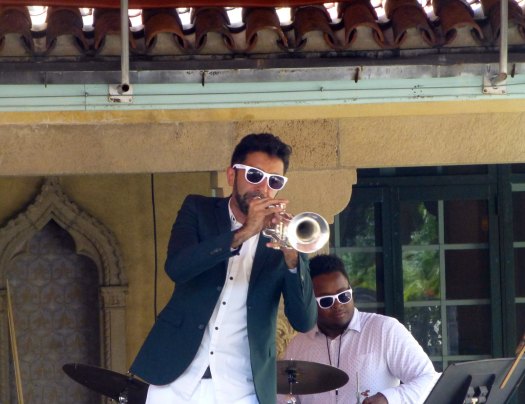
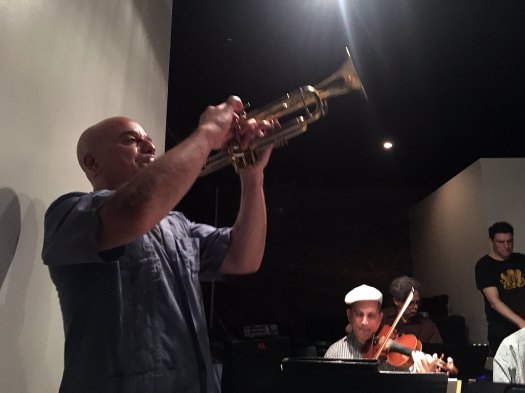
The great Riley Mulherkar tears into some Dizzy Gillespie. (Jim Motavalli photo)

My camera was running low on battery power, so I didn’t get video of the Caramoor  performance, but here the pair is at New York’s great Cornelia Street Café playing “In Time You Yell”:

My two big discoveries for the day both featured Riley Multherkar on trumpet. He led a program with a small group called “In the Land of Oa-Bla-Dee.” If you’ve never heard that particular Dizzy Gillespie song, you owe it to yourself, because it’s the strangest thing in his canon. Here’s a video:


The group played “Salt Peanuts,” “Be Bop,” “Tin Tin Deo” and other Dizzy classics, and Multherkar was on fire whatever the period. He plays very fast, but also very cleanly, fully articulating every note. And he was a good guide to Dizzy’s music, too. I’d never heard “Pickin’ the Cabbage” before.

The Westerlies

The Westerlies offered intricate arrangements of their own music and some well-chosen covers. (Jim Motavalli photo)

Multherkar must have had track shoes on, because almost immediately after the Dizzy show he was in one of the glades as a founding member of the Westerlies. I love the idea of two trumpets and two trombones, all played by high school friends who grew up in Seattle and studied with Wayne Horvitz. The arrangements were intricate, and they played them without sheet music—a lot of woodshedding in evidence there.

The music was quite varied, including a group of songs recorded by the Golden Gate Jubilee Singers. “I Was Born 10,000 Years Ago” is similar to a song recorded by folk groups as “The Man Who Rode the Mule Around the World.” Their originals were great, too, with influences ranging from New Orleans parades to European classical music.

Here they are on video, unfortunately cut a bit short by my batteries running out:


Pianist Zaccai Curtis and his quartet played latin jazz. I thought he sounded a bit like Hampton Hawes, and they cooked on a Mongo Santamaria number. Also in a Latin mood was Pedrito Martinez, a Cuban percussionist. The jazz content wasn’t all that high, so I’m not in a position to judge.

Zaccai Curtis

Zaccai Curtis likes it Latin. (Jim Motavalli photo)

Another highlight was a solo piano set by Sullivan Fortner, during a tribute to Thelonious Monk. His work was brilliantly broad in scale, showing how Monk grew out of stride piano, but also quoting from “Surrey With the Fringe on Top” and just about everything else. As pianist Christian Sands, who had to follow him, put it, “Sullivan played all of the piano.”

And then it was time for the headliners. Helen Sung was a last-minute substitute for Geri Allen, whose passing was a major blow. Playing with the house rhythm section of Gerald Cannon on bass and Francisco Mela on bass, she heated up Tyner’s “Inception” (from his Impulse album of that name).

Craig Taborn was next, and he also gave the master’s music a good run. Tyner himself, 79 now, only played a few numbers, and notably flagged after the second one, but since we were hearing living history nobody seemed to mind.

I learned a lot of new names at Caramoor, and had a brilliant day of jazz.

Yo La Tengo Doesn’t Disappoint in Central Park

NEW YORK CITY—Yo La Tengo opened its free Summerstage concert with a song about being back in the “New York groove,” and few bands are more beloved in the city. They’re most famous for playing a club in New Jersey (the now-closed Maxwell’s in Hoboken) but they’re as quintessentially New York as the Velvet Underground (one of their biggest influences).

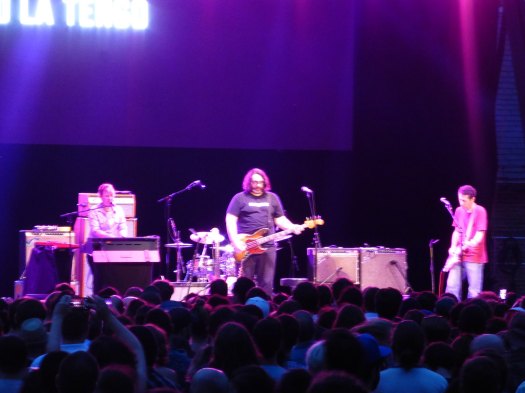
yo la tengo

Yo La Tengo, assimilating their myriad influences. (Jim Motavalli photo)

But not the only influence. Ira Kaplan, guitarist/singer/songwriter, was a rock critic before he got serious about actually playing music, and the group is omnivorous—taking in cues from across the spectrum, avant-garde jazz to garage rock. In some ways, they’re NRBQ without the rockabilly.

Yo La Tengo played free in Central Park 26 years ago, and it was the very first show with bassist James McNew. But Kaplan said he was coming to shows long before that, namechecking Sha Na Na, Poco and the Mahavishnu Orchestra. That would have been 1971 and 1972, when the series was the Schaefer Music Festival at Wollman Rink. I went to a number of those shows, too, and saw the same Mahavishnu/Taj Mahal double bill at my high school in ’72.

I love the diversity of that lineup. Usually, fans of Sha Na Na (doowop revivalists) hated Poco (country rock) and Mahavishnu (jazz-rock). I could listen to all three, and maybe that’s why Yo La Tengo is, along with Captain Beefheart and the Magic Band, my all-time favorite rock group.

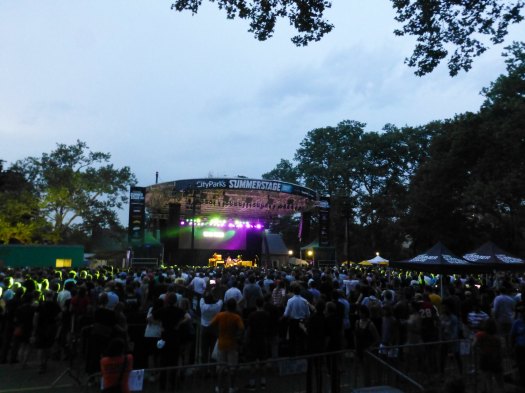
yo la tengo

Day becomes night at Summerstage, under a cloudy sky. (Jim Motavalli photo)

Amazingly, I’d never seen them live, and they didn’t disappoint. The band launched right into a VU-influenced “Sister Ray”-type jam with a hypnotic repeated bass line. Georgia Hubley is one of my favorite drummers, and it’s not because she’s flashy. In the pocket, as the jazz guys say.

What followed was the mix apparent on their records from the beginning—intimate songs alternating with rock and avant-noise. Perhaps it’s the same formula as Sonic Youth, but you can like both of them, can’t you?

McNew did something the ramshackle NRBQ would have been proud to call their own: He pointed to the unblinking lighted “Yo La Tengo” sign behind the band and said, “How do you like our light show? Visual presentation is important for a big outdoor show, and I think we nailed that shit.”

The show concluded with another long jam, this one featuring members of opener Ultimate Painting. It went on for 20 to 25 minutes, far past a number of logical stopping points, which is what I love about Yo La Tengo—going too far, turning it up to 11, confounding expectations. The encore, to promote a series of Hannakuh shows at the Bowery Ballroom, featured Kaplan’s mother warbling a charmingly off-key number—played completely straight. How can you not love a band like this?

Ultimate Painting, the English opener, managed to be both chiming and lilting, without also being catchy. Tight but boring. Odd, that. They had a nice sound, but didn’t have the songs to go with it. Zero stage presence, and flubbed one song twice before making it all the way through. “Their tunes weave in and out of each other like the duo’s respective six-strings, spiraling around each other in a laconic dance,” the publicity said. I missed the laconic dance, I guess.

If Ultimate Painting became a Yo La Tengo cover band, though, they’d do great. The problem was that the band’s lyrics didn’t seem to be about anything, or at least they didn’t put them over as if they did. They didn’t feel invested in their own material.

I should mention that the Summerstage sound was fine, the prices for food and drink not outrageous, and the crowd control was handled well. It’s a nice venue, under the trees in Central Park’s Rumsey Playfield. Other concerts worth your time are PJ Harvey July 19, Regina Spektor July 27, and the “Bhangra royalty” show August 6.

Surprising Wedding Music in Washington State

I went to Washington’s Olympic Peninsula to attend a wedding (my lovely cousin’s), not to hear music. But the American musical Diaspora is so vast that I heard some great music anyway, on the street and in front of the barn.

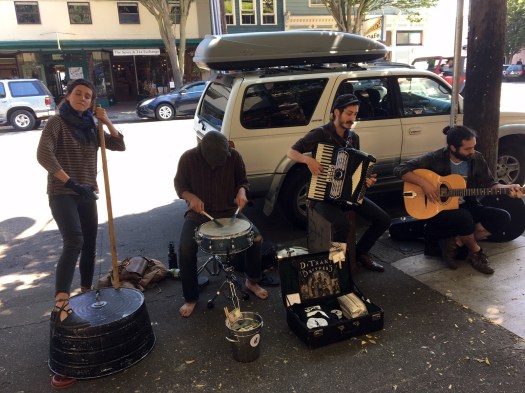
Ditrani Brothers

The DiTrani Brothers live on the streets of Port Townsend, Washington. (Jim Motavalli photo)

The streets of downtown Port Townsend yielded an impromptu gig by the DiTrani Brothers, who describe their influences being “western and eastern-European folk music, Roma swing (gypsy jazz) and early American jazz.” And that’s exactly what they sounded like. There was a guitar (Walker DiTrani) an accordion/banjo (Bobby DiTrani), a drummer (Eddie Gaudet) and a washtub bass player (Dana Anastasia Hubanks). Together, they made music with those influences, plus klezmer, maybe, quite apparent—not your usual street music fare! If Django was a Jewish Italian and resident in Montenegro…I captured this video:

The Brothers have a Facebook page here. Influences include: St. Cinder, Lost Dog Street Band, G-String Orchestra, Resonant Rogues, Ladies on the Rag, Crowquill Night Owls, Carolina Catskins, Folkfaces, Kyle Ollah. I haven’t heard a one of ‘em, but I’m sure they’re all great. They also like Tom Waits, Django (of course), Cab Calloway and Freddy Taylor.

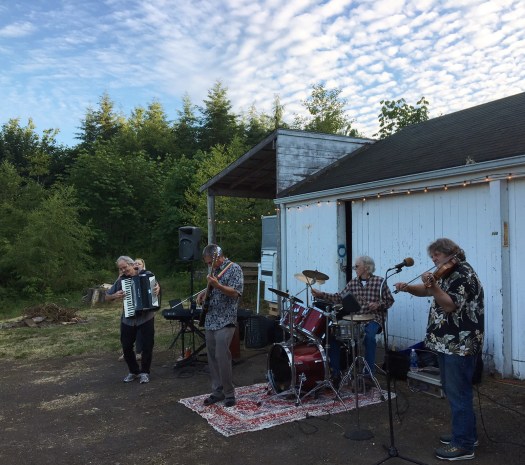
The Delta Rays

The Delta Rays rock Kathy and Tracey’s wedding. Note dramatic sky. (Jim Motavalli photo)

The wedding band was, well, a bit different. The Delta Rays don’t play “Celebrate” or, in fact, any getting-hitched music at all. Their repertoire was Cajun (the vocalist/guitarist doubled on fiddle, and the keyboard player on accordion), jump blues, and early rock-and-roll. I wish I got their names but, you know, it was a wedding.

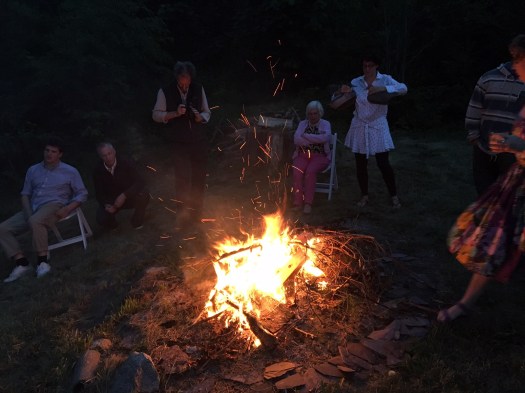
washington wedding

Around the bonfire at the Washington wedding. (Jim Motavalli photo)

They started playing in the late afternoon, as a spectacular cloud formation gathered over the garage. Check out the video; the Delta Rays got people dancing. Here’s a fine instrumental, answering a request for something with a klezmer feel.

Great music is where you find it. I found it on the Olympic Peninsula in Washington. The wedding took place on the couple’s new homestead, with 60 acres of temperate rain forest. Incredible views!

A Swinging Territory Band at John Zorn’s New York Club

The Stone, unfortunately closing in February, is composer John Zorn’s outpost in the East Village. It’s at the corner of 2nd Street and Avenue C, and the only way you know it’s there is some peeling Letraset on the door.

Steven Bernstein

Steven Bernstein, conducting with his trumpet. (Jim Motavalli photo)

The club, which I visited for the first time July 2, reminds me of New York jazz in the 70s, when many artists—Sam Rivers, Joe Lee Wilson, Rashid Ali—had clubs that were about the music first. The Stone doesn’t even serve drinks or food. It’s a shame it’s not lasting, but it was packed 7/2/17 for a first-rate show by the Millennial Territory Orchestra, one of several bands (the Sexmob is maybe better known) that the composer/arranger/trumpeter Steven Bernstein either started or plays with regularly.

The phrase “territory band” has fallen out of favor, but in the old days it means a band—often with horns and vocalists—that traveled around a regional circuit (the Midwest, say). The MTO has a shifting cast of mostly New York-based first-call musicians, so its territory is the Tri-State area, though I believe it’s done some touring internationally.

The Millenial Territory Orchestra

The MTO has a shifting cast, but among the names I caught were Ben Allison, Curtis Fowlkes, Peter Apfelbaum, Ben Perowsky. Erik Lawrence, Doug Wieselman and Will Bernard. (Jim Motavalli photo)

The MTO got together in 1999, Bernstein told me. “I had just finished arranging music for Robert Altman’s film Kansas City, and part of the job was listening to a lot of the territory bands. That music stayed with me. It got left behind in the late 1920s when swing came in, and nobody was playing those songs or that style anymore. The first thing I did was an arrangement of Stevie Wonder’s ‘Signed, Sealed and Delivered.’ I just heard that in my head, and it led to a lot of other music using that kind of instrumentation.”


The night at the Stone included two Ellington tunes, but also some originals, the Grateful Dead’s ‘Ripple,’ some Bessie Smith, and a song or two from a New York territory band. The Dead song is no aberration because the group embraces pop—MTO Plays Sly is the most recent album. Guest vocalists have included Antony Hegarty and Martha Wainwright.

Whatever the material, the sound is a delightful exploration of the possibilities and colors of the kind of little big band that once piled into a pair of Model A Fords and hit the road. Bernstein is a very physical conductor, swooping into the band to indicate the next soloist, to silence a passage or bring on a fanfare. He doesn’t (or didn’t) solo, instead using his signature slide trumpet and muted horn to change the pace.

The music was very visual, somewhat in the way Sun Ra was in front of the Arkestra, though without the costumes (there were a lot of hats, though). “We just want  to give people something to wrap their ears around,” Bernstein said.

On the night, Bernstein quipped that every time he plays a club, it closes. Let’s hope that pattern does not continue. What would be great is a permanent berth for the band, say on Monday nights. As you may recall, that was a tradition for the Thad Jones-Mel Lewis band at the Village Vanguard for decades.

Celebrating Roots Music in Caramoor’s Gardens

I’ve seen the Carolina Chocolate Drops four times, and Rhiannon Giddens under her own name three. You could say I’m a fan, of both the group and of Rhiannon as a solo act. Her show at New York’s Caramoor this year, ending a near-perfect day of outdoor shows and jams as part of the American Roots Music Festival, was an ideal balancing act.

caramoor 2017 rhiannon giddens

Giddens (above) isn’t a cult favorite anymore; she’s gone mainstream. A capacity audience jammed the Venetian Theater, and gave her standing ovations before she was even halfway through. The turning point was a luminous public performance of Odetta’s song “Waterboy,” and her 2015 album Tomorrow is My Turn, produced by T-Bone Burnett. It’s a fine album, but by showcasing her (stellar) vocals, it presents an incomplete picture of what Giddens can do.

Rhiannon Giddens

Giddens was on fire, and she covered all her bases. (Jim Motavalli photo)
A show I saw in Brooklyn promoted the Tomorrow album, and as such left me somewhat frustrated—she hardly touched her banjo or fiddle, though she’s a virtuoso on both. The situation reminded me of the experience of the brilliant Nat King Cole, whose skills as a pianist were pushed in the background after that magnificent foghorn of a voice hit the pop charts—and stayed there. Cole even made an album as a singer with George Shearing at the keys—a shame.

But solo Giddens is stretching her huge wings, and the Caramoor show was unreservedly great, with the full range of her talents on display. She’s already on her way to becoming a major star, and she couldn’t be more deserving of it. Between the opening “Spanish Mary” (taken from Lost on the River/Basement Tapes album of unrecorded Bob Dylan) to Aretha Franklin’s “Do Right Woman” encore, she was simply on fire.

Highlights included a furious fiddle duet with ace collaborator and multi-instrumentalist Dirk Powell, who keeps the traditional fires burning; a string of great original songs centered on the African-American experience of slavery (taken from this year’s Freedom Highway, co-produced by Powell); an intense give and take with Chocolate Drop Hubby Jenkins on the spiritual “Go Where I Send Thee”; a master vocal class with Patsy Cline’s “She’s Got You” and even a Cajun interlude.

Cole Quest

Cole Quest (left) is walking in Grandpa Guthrie’s footsteps. (Jim Motavalli photo)
There was so much music at the American Roots Music Festival it’s hard to do justice to all of it. Spuyten Duyvil, favorite sons (and daughter) here, were their usual boisterous selves (and lead the Grateful Dead-song social hour later). Cole Quest is Woody Guthrie’s grandson, and Arlo’s nephew. His band the City Pickers was a mainstay of the event, mixing it up with nearly everyone there. Quest plays dobro and does justice to Grandpa’s songs.

Kaia Kater

Kaia Kater (right) was a bit subdued, but well worth seeing. (Jim Motavalli photo)
I loved banjo player Kaia Kater’s album Nine Pin, released last year. In performance with a bass player, she was a bit subdued, but still compelling. She later turned up with Giddens, and the two of them make a convincing case that African-American folk music is back, and that women are in the vanguard.

I missed Eddie Barbash’s set, but heard him blow sax in one of the jams, and was amazed that an alto sax can be turned into a credible bluegrass solo instrument. Barbash was a member of Stephen Colbert’s band, and played with Chico Hamilton, Yo Yo Ma, Lenny Kravitz and Parliament. But now he’s leading an eponymous band and “playing American Roots music on alto sax.”

The Mammals

The Mammals are Mike + Ruthy with their old name back. Don’t miss their Summer Hoot in August. (Jim Motavalli photo)
Michaela Anne has a great singing voice, a fine band, but no songs that really stuck at Caramoor. I enjoyed River Whyless more simply because they were so unexpected. They looked like a roots band, but made virtually none of the genre’s clichéd moves—the roots were sprayed with day-glo paint. There were elements of jazz, psychedelic rock, and more. The experimental edge helped them stand out during a crowded day.

Michaela Anne

Michaela Anne (left) had everything but a tackle box for the hooks. (Jim Motavalli photo)
The Lonely Heartstring Band, which started out covering a seminal Beatles album that turns 50 this year, was less adventurous, though I loved what they did to “Graceland.” Who knew that made a good bluegrass song?

I’ve written much about the Mammals (formerly Mike + Ruthy) that I don’t have to reiterate it here. If you have a chance to see this husband-and-wife act, do. Like Rhiannon Giddens, they have it all–dynamic performances, stellar singing (solo or in harmony), and both instrumental and songwriting skills in abundance. Their native habitat is the Summer Hoot in Ashokan, New York.

I caught five minutes of Jefferson Hamer (who made a great album of trad ballads with Anais Mitchell), and he was especially fine on “Old Churchyard”) recently covered by The Decembrists with Olivia Chaney).

The Brother Brothers

The Brother Brothers are Adam (left) and David Moss. You’re going to hear more from these identical twins. (Jim Motavalli photo)
I’m an identical twin, so probably predisposed to love a twin act, but I’d heartily endorse The Brother Brothers if the two were entirely unrelated.

Adam Moss (who also worked with Anais Mitchell) excels on fiddle, is a very strong singer, and haunting songwriter. David Moss has the songs, the singing and killer cello chops.

Together, they’re a modern Everly Brothers in terms of harmonies, so it wasn’t surprising they did two songs from Phil and Don. They’re funny too, and from Peoria. Check out their Tugboats EP.

Sarah Jarosz

Sarah Jarosz was fine, if a bit studied and subdued. (Jim Motavalli photo)
The evening concert featured Sarah Jarosz, the enfant terrible of bluegrass who’s mostly grown up now. With Anthony da Costa on colorful guitar washes and the absolutely ace base player Jeff Picker, she was fine, very tasteful, and sang her lovely songs well. But I prefer her records.

Sarah Jarosz and Adam Moss

Sarah Jarosz (right) with Adam Moss of the Brother Brothers. (Jim Motavalli photo)

Live, Jarosz’ raps were a little too scripted, her instrumental skills were muted in favor of the singing (which won her Grammys), and she could have used a little of Rhiannon Giddens’ fire. But, then, you could say that about almost any performer in the world.

Clearwater is Back for 2017

CROTON ON HUDSON, NEW YORK—At the Clearwater Festival, which came back this year after taking a breather in 2016, it’s either beastly hot or pouring rain. But on June 17, the day I could attend, it was cloudy, with only a couple hours of rain. Remembering the search for shade (which made the dance tent more tempting), it was actually better to be getting wet.

suitcase junket

Matt Lorenz, a/k/a Suitcase Junket, in full flight at Clearwater. (Jim Motavalli photo)


And it was worth it, because the music was so good. I had The Suitcase Junket, a/k/a Matt Lorenz, on my radio show a few days earlier, and he confirmed that he found his guitar in a dumpster, cleaned the mold off, and has been playing the thing ever since. The program described him, accurately, as a “throat-singing, slide guitar-playing, one-man band.”

I’ve been reading Robbie Robertson’s Testimony, the section about the Basement Tapes, and it was a pleasant surprise when Mr. Junket performed “Tears of Rage.” As you may recall, Dylan wrote the song with Richard Manuel of the Band, who is remembered so well in the Mammals’ song “The Ghost of Richard Manuel.” I’m happy because I’m seeing the Mammals this coming weekend at the wonderful Caramoor American Roots Music Festival (along with Rhiannon Giddens, Sarah Jarosz and a whole lot more).

Larry Campbell and Teresa Williams

Larry Campbell and Teresa Williams had the good. (Jim Motavalli photo)

Larry Campbell wooed Teresa Williams with a Louvin Brothers mixtape. “And it worked,” she said. The Louvins’ “You’re Running Wild” was a highlight of their set, but really it was all good. Both are strong singers and songwriters—Teresa is a classic country belter, and Campbell is paging Johnny Cash. Add to that the fact that Campbell is a truly great guitar player, who references all of country history (as does Jerry Miller, the incomparable guitarist in Eilen Jewell’s band).

These two are the Porter Waggoner/Dolly Parton of their age, but Nashville no longer rewards such partnerships, alas. Classic country belters play at bluegrass festivals.

Leyla McCalla

Leyla McCalla and band explored her Haitian heritage. (Jim Motavalli photo)
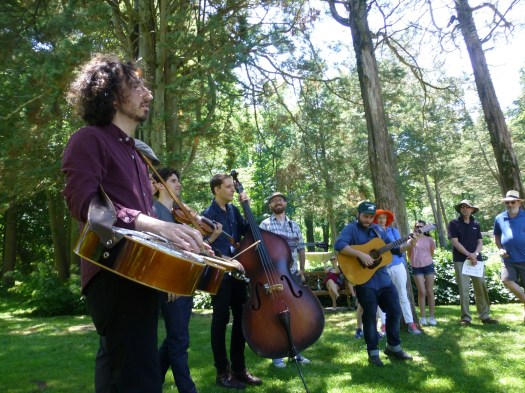
Leyla McCalla, the cellist/singer I first saw with The Carolina Chocolate Drops, is now on her own, and mixing Americana with Creole songs from her Haitian ancestry. She also had a crack band, and one of the highlights of the set was a fascinating duet with her fiddle player.

McCalla is a historian and a folklorist, so she does what any self-respecting cultural ambassador would do—explain the songs, put them in context, and translate the lyrics.

Nick Lowe

Nick Lowe was riveting, with just a guitar in hand. A new man in black? (Jim Motavalli photo)

I heard someone describe Nick Lowe as “Britain’s Johnny Cash,” and while that isn’t entirely accurate, they both dress in black and write and sing like geniuses. With just a guitar, Lowe was riveting—he was really singing well, and took us through “Heart for Sale,” Cruel to be Kind,” “When I Write the Book,” “Heart for Sale” and other modern classics. It wasn’t “folk,” it wasn’t “punk” or “new wave,” it was just good songs, very effectively delivered.

Guy Davis

Guy Davis is keeping the country blues tradition alive–and what a storyteller! (Jim Motavalli photo)

Guy Davis is a folklorist, too, though he finds fertile ground in the country blues. But rather than mining the old 78s, he writes great songs in that tradition—often with lots of contemporary flourishes.

The son of Ruby Dee and Ossie Davis, he could probably tell Hollywood stories if he wanted, but instead we’re set down on the crossroads somewhere. He’s an incredible guitarist and harp player, and one of my favorite singers. Good storyteller, too.

Josh Ritter

Josh Ritter was happy to be at Clearwater. Just happy in general. (Jim Motavalli photo)

Josh Ritter appears to be entering a fertile period. At Clearwater, he played a lot of newer songs. (My favorite was “Cumberland,” which is on his Sermon on the Rocks album.) And he appeared unbelievably, unconquerably happy to be doing what he was doing. With a broad grin that never left his face, he kept thanking the audience for being allowed to play at Clearwater.

The fans reciprocated. During the set, which I watched from behind the stage, I saw two women, with their children, mouthing every word of the lyrics. Later, I asked one about her love of Josh Ritter. “He’s brilliant, poetic, and he has a way of getting across political messages without being overtly political.” I’ll agree with that. He can sing “Girl in the War” for 30 minutes and I’d be happy. After the show, he agreed readily to an appearance on my radio show, so I’ll hold him to that. He was still grinning.

Stilt walking

How’s the weather up there? Stilt walking is a lost art, except at folk festivals. (Jim Motavalli photo)
Some of the show is offstage at Clearwater, and I enjoyed a lady on stilts and Nate the Great, who juggled flaming torches and played a song on a sliding board.

Nate the Great

Juggling three flaming torches? Why not, all in a day’s work for Nate the Great. (Jim Motavalli photo)

I finished the night with two ace zydeco performances in the dance tent. Nathan and the Zydeco Cha Chas are black, and Jesse Legé and Bayou Brew are white, but their music has plenty in common. I’ve been fascinated recently not only by zydeco and Cajun music, but by the process that created it.

Here were these French people expelled from Canada’s Atlantic provinces by the conquering British in the 18th century, exiled to France, then resettled in—of all places—southern Louisiana’s swamps and bayous.

Nathan and the Zydeco Cha Chas

Nathan and the Zydeco Cha Chas. Their version of stage diving is a gentle stroll through the audience. (Jim Motavalli photo)

What a shock to the system! And yet they adopted and, influenced by the rich alternative traditions around them, created both a very appealing culture (French culture plus crayfish equals Cajun cooking) and incredible music.

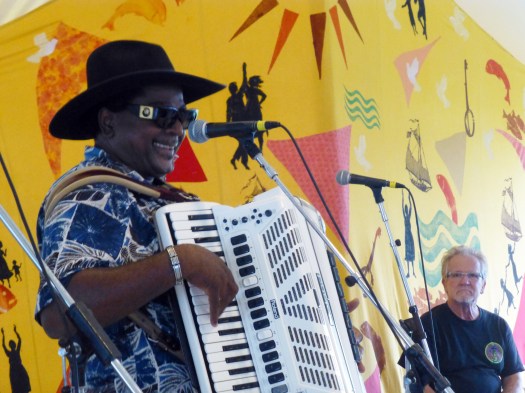
Nathan is an extremely genial presence, given to strolling through the audience, furiously playing his accordion all along. I noticed Jesse Legé sitting at stage right, rapt, for Nathan’s entire set. The Cha Chas are the best there is right now, and if you can see them, don’t miss it.

Legé and his band, featuring three women, was on the same plane. They build up a huge head of steam on uptempo numbers, and get the dancers moving on ballads, too. They’re from Louisiana, but it appears they’re in New England and New York for most of the summer—the festivals come that thick and fast.

All in all, an excellent return for Clearwater. There was an air of celebration in the air, because Indian Point nuclear plant is shutting down, and the usual political and cultural activism was in the air. My favorite sign said: “Group Mime! Sing-a-Longs! Join Us on the Working Waterfront.”

Letting its Light Shine: The Ninth Annual Brooklyn Folk Festival

BROOKLYN, NY—It’s not possible to have a better time at a music event than I had at the Ninth Annual Brooklyn Folk Festival. Maybe if Mississippi John Hurt, Dock Boggs and Woody Guthrie were reincarnated and appeared as a song-swapping trio I’d be happier.

brooklyn 2017

Five hours of the 300-year-old song “Queen Jane”? Why not? (Jim Motavalli photo)

Let me do this chronologically. I got to the festival Saturday afternoon. I’d have liked to see Anne Waldman read her poems, bask in the harmonies of Appalachian mountain duo Anna & Elizabeth, and swing to the Tennessee Stiff Legs, but life had other plans.

Instead, I walked in to Martha Burns doing old-time songs. Alas, she didn’t remember them all that well, but when she was on she was very good.

brooklyn 2017

Brotherhood of the Jug Band Blues, embracing “KC Moan.” (Jim Motavalli photo)

I love jug bands, especially when they’re doing the Memphis Jug Band’s “KC Moan.” And since I’ve never seen a jug band that didn’t do that song, I’m very happy. The BFF actually has two “house bands,” and this was the bigger one, Brotherhood of the Jug Band Blues. Both have Jackson Lynch, who’s a triple threat as guitarist, fiddler and vocalist. Equally good singers are Ernesto “Lovercat” Gomez and Ernie “Papa” Vega. Arturo “Jugman” Stiles is, well, on the jug. A highlight of the set was a great “Richland Woman Blues” by guest singer Samoa Wilson, who’s often seen with 60s jug pioneer Jim Kweskin.

brooklyn 2017

John Cohen: fresh memories of Clarence Ashley. (Jim Motavalli photo)

The tribute to banjo great Clarence Ashley (who brought Doc Watson to New York) was excellent, and held in conjunction with the Jalopy label’s release of the late performer’s first-ever live album. John Cohen, a member of the highly influential New Lost City Ramblers and a folklorist and photographer of note, was on hand to remember the 1961 Friends of Old-Time Music concert he helped promote (and at which he took the album’s cover picture).

Peter Siegel recorded the live album at Gerdes Folk City in 1963, and he was on hand, too, to play (very credibly) “I’m the Man Who Drove the Mule Around the World.” Another highlight was Willie Watson’s “Little Sadie.” Watson got his own set later, and he’s a man to watch in the old-time repertoire. I liked his “Hills of Mexico,” an old song with many variants.

brooklyn 2017

Little Nora Brown: The next generation lines up. (Jim Motavalli photo)
Brooklyn has the Parish Hall stage going along with the main stage, and I enjoyed seeing Little Nora Brown—who couldn’t have been more than 10—wailing away on some mountain classics. We’ll see her, all grown up, at the 19th Brooklyn Folk Festival.

brooklyn 2017

Bill and the Belles: 78s reborn. (Jim Motavalli photo)
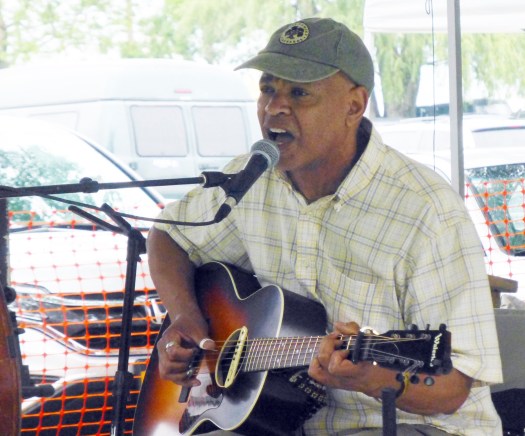
Bill and the Belles should be better known, and now that they’re getting out of Bristol, Tennessee that probably will happen. Kris Truelsen is a music historian with a master’s degree in Appalachian Studies. He produces Radio Bristol at the Birthplace of Country Music Museum, but he’s no mere archivist. As a singer he’s more pop than country, but we’re talking the popular music of the 1930s. He’s a 78 come to life, and has the style down pat.

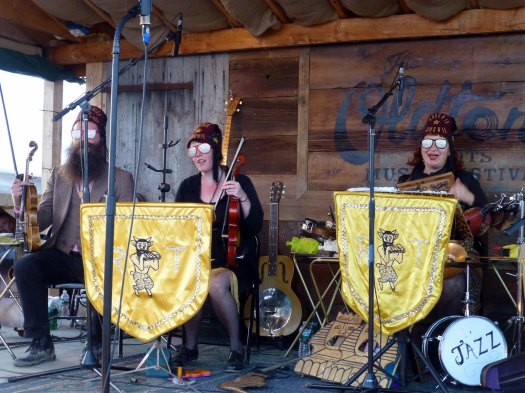
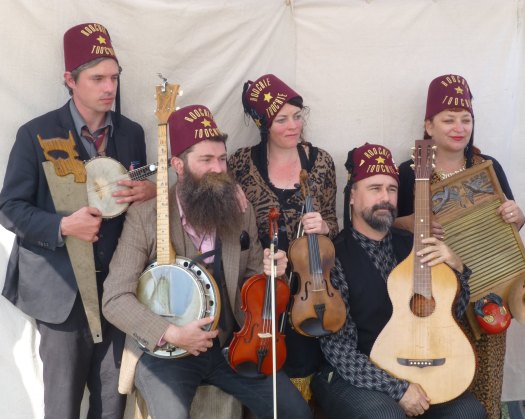
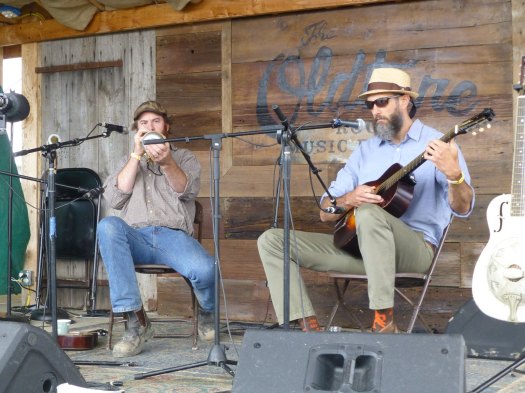
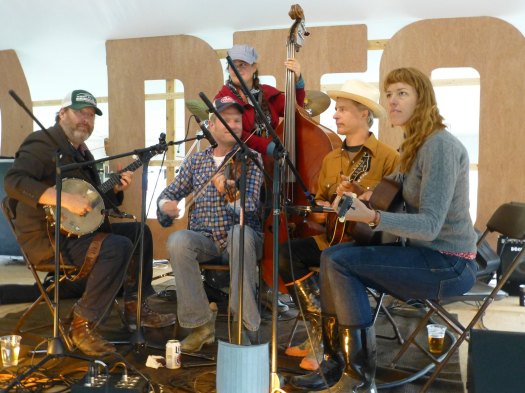
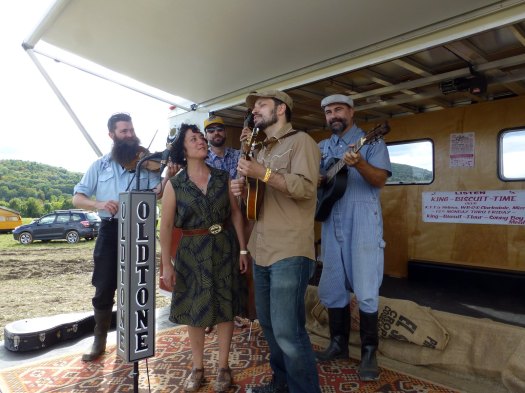
Kalia Yeagle and Grace Van’T Hof are the Belles, and their harmonies give the band’s sound a richness that I haven’t heard elsewhere, plus Kalia is a killer fiddle player. If you missed them in Brooklyn, catch them—and lots of other great stuff—at the Oldtone Roots Music Festival in September.

brooklyn 2017

Amythyst Kiah: Odetta meets Nina Simone. (Jim Motavalli photo)

A mashup of Odetta and Nina Simone would produce Amythyst Kiah, a major find for me. She is a vocalist for the ages, and you’re going to thank me for telling you about her. Accompanying herself in a repertoire that ably skipped around the music world but included the Mississippi Sheiks, Riley Puckett and the Reverend Gary Davis, the presentation was a bit spare (she also appears with the Chest of Glass band) but there was no denying that she possesses a world-class voice and knows how to use it.

I love versatility and the Texas-based Calamity Janes had three singers and three fiddle players. Plus a great sound.

brooklyn 2017

Jerron “Blind Boy” Paxton is a quadruple threat live performer. (Jim Motavalli photo)

I’ve written about the glories of Jerron “Blind Boy” Paxton before, and he’s fine on recordings but amazing as a solo live performer. He plays piano, guitar, fiddle and banjo, all with dazzling authority. And he’s a fine singer, too, with a suitably offbeat repertoire. I’d never heard “The Cat Came Back” before, but it’s a song written by Harry S. Miller in 1893. Funny, too. Here’s a version on video:

The day ended—for me, the festival continued on its merry way—with Reverend Billy and the Stop Shopping Choir, a group that wraps its activist message in some of the best gospel singing around. It’s like some kind of cosmic collective.

brooklyn 2017

Peter Stampfel’s 2017 version of the Holy Modal Rounders is called the Ether Frolic Mob. (Jim Motavalli photo)

Fiddler/vocalist Hilary Hawke of Dubl Handi led an amicable slow old-timey jam to launch day two. You can’t go wrong with “Cumberland Gap” and “Soldier’s Joy.”

brooklyn 2017

Hilary Hawke led the informal slow jam. (Jim Motavalli photo)

The other house band is the Downhill Strugglers, featuring not only Lynch but also Eli Smith, the festival’s main organizer and also its master of ceremonies.

brooklyn 2017

The Downhill Strugglers: A house band with a new album (and veteran John Cohen). (Jim Motavalli photo)

John Cohen is a Struggler, too, and the band has a new album called The Lone Prairie. The album has the spirit of those old Holy Modal Rounder dates, and sounds like it was recorded through one of those horns favored by the RCA dog. The Rounders’ Peter Stampfel was on hand, too.

brooklyn 2017

A great festival find: Meredith Axelrod. Don’t think the 40s, think the 20s. (Jim Motavalli photo)

OK, another great find: Meredith Axelrod. She came out looking like a 40s belle, but when she started singing the clock was set rather farther back. Like Paxton, she featured a song from the pre-recording era—1911. “The Hypnotizing Man” was deeply weird, and Axelrod gave it exactly the dramatic reading it deserved. So when she swung into “Come Take a Ride in My Airship,” it was par for the course.

Axelrod, who made a great live album of duets with Jim Kweskin, is a true original. Not just a singer, she’s a fine actor. See her live.

brooklyn 2017

Queen Esther was country-tinged. (Jim Motavalli photo)

I didn’t know Queen Esther, but she was cosmically wonderful. Imagine Valerie June with a distinctly country edge and you’re close. She’s working on a song cycle about Cathay Williams, the black woman who somehow passed as a man in the Union Army after the Civil War—and then had the temerity to demand a pension for her work. Jeff McLaughlin, who accompanied her, is a fine guitarist.

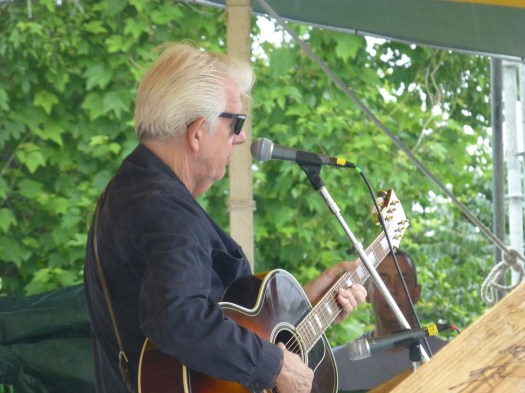
Finally—for me—there was the Locust Honey String Band, one of my favorite old-timey ensembles, featuring the songwriting and harmonies of Chloe Edmonstone and Meredith Watson. Here’s a new song by Watson:

They were fresh from Merlefest, and have a new album coming out in June. Here’s a video of a Watson song that will be on it, with a title like “I Was Making Plans for Nashville, and You Were Making Plans for New Orleans.”

brooklyn 2017

The Locust Honey String Band are one of my favorite old-timey groups. (Jim Motavalli photo)

As I was leaving I stopped by the Workshop Stage, where three singers–Anna Roberts-Gevalt, Elizabeth LaPrelle and Tim Eriksen—were performing five hours of the same 300-year-old song, “Queen Jane.” That would be a singular event anywhere else, but it was just part of the magic at the Brooklyn Folk Festival.

PS: Rick Massimo, author of I Got a Song: A History of the Newport Folk Festival, was in attendance though we somehow missed each other. Never mind, I got the book and will have him on my radio show. Newport has a rich history, and if you want to go this summer, buy your tickets now.

Dirk Powell and Rhiannon Giddens: Made for Each Other

If ever two musicians were destined to meet—and adore each other—it’s Rhiannon Giddens and Dirk Powell. They’re both hugely committed to old-time music, and the history that created it. And they’re both great singers, as well as multi-instrumentalists who can play anything they touch.

rhiannon giddens and dirk powell

Rhiannon Giddens and Dirk Powell, in a rare when they weren’t moving too fast to blur the camera. (Jim Motavalli photo)

In a sublime show at Hartford’s Infinity Tour, the last stop on their tour, they fit together like peanut butter and jelly. Giddens has been great forever (you need to own the Carolina Chocolate Drops albums), but with the release of her first T-Bone Burnett-produced solo album, Tomorrow is My Turn, she’s really connected to the public.

Giddens was the BBC’s Folk Singer of the Year, and she got the Steve Martin Prize for Excellence in Banjo and Bluegrass, as well as induction into the North Carolina Music Hall of Fame. The Hartford show was sold out.

Powell is just as great (as artist and producer). He’s definitely up there with Bruce Molsky as a solo old-time performer—on any instrument. Let’s see, between them, Giddens and Powell played banjo (both), fiddle (both) accordion (him), piano (him), guitar (both) and voice (both). Here’s a video from the show, “At the Purchaser’s Option”:

If ever two musicians were destined to meet—and adore each other—it’s Rhiannon Giddens and Dirk Powell. They’re both hugely committed to old-time music, and the history that created it. And they’re both great singers, as well as multi-instrumentalists who can play anything they touch.
In a sublime show at Hartford’s Infinity Tour, the last stop on their tour, they fit together like peanut butter and jelly. Giddens has been great forever (you need to own the Carolina Chocolate Drops albums), but with the release of her first T-Bone Burnett-produced solo album, Tomorrow is My Turn, she’s really connected to the public.
Giddens was the BBC’s Folk Singer of the Year, and she got the Steve Martin Prize for Excellence in Banjo and Bluegrass, as well as induction into the North Carolina Music Hall of Fame. The Hartford show was sold out. Here they are with a Cajun medley:

Powell is just as great (as artist and producer). He’s definitely up there with Bruce Molsky as a solo old-time performer—on any instrument. Let’s see, between them, Giddens and Powell played banjo (both), fiddle (both) accordion (him), piano (him), guitar (both) and voice (both).

I love what Steve Earle said about Powell: “”Dirk Powell is a badass. To the bone. He is, in addition to being the greatest old-time banjo player alive, a graduate student of both mountain and Cajun fiddle styles and diatonic button accordion, an instrument that fights you back, take it from me, I’ve tried. He is a singer, songwriter, producer, recording engineer, and all in all an artist of unique vision and unbending integrity. As far as I can tell there is no genre of American roots music that Dirk doesn’t understand, no primordial mode he can’t master, no polyrhythmic code he can’t crack. He also cooks the best sauce piquante I have ever tasted. Be forewarned: Dirk Powell and I WILL make a record together someday.”

Sorry, Steve, Rhiannon Giddens beat you to it. He’s all over her second solo album, Freedom Highway, as both musician and co-writer of some of the tunes. From that album, here’s the harrowing “Julie”:

In Hartford, the duo roamed far stylistically, and in a wonderful way. They played Cajun medleys with Powell on squeezebox and vocals, and Giddens on fiddle—sounding as if she was born on the bayou. They played sophisticated Quebecois fiddle music, stomping old-time standards (“Georgia Buck,” “Motherless Children,” “Going Down the Road Feeling Bad”), and one-offs—a take on Elton John’s “The Border Song” for an Aretha Franklin tribute the next night, an original torch song for a maybe-happening TV show set in Maine in the 30s, even a Mexican number “Mal Hombre,” which Giddens sang with aplomb—and acted out, too.

Maybe Steve Earle actually will make a duo record with Powell before Giddens does, since Freedom Highway is a many-splendored affair featuring Hubby Jenkins and Leyla McCalla from the Drops, as well as Powell and many more. Somebody certainly should. The best idea would be for one of the Giddens/Powell shows to be recorded and a live album released from that.

Both these performers are incredibly busy, so the tour may not happen again soon. But it was clear from their interplay on stage that a lifetime bond has been formed. Giddens said she feels “very blessed” to have found Powell, and from his reaction to that, the feeling is mutual.

Django Lives! At Sarah’s Wine Bar in Connecticut

The initial impression was modest: three tiny amps sitting on a bare stage at Sarah’s Wine Bar in Ridgefield, Connecticut. But the trio that eventually arrived with their instruments—Frank Vignola and Olli Soikkeli on hollow-body jazz guitars, and Jason Anick on violin—didn’t need big Marshall stacks—theirs is a subtle craft.

anick

From left, Vignola, Soikkeli, Anick, Pete Anderson. And that’s the bell of Will Anderson’s saxophone. (Jim Motavalli photo)

I have to say that the food and wine served upstairs at Sarah’s combined with the artistry of those three to create one of the nicest evenings of music my wife and I have ever had. This was gypsy jazz, featuring tunes by and the influence of the great Django Reinhardt. It’s a robust genre that has never gone out of fashion, and it’s enjoying an especial renaissance now—with Hot Clubs sprouting up even in unlikely places. Does Detroit have one? You bet.

anick-2

Will Anderson solos–to everyone’s great pleasure. (Jim Motavalli photo)

I’m a huge fan of both Vignola (whose two Frank and Joe Show records I particularly treasure) and Berklee professor Anick (certainly one of the best jazz violinists today), but the Finland-born Soikkeli I knew only from the Rhythm Future Quartet. He looks no more than 20, but he’s been playing for a decade and is a monster on his instrument, offering blistering solos (and duets with Vignola), and lovely ballad playing. The two guitarists have done some work as a duo and their interplay was exciting, and virtually telepathic.

anick-3

Jason Anick blurs the camera, while Vignola and Soikkeli try to keep up. (Jim Motavalli photo)

This group hasn’t worked together all that much, but because they share a common language—chasing Django—they communicated beautifully. Vignola made a joke that Soikkeli “doesn’t speak a word of English” (he’s actually fluent and lives in New York), but it wouldn’t really matter if he couldn’t talk to his bandmates—they speak through their instruments. Here they are on a popular Django tune, “Swing 42.”

I asked Anick about his influences, and he led off with Stephane Grappelli (of course), but then he cited saxophone players. That makes sense, because he’s got a sound that’s at once delicate and—when needed—as muscular as a Blue Note blowing session.

As Django did, the repertoire mixed standards—“Sunny Side of the Street,” “It Don’t Mean a Thing,” “Stars Fell on Alabama,” Moonglow,” “It Had to be You,” “Sweet Georgia Brown”—with the gypsy’s originals, including his classics “Nuages” (with a young guest from the audience) and “Swing 42.”

Special mention should be made of the Anderson twins, Pete and Will, who came out of the audience to deeply impress on clarinet and tenor saxophone. Playing in pre-bop fashion that was old before they were born, these two are going places. If you don’t here Benny Goodman and Ken Peplowski when Pete plays, you’re not listening, and Will brings Coleman Hawkins to mind. Here they are with the group essaying a swinging version of “I Can’t Give You Anything But Love.”

Random Notes on Music and Musicians

An episode in the first season of HBO’s Deadwood ends with an instrumental version of Michael Hurley’s great song “Hog of the Forsaken” playing over the end credits. I hadn’t heard it without words, but the song is unmistakable. A sample of the missing lyrics:

The Hog of the Forsaken he ain’t like you and I,
With bones always breakin’ and no place to go an’ lie,
He’s in the box so dark and wet, he got so much time,
He ain’t even worried yet, the Hog of the Forsaken,
He is the Pork of Crime.

Here’s the video:

I have a huge LP record collection, but mostly listen to digital files on my computer. With that cold fact staring me in the face—and the growing value of LPs—I decided to see what I could raise from some vintage jazz (which I have doubled on CD) at the Princeton Record Exchange.

It turned out all right. Two grocery bags of LPs yielded $178 and a nice pile of unheard music on CD. Still, I’m going to miss a few of them, irrational as it seems. I probably haven’t specifically listened to that copy of Herbie Hancock’s Maiden Voyage on Blue Note for 20 years or more, and I’d painstakingly digitized my vinyl copy of Dizzy Gillespie on Bluebird, but it had such a beautiful cover. And who can resist the song “In the Land of Oo-Bla-Dee,” with music by Mary Lou Williams, lyrics by Milt Orent and vocal by Joe Carroll?

I met a beautiful princess in the land of OoBlaDee
She smiled and said OobaDidela meaning you appeal to me
I said Oobadideaabendue with pride
Oobadideaabendue let’s take a ride
In the land of OoBlaDee OoBlaDee

She drove me straight to her castle in the land of OoBlaDee
And there I met her two sisters Blooeyda and Dooeyblee
Blooeyda without a doubt was twice my size
Dooeyblee the other sister had three eyes
And the two had eyes for me Oobladee

Here’s the video:

One of the CDs I picked up in Princeton was a gospel album by the diminutive Little Jimmy Dickens. I tend to buy bluegrass gospel albums when I find them, because they often contain their author’s most expressive singing. Dickens was pint-sized, but he had a big, and very country, sound that went instantly out of fashion when Chet Atkins and others started with the modern Nashville “countrypolitan” (strings and horns) sound.

Dickens didn’t go out of fashion with me, though. Here’s a great video. He’s little but he’s loud, and he’s “countrified” and doesn’t care who knows it:

A new album that arrived in the mail yesterday is making quite an impression. It’s Tugboats, an EP by the Brother Brothers, David and Adam Moss, whose music I enjoyed at the Summer Hoot last year. I’m a twin, so it’s nice to see twin acts. Do their voices blend? Do you have to ask? They’re both monster talents as songwriters and singers, and collectively play fiddle, guitar, cello and more.

The only thing wrong with the EP is it’s too short, and doesn’t have enough of their songs on it. Here’s “Cairo, IL” on video:

Other new things I’ve heard and really like:

  • The Maja and David fiddle duo. She’s Danish; he’s French Canadian, and their music seamlessly combines the two folk traditions.
  • Saturn’s Spell, the new album by the Organic Trio on Jazz Family. They take the familiar soul-funk organ trio—organ, guitar, drums—and bring it into the 21st century with, as the notes say, “just the right amount of grease.”
  • The Jason Anick (violin) and Jason Yeager (piano) record United (Inner Circle Music). I don’t know Yeager’s work, but Anick is a brilliant, fiery fiddler, and these two have a solid bond. Also check out Anick’s work with the Rhythm Future Quartet.
  • The hushed music of Allysen Callery, a Providence-based chanteuse.
  • Rayna Gellert’s Workin’s Too Hard (StorySound). Like the Brother Brothers EP, this one should be longer. I loved Gellert’s fiddle playing and singing in Uncle Earl, and was frustrated by her mostly instrumental albums, great as they might be. This one is starting to show her true potential in front of a band. It sounds better every time I hear it.

Robbie Fulks should have won that Grammy for Upland Stories.

Homeward Bound: The Life of Paul Simon by Peter Ames Carlin is well-written, and it paints a none-too-nice picture of the brilliant auteur. Why couldn’t he just enjoy his success, be nice to people, and give credit where it was due?

A more amiable read was Neil Young’s book about cars, Special Deluxe. Wouldn’t Long May They Run be a better title? The book is so Neil Young, rambling, anecdotal, funny, obsessional. He likes old rides, buys them compulsively, and only occasionally fixes them up. The rest go to a kind of vintage junkyard at his northern California ranch.

I’d love to talk old cars with Neil Young some time. We could talk about music, too.