NORTH HILLSDALE, NEW YORK—It’s taken me a month to have enough of a work breather to write about the wonderful time I had at the Oldtone Roots Music Festival in North Hillsdale, New York. This is where three states—New York, Connecticut and Massachusetts—all come together, and it’s a festival hotspot, with the region home to Falcon Ridge and Grey Fox.
Bruce Molsky (center) with his Mountain Drifters. (Jim Motavalli photo)
Oldtone is the newcomer, and thanks to the energies and enthusiasm of Kip Beacco and his many volunteers, it grew to a full multi-day festival this year. But expect it to become a perennial. Though the genre is decidedly healthy—with loads of devoted young bands—there aren’t many festivals devoted to old-time music (not bluegrass).
If your idea of an old-time festival is a bunch of septuagenarians in suspenders playing their fiddles between spits of tobacco juice, think again. Most of these performers—many of them new to me—are under 30. But they’re as devoted to the form (based on collective playing, not flashy solos) as anyone could be.
I was thrilled to see Molsky’s Mountain Drifters for the first time. Here they are on video:
Bruce Molsky is, to my way of thinking, the finest living old-time musician—adept as a vocalist, a virtuoso on banjo, fiddle, guitar and anything else with strings, and an historian par excellence.
In the Mountain Drifters he’s ably supported by Stash Wyslouch of the Deadly Gentlemen on guitar and Allison de Groot. It’s a fine band, with a new CD out, too, and the only drawback is that, of necessity, Molsky stuck to his fiddle. For the full experience, see him solo.
Tony Trischka (left) and Michael Daves show just how much music a duo can make. (Jim Motavalli photo)
The Foghorn String Band have eight albums out, and play widely, but somehow I’ve never seen them until now. I was clearly missing something; they’re a tight unit, in service to the songs.
Run Mountain is the trio version of Moonshine Holler. (Jim Motavalli photo)
Moonshine Holler and Run Mountain are variations of the same band, centered on husband-and-wife team Bill Dillof and Paula Bradley. Add Vermont fiddler Jim Burns and Moonshine Holler becomes Run Mountain. Either way, they celebrate front-porch old-time, and mine the rich seam of country music that emerged on record in the late 1920s. Bradley, by the way, plays in a dizzying assortment of bands; I last saw the Uncle Earl veteran in an all-girl country swing outfit called Girl Howdy, and don’t forget Miss Paula and the Twangbusters.
Here’s Run Mountain with “Goodbye Boll Weevil”:
The Two-Man Gentleman Band doesn’t get together all that often these days, and that’s a shame. They’re an absolute hoot, the Smothers Brothers of old-time. Andy Bean, who sings his own (mostly comic) songs and plays banjo in a style that dates to the 19th century, is joined by his straight man, the Councilman, on bass.
This stuff would be deadly if Bean couldn’t sing, or his songs were weak, but neither is the case. Plus he’s a killer banjo player, inhabiting a genre very few others are keeping alive. He’s apparently making music for a new cartoon series now, while the Councilman plays base with the Legendary Shack Shakers. On hopes the reception they got at Old Tone will keep the Two-Man dream alive.
I enjoyed sets by Hillary Hawke, Michael Daves and Tony Trischka, Bear Minimum (great singer), Bradford Lee Folk and the Farwells. Jesse Lege and Bayou Brew were ripping it up in the dance tent. I’m sorry I missed artists who played on other days, including Brooklyn’s Downhill Strugglers, mainstays of the Brooklyn Folk Festival. And the Hayrollers and the Easy Ridin’ Papas sure sounded interesting.
The venue is just fine, the working Cool Whisper Farm. We were warned not to approach the bull, and after getting a look at him I didn’t need to be told twice. There was plenty of good food available, and it was affordable, too. The crowd wasn’t huge, but this was the first year. I expect great things from this festival next year and forever after. Next year I’ll stay longer.
I’m having a great summer, with as many weekends as I can manage at festivals. I intend to make it three in a row. Two down, one to go!
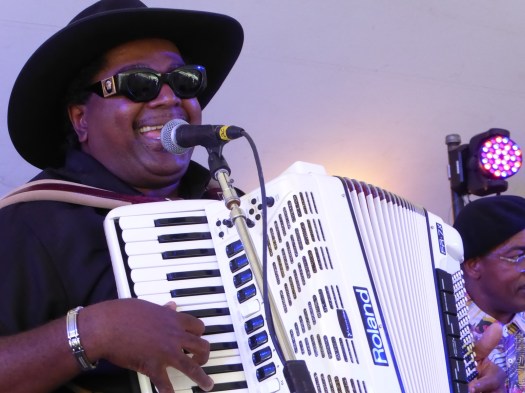
Nathan and the Zydeco Cha Chas, seen in the Rhythm and Roots dance tent, are the goodtime band par excellence. (Jim Motavalli photo)
Just concluded is the Rhythm and Roots Music and Dance Festival, held every September in Ninigret Park, Charlestown, Rhode Island. I haven’t missed this one for years, and it keeps getting better. Two thousand sixteen was the year of Hat Fitz and Cara. I know, you’re not familiar, and unless you were in Ninigret Park you missed them—it was their first U.S. appearance, and so far their only one. Last year they couldn’t get visas.
Hat Fitz and Cara got a huge response–and signed tons of CDs. (Jim Motavalli photo)
Drummer/Otha Turner-influenced fife player Cara is (very) Irish (from Belfast), and guitarist Hat Fitz (a/k/a “Fitzie”) is Australian down to the bush hat—he looks like a rougher version of Mel Gibson, who’s Australian too. Together they’re a combustible hands-across-the-ocean mix, but it comes out as high-energy country blues, via influences like Blind Lemon Jefferson and Dorothy Love Coates. Here’s video:
Given the instrumentation, the White Stripes might come to mind, but I like this duo interpretation much better. For one thing, Cara is a great belter of a singer, reminding you of Bonnie Raitt one moment and Mahalia Jackson the next. And Fitzie doesn’t have Jack White’s Led Zeppelin fixation, preferring the source material that LZ ripped off. He told me that he stopped playing the Reverend Robert Wilkins’ “Prodigal Son” for a decade or more because people asked him about the “Rolling Stones cover.”
Hat Fitz and Cara have two albums (one of which I found in a Dublin, Ireland Oxfam shop) and a third on the way. Don’t waste another day not knowing about them.
Uncle Earl had a timely reunion at Rhythm and Roots. (Jim Motavalli photo)
I was also enthralled with two reunions—Geoff Muldaur with Jim Kweskin (they made the 60s much livelier) and the women of Uncle Earl. The latter broke up almost a decade ago, and banjo player Abigail Washburn has gone on to big things with husband Bela Fleck (they won a Grammy!) Here’s Muldaur/Kweskin video:
I’d missed them in their heyday, and never seen fiddle player extraordinaire Rayna Gellert in person, so this was a treat. It was like they’d never broke up. This was a one-off gig, but I’ll be there will be more down the road.
Donna the Buffalo were reliably great, though a short Saturday slot isn’t really their métier. Jeb Puryear hardly had time to warm up his guitar. They made up for it by debuting a bunch of wonderful new songs—one of which seemed to be called “You Better Look Both Ways (Before You Cross My Heart”). I should have seen them Friday night, when they played for two hours.
Morgan Eve Swain is the Huntress. (Jim Motavalli photo)
My old friend Morgan Eve Swain is back, after the tragic death of her husband and partner in Brown Bird, Dave Lamb. The Huntress and the Holder of Hands is Morgan Eve’s show, and focuses on her upfront vocals and spiky songs. It was just fine, with strong bowed bass and cello adding to the rich mix, and Morgan Eve is a very capable leader, but I missed her virtuoso playing—of guitar, fiddle, bass, and everything else with strings. We did get a nice turn on ukulele.
This was my first time ever seeing Lucinda Williams, believe it or not, and these days she’s heavy on the guitar—from a spectacular player named Stuart Mathis. I appreciate a good shredder, but I’m not sure I want to hear it on every one of Williams’ songs—even the slower ones. Did I count seven guitars on Mathis’ stand? I prefer what Jerry Miller does in Eilen Jewell’s band—it’s more in service to the song. But did I mention that Mathis is a fantastic guitar player?
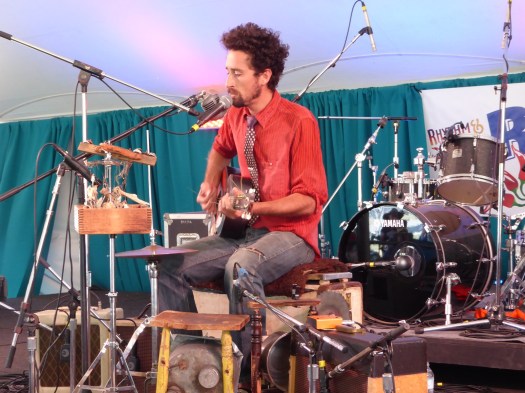
Suitcase Junket: the guitar was found in a dumpster, and his baby shoes play the drums. He’s sitting on the suitcase. (Jim Motavalli photo)
Also wonderful was Nathan and the Zydeco Cha Chas—Nathan enthralled the dance tent by walking amongst ‘em with his wireless accordion rocking all the while. It was also good to see Dave and Phil Alvin—Dave shreds, too—and Suitcase Junket, first encountered at the Summer Hoot last year.
Speaking of the Summer Hoot, it was even better in 2016 than in 2015. It’s Mike and Ruthy’s small but impeccably curated event at the Ashokan Center (founded by her father, famed fiddler Jay Ungar) in Olive’s Bridge, New York, near Woodstock.
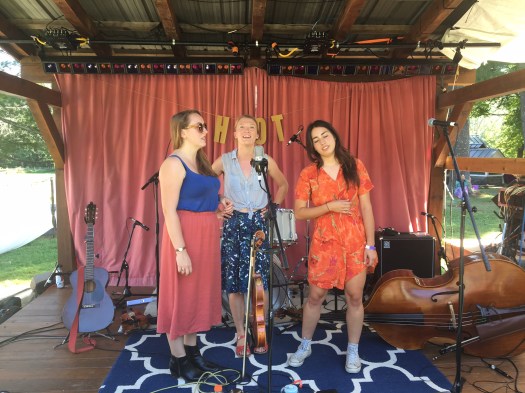
Lula Wiles in full song at the Hoot. (Jim Motavalli photo)
Aside from being an incredible bargain, with two stages going constantly for a relaxed crowd, great food vendors and even affordable accommodations, it’s a place of musical discovery. I didn’t know half the acts performing but I do now. There’s jugglers, too.
I was glad to make the acquaintance of the Ladles, a female harmony trio that very much complemented the also-appearing Lula Wiles (whose take of Keith Whitley’s “I’m Over You” was a showstopper). Singing together, the Ladles get that otherworldly sound going—a beyond-themselves vocal blend so celebrated by Crosby, Stills and Nash.
The Brother Brothers: Terrible name, but a great group–of identical twins. (Jim Motavalli photo)
The other big discovery was the badly named The Brother Brothers. They are, in fact, identical twins (like my brother and I), and a more perfectly balanced duo could not be found. They both write like angels, sing great, and are aces on fiddle and cello.
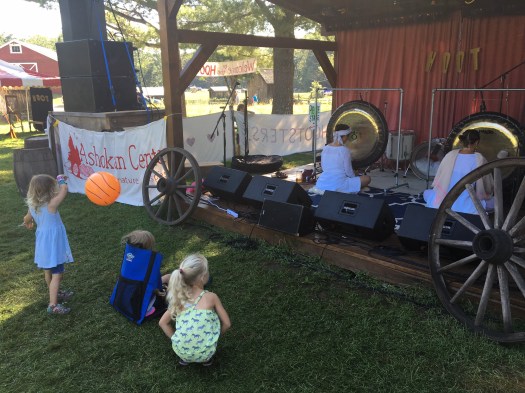
Gongs started the morning at the Hoot–and they had young fans. (Jim motavalli photo)
A great aspect of the Summer Hoot is the workshops, and at this year’s celebration of the banjo North Carolina player Paul Brown (who made a great album with Mike Seeger) held forth on its origins as an African instrument. He also played a persion of “Polly Put the Kettle On” that harked to its beginnings in the late 1700s.
Another true historian, Dom Flemons (late of the Carolina Chocolate Drops, which he co-founded) was also on hand to offer nuggets. He’s working on a record about black cowboys for Smithsonian Folkways. I could listen to Flemons talk for hours, but that’s not the point when he plays so well (this year with the incredible bassist/fiddler Brian Farrow). Here’s a video of them playing together:
One more event, the Oldtone Roots Music Festival, is this coming weekend in North Hillsdale, New York, where that state comes together with Connecticut and Massachusetts. The ultra-great Bruce Molsky is playing, and I’d drive 300 miles for that. See you there?
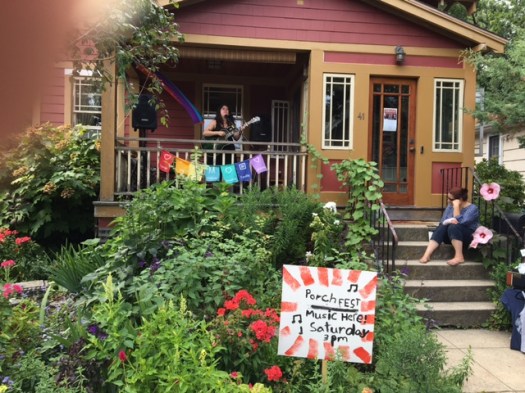
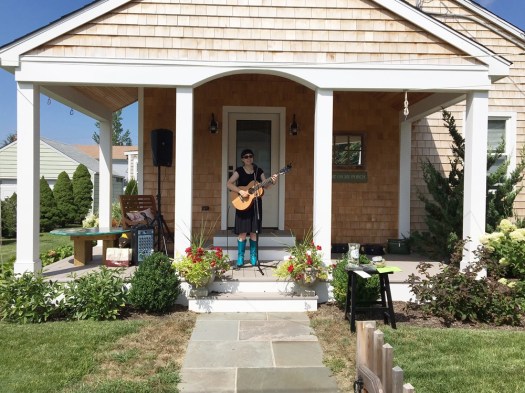
Porchfests, launched in the college town of Ithaca, New York in 2007, are catching on. The concept has quietly spread—without my ever hearing about it—until one finally appeared next door, in the Bridgeport, Connecticut neighborhood of Black Rock. Porchfest came off without a hitch, I’m happy to say, and everyone involved says it’s going to become annual.
That Virginia livens up a summer day at Porchfest 2016 (Jim Motavalli photo)
The music was local, including strumming folksingers, singer-songwriters, and slumming alter-ego groups playing covers. The sound was universally decent, food trucks lined up next to homeowner-provided lemonade stands, and dogs were welcome. There were lots of dogs.
Porchfest is a neighborhood thing, and it’s about the people. Reaganomics (the band) got about 200 people out and talking. (Jim Motavalli photo)
I heard three different sets, including one my friend Lys Guillorn, and another by a band featuring a friend’s son. It was all very relaxed, and relaxing. Neighbors who probably rarely see each other caught up. Bridgeport’s mayor (back from prison, and improbably re-elected) was there, but you’d expect that.
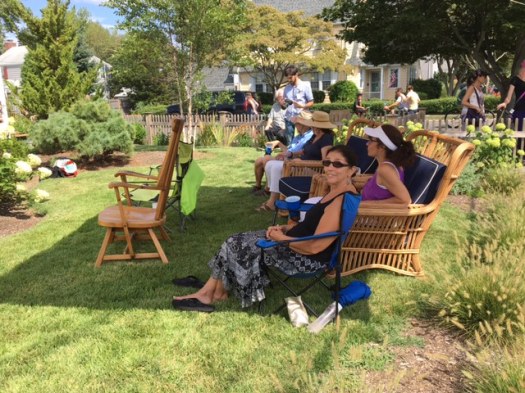
The smart ones brought lawn chairs. (Jim Motavalli photo)
People ask me what Woodstock was like—did you see all the heavy groups? I say yeah, yeah, but it was more about the people—the sense of community. Ditto Porchfest.
Lys Guillorn on the porch. (Jim Motavalli)
C’mon, how often do you actually talk to your neighbors, other than to wave hello? At Porchfest, one ear is on the band and the other is catching up with the people next door.
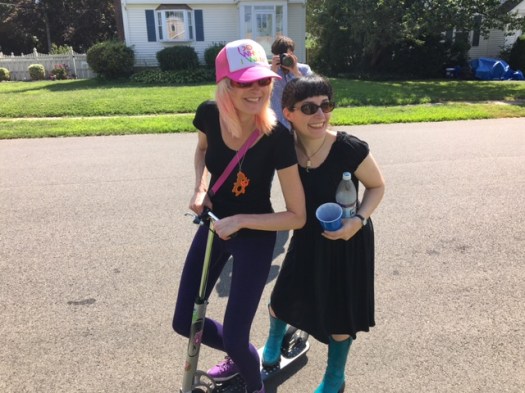
You could walk to the next Porchfest gig, but a scooter came in handy. Performer Lys Guillorn is at right. (Jim Motavalli photo)
We need more low-pressure, local music—neighbors entertaining neighbors. We need fewer big-deal stadium shows with distant views from the nosebleed seats and scalper-inflicted ticket prices.
If there’s no Porchfest near you, well it’s time to organize one. Won’t your porch look better with a band on it? By the way, you can still make it up to the original Porchfest, in Ithaca. It’s on September 18.
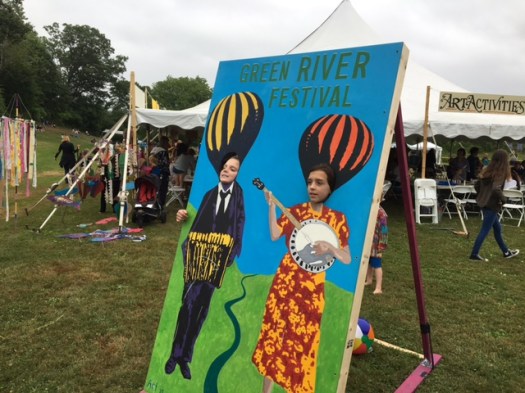
GREENFIELD, MASSACHUSETTS—Normally the Green River Festival dawns hot and stays that way, but the 2016 version was cool and misty. Not that I was complaining. I’m usually weighing listening to a hot band or making a dash for the thoughtfully provided cooling station. (I wish all outdoor festivals were this well organized; Green River and Caramoor in New York are the best).
The Green River Festival is VERY kid friendly. If your children are bored it’s because they spend too much time with their devices. (Jim Motavalli photo)
This is my third Territorial Imperatives report from the Green River Festival, and unless the pearly gates call it won’t be my last. I always discover new music at Green River, which is joined at the hip to my favorite record label, Signature Sounds. Jim Olsen is both the festival director and the label’s founder—it’s a family event. Sometimes when a new band appears at the festival, they proudly proclaim they’ve just been signed.
Lula Wiles, sharing a mike. (Jim Motavalli photo)
We got to the festival under threatening skies just in time to see Lula Wiles, the female Americana trio from Boston I’d somehow missed at Caramoor. They have strong original songs written by all three, and both guitar players also play fiddle—how’s that for variety? Here they are on video:
And the trio–Isa Burke and Ellie Buckland (the multi-instrumentalists) and Mali Obomsawin (bass)—are great all by themselves, as on the unaccompanied “Turtle Dove.” The only problem with their set was it was too short (a deficit they made up later on the Parlor Stage).
Dustbowl Revival is a New Orleans funk band with horns–no, they’re bluegrass! (Jim Motavalli photo)
Venice, California’s Dustbowl Revival (Signature Sound artists!) manage to marry New Orleans horns with bluegrass in a delightful fashion. The lead vocals are shared by Zach Lupetin and Liz Beebe, and both can really belt ‘em out—on old songs (really old, some of them) and new ones that sound old. The fiddler and horn players (trombone and trumpet) are all very strong, and it’s no hardship when the vocals take a back seat.
Hannah & Maggie–out there with just the two guitars. The songs made all the difference. (Jim Motavalli photo)
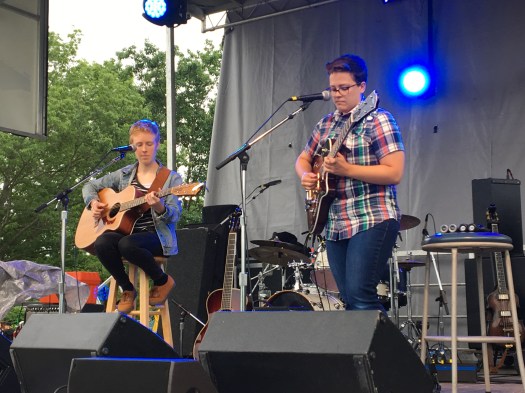
My discovery of the day was Hannah and Maggie, also on the Four Rivers Stage. The pair met at nearby Smith College, where they were part of what I think they said was the Smithenpoofs. As they pointed out, the other well-known lesbian folk acts are The Indigo Girls and Tegan and Sarah, and people who compare them to the former are not that far off. But don’t pigeonhole them. What makes Hannah and Maggie stand apart is the strength of their songwriting and singing. C’mon, it’s just the two of them up there with guitars—with weak material it would be a trial to listen to them. But their songs were uniformly excellent in an all-original set (with one song, “The Boxer,” from that other well-known lesbian duo, Simon and Garfunkel).
Nick Loss-Eaton out front with Leland Sundries. (Jim Motavalli photo)
Leland Sundries, featuring the songs of leader Nick Loss-Eaton were another pleasant Green River surprise at a festival that doesn’t like to get slotted into the folk bucket. Nick is a great balladeer whose baritone gets him into James McMurtry territory, but he also rocks out—especially on a song hoping that a zombie apocalypse will get him back together with his girlfriend.
Shovels and Rope: A bit shouty. (Jim Motavalli photo)
A disappointment, for me, was Shovels and Rope, whose duo albums I’ve loved. In person they were shouty and monotone. The songs have subtlety, but they weren’t coming through on the main stage. Here they are on video, with the quietest song in the set:
Not all the good music was on the stage. As at Caramoor, there’s a lot of off-stage jamming. Here’s a bit I caught in the rain at the guitar/ukelele tent out of Easthampton:
Three stages meant too many choices; I didn’t hear Amy Helm, And the Kids or Anthony D’Amato. The rain messed up the latter part of the evening, so I also never got to hear Oh Pep! From Australia, Dawes, The Soul Rebels, Shakey Graves, the Felice Brothers or big soul band the Suffers. Oh well. Next year they’ll all be on Signature Sounds and I can catch them on a dry day.
Special mention should go to the food vendors, who never gouge. Coffee? $2. The ample tangine at Aurora’s Gypsy Café? $8.
NEW ORLEANS AND KATONAH, NY—Ever era needs its Fats Domino. Without the Fat Man, the 50s would have been inconceivably duller. That grin, that flattop, that piano playing, those songs that sprang from but also transcended blues and R&B to hit American popular culture in its soporific core.
Nathan Williams gets his ya yas out. Maybe he’d remind you of Fats Domino, too. (Jim Motavalli photo)
Did you ever hear Fats essay the Beatles” “Lady Madonna”? I remember hearing him sing it via the scratchy transistor on the school bus. Fats’ version was a minor hit in ’68, which was poetic justice because he’d inspired it. Paul McCartney:
“Lady Madonna” was me sitting down at the piano trying to write a bluesy boogie-woogie thing … It reminded me of Fats Domino for some reason, so I started singing a Fats Domino impression. It took my other voice to a very odd place.
All this is prologue to seeing Nathan [Williams] and the Zydeco Cha Chas at the free 10th annual Louisiana Cajun-Zydeco Festival in [Louis] Armstrong Park. I was in New Orleans for a family wedding, and my wife caught the listing. Free, the Cha Chas with Steve Riley and the Mamou Playboys.
The Cha Chas in full cry. (Jim Motavalli photo)
Riley’s OK, but he doesn’t rock my boat. I have an intellectual appreciation for a guy who carries on the Cajun tradition, singing in French and all that. He’s a little bantam-weight, built fellow with a period ducktail. His band played good, and Riley himself is more than competent on accordion. But nothing was transcendental.
And then Nathan and the Cha Chas. Williams actually looks a bit like Fats, and has that same confident insouciance. He’s the quintessential zydeco front man, a great singer and showman (getting down on his knees like James Brown), and on accordion he’s always right in the pocket—never flashy, always serving the song. Special mention also should go to guitarist Dennis Paul Williams, who also happens to be Nathan’s brother.
Check out this video, in which Dennis is sidelined by a breaking string, but when he comes back it’s apparent what a big contribution he makes to the Cha Chas’ music:
Nathan, whose big inspiration was Clifton Chenier, not New Orleans’ own Fats Domino, plugs into the rocking good time like no one since the late and much missed Boozoo Chavis (with whom he shared many a stage). Here’s another video of the man in action:
I really, really didn’t want Nathan’s set to end, but it did and we went for a walk down Bourbon Street, which I found absolutely appalling. Cheap commercialism, bad tourist food and worse music, panhandlers, and Larry Flynt Hustler Clubs. Plural, because there were two of them.
The Secondhand String Band on Royal Street, French Quarter. (Jim Motavalli photo)
But just one block away, Royal Street was quiet and reeking of historic atmosphere. And there was street music I actually wanted to hear, from the Secondhand Street Band. A rag-tag ensemble, they were playing one of the hallowed New Orleans classics, “I Thought I Heard Buddy Bolden Say,” with great aplomb. Here’s a Royal Street video:
Also check out the Secondhand Street Band’s studio album, Birds:Boats:People.
From New Orleans to Katonah, New York and Caramoor’s annual American Roots Music Festival. I love what Maggi Landau does with this event. Like Barbara Manners (with her superb CHIRP summer concerts in nearby Ridgefield, Connecticut) Landau’s event is all about providing a space for great young bands and singer-songwriters to be heard.
Young bands rule at the Caramoor Americana Festival. This is Man About a Horse in a sylvan setting. (Jim Motavalli photo)
All the musicians comment on how beautiful the Caramoor gardens are, and they play right in amongst ‘em, without amplification, in locations with names like Spanish Courtyard, Cedar Walk and the Founders Tent. Silver City Bound, with Sam Reider on extraordinary accordion (there’s that instrument again) greeted visitors coming in. How could he play so loud without an amplifier?
Monica Rizzio, a Texan relocated to Cape Cod, loves Willie Nelson. A lot. (Jim Motavalli photo)
I saw several acts I’d never heard before, but want to hear again. These included High Plains Jamboree, with a singer/songwriter/mandolin player, Brennen Leigh, who could be a big star; Monica Rizzio (whose album, Washashore Girl, I quite like); Man About a Horse, an exuberant bluegrass band who trotted out the teen tragedy “Last Kiss” but didn’t know its history before Pearl Jam (it made #2 by the Cavaliers in 1964); and the enchanting Lowest Pair, with not one, but two banjo player/singer-songwriters. Here’s their song “Rosie” from the main stage:
I can’t emphasis enough the role the sylvan glades play in this festival. Here’s music as people heard it for thousands of years, in a natural state, with very little barrier between performer and audience.
Silver City Bound, back from Turkey, get rural. (Jim Motavalli photo)
Also playing was Sara Watkins, who sounded great playing solo fiddle and ukulele on songs like “Different Drum” and “One Long Hot Summer Day,” but was less exciting with her own songs and a full band; and John Fulbright, who amazed me with a long and vividly imagistic tune called “Catfish Song.” I was only slightly disappointed when I learned that Townes Van Zandt had written it. Sorry I missed Hurray for the Riff Raff, because I love them.
Silver City Bound, by the way, just came back from a State Department-sponsored tour of Turkey and Azerbaijan. Other bands should look at spreading the word internationally like that.
One of the songs that will stick with me from Caramoor is “One to Run the River With” by Noel McKay, who did it with High Plains Jamboree. Someone should have a hit with that one. It was ringing in my ears when I left the lovely festival grounds.
Sometimes music makes me cry. When I find a song like that, I play it incessantly until its deeply embedded, and I can summon the feeling whenever I need it.
The King of Rome came back–and lived a long life.
Such a song is “The King of Rome,” as sung by June Tabor. Here it is on video:
The song is a true story about a working-class gas-lamp lighter named Charlie Hudson, who lived a hardscrabble existence in the city of Derby. His one indulgence was homing pigeon racing, a new sport then. The basic idea is that competitors release pigeons in some distant location, and their homing instinct sends them home—first one back, wins (with distance taken into account).
In 1913, as the song tells us, Charlie got wind of a big pigeon race starting from Rome. Everyone told him he was crazy, he’d just lose his best bird if he sent it all the way there. But Hudson was undaunted, he dispatched the pigeon—and then he waited.
As it happens a big storm kicked up over the Alps on race day, and thousands of pigeons were lost—Hudson’s presumably among them. And then, and then! The gang was down at the pub in Derby, and one of them sees a flash of wings. It’s the long-lost bird come home and perched on Charlie’s roof! “Come on down, your majesty, I knew you’d make it back to me,” Charlie said, because by then the pigeon was named “The King of Rome.” It won the race.
Charlie treasured his pigeon, who lived out his years in splendor, dying sometime before 1946. Charlie himself made it to 1958. The bird, stuffed, now appears ready to take wing in a Derby museum.
Derby resident Dave Sudbury wrote the song, but his version is too folkie for me. It takes an unmatched interpreter like June Tabor to totally bring it home. Also great is a version, with full brass band, by the Unthanks. Garnett Rogers does it, too. Here’s the Unthanks:
“The King of Rome” reminds me strongly of Archie Fisher’s “Bill Hosie,” another song about a long shot. Hosie was inspired by the pre-war Schneider Trophy seaplane races. The S5 Supermarine was the fastest seaplane ever built, powered by a Napier Lion engine and capable of 300 mph. It was the father of Britain’s Spitfire, a hero of World War II.
“Bill Hosie” is about an ordinary guy who built a replica of the S5 Supermarine, took it up over Cornwall skies and…well, listen to the song:
And don’t forget “Bud’s Sea-Mint Boat” by Kate Campbell. Yet another song about a dreamer whose dreams actually come true. And all three are about real people. Let’s hear it for dreamers.
In the hot summer of 1518, as many as 400 residents of Strasbourg, France were overcome with an irresistible urge to dance. According to The History Channel, “The hysteria kicked off when a woman known as Frau Troffea stepped into the street and began to silently twist, twirl and shake. She kept up her solo dance-a-thon for nearly a week, and before long, some three-dozen other Strasbourgeois had joined in. By August, the dancing epidemic had claimed as many as 400 victims.”
A contemporary artist’s interpretation of the dancing plague, complete with band.
Nobody could explain it, but you can’t blame the town for not getting into the spirit of things—a band was even hired. Some of the dancers kept it up until they collapsed from sheer exhaustion, and there were multiple deaths.
But never mind about all that. Let’s turn instead to the Holy Modal Rounders and their recording of “Spring of ’65,” on the classic Good Taste is Timeless album. The song is about a dancing plague, this one taking place in some remote American farming hamlet. Farmers leave their plows and gather to hear a fiddler play “The Crippled Kingfisher” for hours on end. The mass hysteria only lasts a day, and nobody dies, but it’s an eerie, compelling song. Here it is on video:
I must have never checked the credits on an album I’ve owned for decades, because I thought Peter Stampfel—who sings it—also wrote it. But no. Eli Smith, who runs the estimable and just-concluded Brooklyn Folk Festival (and recorded with Stampfel), tells me the source is an unaccompanied song by J.B. Cornett, collected by New Lost City Ramblers veteran (and Smith associate) John Cohen. The original is on Mountain Music of Kentucky, and issued on Smithsonian Folkways. Stampfel takes a few liberties with the lyrics, but not that many. Here’s the video:
All this was triggered by a brand-new song, “Mercy,” by a group called Petunia. The accompanying video documents just such a dancing plague, inspired by the events of 1518. The costumes look more like 1818, but never mind. Here’s Petunia:
The History Channel again: “The Strasbourg dancing plague might sound like the stuff of legend, but it’s well documented in 16th century historical records. It’s also not the only known incident of its kind. Similar manias took place in Switzerland, Germany and Holland, though few were as large—or deadly—as the one triggered in 1518.”
Did I mention that “Mercy” is a great song, even if it’s not obviously about dancing plagues? Petunia has a bright future.
So what’s our modern equivalent of dancing plagues? The disco era? Studio 54?
BROOKLYN, NEW YORK—Brooklyn Heights has an impressive literary pedigree. It harbored Walt Whitman, Truman Capote (who said he lived there “by choice”) and Norman Mailer—to name a few highly disparate penmen—and we walked past the brownstone where W.H. Auden had labored for a decade in the period around the Second World War.
The Old Scratch Sallies–your country 78s, reborn. (Jim Motavalli photo)
Today, Brooklyn Heights’ pedigree seems more musical—every young and ambitious band, in virtually every genre, relocates there. And so it is that singer songwriters, techno duos, jazz singers and string quartets call the place home today.
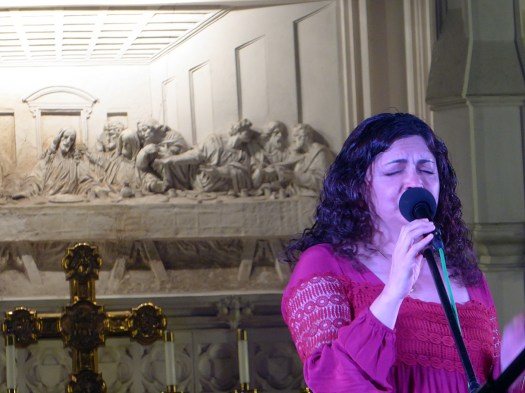
The homey St. Ann’s Church, on Montague Street, has a huge stained glass window, and a bas relief of the Last Supper—more than one performer at the Eighth Annual Brooklyn Folk Festival commented on the symbolism of rocking out in front of it.
Piedmont Bluz: A welcome reintroduction to country blues. (Jim Motavalli photo)
This festival is a minor miracle in the middle of a trendy Brooklyn neighborhood. It’s the brainchild of emcee Eli Smith and the Jalopy Theater (in nearby Red Hook). The Jalopy is a bit out of the way, and I’ve sadly never been there, but it’s the absolute party central for old-time music in New York. And, yes, the city—Brooklyn, especially—has a thriving scene for pre-bluegrass music. Imagine this—Saturday was a sellout, and the church was packed with young people who may have come for Spirit Family Reunion (great, by the way) but stayed to hear jug bands and family groups celebrating the pre-war music of rural Georgia (the Hickhoppers).
I don’t recall having such a good time at anything. For something like 10 hours, I did very little but occupy my front pew as one fine ensemble after another hopped on stage. It’s plain that the old-time community here has stars—Jackson Lynch, who looks like Justin Timberlake’s country cousin—played fiddle or banjo in half a dozen groups; and Jerron “Blindboy” Paxton, who’s played at all eight of the festivals. More on him later.
Rafe and Clelia Stefanini could easily switch instruments. He learned to love the music in, of all places, Italy. (Jim Motavalli photo)
The first band, Old Scratch Sallies, is a loose aggregation (there was Jackson Lynch!) from New Orleans that more or less perfectly recreates the all-play-together-and-hopefully-end-at-the-same-time spirit of recordings made during the 1920s country recording boom that was killed by the Depression. If you’d somehow missed “Jailbird Love Song” by the Mississippi Sheikhs, you could hear it reproduced faithfully by the Sallies.
Another group, the Whiskey Spitters, does this too. I missed their set, but they were kind enough to pass around a card good for a free download. The album is called “Greatest Spits.” I love their version of “Going to German,” given that odd title by Gus Cannon’s Jug Stompers in 1929. To illustrate how American music is often best appreciated by Europeans, the version I’m most familiar with is by the—British—Panama Limited Jug Band from about 1968.
The Spirit Family Reunion filled the hall with life-affirming songs that Pete would love. (Jim Motavalli photo)
The Brotherhood of the Jug Band Blues, featuring the vocal stylings and guitar of Ernesto “Lovercat” Gomez (and Lynch again!), was another Brooklyn-based group that respected the tradition. But they also had a jug player, which Gus Cannon would have appreciated. The group had seven members—two banjo players, two guitarists, twin fiddlers, a washboard, a jug guy and a harmonica. I know that’s nine; there must have been some doubling up. Highlights: “Tear it Down,” “On the Road Again.”
Jerron “Blindboy” Paxton: a hometown favorite, authoritative on any instrument he picks up (including fiddle). (Jim Motavalli photo)
I met Rafe and Clelia Stefanini at the Summer Hoot last year; they’re a father-and-daughter duo, and both very high-level players who switch off on guitars, banjos and fiddles. Rafe is Italian, and a veteran of a thriving country music scene there. He has thoroughly absorbed the old-time tradition and—a difficult thing—sings the stuff well, too. I could listen to them play “Apple Blossom” and rarely heard vocal refrains like “Roustabout” (which had an exquisite instrumental coda) all day long. Here’s a moment on video:
Ed Sanders (center) and the 2016 Fugs. It’s “Morning, Morning,” still. (Jim Motavalli photo)
Rayna Gellert, who I’d really wanted to see, was unfortunately ill so the Pearly Snaps duo (Rosie Newton, fiddle and vocals and Stephanie Jenkins, banjo and vocals) took their place. They don’t get together all that often, and a few numbers were a bit ragged, but both are exceptionally good musicians and singers. Unfortunately, on ballads like “Silver Dagger” (memories of Joan Baez at Club 47) the group was ill-served by the marauding children who had taken over the front of the stage. If they were just running around it could have been OK, but they were also screaming their heads off, and that was really distracting. Fortunately, they were soon corralled.
I’d also seen Piedmont Bluz before, at the 2015 CT Folk Festival, and the husband and wife team of Valerie and Ben Turner revive the Southern country blues tradition. Valerie is a very strong singer and guitarist, and Ben chimes in on harmonies, little instruments and handclaps. A highlight was a song associated with Taj Mahal, “Needed Time.” Here it is on video.
Roy Williams and Human Hands–gypsy jazz lives! (Jim Motavalli photo)
The Hickhoppers were great to see, because the patriarch, Mick Kinney, has plainly taught his children well—both his sons were nearly as good on fiddle, banjo, guitar and vocals as the old man himself. Mick by the way, has done it all. According to the John C. Campbell Folk School, “He has worked with Stranger Malone, John Hartford, Sarah Guthrie, Vic Chesnut, Victoria Williams and REM’s Peter Buck. Along his musical journey, Mick has played stride piano at Manhattan’s Swing 46 with veteran tap dancer Harold Cromer, fiddle with Creole jazzman Al Broussard in New Orleans’ French Quarter, and lap steel at Louisiana’s Cajun Rendez-vous. He has performed at McCabe’s in Los Angeles, the Bluebird in Nashville, and on NPR’s Mountain Stage.” How’s that for a diverse career?
The Hickhoppers gave us Gid Tanner and the Skillet Lickers songs, as well as a tune from an obscure Georgia player who “made a few Edison cylinders in the early 1920s.”
Gaida, from Syria, wails in front of the Last Supper. (Jim Motavalli photo)
I was getting a bit tired, but I never saw the Fugs—though I was briefly a promo man for their label, ESP Disk. And so a trio with Fugs leader Ed Sanders (yes, the same guy who wrote that book about Charles Manson) was a must-see. And they were gently great, combining old Fugs songs like “Morning, Morning” with musical settings for William Blake poetry, properly credited to the late Tuli Kupferberg—a great New York character if ever there was one. It certainly wasn’t rock, but it made sense as a 2016 version of the Fugs. The salute to Bernie Sanders was perhaps the only song ever to mention the Glass-Steagall Act.
The Spirit Family Reunion was, as I noted, lovable, offering a series of original, melodic and life-affirming sing-a-longs that Pete Seeger would have loved. The audience, on the floor at their feet, knew every word. Who could criticize a group that gets an audience of Millennials singing along to a Woody Guthrie song?
Paxton is also well-loved by the Festival audience, and turned in a crowd-pleasing set that saw him playing—really well—piano, guitar, banjo, harmonica and fiddle. He’s a totally compelling singer, and funny, too. He did a lot of songs that were either already old or current when FDR was Presidential timber, including one from the Great American Songbook, “The Very Thought of You.” British vocalist Al Bowlly recorded that one in 1934, then died in the Blitz.
There was a LOT of music over the three days, and I’m sorry to have missed some of them, including a set by a favorite band, Dubl Handi, and a tribute to Sonya Cohen Cramer, a wonderful singer and interpreter. She was the voice on Dick Connette’s indispensible “Last Forever” recordings. And it goes without saying that Michael Hurley is a unique experience.
I stumbled out into the night after a fine set by Roy Williams and the Human Hands. It was gypsy jazz, a change of pace for the folkies (did I mention Syrian vocalist Gaida?). Once again, there was a stage full of young, fully committed musicians up there, giving their all to an antique but still vibrant musical form.
Jazz is where you find it. I was recently strolling down the main street of Columbia, Missouri and encountered a storefront called We Always Swing, with frequent live music (12 concerts a year), discussions and film series.
I live an hour from New York City, the jazz capitol of the world, but I don’t always want to take the time—and spend the money—to hit the nightspots there. But I can keep entertained right here in Connecticut. Here’s two shows I went to lately.
Marcus Goldhaber in Milford. The Sinatra mantle was worn lightly. (Jim Motavalli photo)
Marcus Goldhaber is a New York-based jazz singer who’s also a prolific songwriter who’s made four strong albums. In New York he often performs with a guitarist and a guest singer (including one of my favorites, Melissa Stylianou).
But I was pleasantly surprised to see him coming to Connecticut in a Sinatra tribute show sponsored by the Milford Arts Council in their cozy cabaret-style performance space—which just happens to be the former railroad station. Through some miracle of soundproofing or train schedules, we didn’t get interrupted all that much.
The Sinatra mantle was lightly worn; Ol’ Blue Eyes sang every standard in the book, and just about all male jazz singers are influenced by him. It was a night of the Great American Songbook with a tight trio, and the audience loved it. To duplicate it, check out his standard-laden first album, The Moment After (2006); to hear Goldhaber the songwriter, it’s A Lovely Way to Spend an Evening (2014).
Brubecks Play Brubeck (in the Brubeck Room)
More recently, I was back at the Wilton Library—in the Brubeck Room—to hear actual Brubecks. It was three of Dave’s sons, Chris, Dan and Darius, playing their dad’s music with a ringer (British saxophonist Dave O’Higgins).
The Brubecks in Wilton. From left: Darius, Dave O’Higgins, Chris and Dan. (Jim Motavalli photo)
I interviewed Dave Brubeck many years ago when I was a reporter at the Wilton Bulletin. He was a laid-back Californian, a very gracious host, and a fine raconteur. At the time I was more into fiery stuff like Eric Dolphy and John Coltrane, but these days I’m also getting a lot of pleasure out of west coast players like Brubeck, Chet Baker, Stan Getz and Gerry Mulligan.
In Wilton, Darius—at the piano—was the raconteur, and he tells stories well (including one about Dan’s band being up for a Juno). The band played mostly older Brubeck compositions, including one Darius said was his first song ever, “Weep No More,” written in 1942 when he was overseas and missing his new wife. Here it is on video:
All four musicians played well. Darius channels the old man, but he also has a fair amount of Bill Evans in there, too. Dan cut loose on the last song, the inevitable “Take Five” (actually written by Dave’s alter ego, alto player Paul Desmond). O’Higgins shone on ballads.
I was especially taken with Chris Brubeck’s bass playing. I felt a sense of dismay when I saw him plug in an electric bass, but like Jaco Pastorius (there’s some overlap) he does something hugely original with it. His playing is very bright and busy, and it swings mightily. Chris also plays trombone, and on Louis Armstrong’s “Black and Blue” he took it out for a duo with Darius, nodding to Louis’ old sparring partner, Jack Teagarten.
This was the first night of the Brubecks Play Brubeck tour. The band is playing Dizzy’s at Lincoln Center in the aforementioned New York City March 30 and 31. It’s also doing a bunch of dates in the UK. That’s a tradition; here’s a review of the same band playing in London in 2014. Catch them if you can.
Last weekend was a jazz festival for me, at two different libraries. Both were fine shows.
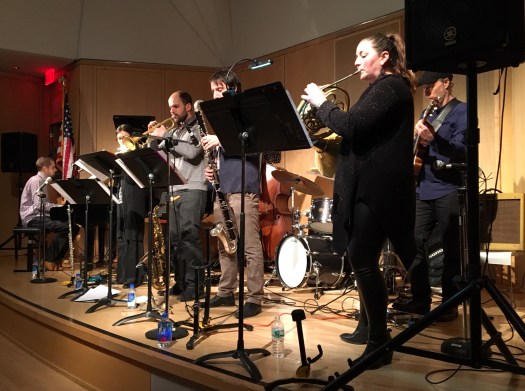
Jamie Baum and her Septet+ played the Wilton Library’s Brubeck Room (Dave was a Wiltonian) on February 27. Flautist Jamie lives in New York now, but she’s a Fairfield, Connecticut native, and expressed pleasure being back in the county of her birth.
Jamie Baum’s Septet+ on stage in Wilton. (Jim Motavalli photo)
Actually, describing Baum as a flautist doesn’t do her justice, though she’s great on the instrument. What I find fascinating with her is the palette she uses as a writer and arranger. The music she played in Wilton is soon to be recorded for an album called “Bridges”—maybe some kind of answer to Donald Trump’s wall.
Baum is a cultural ambassador, and her new music is informed by a fascination with Asian music, and recent visits to Nepal—including the Kathmandu Jazz Festival. She’s also inspired by the singing of Pakistan’s late, qawwali singer Nusrat Fateh Ali Khan.
Baum, a 2014 Guggenheim recipient, was commissioned by New York’s Rubin Museum of Himalayan Arts to write “Honoring Nepal: The Shiva Suite,” which she played in Wilton. Like all the music she played, it was complex, changeable, challenging—and lots of fun, too. You never knew where she was going next.
I loved a piece called “Ucross Me,” inspired by a visit to the Ucross Foundation in Wyoming. It started with long through-composed introduction that almost had Phillip Glass overtones, briefly became a conventional jazz taut piece, moved into exchanges between trumpet player Amir Elsaffar and guitarist Brad Shepik (a standout player that night) and closed with a long and hugely impressive guitar solo that accessed late period Miles and rock music, too.
Here’s the band playing “Lament”:
So much writing for larger bands doesn’t take full advantage of multiple voices, but Baum’s music is endlessly inventive, and it made this seven-piece sing. Outstanding soloists were Shepik on guitar, Sam Sadigursky on alto and bass clarinet, and Elsaffar on trumpet, but all rose to the challenge of this tricky music.
Just one day later, I was at the lovely old (turn of the century) Pequot Library in Fairfield, catching the WPKN Jazz All-Stars. WPKN is a radio station I’ve been proud to call home for 43 years, and this was a benefit organized by the drummer and jazz DJ Rick Petrone.
The first set was nice and polite. Joining Petrone were pianist David Childs, saxophonist Chris Stelluti, and veteran drummer Joe Corsello, who was in the house band at Michael’s Pub and has recorded with Sonny Rollins, Marian McPartland, Benny Goodman, Steve Marcus, Ralph Lalama, Mike Moore, Sal Salvadore, Gene Bertoncini and Mike Mainari. He tours with Rollins.
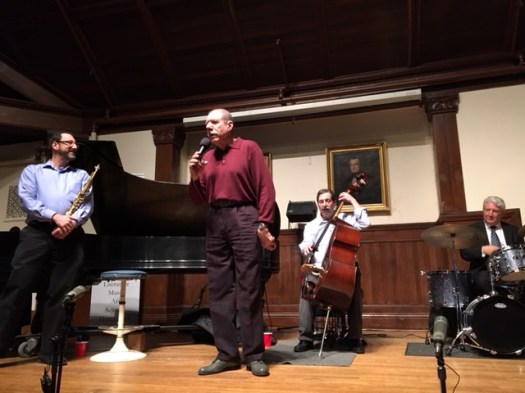
Giacomo Gates on stage at the Pequot with jazz rabbi Greg Wall admiring at left. (Jim Motavalli photo)
Stelluti has a nice tone on tenor that reminded me of Zoot Sims or Stan Getz, but he didn’t play all that forcefully or improvise all that much at the Pequot. The energy level picked up a lot in the second set when he was joined on the bandstand by Greg Wall, a Westport, Connecticut rabbi when he’s not blowing a really exciting soprano sax. The Jazz Rabbi can be regularly heard turning up the heat at a club called 323 Westport, when he’s not presiding at Bar Mitzvahs.
And then Giacomo Gates came out. I love this guy, a standout male jazz vocalist who really commands the stage. Watching him direct the band with body language was a treat. I don’t think they’d played together much, if at all, but everyone spoke jazz so it didn’t matter.
Betty Carter did a lot with Gigi Gryce/John Hendricks’ “Social Call,” but Gates swung it madly. There were also tunes from Thelonious Monk and Babs Gonzalez. Nobody wanted the show to stop, but eventually it did. And a full house enjoyed a nice afternoon of jazz and benefited their favorite radio station in the process. Let’s hope the Jazz All-Stars turn it into a regular happening.














 Territorial Imperatives