My wife and I rang in the new year at the Jazz Forum in Tarrytown, New York with the incomparable jazz singer Catherine Russell. It became 2024 during the performance, but we were transported back to a simpler era when the Great American Songbook produced hits, and blues was the entertainment at South Side Chicago clubs.
Catherine Russell brings in New Year’s Eve with guitarist Matt Munisteri and bassist Tal Ronen. (Jim Motavalli photo)
We were issued party hats and beads, and there was a countdown, but the main attraction was Russell and her great band. I was intrigued by guitarist Matt Munisteri, who also backs singer Kat Edmondson. He was fine on the swing stuff, but really shone on blues—of which there was an abundance. Ben Paterson (piano) and Tal Ronen (bass) acquitted themselves well. The amiable Ronen has played with another fine singer, Tamar Korn.
Russell has the pleasant habit of introducing songs with the author’s name(s). That’s how I know that New Orleans R&B artist Earl King wrote “Let the Good Times Roll,” and that vocalist Al Hibbler recorded “After the Lights Go Down Low.” Hibbler got to number 15 with Phil Belmonte, Allen White and Leroy C. Lovett’s composition circa 1956. “Shiny Stockings” is from the pen of horn man Frank Foster. None of that matters to the enjoyment of a contemporary Catherine Russell concert—she just sings great songs, but from a far more elegantly curated repertoire than the average jazz singer. And she’s a practically flawless singer, never missing a note, never failing to put the tune over.
Guitarist Matt Munisteri is equally at home in swing and blues. He also accompanies Kat Edmonson. (Jim Motavalli photo)
The brilliance of seeing Russell is that even if the sound was off you could enjoy her performance. She’s a very physical performer, celebrating the song as much with her mobile face as with her voice. And you learn about a lot of tunes! She went through Steve Allen’s “Cool Yule,” Irving Berlin’s 1938 “Change Partners,” Hoagie Carmichael’s 1937 “The Nearness of You” and a lot more. I hadn’t heard King Oliver’s 1926 “Doctor Jazz” in a while.
And then, of course, there was her dad’s “At the Swing Cat’s Ball.” Luis Russell was a noted bandleader, as well as Louis Armstrong’s musical director, and a bunch of his performances were recently pulled out of a closet by his daughter and released on a Dot Time album.
Catherine Russell with bassist Tal Ronen. (Jim Motavalli photo)
It’s a colorful family. Russell’s mother, Carline Ray, an excellent singer as well as a bassist and guitarist (International Sweethearts of Rhythm, Mary Lou Williams and Sy Oliver), told her, “Child, you’ve got enough mouth for another row of teeth.” Both parents imbued their daughter with a great love for a century of great American music. Russell is both an historian and a peerless interpreter.
Every Man for Himself and God Against All by Werner Herzog (Penguin Press)
By Jim Motavalli
If even half of Werner Herzog’s memoir is true, we’re lucky he made it to his current 81. He describes miraculous survivals all over the world—shooting untamed rapids, a bow-and-arrow attack from an uncontacted tribe, smuggling adventures on the U.S.-Mexican border, close encounters with the wildman actor Klaus Kinski—that are great fun to read, even if their total veracity is in doubt.
Of course, enough of this is well-documented—including the author’s hardscrabble upbringing in postwar Germany, the eating of his own shoes in a bet with filmmaker Les Blank, and the arduous path to completing Fitzcarraldo and Aguirre: The Wrath of God—that the wilder stories seem at least characteristic. Kinski and Herzog were well-matched.
Herzog’s droll, deadpan German-accented voice is familiar from his documentaries. Click on his thoughts vis-à-vis the stupidity of chickens. This book is perhaps best enjoyed in the audio version. The book was written in German and ably translated by Michael Hoffman, though Herzog (who lives in Los Angeles) reads it in English.
Herzog’s films are wildly disparate, but they all grow out of Herzog’s fascination with mankind in extremis, and people who stubbornly refuse to conform to society’s expectations.
Much of the director’s time must be spent trying to get his many films financed, but that material doesn’t make it into the book. The director is (or at least sees himself as) a man of action, and it’s no wonder he became a close friend of the similarly peripatetic Bruce Chatwin (whose novel The Viceroy of Ouidah he made as the film Cobra Verde).
As he tells it, Herzog had zero training as a filmmaker. He just started doing it, directing his first short, Herakles, in 1961. Since then, he’s produced documentaries, features and filmed operas in a steady stream, sometimes two a year. He’s still at it, with the volcanic The Fire Within (2022).
I’ve never seen a bad Herzog film, but I realize from the filmography thoughtfully provided at the end of the book that most of his work is unseen by me. I hope to remedy that, with the help of streaming services.
Herzog the author is very much like Herzog the director—curious, droll, sardonic, funny. He’s a bit of a German fatalist, though hardly a typical German. Like Fassbinder, he’s an internationalist, whose most famous films are set in France (Cave of Forgotten Dreams), Alaska (Grizzly Man), Australia (Where Green Ants Dream) and South America (Aguirre, Fitzcarraldo, Ten Thousand Years Older).
Most autobiographies feature younger, idealized cover photographs of their author. Herzog chooses to portray himself as he really is now, grizzled like his grizzly man, uncombed, and appearing to be in the midst of confronting something distasteful.
Two of the Down Hill Strugglers, Eli Smith (left) and Jackson Lynch. (Jim Motavalli photo)
BROOKLYN, NY—Folkways Records was founded in 1948 by Moses Asch and Marian Distler, a pair of serial record company founders who’d previously led Asch, Disc and Cub. It was Folkways that endured, and it was Folkways that issued, in 1952, the Anthology of American Folk Music, produced by Harry Smith (whose 100th birthday it would be).
You have to consider the times. In 1952 the only way you could hear America’s recorded legacy, especially the groundbreaking blues, country and folk records recorded in the 1920s, was on scratchy 78s. Reissues were rare. Putting a treasury of old music onto three long-playing records had a profound impact on the generation of folkies, many of them urban, who clustered around New York in the early 1960s, Bob Dylan certainly included.
The 15th annual Brooklyn Folk Festival, held at St. Ann’s Church in Brooklyn Heights, celebrated 75 years of Folkways, still very much with us and signing up artists as Smithsonian Folkways. Asch’s estate sold the label to the Smithsonian in 1987, a deal negotiated by Ralph Rinzler.
Sometime in the late 70s, before the sale, I visited Folkways to see if they needed any radio promotional help. I remember talking to Asch in a cluttered office. He was genial, as long as I didn’t mind getting paid in records. That’s how I got my Uncle Dave Macon album, complete with dimples baked into the bad pressing. And I think I got some Folkways on the air, too.
So it was as an actual former employee of Folkways that I joined the celebration, which turned out to be great fun. In a panel discussion, festival organizer Eli Smith (a mainstay of the Down Hill Strugglers, too) was joined by author Elijah Wald and Peter Siegel, the latter an engineer and producer at Folkways responsible for albums by Hazel and Alice, Doc Watson, Joseph Spence and many more.
For Hazel (Dickens) and Alice (Gerrard)’s first album, Siegel said he was paid $75, $37.50 of which he got in advance to buy a ticket to Washington, D.C and enough Scotch tape to record the group on his reel to reel. When he came back, he got the other $37.50. Not only was Siegel at the festival, so was Alice Gerrard, now 89 and still in good voice.
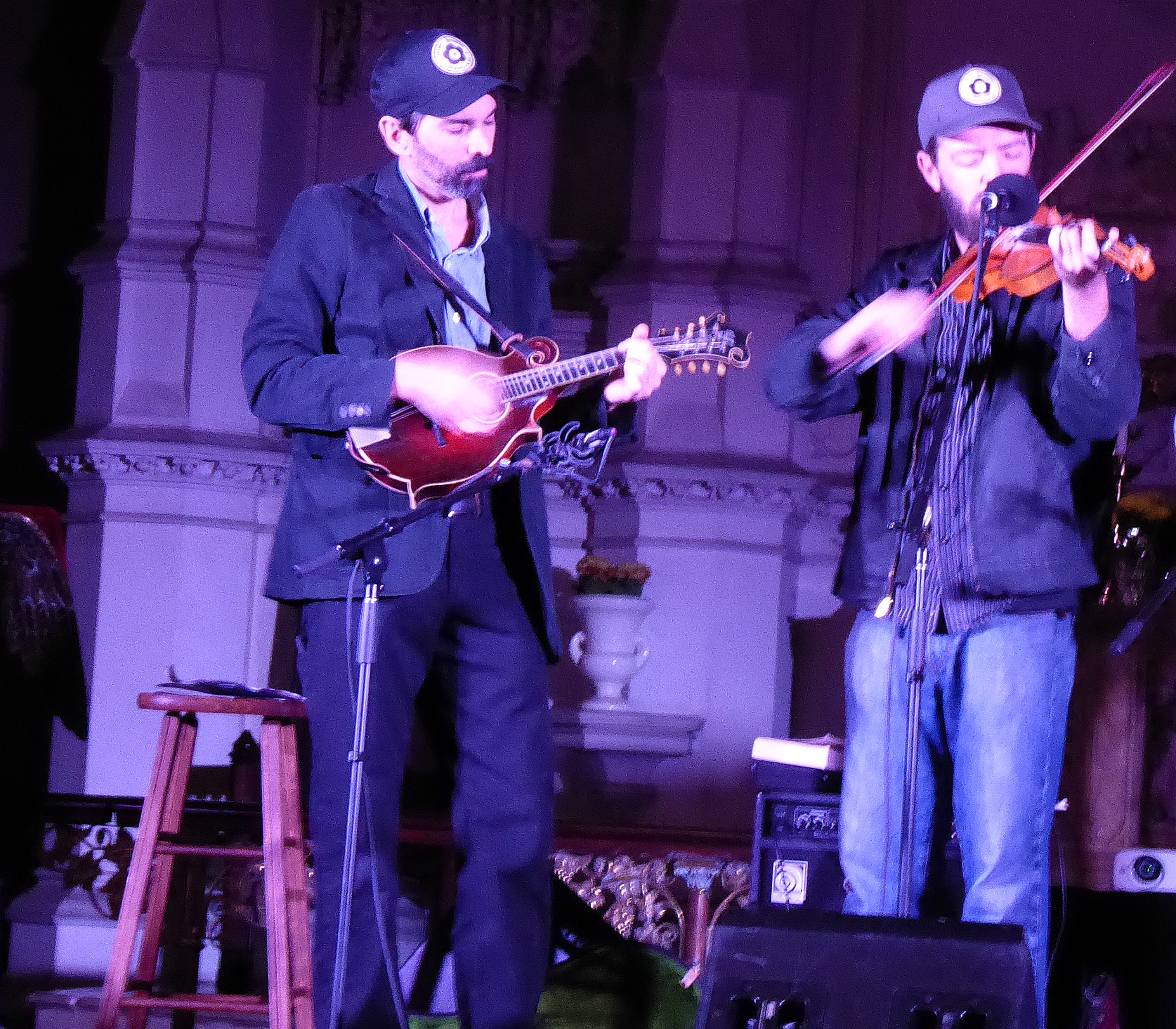
Brooklyn’ folk fest is run by the Red Hook-based Jalopy Theatre, which has grown to encompass a performance space, a record label and a music school. Many of the festival performers have records on the label, including the Down Hill Strugglers, who played first with some songs from the Anthology. Jackson Lynch continues to astonish on fiddle, as they made their way through tunes like “When First unto This Country” and “Cumberland Gap.” Walker Shepherd is a switch hitter who sometimes joins Lynch on fiddle, and Smith moves from guitar to banjo. They’re urban old-time musicians, just like the pioneering New Lost City Ramblers.
I didn’t know that Woody Guthrie played the fiddle, but apparently he not only played it but wrote music for it. The Strugglers ventured into his “Cowboy Waltz.”
Peggy Seeger, a Folkways stalwart along with her brother Mike (a folklorist and member of the New Lost City Ramblers), was one of several still-vigorous veterans who played the festival. She’s 88. Also appearing was Rambling Jack Elliot (92), Ed Sanders of the Fugs (84) and poets Anne Waldman (78) and (by phone) Sonia Sanchez (89).
Seeger, accompanied by her son Calum McColl on guitar and vocals, appeared on video from her home in England. She is an adept interpreter of old songs, and proved it with “The Wagoner’s Lad” and “Dink’s Song.” But she also offered some originals, one of them a clever ditty about automated phone answering systems. And she didn’t forget her late husband’s “The First Time Ever I Saw Your Face,” written for her.
Ed Sanders, the link between the beats and the hippies. (Jim Motavalli photo)
The Fugs, featuring Sanders, hit the nostalgia button with “Slum Goddess of the Lower East Side,” “CIA Man” and “Kill for Peace,” the latter by the legendary Tuli Kupferberg. The Fugs were always sort of ramshackle, and they still are. A moment of order came with the song from the guitarist Steven Taylor, “God Bless Johnny Cash.” Taylor said he showed a draft to Sanders, who said the song was “prolix.” Maybe it’s been shortened since.
Charlie Parr proved very accomplished on his National steel guitar. His songs, mostly about down and outs, were intermittently successful. “I Ain’t Dead Yet” was a highlight.
Dom Flemons, “Freight Train” and “Cannonball Blues” medley. (Jim Motavalli photo)
And then came Dom Flemons, who had heard just that morning that his new album Traveling Wildfire had been nominated for a Grammy. Flemons, a former member of the Carolina Chocolate Drops with Rhiannon Giddens, is a delightful solo performer, and starting to branch out a bit.
Wildfire is his own songs, some with a country feel such as the very romantic “Slow Dance.” Traditionalists could delight in his ornamented guitar medley of “Freight Train” and “Cannonball Blues.” And he didn’t forget the black cowboys, the subject of his last Grammy-nominated album. Did you know that Reverend Gary Davis had a cowboy song, “Saddle it Around”?
A great way to start Saturday morning was Ken Schatz leading the audience in sea chanties. The pews were full of his fellow acolytes, and he called them up one by one to sing lead, with the rest of us joining on the choruses. I was thrilled to hear “Cape Cod Girls,” previously encountered only on Patrick Sky’s second album, A Harvest of Gentle Clang.
The Harry Smith Frolic folks, getting through the Anthology of American Folk Music. (Jim Motavalli photo)
Kyle Tigges, with a full band of fiddle, bass and piano, offered easygoing songs. He’s one to watch. And I really loved a performance by members of the Harry Smith Frolic. This is an event, held in Massachusetts annually, that each year attempts to get through one volume of the Anthology, helped by anyone in the audience who can sing (or is willing to attempt to do so). Four of the frolickers showed up at the festival and banged out such Anthology numbers as “The Brilliancy Medley,” “I Wish I Were a Mole in the Ground,” “Indian War Whoop” and “The Mountaineer’s Courtship.” The latter is a novelty number from the Stoneman Family, and the kicker is that the rube getting hitched already has six kids.
And then there was David Johansen. The former New York Doll made two wholly unexpected albums as David Johansen and the Harry Smiths, and they are a revelation. He sounds utterly authentic, Charlie Poole’s cousin, and fully inhabits the old songs. On stage with two guitarists, he still looked like a rocker, skinny in striped pants, but as soon as he opened his mouth the Old Weird America came crawling out. Quite wonderful. “Old Dog Blue,” “Casey Jones,” “Single Girl, Married Girl,” “Delia.”
Johansen barely talked, but he did say, “This is a wonderful event. It’s so much fun to play these songs. It’s a constant source of rejuvenation for me.” Fans of Buster Poindexter or the Dolls can catch him in a different context, such as Personality Crisis, the recent Martin Scorsese documentary.
Wyndham Baird was a repeat visitor, and a somewhat low-key performer who offers beautifully sung and sturdily constructed cover songs, from Dylan (“License to Kill”), Ian Tyson (“The French Girl”) and Roscoe Holcomb (“Trouble in Mind”).
Nora Brown, contemplating the past. (Jim Motavalli photo)
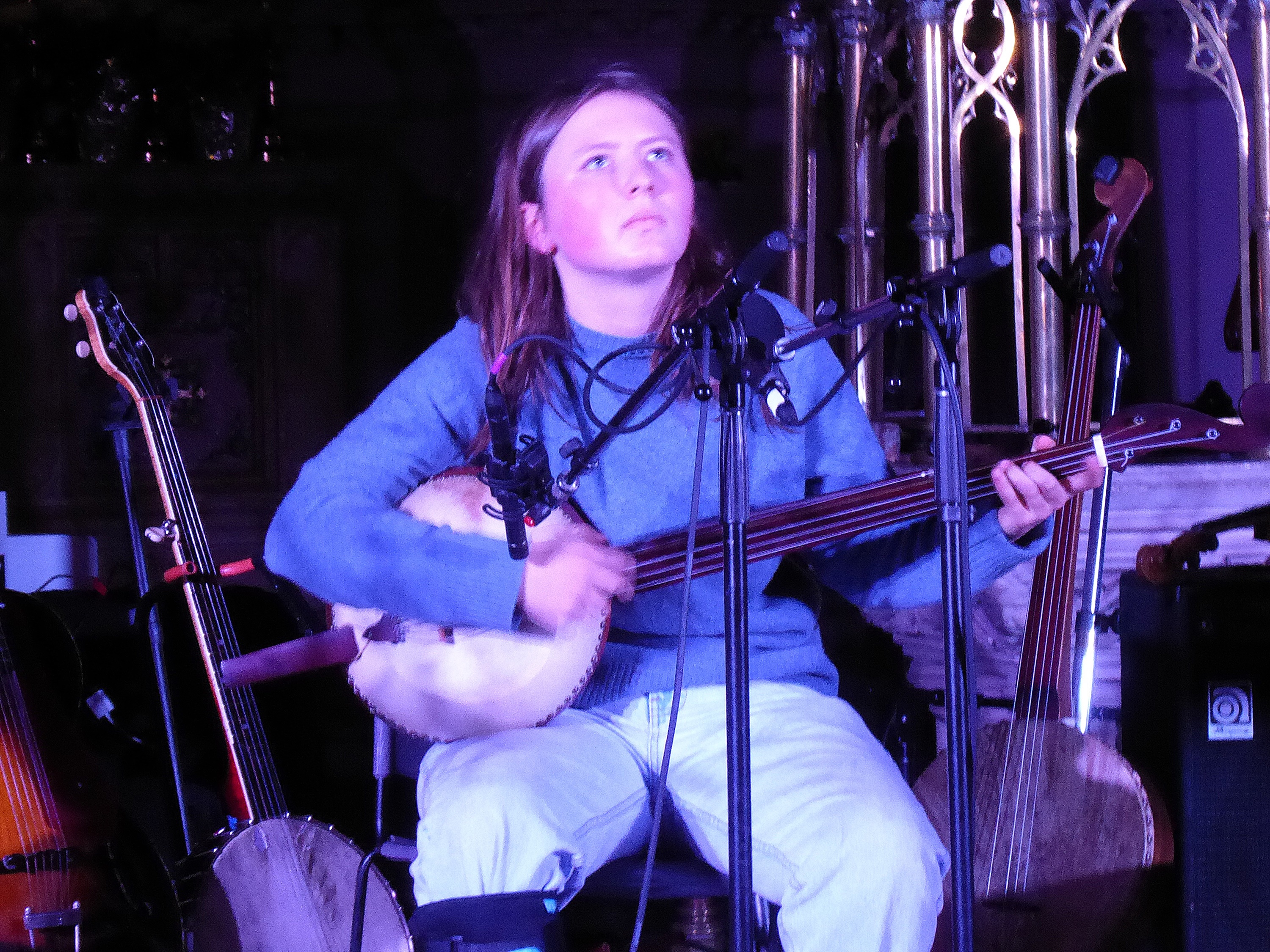
The young banjoist Nora Brown was in a slightly downbeat mood, having recently contracted a cold and sprained her ankle. She opened with “Morphine.” It’s always great to hear both her interpretations and her descriptions of where the songs came from. “Copper Kettle,” an immediate postwar song by Albert Frank Beddoe and recorded by Bob Dylan on Self Portrait, was typically splendid. Nora was joined by fiddle player Stephanie Coleman, and the pair recently made an EP together. Brown was on several stages over the weekend; the musicians love to play with her.
Brown sometimes sits in with multi-instrumentalist Jake Blount; as he pointed out, they “like the same songs.” In Brooklyn Blount was subdued but also pissed-off and electrifying as he tells stories of slavery and African-American life, often through the lens of old songs. He’s a ferocious fiddle player—sometime using it to generate a drone, with electronic effects—and just as good on banjo and guitar.
Jake Blount, fiddle drones. (Jim Motavalli photo)
“I’ve Heard of a City Called Heaven” comes from the singing of Jean Ritchie, and Blount did it brilliantly. “Hard Times” via Skip James was also imaginatively reinvented.
Alice Gerrard (center) with Tatiana Hargreaves (left and Reed Stutz (right). Missed the bass player’s name! (Jim Motavalli photo)
Alice Gerrard lives in North Carolina now, and brought some musicians up from there, including Reed Stutz and Tatiana Hargreaves. Sad songs (“The One I Love is Gone,” via Bill Monroe) funny songs (“How Can I Keep from Fishing?”) and serious ones (“The Coal Miner’s Blues”) were all offered and treated with respect.
I unfortunately had to miss Sunday and Rambling Jack Elliot, among others, but what I did get was two intense days and nights of roots music.
See more of what’s going on at Brooklynfolkfest.com and Jalopytheatre.org. The same folks put on the Washington Square Folk Festival, the Brooklyn International Folk Festival and Roots ‘n Ruckus Fest.
The Slovakian capital of Bratislava is only an hour by train from Vienna, Austria, which turned out to be convenient—because we were in Vienna. That’s homebase for my niece, a newly minted doctor, and her retired racing greyhound dog. My wife is 50 percent Slovak, and she’d never been there, so we decided to spend a few days traveling around the country, visiting her family’s old stomping grounds in Trenčín.
Bratislava was in high political season while we were there, with posters on every flat surface. The election was won, three weeks later, by Robert Fico, ostensibly a leftist but also a populist friend of Russia and an opponent of aid to Ukraine. His SMER-SSD party only got 23 percent of the vote, though, so in a parliamentary system it will have to form a coalition to actually govern.
A land of castles, Slovakia has one foot in the past and the other very much in the present. There are more than 100,000 Ukrainian refugees in this small country of 5.4 million. Ukraine and Slovakia share a border to Slovakia’s east. Slovakians know something about foreign oppression—the ruling Hungarians suppressed Slovak language and culture in a program of “Magyarization” that followed the Austrian-Hungarian Compromise of 1867. That period ended with the joining of Slovak and Czech into one nation circa 1918. (They separated again in 1993.)
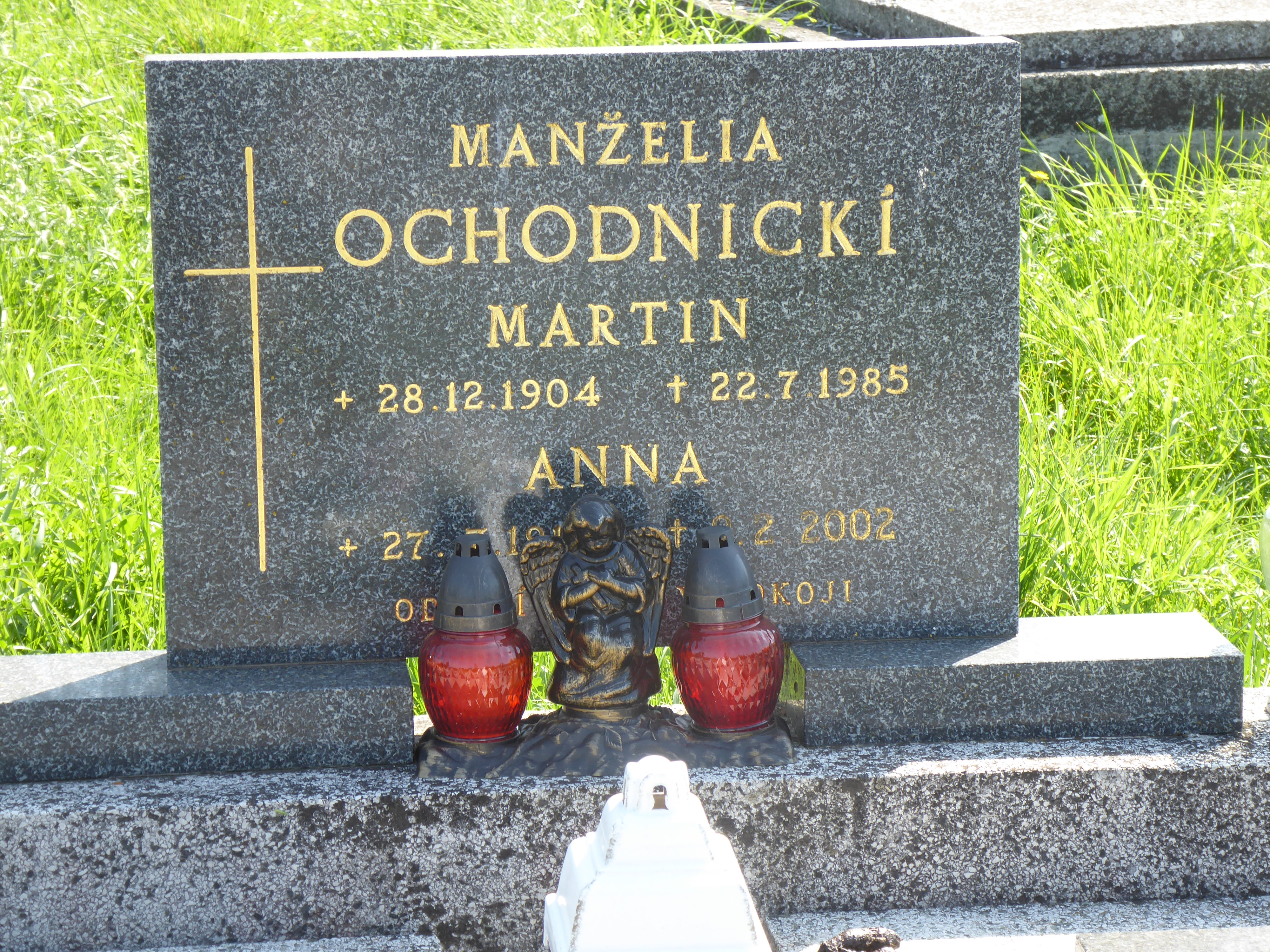
For the day, we hired Martin Talac of Slovakation, which promotes “active” tours, which means hiking in the High Tatra and Sulov mountains, plus other destinations such as Slovak Paradise National Park. We did a fair amount of walking, though probably not as much as is customary for Martin, and at one point briefly entered the Czech Republic on a mountain path with breathtaking views. We found the Protestant cemetery in the town of Krajne where my wife’s relatives are buried (see above), had lunch at a restaurant with a great selection of America oldies, and we even found the address that was printed on the fading envelopes from the old country. In a town as small as Trenčín, there are no street names—just numbers.
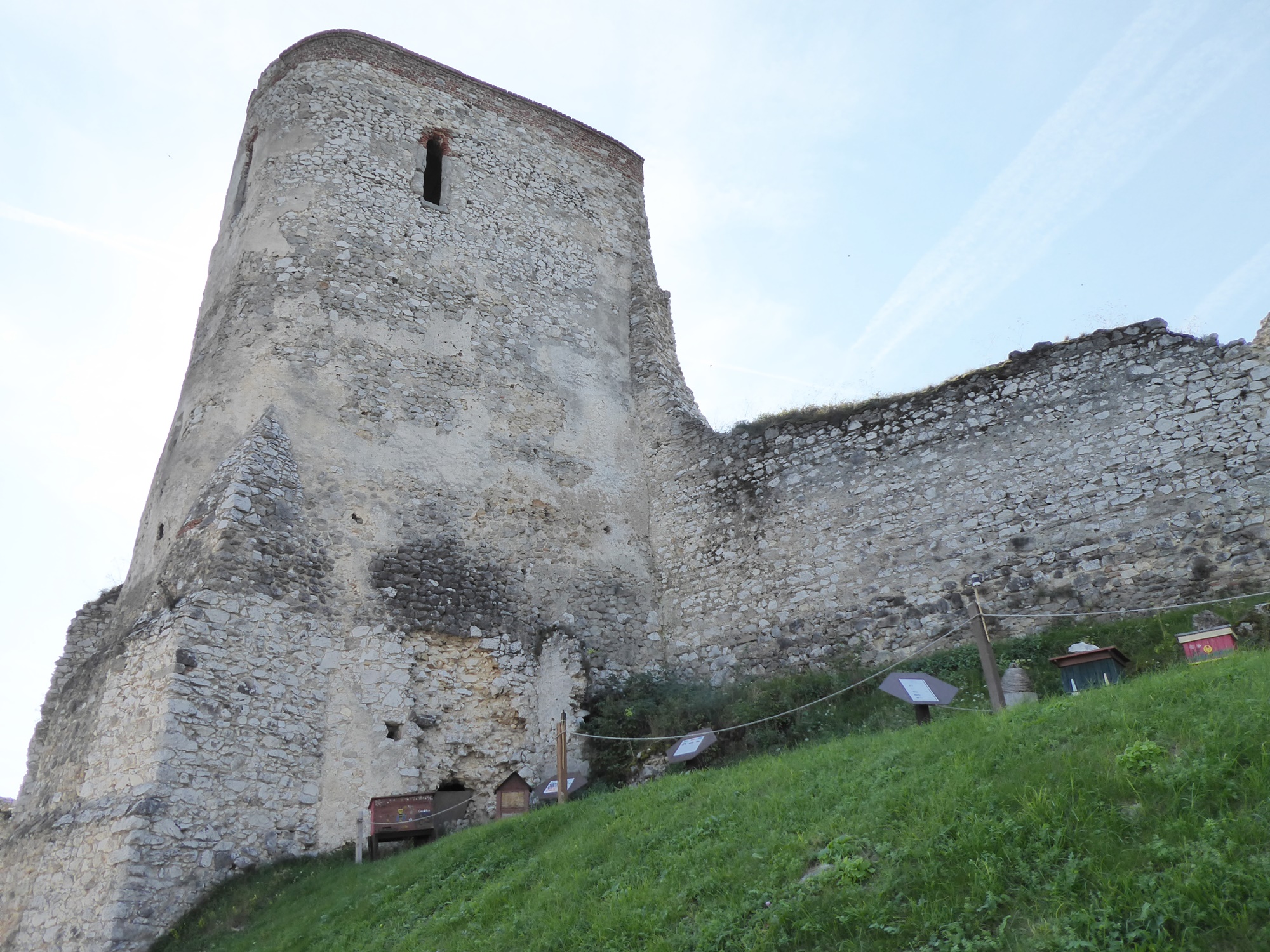
Castle Čachtice up close. (Jim Motavalli photo)
I mentioned castles, and in western Slovakia the ruins of Castle Čachtice, which looms over a town of the same name, was a highlight of our tour. The early Gothic pile was built in approximately 1260 by Casimir of the House Hunt-Poznan. By 1273 it was withstanding the onslaught of King Premysl Otakar II. Under the Orsags family (1436-1567) the castle was expanded with improved defenses and sumptuous residences.
The view from the castle walls. (Jim Motavalli photo)
But it’s the 17th century we’re concerned with here. Countess Elizabeth Báthory (1560-1614) inherited the castle after the death of her husband, the war-loving Count Ferenc Nádasdy, in 1604. No less an authority than National Geographic says that the count schooled his wife in sadism and torture. “For Báthory’s pleasure, Nádasdy had a girl restrained, lathered in honey, and ravaged by insects,” the magazine said. “He gifted the countess gloves spiked by claws, with which to thrash her servants for their mistakes.”
The countess in a likeness that’s likely a copy of the original painting.
In popular lore, Báthory believed that bathing in the blood of virgins preserved her own youth, and she was accused of killing more than 600 young girls for this purpose. Apparently, it was OK to abuse servants—that was common at the time—but when the countess started kidnapping and murdering the daughters of the nobility her crimes could no longer be ignored.
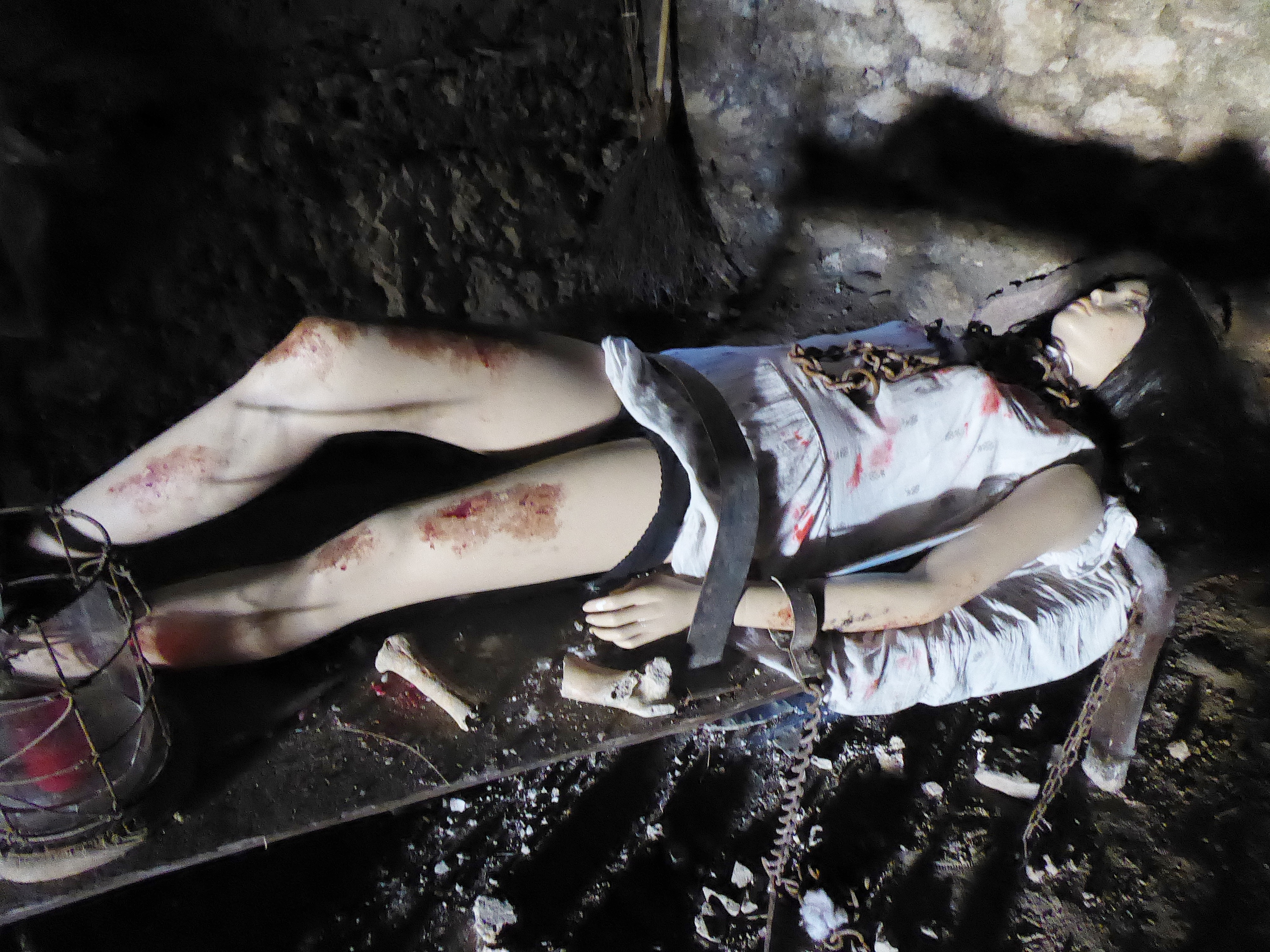
Is this the way it was? An evocative tableau inside the castle, with mannequin victim. (Jim Motavalli photo)
An investigation was launched by the King of Hungary, Matthias II, in 1610. Báthory was charged in the deaths of 80 young women, but despite the gathering of considerable testimony (which makes grim reading), was never convicted. She was instead imprisoned in her own castle, though four of her servants were hideously tortured to death. “The Blood Countess” lived in a tiny room, with meals slid into her, for four years until her death in 1614. She was 54.
The iron maiden is likely not the original. (Jim Motavalli photo)
Today, many historians say that the countess was the victim of local politics, or of mass hysteria similar to the Salem witch trials. The crumbling castle isn’t saying.
Tourism is down in Slovakia, both because of COVID and disruptions related to the Russia-Ukraine war. But Castle Čachtice is doing its best. Báthory Wine is available in the gift shop, and there are some interesting tableaux among the battlements, including an iron maiden (the countess may have used something similar) and what appeared to be a department store mannequin tied down, bloodied and ready for more torture.
People flood the car-free cobbled streets of downtown Trenčín.(Jim Motavalli photo)
The cobbled streets of downtown Trenčín yield no less than three vegan restaurants that served lunch. It’s lovely, and another castle looks down. A delightful museum is devoted to pre-war Skoda cars. In Bratislava you can buy a card that’s good for all public transit and most museums—we went to four, including the castle (of course there’s a castle), clocks, natural history and transportation.
An open-topped car in the Skoda museum. (Jim Motavalli photo)
Even if you haven’t considered Slovakia—but you’re headed for Europe—by all means see if it can fit into your itinerary. The food is great, the lodging friendly and inexpensive, and the people—universally both very friendly and at least competent in English.
SHEFFIELD, MASS. Those of us in the old-time country/swing jazz music scene have dearly missed the Oldtone Festival, which took place for eight glorious years in North Hillsdale, New York, at that magical corner where Connecticut, Massachusetts and New York come together. You don’t want to get emails like this back in February: “With heavy hearts we are announcing the closing of the Oldtone gates. It’s been an amazing run and the community we have built is nothing short of breathtaking. Without all of your support and love for the music and the farm, all of this could not have been possible.”
While other festivals feature the music, they don’t focus on it. Old Tone brought out some incredible artists seldom seen at mainstream events: JP Harris, the Downhill Strugglers, Nora Brown, Moonshine Holler, Roochie Toochie and the Ragtime Shepherd Kings, Dumpster Debbie, Tuba Skinny, the Bad Penny Pleasuremakers, Anna and Elizabeth, and many more. They all took the stage at Cool Whisper Farm.
Well, Oldtone is alive, at least in spirit. Kip Beacco (an Oldtone mainstay) and Matt Downing of the Lucky 5 (a fine swing band) teamed up with Alex Harvey of Shinbone Alley and the inestimably valuable Jalopy Theatre in Red Hook, Brooklyn to form the Down County Jump Festival, held September 30 at the Race Brook Lodge in Sheffield, Mass. There was 10 hours of music, with lunch and dinner breaks. It was described as a “pre-party” for the highly anticipated Brooklyn Folk Festival, which is November 10-12 at St. Ann’s Church.
Moonshine Holler kicked off the festivities. (Jim Motavalli photo)
Many of the performers were at Oldtone at one time or another. The show opened with Moonshine Holler, an old-time trio featuring guitarist/singer Paula Bradley. With her late husband, Bill Dillof—an incredibly knowledgeable music historian, Bradley formed the group to celebrate some of the little-explored corners of old-time. That tradition continues. Bradley is now working with young musicians Pete Killeen (banjo) and Rafe Wolman (fiddle). The repertoire avoids cliches.
“What You Gonna Do with the Baby?” comes to us from the late 1920s singing of Grayson and Whitter, and Bradley said it didn’t work as a song for kids—because they were too worried about what happened to the tune’s namesake infant. It wasn’t harmed in the making of the song.
All three are fine musicians, and they recognize this music has to be performed with energy and passion—not like a dry academic exercise. The set proceeded through “Steeley Rag,” from the Red-Headed Fiddlers, a song from Moonshine Kate (daughter of the legendary Fiddlin’ John Carson), “You May Leave, but This will Bring you Back” by the Memphis Jug Band, “Stone Mountain Wobble” by the Scottsdale String Band from Georgia, and many more.
Shinbone Alley took us out to sea. (Jim Motavalli photo)
Shinbone Alley, Alex Harvey and Jordan Shapiro, dealt in old sea shanties. These venerable tunes have had moments in the sun, but not recently. Have you heard the long tale, “Doodle, Let Me Go”? Harvey talked about songs “traveling in the belly of the boats for decades.” Some dated to the 1600s. Evidently if you go to the bars of Cornwall, England, they’ll all be familiar with a number called “The Sweet Nightingale,” who sings in the valley below. Robert Bell’s 1846 Ancient Poems, Ballads and Songs of the Peasantry of England says the song “may be confidently assigned to the 17th century.” It was originally sung in the Cornish language.
“The Rosabella,” about taking a ride in a “deepwater ship with a deepwater crew” is relatively recent—from the 19th century. Shinbone Alley turned it into a sing-a-long. One song the group did, “The Saucy Sailor,” was once essayed by English folk-rock ensemble Steeleye Span, but most were heard for the first time—by me, at least. Sailors were well-traveled, of course, and Harvey pointed out that many were of mixed race, and were influenced by sources as diverse as Indian classical music and Polynesian sounds. Shapiro has a bluegrass group called Astrograss, and also played keyboards on the album World of Captain Beefheart—and toured with Beefheart guitarist Gary Lucas.
Fatboy Wilson and Old Viejo Bones work internationally. (Jim Motavalli photo)
Fatboy Wilson and Old Viejo Bones is Samoa Wilson (niece of Jim Kweskin, and no fatboy) and Ernesto Gomez (who wasn’t that old). Together, they were magical, and occasionally in Spanish.
Wilson has a strong voice, and Gomez is an excellent guitarist, singer and harmonica player. “Hand Me Down My Walking Cane” and “Single Girl, Married Girl” are songs that uncle Jim could and would do. But “The New St. James Infirmary Blues” was a recent update featuring COVID 19.
The Lucky 5 swinging, sometimes in French. (Jim Motavalli photo)
The Lucky 5 is a swing band that loves Django Reinhart and, perhaps, his milieu. There’s a French accent to what they do, thanks to trombonist/vocalist Carolyn Dufraine. Her “Cou Cou” is a favorite. But all their tunes are very entertaining, including fiddler Jonathan Talbot’s “Red Spain.” Beacco is a fine singer and guitarist, and he writes original songs for the band, too. “Russian Lullaby” sounds exotic, but Irving Berlin wrote it. Beacco said Lucky’s version is via Argentinian guitarist Oscar Alemán. Here’s their “Me, Myself and I”:
Slowey and the Boats were a major discovery. What a fun group! It’s led by Isaac Stanford, a wildly red-haired virtuoso steel guitarist who likes it Hawaiian. For those who aren’t familiar, Hawaiian music was hugely popular in the U.S. around 1916, after a show called Bird of Paradise introduced it on the mainland. In 1916, recordings of Hawaiian music outsold everything else. Here are the Boats takin’ it cowboy style:
Slowey and the Boats led us down a steel guitar-driven memory hole. Remember the Hawaiian music craze? (Jim Motavalli photo)
Slowey’s repertoire features a lot of half-remembered music, such as “Ebb Tide,” which was a hit for Frank Chacksfield in 1953, but then everyone from Frank Sinatra to the Righteous Brothers recorded it. The sound was Martin Denny meets Bob Wills. The group’s baritone vocalist, Steve Stanislaw, was late but arrived for some cowboy songs such as “Back in the Saddle Again.” Such tunes are the focus of the group’s new album, and as Justin Poindexter and his group has shown, they adapt well to swing.
The Haughties rock it steady. (Jim Motavalli photo)
The Berkshires-based seven-piece Haughties is a contemporary reggae band with a fresh sound and two women up front.
Rose and the Bros brought the Cajun folk-rock sound. (Jim Motavalli photo)
Rose and the Bros from the Ithaca, New York area are one of Rosie Newton’s incarnations. She also has an old-time-type duo with Richie Stearns called Richie and Rosie. As Rose and the Bros, she rocks out with a Cajun flavor to her accordion and fiddle. They opened with Michael Hurley’s “Blue Driver,” as they frequently do.
They did a Julie Miller song, “Don’t Listen to the Wind,” and then started tearing through “Summer Breeze” by the band’s Paul Martin (who runs Sweet Land Farm in Trumansburg, N.Y., home of the Grassroots Festival, when he’s not with Rose and the Bros). But that’s when I had to leave. Oh well. And there was voodoo and Haitian chants from Tjovi Ginen and post-war New Orleans R&B from the Jackson Lynch band still coming up.
P.S. There was an intermission band, a young couple on guitar (him) and fiddle (her). I didn’t get their names, but he was really into Charlie Poole, and sounded like him, too. She sang a fine version of Townes Van Zandt’s “Delta Momma Blues.” Together, they sang “Don’t You Rock ‘Em, Daddy-O” which Lonnie Donegan recorded in ’56. The future of the music is safe with them.
These were the transcendent moments at FreshGrass 2023, held annually at the MASS MoCA arts center in northern Massachusetts:
Sierra Ferrell, Friday night. It would have been hard to top the set Ferrell delivered at the Red Wing festival in Virginia earlier this summer, but she achieved that feat in Massachusetts. The richness of her voice combined with her stage presence, compelling, crowd-pleasing material from her album Long Time Coming, and some great new stuff from the record coming out next year.
Sierra Ferrell and band were incandescent. (Mary Ann Masarech photo)
Ferrell was introduced as “the most exciting artist in the roots music world,” and for once it wasn’t biz hyperbole. She is that. Proof that she will only grow as an artist came in a new song that I think is called “I Can Drive You Crazy (Yes I Can).” It’s a not only a great tune, but also strong evidence that she knows country music history back to Bristol, Tennessee in 1927.
One new song, “The Garden,” finished in the studio as the band was recording the new album, came across like a mashup of the Louvin Brothers and Dolly Parton. A special mention should be made of Ferrell’s band, just three guys (in maroon to her white) on fiddle (Oliver Bates Craven), mandolin (Josh Rilko) and bass (Geoff Saunders). Craven co-wrote “The Bells of Every Chapel” and doubles on guitar.
The sum of these parts makes for a very exciting stage show, but also a very controlled and professional one. It’s kind of at odds with her wild posts on Instagram, taking a kind of Cindy Sherman-esque approach to her physical being. Quite the complex character, this Sierra Ferrell. I bought her little-known and minimally packaged first album, Pretty Magic Spell, in the merch room, and it’s well worth seeking out, if not quite as stellar as Long Time Coming.
Bruce Molsky, Michael Daves and Tony Trischka, Saturday morning. These three, who play together occasionally, constitute a supergroup in the fairly small world of old-time country music. Molsky is probably the greatest living exponent of the style—both as a singer and as a guitarist and fiddler. At Freshgrass he confined himself to fiddle, but—trust me—he’s just as good on guitar. His skills weren’t needed there, because Daves is an incredible guitarist, as well as a singer in the high, wide and lonesome style of the music’s origins. (Actually, his voice has gotten a bit deeper over the years.)
From left, Tony Trischka, Michael Daves and Bruce Molsky. (Jim Motavalli photo)
Trischka is up there with Bela Fleck on banjo, though their styles are quite different. His “Fox Chase” instrumental was a highlight of the set. But the transcendent moment, which I wish I’d captured on video, was the finale, “Down in Rockingham,” taken at full tilt, a prime example of the unbridled energy and drive in old-time country. Here’s the band doing “Jawbone,” which I did capture on video:
Bombino, Saturday afternoon. Omara “Bombino” Moctar is from the nomadic Tuareg people in Niger, and plays guitar in the desert style of groups like Tinariwen (from Mali). He’s been called “The Sultan of Shred” by the New York Times, and the world’s best guitarist by a music blog. His most recent record, Sahel, came out this year. These are the bare bones, but they don’t prepare you for the reality of seeing Bombino in person.
Forget about the “world music” tag and the fact that the lyrics are in the Tamashek language and address geo-political concerns halfway around the world. This is simply one of the best live groups on the planet, and you have to see them live. It’s so propulsive you want to scream out loud. There are parallels to Fela Ransome Kuti, the Nigerian sax player and singer who likewise addressed a repressive African state with exhilarating, long-form music of defiance. Bombino’s music is informed more by rock than jazz, but both artists evolved their own distinctly African styles.
Bombino is a singularly exciting guitarist, but he also has an exceptional band. Fellow Tuareg Illias Mohammed is on second guitar and vocals, Mauritanian (by way of Belgium) Youba Dia on bass, and Bostonian Corey Wilhelm as the long-term drummer. The latter has an absolutely ferocious—and very musical—attack, which he sustains for longer than would be thought possible. Even on that cool, rainy day, he probably sweated off five pounds. Any metal band would be lucky to have him, even if they had to fire John Bonham in the process. He’s been with Bombino for 10 years said, Dia, the group’s spokesman, said. Dia also had some words for the New England weather.
Melissa Carper, serious about good country music. (Jim Motavalli photo)
Melissa Carper, Sunday morning. The world needs to discover this powerhouse bassist, singer and excellent songwriter. She writes songs (including with the stellar Brennen Leigh) that combine classic country and country-swing influences, honed by growing up in a family band and listening to the giants. Her set was a master class in how to create and perform music that just about everyone will want to hear—repeatedly. She has a deceptively small but very effective voice, and a fine band. Her songs are kind of sad, but this is country, after all. She closed with the amazing “My Little Christian Girlfriend.”
Melissa Carper’s group enlivens Laurel and Hardy. (Jim Motavalli photo)
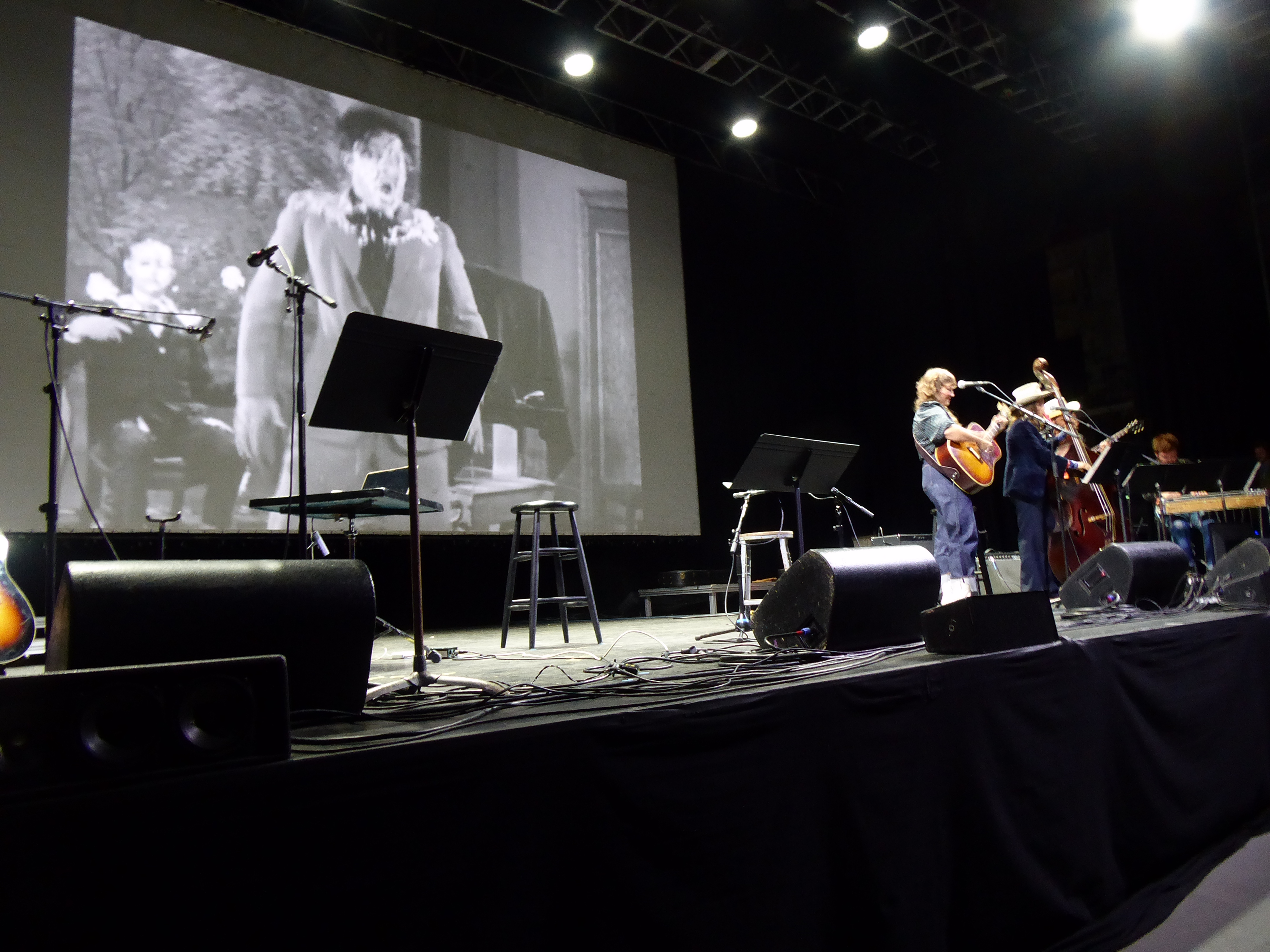
Carper was also featured as part of the commissioned “Freshscores” program, with musicians writing original music for silent shorts. Her inspired choice was the Laurel and Hardy 1927 epic The Battle of the Century Pie Fight. Some 3,000 cream pies met their doom in its creation, she said. Carper’s music perfectly complemented the action and included passages explicitly commenting on it. Other scores were provided by Michael Daves and Kaia Kater.
Rhiannon Giddens in full cry. (Jim Motavalli photo)
Rhiannon Giddens, Sunday afternoon. On her new album, You’re the One, and in concert, Giddens is going in a more popular direction. She now employs a kick-ass backbeat drummer, which makes the whole band overall louder and less subtle. The crowd seemed to love it, though. And since Giddens is one of the world’s greatest musical treasures, there was still plenty of very fine moments. Dirk Powell was on board, and his fiddle-led medley of “God Gave Noah the Rainbow Sign/Breaking Up Christmas” was a highlight, as was Powell co-write “They Could Fly.”
Giddens the stellar player on fiddle and banjo was missed. It was hard to hear the latter on, for instance, the long and loud Brazil-meets-rock-and-old-time-country instrumental they did. But here’s a good Giddens joke, while tuning” What’s perfect pitch? That’s when you throw a banjo into the garbage and it hits the accordion going down.
**
Short takes:
Narrow North, an Americana trio from Albany, New York, had some nice moments on the smaller Freshroots stage. With mandolin, guitar and bass, they make a pleasant brew. All three sing. The Wildwoods from Lincoln, Nebraska were delightful on the same stage, performing a mixture of covers and originals like “West Virginia Rain.” Here they are doing some gypsy jazz, making use of fiddle player Chloe’s degree:
Aiofe O’Donovan had a full chamber orchestra and choir. (Jim Motavalli photo)
Aiofe O’Donovan was also featured in a commissioned piece, indoors at Hunter Center. Celebrating women’s empowerment, she employed a full chamber orchestra, horn section, the Westerlies brass quintet and a choir. O’Donovan, a highly skilled interpreter, was in fine voice. The only drawback was weak songwriting. The tunes were meandering and fairly vague. The singer is transcendent when shaping other people’s songs (as she did in Crooked Still), and there’d be no problem with her sticking to that–Linda Ronstadt and Maria Muldaur, for instance, left the composing to others.
CJ Field, a Nashville-based singer-songwriter, exhibited most of the moves of the new Nashville, meaning more rock than country. It was all pretty standard and forgettable, but his song “6th of October,” recently recorded and co-written by Ashley McBride, stood out as worth a second listen.
I’ve been having trouble with what passes for country in Nashville recently. In Munich, at a friend’s urging, I went to see a young and heavily tattooed performer named Morgan Wade.
Good money, wasted. Morgan Wade was just terrible. But in Germany, not Massachusetts! (Jim Motavalli photo)
Attired in a Black Sabbath t-shirt, she delivered one of the most deadening, monotonic, musically barren performances I’ve ever seen. It was loud, stupid and relentless, and showed nothing but contempt for the audience. I rarely walk out of a show, especially one I’ve paid 20 euros for, but I couldn’t stand to be in her presence for one more minute. Get your act together, Morgan Wade, whoever you are.
Sunny War, with her widely spaced interpreter. (Jim Motavalli photo)
Sunny War was pleasant, in a very Tracy Chapman kind of way. She has a dark, syrupy voice you could compare to Cassandra Wilson. The songs were universally slow and quiet, except for “No Reason” from latest album Anarchist Gospel, which really picked things up usefully. Special mention should be made of second guitarist Anthony da Costa, who has done similar duty for Aoife O’Donovan and Sarah Jarosz. He not only played excellent impressionist guitar that really fit the songs, he also sang some interesting counterpart vocal parts.
And da Costa talked, acting as War’s spokesman. She’d whisper something to him and he’d turn to the audience. “Sunny says….” It was kind of cute.
TRUMANSBURG, NEW YORK—One of the great things about music festivals is the act of discovery. I love events that have multiple acts I’ve never heard of. It’s whole undiscovered countries of exciting sounds. The fact is, music is such a deep well you never get to its bottom.
Walter Mouton and the Scott Playboys. Walter formed the group in 1952. (Jim Motavalli photo)
Chronological works here. I walked in on the Boston-based Dead Sea Squirrels performing for some enthusiastic square dancers. It was raining, so the dance tent was a good place to set up. The dancers didn’t even need to sit down, because up next was Walter Mouton and the Scott Playboys. Cajun/zydeco music always goes down well at folk festivals, even when it rocks out. Mouton is a legendary accordion player who put together the first version of the Playboys in 1952 but, now 85, he was at the pedal steel—an instrument I haven’t seen in zydeco before. He also sang a little. The band has a fantastic young fiddle player, but I got distracted by a girl in a top hat dancing on stilts.
December Wind, big boys now. (Jim Motavalli photo)
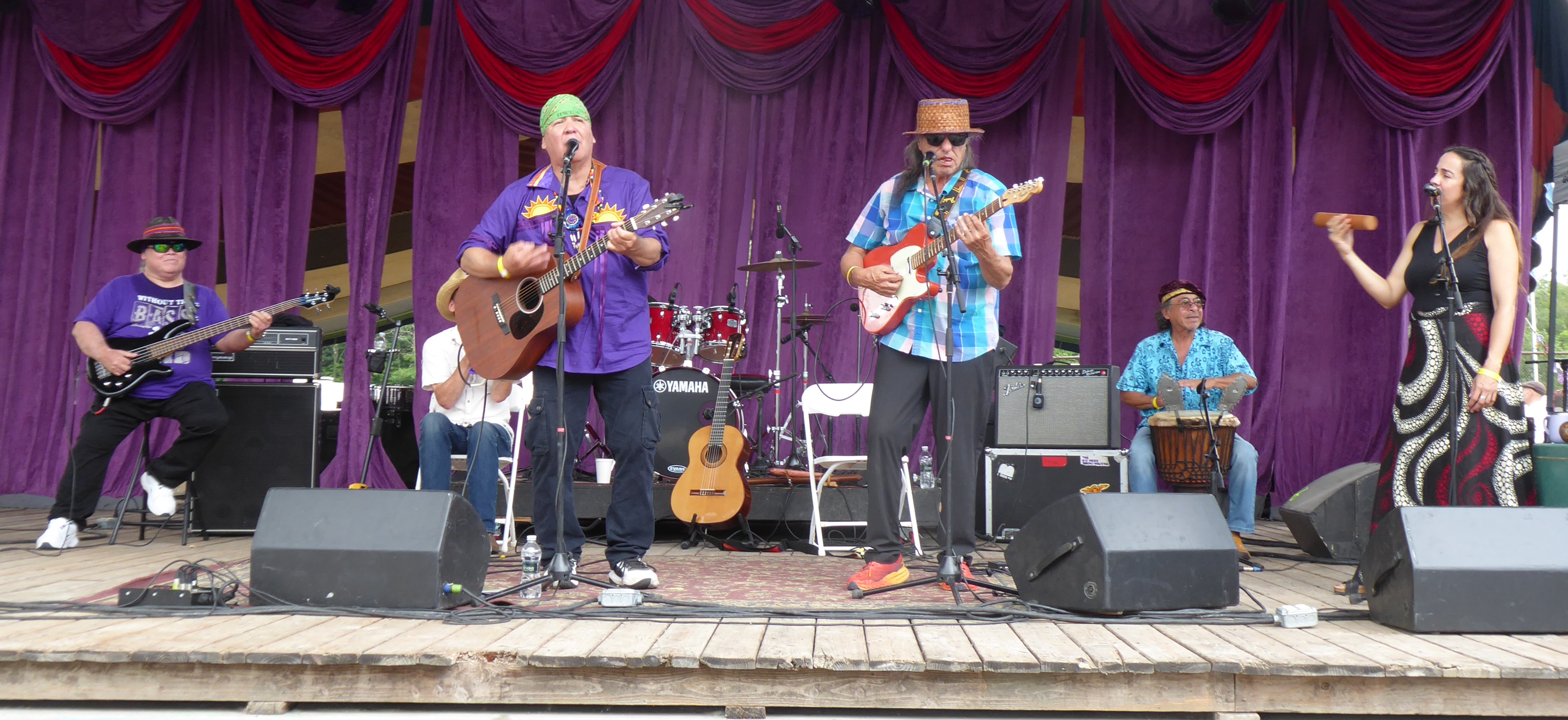
December Wind with Keith Secola (who also led his own set) is an impressive Native American band. Their song “Imma Big Boy,” backed by slide guitar, was captivating. I want to know more about the local-to-Ithaca Fall Creek Brass Band, which had no less than nine horns (three trumpets, four trombones, two saxophones) in the front line. A sousaphone handled the bass duties. An original “We the People” captured the essence of New Orleans brass band music.
Richie and Rosie: Grassroots regulars. (Jim Motavalli photo)
Richie and Rosie (with Rose Newton also leading Rose and the Bros) are a Grassroots institution. Richie Stearns is a native of Ithaca and has been in some of its legendary bands, including the Horseflies and Donna the Buffalo. Richie and Rosie is the two of them, with Rosie on fiddle and Richie on banjo and guitar. Both are fine singers/players, and Richie is an excellent songwriter, as witness his “Nowhere in Time” and “I Am With You Always.” The latter is on their Tractor Beam release. I also loved a bluegrass-heads-east piece called “Last Train to Rajasthan.” That one’s on Nowhere in Time. “I’ve Endured” came via the great Ola Belle Reed.
Richie and Rosie did a fine version of Dirk Powell’s “Waterbound,” with unison singing. We listened to the music through an ancient Fender Princeton Reverb tube amp, so beat up they didn’t mind leaving their drinks on it.
Preston Frank and band. Note the presence of Dirk Powell. (Jim Motavalli photo)
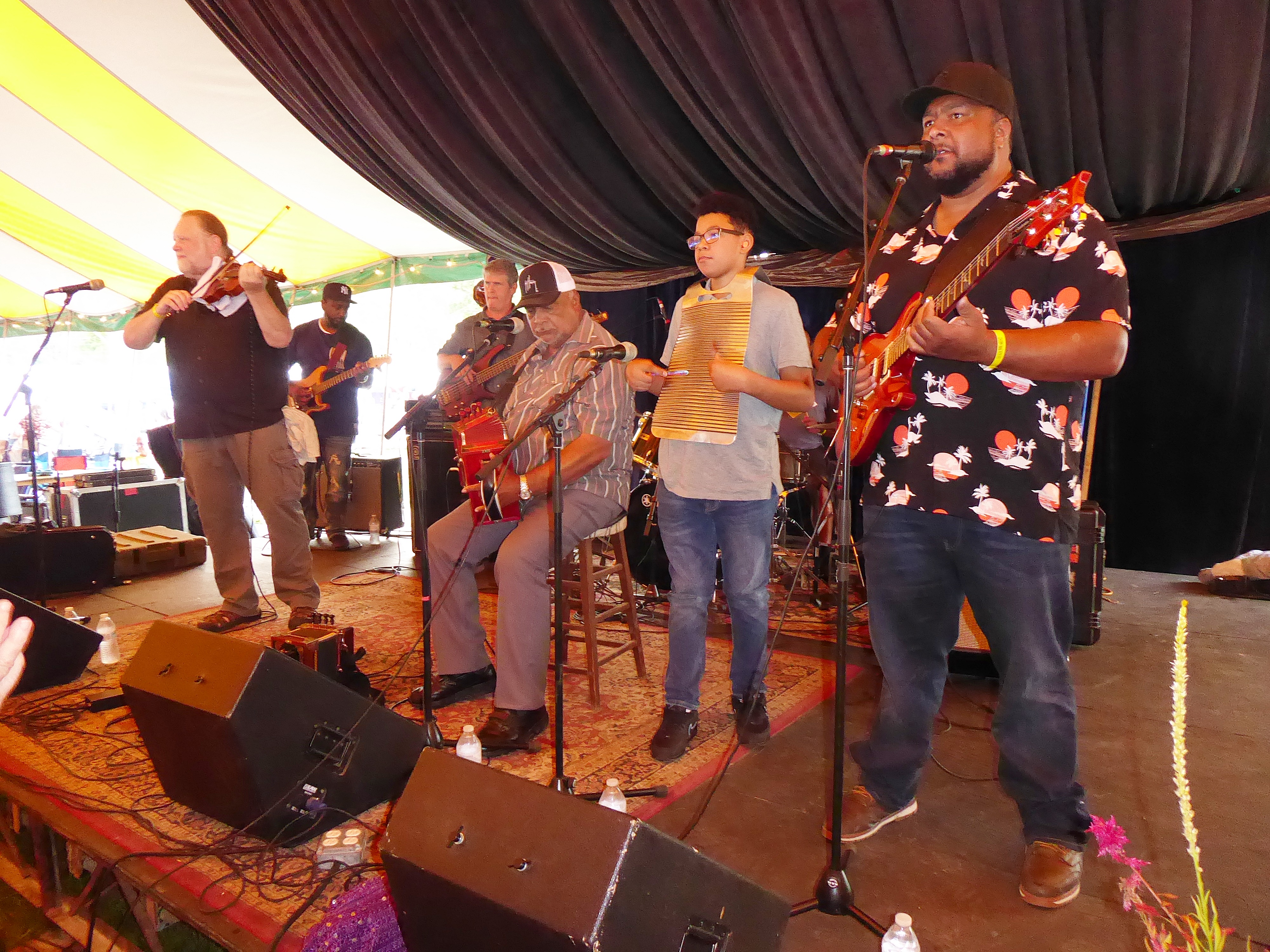
More cajun came from Preston Frank and his Zydeco Family Band. My notes say, “The most infectious sound in the world.” The music makes you happy, but Frank himself is very deadpan. The 12-year-old rub board player is a grandson. Or maybe a great-grandson. There are no grandstanding soloists in this music; it’s all about the groove.
Jim Lauderdale fronts the Buffalo. (Jim Motavalli photo)
Singer-songwriter Jim Lauderdale made an album with the hosts, Donna the Buffalo. Wait ‘Til Spring came out in 2006, though it seems much more recent than that. The Buffalo is more or less Lauderdale’s backing band on the project, though their signature sound can’t help popping up. They clearly enjoyed each other at Grassroots. The Campbell Brothers took forever to set up, but appeared to have it together with their sacred steel before I had to leave. The Flying Clouds of South Carolina, with a rocking approach to gospel, were very convincing.
Day Two started with Jeb and Friends, featuring the laid-back Jeb Puryear of Donna fame. At least he was laid back on stage—organizing the festival (plus three others) with Tara Nevins and the local village must be quite taxing, as well as Donna’s energetic concert schedule.
The set was many of Jeb’s new songs, plus some by friends Uniit Carryou—a very appealing and warm Celtic-influenced singer—and aided by Hank Roberts on truly jaw-dropping cello. I’d like to know more about both of them. Roberts demonstrates why folk music needs more cello. Together it was Woodstock-adjacent upstate New York music. Willie Nelson’s “Bloody Mary Morning” sure sounded good—it had that Texas outlaw vibe, a second cousin to “Sunday Morning Coming Down.” I didn’t get the bass player’s name, but he switched to guitar and led a couple of fine songs. They closed out with a rousing version of Donna’s “Conscious Evolution.”
Drank the Gold offered old-time duets and some contemporary singer-songwriting. Oona Grady brought out her ornate Norwegian Hardanger fiddle, with a second set of strings under the bridge. They also played “The Fox,” which is sometimes described as the oldest folk song in English—dating to the 15th century. But it’s undergone considerable updating since then. My earliest recollection is of Pete Seeger singing it. Maybe “Sumer is Icumen in” is older, since it’s from the 13th century—but it’s in Middle English. “Froggie Went a Courtin’” is pretty ancient, too.
Vivian Leva and Riley Calcagno–their talents came together. (Jim Motavalli photo)
I can’t say enough about North Carolina-based Viv (Leva) and Riley (Calcagno). Vivian, folk royalty through her parents, James Leva and Carol Elizabeth Jones, carries on the family tradition—she’s also in a duo! Leva is a fine autobiographical songwriter and singer, and Calcagno is a virtuoso player, especially on fiddle but also on guitar and banjo. The group loves the tradition, as their seven-minute “Bury Me Not on the Lone Prairie” (not any version I’m familiar with) definitely demonstrated. They also revived a song by the great unaccompanied singer Texas Gladden called “Cold Mountains,” and put a lovely chorus to it. The group’s new album, Imaginary People, is out in September. Here are two videos.
Dirk Powell’s set was a highlight for me. His band includes his daughter, Amelia, on guitar and vocals. Powell is one of our best old-time interpreters, but he’s also steeped in cajun music, having married Christine Balfa and played in her father Dewey’s band, Balfa Toujours. He was a sideman with Preston Frank, too. The band opened with a trip down to New Orleans, Amelia on lead vocals—she’s good at it, too. The music was driving, with multi-instrumentalist Dirk on fiddle. The band was enhanced with Riley Calcagno’s fiddle, and there were some intense duets with Dirk—on cajun and bluegrass/old-time.
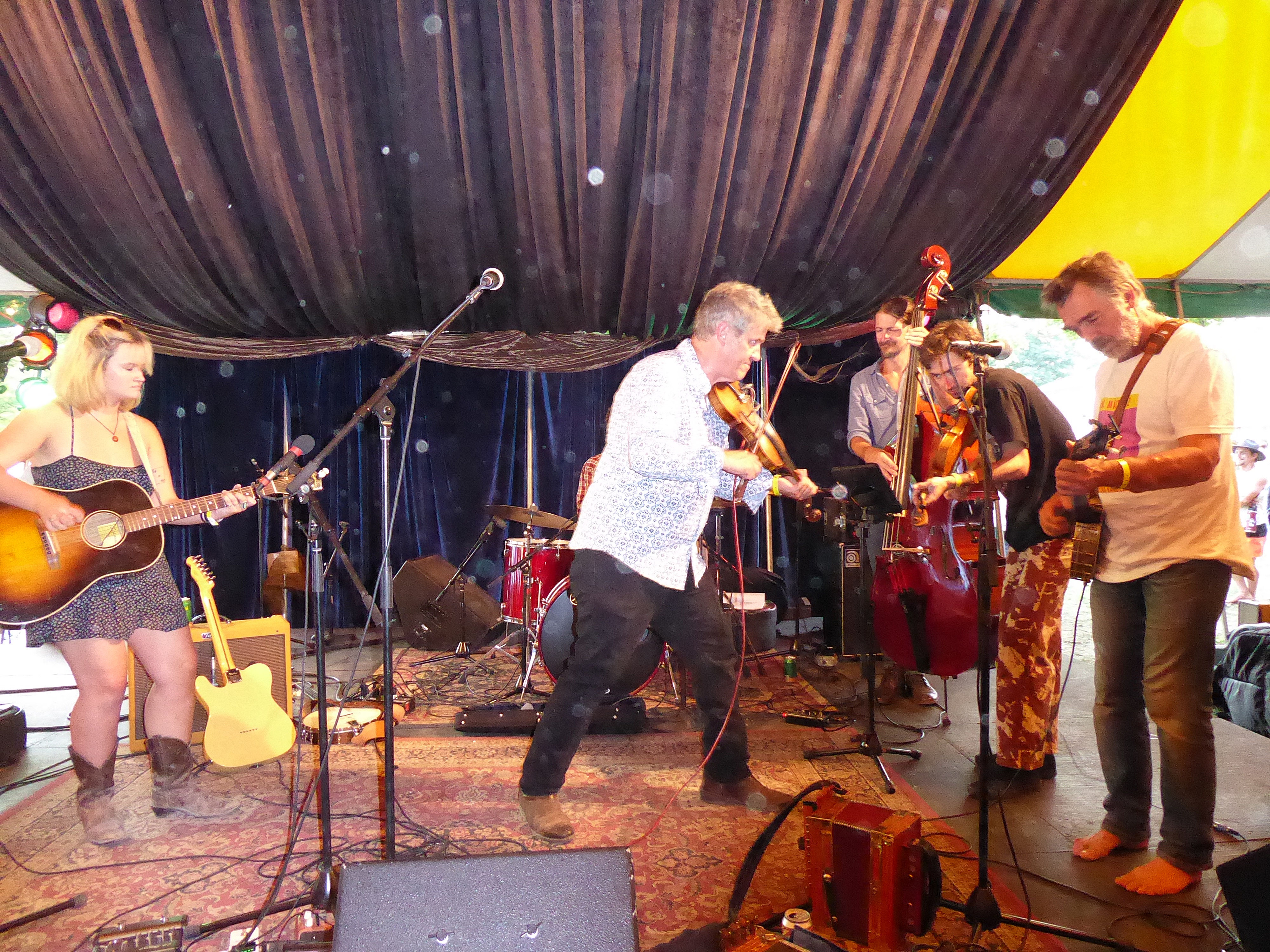
Dirk Powell with daughter Amelia, Riley Calcagno and Richie Stearns. (Jim Motavalli photo)
Coming back up north, the band made an Amythyst Kiah song, “The Worst,” their own. Kiah, who is from Chattanooga and currently lives in the early old-time epicenter of Johnson City, Tennessee, is a student of early African-American banjo music, among other things. Then, having heard that Richie and Rosie did his song, Powell offered his own just-fine version of “Waterbound,” which morphed into a spirited take on “Cumberland Gap.” Here’s the video:
Powell’s set was quite varied. He also did a rockabilly-type song with Chuck Berry overtones that was part of a workshop challenge to produce a song in an hour. The man can rip an electric guitar. Richie Stearns was also brought up to the stage on banjo. Powell used to live in the Ithaca area and knows the scene there. They concluded with a square dance.
Rising Appalachia has many fans in Ithaca. Their mix of old-time and a sort of New Age trance music was quite well received. And Watchhouse proved that a shredding mandolin can be the lead instrument in a driving and almost commercial folk approach. Good songs from Andrew Marlin definitely help. His wife, Emily Frantz, is a very strong singer.
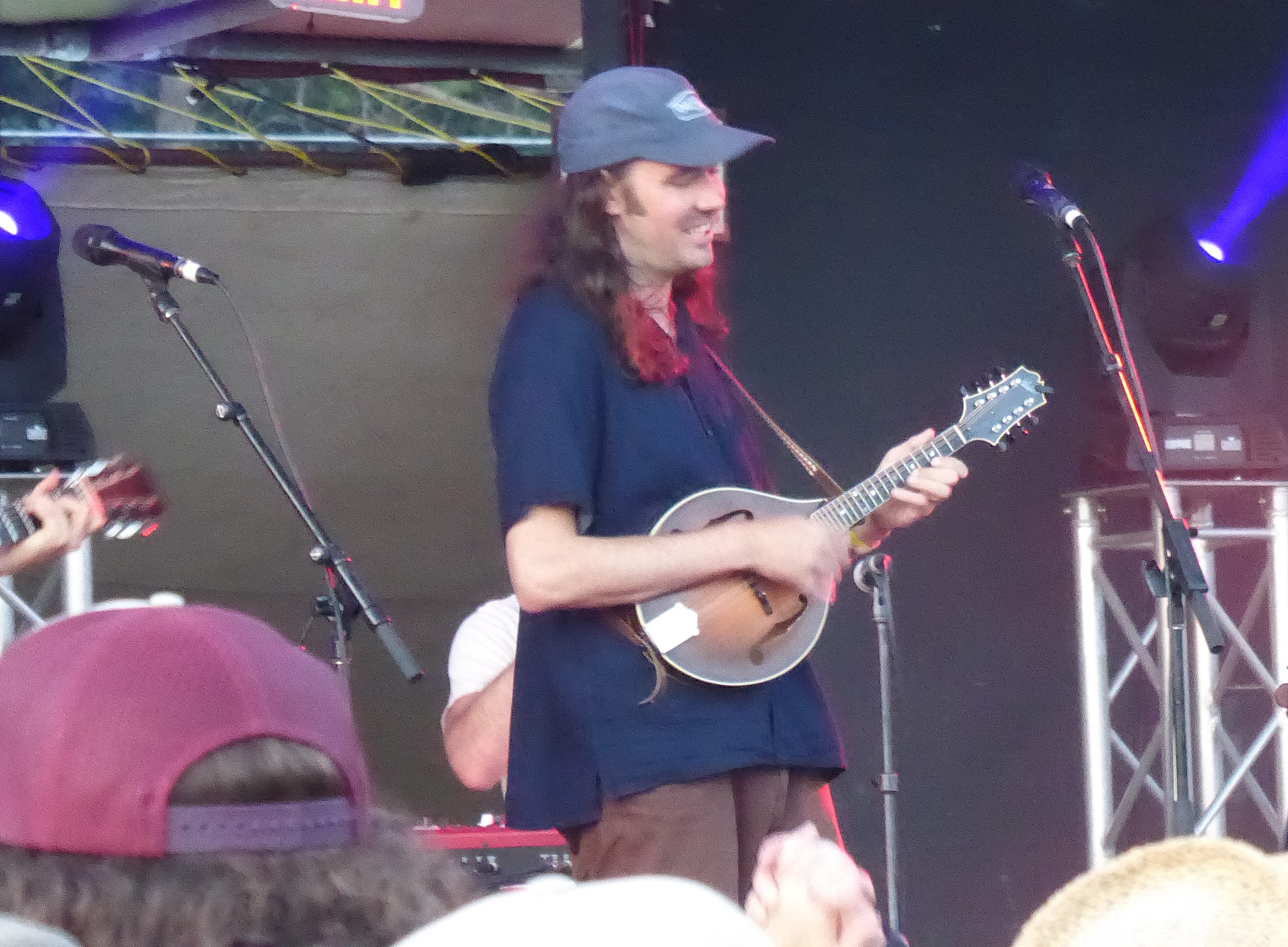
Andrew Marlin of Watchhouse, making the mandolin sing. (Jim Motavalli photo)
Donna the Buffalo wasn’t coming on until nearly 11 p.m., and I had miles to go before I slept. I’ll catch them the next time. Memories of 20 other Donna shows will have to hold me for a while.
Tara Nevins had to think about it. “Yes,” she said, “it really is true that we’ve been doing Grassroots for 31 years.” Nevins is one of two front people in Donna the Buffalo, the un-characterizable rock band influenced by old-time country that calls Ithaca/Trumansburg, New York home.
Tara Nevins of Donna the Buffalo: To the accordion, add fiddle and washboard.
The Finger Lakes Grassroots Festival of Music and Dance starts today in Trumansburg, July 20, and runs through July 23. There are four days of event, four stages and more than 80 bands. What characterizes Grassroots is not a focus on big stars, though there are a few of those, but a celebration of the wide net that is Americana. At Grassroots, you guy expecting to hear a lot of music from performers new to you.
The names are Donna itself, Watchhouse, the Mavericks, Dirk Powell Band, Rising Appalachia, Jim Lauderdale, the Pine Leaf Boys, Keith Frank and Walter Mouton. They’re all great, but I’m also looking forward to seeing Vivian Leva and Riley Calcagno (now trading just as Viv and Riley), and the Cajun band Rose and the Bros, plus Rose’s other band, Richie and Rosie with former Donna keyboard player Richie Stearns.
But I love the names of some of the forthcoming acts: the Original Dead Sea Squirrels, Giant Panda Guerrilla Dub Squad, Ithaca Underground, the Grady Girls, Vicious Fishes, the Rollin’ Rust, the Flying Clouds of South Carolina. You can’t lose with acts like these.
Caught Live
I saw two shows as part of Concerts on the Hill at Christ Church, Easton, Connecticut. A duo called Anchor Amber includes my friend Dan Tressler, the sometimes-elusive folk savant of Fairfield County. Dan is adept on fiddle (he briefly taught my daughter) guitar and mandolin, and he’s a really great singer as well as a songwriter of some distinction.
Amber Anchor, with Dan Tressler (left) and Jeff Smith. (Jim Motavalli photo)
Amber Anchor on July 2 consisted of Tressler and Jeff Smith, also a multi-instrumentalist (including on dobro) and singer. They came out with the vibrant “Lazy John,” fiddle and banjo. They were very entertaining, sailing through Iris Dement’s “Let the Mystery Be,” Tom Waits’ “Come on Up to the House,” Randy Travis’ “Digging up Bones,” and standards like Irving Mills’ “Straighten Up and Fly Right,” Hank Williams’ “Hey Good Lookin’” and Jesse Fuller’s “San Francisco Bay Blues.” They closed with “Amazing Grace.” I could listen to bands like this all night and, in fact, did.
Hitch and the Giddyup played July 17, after being rained out July 16. Vocalist/guitarist Dan Carlucci is a sometimes collaborator with the other Dan. Hitch is a full old-time/bluegrass band, featuring all great musicians, Pete Kaufman on banjo, David Kaye on mandolin, Bobby Csugie on bass and some lead vocals, and Kenny Owens on drums.
Hitch and the Giddyup, on the hill. (Jim Motavalli photo)
Together, these folks created some real rave-ups. Carlucci’s vocal mike got drowned out now and then, but the band was in fine fettle. Carlucci sailed through two broken strings, and offered some really sweet picking. Kaufman is a really great banjo player and composer, and Kaye’s fingers blurred on the mandolin. As with Amber Anchor, the bill was a mix of originals and covers. I loved their take on the Beatles’ “Dear Prudence,” about Mia Farrow’s sister during their sojourn in India. And John Hartford’s “Steam Powered Aeroplane” sure sounded great, and showcased the band’s prowess. Songs from Michael Martin Murphey, the Bottle Rockets, Steve Earle and the late Dave Hogan of the Rafterbats were heard. A song called “Meet Me at Mickey’s” made me want to investigate that Bridgeport canteen.
I also checked out Charles Turner and Uptown Swing at the Levitt Pavilion on July 9. They’ve been there before, and wowed the place. Rain threatened (and indeed, arrived), cutting down attendance, but the band was undaunted and played most of their set.
Charles Turner (right) with one of the Swingettes, who were debuting that night. (Jim Motavalli photo)
Turner is an energetic, muscular African-American jazz singer who includes his LGBGT identity in his act. He had a full band, featuring trombone, trumpet, a pair of dancers (“The Swingettes”), keyboards, bass and drums. They opened with “Fly Me to the Moon” (“How High the Moon” was later) for a straightforward take. Turner, who never stops moving, is a charismatic performer and fine resonant tenor vocalist who could also scat sing. He could easily anchor a musical—Broadway, are you listening?
Turner’s own “Bring Me to Fire Island” where “the scent of poppers is in the air” was a strong statement of identify, not to mention a really good jazz song. They moved through “Round Midnight,” “Sweet Georgia Brown” and other standards. I thought they were just fine (more Swingettes!), marred only by Turner’s tic of endlessly repeating a few words from the chorus of his songs as an excitement builder. It worked the first time. Check this band out if they’re playing near you, maybe on Fire Island.
The heavens had their way with the 10th annual Red Wing Roots Festival in Mount Solon, Virginia, with thunder and lightning on Friday and Saturday June 23-24, causing site evacuations and a soggy parking lot. But the event was so well run that the evacuation was orderly, and alternative parking was quickly found. The bus drivers were amazingly stoked. The mud got covered in straw—it was like Woodstock ’69 (and I was there).
The Steel Wheels, from afar. (Jim Motavalli photo)
The Steel Wheels, an increasingly popular Americana band rooted in bluegrass and its antecedents, has run Red Wing since its inception, and they also open it. Among their many tricks, they turbocharge old-timey songs, including in this case “Jack of Diamonds” and “Cluck Old Hen.” The guitar/banjo/fiddle front line is very adaptable. The group boasts an abundance of vocal and instrumental prowess, including on a plethora of new originals. “Every secret is a station/Every whisper is a train,” that’s a good line. “Kitchen Girl,” an instrumental, pioneers a new category called “chamber grass.”
Michaela Anne, not smoking. (Jim Motavalli photo)
Michaela Anne grew up in a military family, moving from post to post with a dad who was a submarine captain. At the age of 7, she became semi-famous with a song called “Hey Don’t Smoke.” These days, a number of her songs deal with that peripatetic youthful experience. She was the “new kid” a lot. The highly personal songs were good enough to get her signed to Yep Rock. James Paul Mitchell was on guitar.
Michaela Anne’s pick hit was the uptempo “If I Wanted Your Opinion, You’d Know It,” written with friend Mary Bragg. This is not a woman who welcomes unsolicited advice (including at the merch table) from men. Don’t say that her capo is in the wrong place.
The Larry Keel Experience sounded interesting but I only catch snatches, given the reality of only being able to visit one of five stages at any one time. But I was able to spend much more attention to A.J. Lee and Blue Summit. A.J. has a big voice, and all members of her young band can really play and sing. It was bluegrass, but also somehow not. “City of Glass” was a standout original, and they also did right by Rowland Salley’s “Killing the Blues” (a song that somehow works without any actual rhymes) and Bob Dylan’s “Meet Me in the Morning.” A favorite moment was when they suddenly switched to playing a more-than-competent swing tune, with jazzy solo spots for all the players.
Maya de Vitry just before the plug got pulled. (Jim Motavalli photo)
Portland, Oregon’s John Craigie teamed up with Maya de Vitry, about whom more later. He’s a self-effacing sort of guy who tells long, funny, relatable stories when he’s not playing songs that reminded me of Loudon Wainwright. “I was advised to come out and play all my hits, and as soon as I have any hits I’ll be happy to oblige,” he said. Craigie claimed to be paralyzingly shy, but it wasn’t apparent from his outgoing stage persona. “I Am California” was one of his better songs.
Melissa Carper: from the hills of Nebraska. (Jim Motavalli photo)
I quite enjoyed the set from Nebraska-born Melissa Carper. She has a from-the-hills voice reminiscent of Hazel Dickens, but her songs seem to incorporate a variety of influences, including honky-tonk and the Great American Songbook. She is old-fashioned in the best sense, and her music would play well at a 1962 concert in a VFW hall. Most of all, songs like “My Only Regret” have a welcome swing to them. Did I hear her right in saying she had a song on Star Trek? She ended with “Don’t Let the Aliens Take Him Away,” so maybe that was the one.
Reeb on the left, Caleb on the right. (Jim Motavalli photo)
The Caleb Klauder and Reeb Wilms Band serve up classic country songs that could have been written in the ‘50s but were instead likely penned last week. The pedal steel was helpful. Klauder is a fine mandolin player as well as singer. Wilms invokes her farm childhood very well in a song called “Same Old Heart.” Their tunes have swing in common with Carper—you could dance to the best of them. The Lil Smokies had energy and a jam band feel, and drew a hugely enthusiastic young crowd to the Roots Stage. Similar to them were Sam Burchfield and the Scoundrels and Goodnight Texas.
The big-voiced Miko Marks. (Jim Motavalli photo)
If you like big-voiced African-American folk/rock divas like Odetta and Mavis Staples, you’d love Miko Marks, born of a single mother in Flint, Michigan. Her versions of Stephen Foster’s “Hard Times” and the Monroe Brothers’ “Long Journey Home” really connected. Marks took a long break from music but is now back at it, and things seem to be working for her.
The famous Natural Chimneys. (Jim Motavalli photo)
I only heard about 30 seconds of Old Crow Medicine Show, playing at around 8 p.m. Friday night, when the plug was pulled on them and the entire audience was sent off the site because of lightning nearby. Nobody got trampled; it was all very orderly, but the torrential rain turned the parking lot into solid mud. The later evening shows had to be canceled. Early Sunday the same thing happened again about five songs into an excellent solo set from May de Vitry. (You may know her from the Stray Birds, whose bass player, Charlie Minch, remains onboard). The storm turned out to be fleeting, and we only had to shelter under some wooden roofs for a short time.
Damn Tall Buildings in full cry. (Jim Motavalli photo)
On Saturday, the parking lot remained unusable but some alternatives were found and everyone got in. The first thing heard was Damn Tall Buildings, who put a lot of old-timey in their music (Bill Monroe’s “Uncle Pen”) but also Roy Orbison’s unkillable “Blue Bayou.” Sasha Dubyk is a fine singer, and Avery Montana has solid fiddle chops.
Palmyra plays “Shenandoah.”
Palmyra, formed at nearby James Madison University, was an interesting band. These long-haired guys seemed too young to be so depressed! “The older I get the more restless I get,” was one line. “When did I start losing my grip?” was another, and “I’m so damned lonely” a third.
Palmyra has a rough time on the road. (Jim Motavalli photo)
One of the two principal songwriters “had to be talked off a ledge.” But they rallied to perform an excellent version of “Shenandoah,” with local relevance.
Seeing Hubby Jenkins (above) is like having a black musical history lesson. He’s an amazing banjo player, opening with a fast improvisation with vocal interjections. He offered a long gospel medley (see below) and talked about the influence of the church and the coding inserted into the songs. Moving chronologically, he talked about the bizarre blackface minstrel tradition, which typically only accepted real African-American musicians if they performed with their faces blackened. And he talked about early recording figures like Ralph Peer (who waxed the country music session that gave us the Carter Family and Jimmie Rodgers) but who wanted black performers restricted to blues and jazz (so-called “race” records).
Jenkins played songs like “Little Log Cabin in the Lane”—essentially an older black person waxing nostalgic about slavery days—through huge layers of irony. The banjo is an African-American instrument, but it was wholly appropriated by white country musicians, and few recordings of black string bands were made. That legacy is now being recovered through musicians like Rhiannon Giddens and Hubby Jenkins.
Danny Knicely (center) with Chao Tian and an ace band. (Jim Motavalli photo)
For something entirely different there was the group led by old-timey musician Danny Knicely (an ace mandolin player), complemented by Chinese dulcimer player Chao Tian and group. It was really effective fusion music, with jazz, Americana and Asian music all blending into a very listenable mix. Transcendent, really.
The Honey Dewdrops. (Jim Motavalli photo)
The Honey Dewdrops, Kagey Parrish and Laura Wortman, make a fine noise. Wortman is a really strong songwriter with a lovely voice. Parrish can play anything with strings (especially electric guitar and mandolin) and has a high voice that he nonetheless uses to good advantage on songs like “When God Made Me (He Made a Rambling Man).” There’s a bit of Hank Williams in what he does. The duo harmonizes well.
Peter One: His group got bigger. (Jim Motavalli photo)
I’ve been enjoying the music of Peter One, from the Ivory Coast, on his new album. He came out solo, then was joined by two singers, a keyboard player and—amazingly enough—pedal steel. It worked just fine, singing in French and English. The pick hit is “Don’t Go Home.”
By then it was dark and time for Sierra Ferrell, who just gets better and better. She was first encountered on the Red Wing Roots Stage two years ago, and since then her career has taken off meteorically on the strength of constant touring and a superb first album.
Ferrell is a real character, one of our very best songwriters, and a snappy dresser, too. Check out her many flamboyant YouTube and Instagram postings. She was in a white backless number at Red Wing and her band was in black, and everyone wore hats. It’s hard to see how her set could have been improved. She tore through most of her first album, and previewed much of her soon-to-be-released second. “I Can Drive You Crazy” is a future classic. Her band is super-tight, both in its virtuoso-level playing and its coordinated movements. I knew Ferrell was a good guitarist, but she also offered some competent fiddle work.
And Ferrell is an absurdly charismatic leader, with a voice that cuts through like a buzzsaw. The audience was in her corner before the music started—many people knew all the words—but by the end of the long set they were ready to follow her anywhere. I was too. A fine collection could be made of her cover songs, including “Gum Tree Canoe,” a 19th century favorite, and Patsy Cline’s “I Fall to Pieces.” In her Red Wing set were the traditional “Don’t Let Your Deal Go Down,” John Anderson’s “Years” and the Beatles “Don’t Let Me Down.”
A lovely event, despite the thunder and rain, thanks to the hard-working and expert Red Wing staff.
I saw jazz singer Samara Joy for the second time at the Levitt Pavilion in Westport, Connecticut on June 3, one night after seeing guitarist Bill Frisell at the Sacred Heart Community Theater in Fairfield, Connecticut–one town over. What an amazing one-two! They were both superb, in very different ways.
It was an uncharacteristically chilly night at the Levitt, which stages a full program of summer shows. The wind chill off the adjacent Saugatuck River made it feel even colder, and Joy—who was in an ebullient mood—acknowledged the heartiness of the audience. Her performance was unaffected, though she wore only a billowing bright orange stage dress. In fact, since I saw her at Queens College—before the two Grammys—she has only grown as an artist, and in Westport scat sang with abandon, held notes and in general exulted in the sheer power of her improvisatory voice.
With Luther Allison on piano, Evan Sherman on drums and Marty Jaffe on bass, she would have lifted the roof off the Pavilion—if it had one. On “No More Blues,” an Antonio Carlos Jobim/Jon Hendricks composition, she held on to the “S” in “Blues” until it screamed. She flawlessly essayed the Portuguese lyrics, too. Joy must be wearing out her copy of Inside Betty Carter because she frequently references songs from that superb 1964 outing, including in Westport “Beware My Heart.” Allison was very strong on this one. Jaffe was also great, though over-amplified through no fault of his own. Joy’s take: “Beeeeewaaaare my heart.”
The Billy Mays/Milt Raskin “Somewhere in the Night” she got from jazz singer Teri Thornton and her 1963 recording. As Joy noted it was the theme song for the popular TV show Naked City. Up next was Joy’s version of the ill-fated trumpet player Fats Navarro’s “Nostalgia,” with her lyrics to the trumpet solo. This is, of course, what Lambert, Hendricks and Ross used to do, and her roller-coaster treatment was up to their high standards. And then another Betty Carter song, “Tight Mr. Gentleman,” taken at a fast tempo as Betty was wont to do, with on-a-dime turnarounds and acapella sections.
Joy’s version of Monk’s “Round Midnight” included the Bernie Hanighen lyrics, of course. It was a brilliant version. She mentioned that Margo Guryan, little remembered today, wrote lyrics for many jazz standards. Among the musicians who benefited from her words were John Lewis, Ornette Coleman (“Lonely Woman”) and Arif Mardin. Of course, she also wrote “Sunday Morning,” a hit for Spanky and Our Gang. I love that Joy researches the songs she sings. She also finds relative obscurities such as another Monk song, “Worry Later.”
From the bestselling Linger Awhile (now in an expanded version) she sang Nancy Wilson’s “Guess Who I Saw Today,” which was written by Elisse Boyd and Murray Grand. The song reminds me of June Christy’s “Something Cool,” which is full of similar 1950s specificity. Wilson’s version is nice, but I have to say that Joy kills the thing.
Joy’s family was in the front row. Maybe that’s why she was so good. But I suspect she’s always going to be that good.
The author (right) with, at left, Joe Celli (WPKN programmer who presented Frisell in concert in downtown Bridgeport years ago) and the amazing Bill Frisell. (Jin Hi Kim photo)
For Frisell, I didn’t take any notes, I just let his beautiful music wash over me. So instead of offering a blow-by-blow of his trio show with Thomas Morgan and Rudy Royston, I offer these quotes from the WPKN interview I conducted with him a few days before the show.
Were you happy with the Phillip Watson biography Beautiful Dreamer?”
Happy, yes, it’s hard to describe what I feel about it. It’s so intense. Try to imagine someone going through your entire life, every moment. I spent a lot of time with him, he came to my house, he rummaged through my basement, he talked to so many people. And I spent so much time with him. But then he went away to write the book. I had no control over what it was. And then he came back and said, “Hey, Bill, it’s all done and I want you to read it all through.” It was one of the strangest and most intense thing ever. I would say he was very, very thorough and very careful. He wanted it all to be correct, and he did an incredible job.
Why no bass on the 2023 Blue Note release Four? The album features Gerald Clayton on piano, Gregory Tardy on sax and clarinet, and Johnathan Blake on drums.
I just wasn’t thinking about it. I was thinking about that combination of personalities together, and it was only later it dawned on me, “Oh, wait, there’s no bass.” I’d had a dream about playing with those specific people, the way their minds would work together. I spoke to Don Was, the president of Blue Note, and he said, “Wow, let’s do it,” and suddenly it became real. I had a moment of panic when I thought about getting a bass, but no, I stuck with the original idea.
I love the diversity of your music, and your embrace of Americana.
When I was in high school, I was so fired up about music and the way one thing would lead to another. I really loved Bob Dylan, and I loved James Brown, and I was listening to all this blues stuff. And then I went and heard Charles Lloyd’s band with Keith Jarrett on piano. So I bought a Keith Jarrett record and Charlie Haden’s on it and they’re playing a Bob Dylan song. It’s a continuous stream of music really.





























 Territorial Imperatives