There are some nights when it all comes together, and the music just takes off, throwing off light like a sparkler. The last show of the season at Tressler’s Barn in Easton, Connecticut was like that. It was a cold night with the barn doors open and the failing afternoon illuminating the dusty artifacts—hanging guitars, dobros and antique concert posters—that attest to the space’s history as the home of hootenannies since the 1960s.
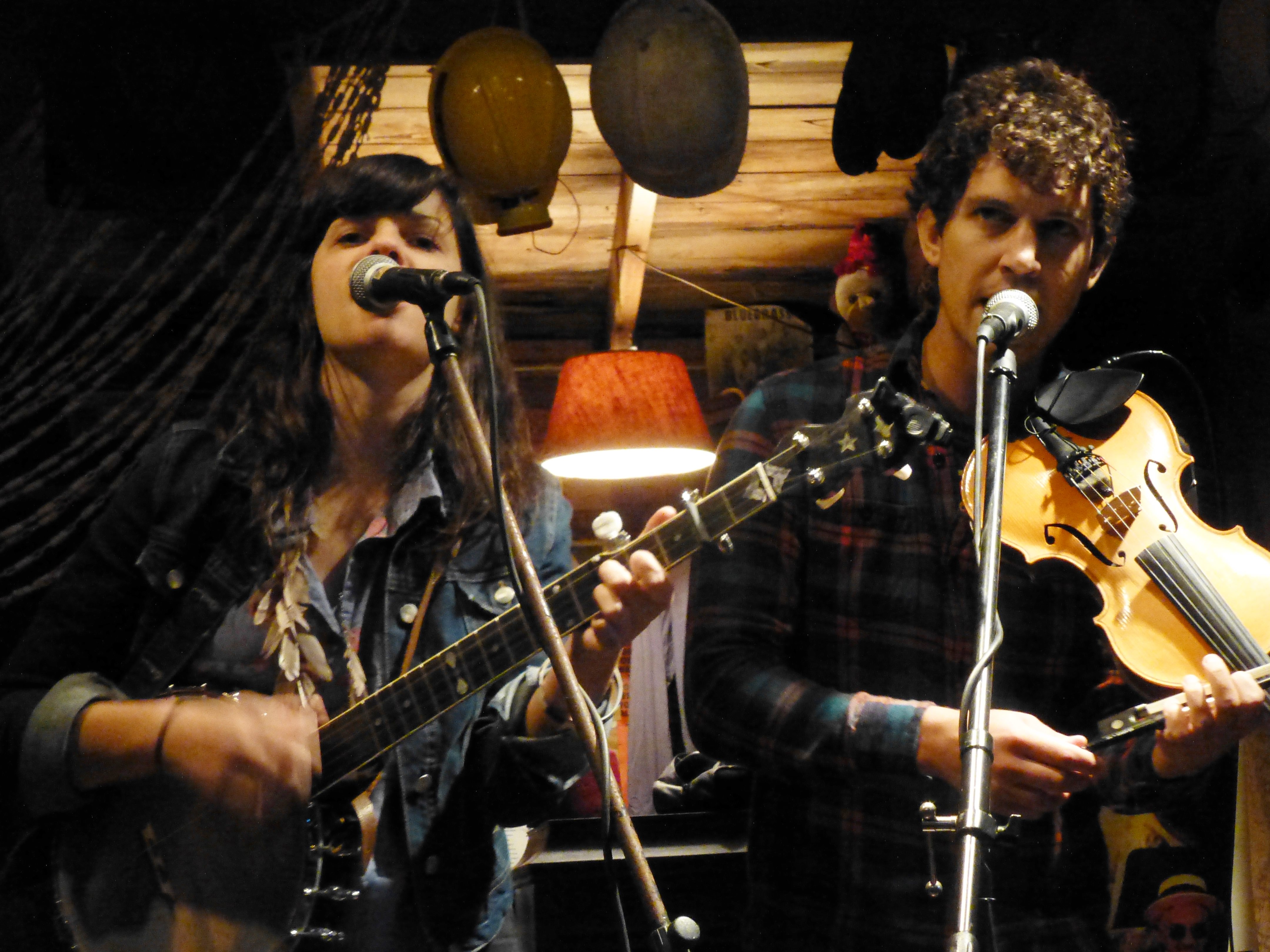
10 String Symphony on stage at Tressler’s Barn. (Jim Motavalli photo)
The evening’s stars were Rachel Baiman and Christian Sedelmyer, a/k/a 10 String Symphony and one of an increasing number of boy/girl old-time duos that are keeping this music alive (see The Littlest Birds). On the strength of one album, 10 String Symphony—based in Nashville—is touring the country, playing showcases at the Rockwood Music Hall in New York and the International Bluegrass Music Association.
But this isn’t bluegrass, it’s proudly old-time. Rachel and Christian both sing and play fiddles, which makes for an intriguing blend. Rachel also picks a banjo. They did stuff like John Hartford’s “In Tall Buildings,” a vivid number from Gid Tanner and the Skillet Lickers, a poignant Townes Van Zandt cover, and very strong originals. Rachel’s “Weight of the World” is destined to be a standard.
10 String also covers the trad “Prettiest Girl (In the County),” and plays it on two fiddles. I noted with amusement that they change “I’m gonna love her in the morning/I’m gonna love her in the evening” to “I can’t get her in the morning.” I pointed out to Rachel how Dirk Powell’s version goes, and she said, “I know, and that version makes more sense, but that’s how we learned and recorded it, so we can’t change it now.” Ah, the folk process! Here’s their version of the song:
10 String Symphony with Dan Tressler (right) sitting in. (Jim Motavalli photo)
Yes, it was freezing, because Tressler’s barn isn’t heated, but it was also delightful. And as an added bonus Dan Tressler himself did a mini-set in the middle. If you haven’t heard him, Dan Tressler is headed for greatness, able to play just about any instrument, and simply one of the best vocalists I’ve ever heard—combining a thorough knowledge of folk history with a soul balladeer’s emotional control. And as attested by his work with String Fingers and (briefly) Cricket Tell the Weather, he’s a great writer, too.
Here’s Dan Tressler and 10 String Symphony together on a Tressler song called “I’m Missing You”:
Jake and the Family Jewels made two highly regarded but slow-selling albums for Polydor in the 1970s, but then—in a familiar tale—vanished from the face of the earth. Most such bands are never heard again, and certainly not 40 years later, but Jake and his Jewels have just had a miraculous rebirth, with not only live concerts but a crackling new album.
The reconstituted Jake and the Rest of the Jewels at Lyric Hall in New Haven. (Jim Motavalli photo)
It sounds like Al “Jake” Jacobs and crew have never been away. The reformed group, with many former members waiting to sit in, held a reunion show at Lyric Hall in New Haven, Connecticut recently, and the good vibes were intact.
Jacobs’ highly melodic music has many roots: Motown, doo-wop (Dion was an idol), the folk-rock of Bob Dylan and the Band. A New Yorker through and through, Jacobs was briefly in the underground sensations known as The Fugs, and led a memorable duo named Bunky and Jake (the late Andrea “Bunky” Skinner sings on six of the new album’s songs). It’s party music of a very particular kind, and should have found a wide audience. Check out the urban tale “I Remember Cissy’s Baby” on video here:
In concert, Jacobs unveiled a batch of new songs in a solo set, then unleashed the full band. I especially liked the tune celebrating unrequited love for Ann Sternberg, the bassist in an obscure all-female 60s rock band called the UFOs. Jake was a warm and friendly host, plus the old-new band wrapped around the old chestnuts like a shell. Steve Asetta, the driving force behind the Lyric Hall gig, was a particular asset on muscular tenor sax. And keyboard player Jan Jungden was very effective, doubling on vocals and flute.
Jacobs lived in New Haven for a while back in the day, and the evening brought out not only many old fans but a plethora of musicians who’d been Jewels at one time or another. Even Terry Adams, keyboardist in NRBQ (another band with Connecticut roots) turned up and did an ace duet with Jake.
Jacobs was over the moon with the success of the New Haven show, so it’s unlikely to be the end of the story. The band will also play New York’s Bitter End (an old haunt) at some time in the near future. Meanwhile, A Lick and a Promise is out for all to enjoy. The Polydor albums haven’t been reissued, but you can find some of the songs, including the original version of “I Remember Cissy’s Baby,” on Youtube. Here’s “It Came Without Warning”:
For years, I used a Jake and the Family Jewels instrumental, “Mother of Pearl,” as a theme song on my radio show. It never got old. The group may have white hair now, but they didn’t get old, either.
I got interested in bluegrass while I was in college in California. Disco was the music on popular radio, and I was looking for something else to listen to. KFAT in Santa Cruz had a show called “Cousin Al’s Bluegrass Hour,” which featured bluegrass, old time and classic country. I fell in love with the banjo, so I rented one and started learning clawhammer and the Scruggs style. When I got to Yale, Kelly Brownell—a faculty member who I jammed with—had a neighbor who was a better banjo player, and he suggested I play the bass.
Brownell, by the way, is now dean of the Sanford School of Public Policy at Duke, and the Robert L. Flowers Professor of Public Policy and Professor of Psychology and Neuroscience. He’s an expert on obesity. Maybe he still plays that banjo.
Professors of Bluegrass circa 1990s. That’s Salovey on the left, Kelly Brownell next to him.
That was back in 1990, the first flowering. A second incarnation existed from 1996 to 1999, and now this third version since 2005. The mandolin player, Craig Harwood, is the former dean of Yale’s Davenport College (now at Hunter). The fiddle player/vocalist is Katie Scharf, formerly of counsel at the White House’s Council on Environmental Quality and now Deputy Commissioner for Energy at the Connecticut Department of Energy and Environmental Protection (CT DEEP).
So it’s kind of a heavyweight group that played very high level bluegrass and old-timey music at the Connecticut Folk festival and green expo in New Haven recently. For a group of busy individuals who rarely gets together to practice, they were very tight (despite messing up the intro in this video of the Professors essaying a Bill Monroe song, “Little Georgia Rose”):
As the Professors were playing, I was startled to see a line of protesters silently observing the proceedings behind me. They were from Fossil Free Yale, a group that wants the school to divest itself of polluting stocks. A spokeswoman explained to me that this was their best time to catch Salovey in an unguarded moment. The signs targeted mountaintop removal mining because, well, the Professors’ repertoire is Appalachian music.
I’m sure President Salovey would go to the mat to defend his students’ right to protest, but on August 27, the dissidents say, “Yale rejected our proposal for divestment.”
That’s probably not the final word on the subject. According to the New York Times, Yale’s investment office recently wrote its money managers “suggesting” (not insisting) they stay away from companies that refuse to take reasonable “steps to reduce greenhouse gas emissions.” That’s progress, but I’m sure the protests will continue until the students get more tangible results. Fossil Free Yale says that 83 percent of undergraduates voted to divest in a non-binding referendum.
Divorced from politics and their heavyweight membership, the Professors of Bluegrass are just a really good band, one of the best I heard all day. It didn’t hurt that they were joined by the great Stacy Phillips on dobro–he’s one of Connecticut’s best musicians in any style. It’s too bad they play out so rarely. President Salovey was leaving right after the concert to “catch a plane at JFK.”
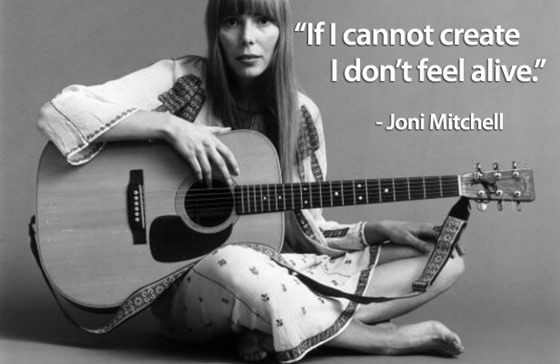
Joni Mitchell: “Freedom to me is a luxury of being able to follow the path of the heart, to keep the magic in your life. Freedom is necessary for me in order to create, and if I cannot create I don’t feel alive.”
Joni Mitchell is a restless artist but not necessarily a happy one. (From Joni Mitchell: In Her Own Words)
That’s from Joni Mitchell: In Her Own Words (ECW Press), consisting of three interviews (between 1973 and 2012) by author and Canadian broadcaster/singer Marta Marom. It’s a fascinating read, though maybe entirely not in the way the author (a devoted fan) intended.
As Publisher’s Weekly notes, “The creative process is a central theme in this new book.” Mitchell is a restless soul, and intent to grow with her music, even if she loses old fans in the process. That led her to jazz and making the Mingus album, among others.
There’s nothing at all wrong with creative evolution, and Mitchell is brave for undertaking it instead of singing her greatest hits at oldies shows. I’m in awe that her path to jazz took her first to the smooth LA jazz of Tom Scott and then to the real thing with Wayne Shorter and Jaco Pastorius (with whom she made the sublime Hejira). Pause to savor that song:
But why don’t Mitchell’s choices make her happy? Why can’t she accept that her path led to a smaller (but probably equally devoted) audience?
She can’t have it both ways. Mitchell’s first five or six albums were brilliant, but also solidly in the commercial mainstream. You didn’t have to know who Charlie Mingus was to like “Big Yellow Taxi.” When she gave up that formula—as her creative mind dictated she must—the big crowds that gave her hits weren’t following behind; they bought Carole King and James Taylor instead.
Mitchell’s high standards mean she gets no pleasure from the awards heaped on her, because she says they’re just celebrating the “60s artist” she was, rather than the creative force she is now. Don’t ask her to hand out Grammys, because she dislikes most contemporary music.
Perhaps because of this, Mitchell in these interviews comes off as somewhat mean-spirited, claiming Bob Dylan and Leonard Cohen are plagiarists (hasn’t she ever heard of the folk process?), and disparaging other old friends like David Crosby (who produced her first album).
She also claims she cares not what critics say, then quotes them word for word. I don’t really get this. Why can’t she just relax and enjoy the laurels from her long and illustrious career? On the other hand, maybe she wouldn’t have had that long and illustrious career if she weren’t a restless, hard-to-satisfy genius.
I’m not really a jam band guy. I love the concept of groups picking up where Jerry and crew left off, but not often the execution. The main issue, for me, is the lack of really memorable tunes. The usual formula is strong instrumental prowess, weak songwriting skills. Audiences are fairly undiscriminating, so it’s not like they’re paying much penalty for that deficit.
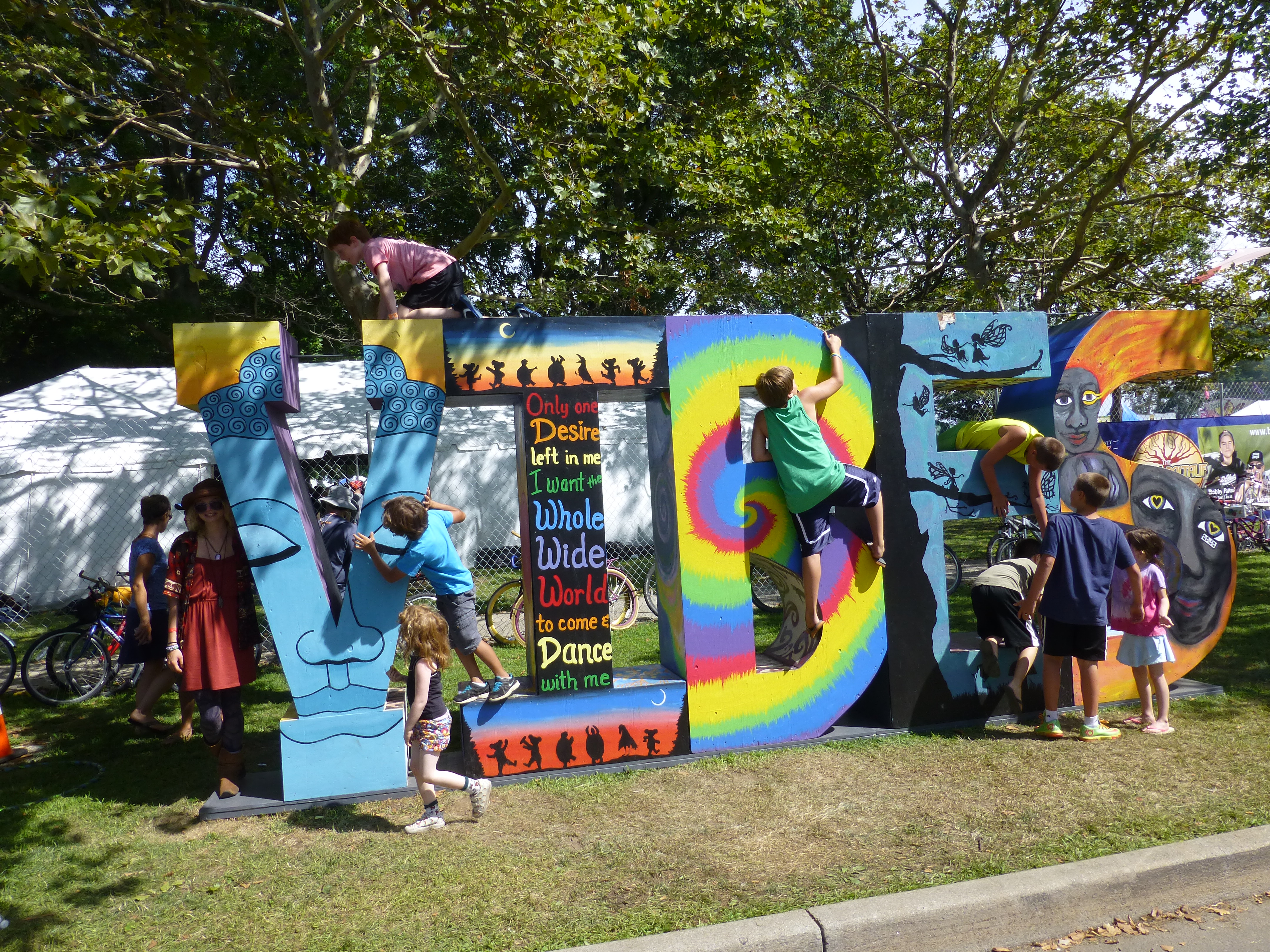
Fun with logos at the Gathering of the Vibes in Connecticut. (Jim Motavalli photo)
It was interesting to see Phil Lesh, the Grateful Dead’s bassist, dissing jam bands in a recent Rolling Stone interview. He said, basically, that the rhythm sections repeat the same patterns as the soloist goes off into virtuosic flights, which is contrary to the Dead’s spirit of everyone working together—collective improvisation, he called it.
Donna guitarist/songwriter/singer Jeb Puryear in full flight. (Jim Motavalli photo)
That brings me to the most recent Gathering of the Vibes, held local to me in Bridgeport, Connecticut. I’ve been a speaker on the Green Stage for several years, and last weekend not only talked about the wonders of electric cars but introduced my favorite “jam” band, Ithaca, New York’s Donna the Buffalo. I put “jam” in quotes because co-founder (with Jeb Puryear) Tara Nevins objected to the term when I talked to her backstage, and rightly so.
Tara Nevins on fiddle at the Vibes. Her other “axe” is an accordion. (Jim Motavalli photo)
Donna, she says, is rooted in old-timey music, which lacks the soloist concept—that was the bluegrass innovation. (Bill Monroe obviously listened to jazz, the popular music of his day.) Donna isn’t about Puryear shredding on the guitar (or, in Tara’s case, the fiddle and accordion). It’s about furthering the groove!
But despite their slightly off-kilter conception, Donna is a hit with jam band audiences like those at the Vibes. They’ve got deeply felt and rootsy songs, which the purchase of any of the records in their large catalog will prove. And if you didn’t know, the group hosts a series of Grassroots Festivals, in upstate New York and North Carolina (the latter coming up in October). Watch this video I shot at the Vibes–with one of their longer group improvisations–and you’ll see what I’m talking about.
My all-time favorite summer music event is the Green River Festival in, appropriately enough, Greenfield, Massachusetts.
Not only is it chock-full of great artists, many of them from the peerless Signature Sounds collection, but it’s also extremely well run, with affordable and wide-ranging food (Aurora’s Gypsy Café food truck from Connecticut was a favorite), plentiful porta-potties and beautiful music with clear sound on three stages.
Dave Alvin tears it up on rootsy electric guitar. (Jim Motavalli photo)
It’s hard to pick favorites, but I’m a critic, right? In rough order, Dave and Phil Alvin with the Dirty Ones, Puss ‘N Boots, Hurray for the Riff Raff, The Dirty Dozen Brass Band, Parsonfield (formerly Poor Old Shine), Shinola Revue with Freedy Johnston and Syd Straw, James Hunter Six, Josh Ritter.
Duds: Trombone Shorty (going for the commercial gold), Lady Lamb the Beekeeper (getting her big break on the main stage, but ruining it with useless bombast), Heather Maloney (tunefully challenged), The Lone Bellow (Nashville country noise).
First, the good stuff. Dave and Phil were together in the Blasters in the 1980s, but haven’t played together much since. They’ve reunited on their shared passion for the Big Bill Broonzy catalog. That could result in something respectful and archival, but instead it was insanely exciting. I had no idea Dave Alvin was such an exciting live electric guitarist. And that drummer!
Lisa Pankratz of Dripping Springs, Texas works up a rootsy groove. (Jim Motavalli photo)
Lisa Pankratz, where have you been the rest of my life? Aside from looking cool, she was mammothly funky, and even rocked a drum solo. Pankratz was also part of Dave’s excellent “Guilty Women” project. Here’s the Green River group on video:
I’ve never seen Norah Jones or my fave Sasha Dobson live, so Puss ‘N Boots was a great place to start. As on their brand-new record, they take turns on the lead, and harmonize beautifully. They transform old warhorse material like Tom Paxton’s “Leaving London.” And who knew that Norah Jones (who never cracked a smile, as far as I could tell) could be such a fiery electric guitarist?
Alynda Lee Segarra of Hurray for the Riff Raff is a magnetic leader. (Jim Motavalli photo)
Hurrah for the Riff Raff got moved off the main stage because of scheduling problems, which turned out to be fine because they’re great in a smaller setting. Alyndra Lee Segarra is a magnetic performer, using the Americana tradition to tell new stories. “The Body Electric,” for instance, takes the hoary murder ballad and asks why all these gals get taken out by all these guys. No more! It stops here! Here they are on video:
The Shinola Revue brought back Syd Straw of the Golden Palaminos after a long absence, at least from my life. Boy, can she belt. A combination of Janis Joplin and Patti Smith, I’m thinking.
James Hunter is the consummate showman, and Josh Ritter is surprisingly jovial and cheery in concert—even when he’s introducing a pretty downbeat song. Parsonfield cross Band-like songcraft with huge amounts of youthful energy. The Dirty Dozen practically levitated the field, with some young members of Dirty Bourbon River Show respectfully sitting in. Trombone Shorty, listen and learn. It doesn’t have to be ear-piercing to rock the house.
And that brings us to the duds. A few too many groups at Green River can play and sing, but lack any memorable songs. These include the Deadly Gentlemen, the aforementioned Heather Maloney, that beekeeper woman and, alas, Girls, Guns and Glory, who were otherwise quite fine.
Let’s have a rule of thumb here: If you don’t got the tunes, perform covers. Or woodshed, study the greats, and come back when you’re really ready to go on stage. One of the problems is that audiences, particularly for jam bands, aren’t all that discriminating. But just because there’s wild applause, doesn’t mean the songs are connecting. They didn’t with me.
Bruce Molsky at Caramoor (with Michael Daves partially obscured). He’s also a threat on guitar and banjo. (Jim Motavalli photo)
I relished the chance to finally connect with Bruce Molsky at Caramoor. He was debuting a new trio with banjoist extraordinaire Tony Trischka and guitarist Michael Daves (whose new album is a duet with Chris Thile of Nickel Creek). This was only their second time playing live, but Bruce told me there’s been a lot of offers so expect them to pop up somewhere else.
Cricket Tell the Weather rips it up at Caramoor. (Jim Motavalli photo
I consider Bruce our finest solo old-time music guy, now that Mike Seeger’s passed, and it was wonderful to see him live, especially with such stellar company. He’s singing a lot, too, with “The Blackest Crow” and “Jawbone” my favorites. There’s a video of him singing that with Scottish singer Julie Fowlis.
Joe Crookston (left) in the sunken garden. (Jim Motavalli photo)
Highlights of Caramoor for me included seeing the new, slimmed-down Cricket Tell the Weather, a group that’s making giant leaps forward in material and stage presentation—with singer/fiddle player Andrea Asprelli out front. “Remington,” which they did early, is an award-winning Asprelli song about the days when gun manufacturing ruled the Connecticut economy.
Miss Tess at the hootenany, channeling her inner Pete Seeger. (Jim Motavalli photo)
Miss Tess and the Talkbacks aren’t folk exactly; more like a soul stew of Americana styles. Miss Tess has a swinging style that enlivens whatever genre. As I’ve pointed out, she’s also known to revive some forgotten gems.
Caramoor has a tradition in which all the performers gather in a beautiful grove and take turns getting everybody singing along to folk songs. Matt Turk, Miss Tess, Andrea Asprelli and Jason Borisoff of Cricket, Bruce Molsky and Mark Miller of Spuyten Duyvil all took turns in a set loosely based on Pete Seeger songs. In the waning light, it was magical.
Laura Cantrell: Country roots without Nashville glitz. (Jim Motavalli photo
In the evening, Rosanne Cash took us on trip through the South with the very strong (and strongly autobiographical) album The River and the Thread. Performing the album in its entirety (plus a few greatest hits), she exhibited the kind of major label, moving-right-along smoothness that mainly eludes the genial, laid-back performers earlier in the day. That’s not to criticize them at all—I like it relaxed.
Rufus Wainwright: Great, but consider the audience, man! (Jim Motavalli photo)
The only dud of the day was the Lone Bellow, a mainstream “country” act that put everything wrong with Nashville music on full display. It was telling that mandolin player Kanene Pipkin’s instrument was all but drowned out in the blare. They got the “bellow” part right.
Speaking of country, I loved hearing Laura Cantrell at Clearwater. She’s a keeper of the flame for classic country, and played deep tracks from Bakersfield and the Deep South in a radio career on WFMU. But she’s no purist–look to see her touring with pop band Camera Obscura this summer.
Richard Thompson: The world’s greatest one-man orchestra. (Jim Motavalli photo)
Richard Thompson was absolutely stunning as a solo act, because it brings his unrepeatable guitar playing to the fore. Like Jerry Miller of Eilen Jewell’s band (and the Sacred Shakers) he manages to distill every great Americana style into each note, but then adds Celtic flavoring as well. Rufus Wainwright was utterly distinctive, too, but seemed unaware that Clearwater has a rather different audience than cabaret night at a New York bar. With those parents, he’s got an inner folkie somewhere.
Guy Davis, who’d just lost his amazing mother, Ruby Dee, was great in several contexts. He’s one of our best blues guys. Kids should be following him around.
Guy Davis: A rootsy treat in several contexts. Here he is on the family stage. (Jim Motavalli photo)
At Clearwater, I stopped by the dance tent and was introduced to Jesse Lége and Bayou Brew. Jesse’s a veteran of 40 years of Louisiana dance halls, and it’s lucky for us he now lives in New Jersey. I don’t know the name of the song in this video, but bass player Evelyn Schneider told me Jesse’s got a huge repertoire and is apt to spring unknown songs on his band.
Catch these folks if you can, and maybe get a Cajun dance lesson as part of the experience.
We all hate fracking and nukes near cities, but are renewables ready for the prime time? (Jim Motavalli photo)
Finally, I love the anti-nuke and anti-fracking signs all over Clearwater. Yes, the stages are solar powered, but I’m not sure New York is really ready to unplug from both nuclear power (the nearby Indian Point) and fracked natural gas. New York Green Party candidate Howie Hawkins things we can, since the flyer I was handed calls for banning fracking, phasing out nukes and having 100 percent clean energy by 2030. I’m all for it, sure, but let’s see the actual blueprint for keeping the lights on with intermittent power.
I’m somewhat obsessed with how songs evolve. I was thinking of just that when listening to the latest album from the lovely Miss Tess, whose latest album with the Talkbacks is “The Love I Have for You.” She sings a Hank Williams tune called “The Alabama Waltz,” which is uncannily similar to the huge Pee Wee King/Redd Stewart hit “Tennessee Waltz” (recorded by Patti Page, Patsy Cline and many others).
Musical borrowing has gone on forever, of course. Bob Dylan cribbed freely from old Appalachian tunes and British ballads for tunes such as “Bob Dylan’s Dream,” “Percy’s Song” and “Paths of Victory,” among many others.
Miss Tess and the Talkbacks sing “Night Life” at Rockwood Music Hall March 20. (Jim Motavalli photo)
Williams’ mimicry was no coincidence. Miss Tess tells me, “Actually the ‘Alabama Waltz’ was written by Hank Williams to try and get a hit song, after the notable success of the ‘Tennessee Waltz.’ It was actually first recorded by Bill Monroe—and something of a hit from that recording I believe. There’s also a ‘Kentucky Waltz.’ There was a day when state waltzes were popular I guess!”
Definitely so. According to Colin Escott’s biography of Hank, the King of Country wrote and recorded the “Alabama Waltz,” to “stoke the ongoing craze for state waltzes.” Monroe—a tried and true Kentuckian—had earlier had his hit with “Kentucky Waltz,” but recognized Williams’ star power and also recorded “Alabama Waltz” in 1950. Williams may well have been at the session. Here’s Hank’s “Alabama Waltz.”
On the same album, Miss Tess does a slam-bang version of “Night Life,” a Willie Nelson tune whose chorus goes, “Oh, the night life/It ain’t no good life/But it’s my life.” I saw Miss Tess do a wonderful version of the song at a Rockwood Music Hall show in New York (with the incomparable Mike + Ruthy) last week.
That darned song reminds me heavily of another great classic, “Sporting Life,” as recorded by Brownie McGhee, Dave Van Ronk, Eric Clapton and tons more. The chorus of that one goes, “That old night life/That old sportin’ life’s/ Killing me.” Not identical, but to my mind closer than suing George Harrison for ripping of “She’s So Fine” for “My Sweet Lord.”
Judge for yourself. Here’s Willie Nelson doing “Night Life”:
Isn’t the “first album phenomenon” fascinating? How many fabulous artists do you know whose number one disc is also their greatest one? Two come to mind quickly, John Prine and Jackson Browne.
No, it’s not actually titled “Saturate Before Using.” Those were instructions for conditioning a burlap water bag.
I was reminded of the essential nature of the latter’s 1972 LP, commonly known as “Saturate Before Using,” when I heard a new tribute to this wonderful songwriter called “Looking Into You: A Tribute to Jackson Browne.”
I don’t think Browne was out of his teens when he wrote songs like “My Opening Farewell,” Jamaica Say You Will,” “Doctor, My Eyes” and “These Days.” The last one isn’t on the album (actually, it’s just “Jackson Browne”), but he’d already penned it. Before he could grow a proper mustache Browne had already a) had an affair with German chanteuse Nico, who may have been the first to record “These Days”; and b) given voice to some very adult emotions in songs that have sturdily endured for more than 40 years.
I’d say that was a good excuse for a tribute album, wouldn’t you? The album works as a whole, from Bonnie Raitt with David Lindley reggae-ifying “Everywhere I Go” to Lucinda Williams making “The Pretender” into a poignant ballad. These songs have good bones.
Don’t read that book about Laurel Canyon; it will sour you on all these LA dudes (especially, for me, J.D. Souther). But the music endures.
Browne got a bit didactic for me later on, but he never turned out a bad song. Long may he wave over Laurel Canyon or wherever he is now. Here’s Browne performing songs from “Satura…,” no, from “Jackson Browne”:
This post is borrowed with permission from Mother Nature Network, where I’ve been writing regularly about the environmental side of the car industry and other cool topics for the past six years:
It’s easy for me to relate to Andy Revkin’s twin passions — music and the environment — because I have the same pair. I satisfy the musical itch by doing a radio show and hosting live bands, and recently had Andy on playing songs from his new folk album, “A Very Fine Line.”
Andrew Revkin (right) with Pete Seeger and Steve Stanne (center) in Beacon, N.Y., in 2010. (Photo courtesy David Rothenberg)
Most likely you know Revkin’s work from the New York Times, where he served as an environmental and science news reporter from 1995 to 2009, and as a popular blogger (Dot Earth) from 2007 to now. He’s one of the great interpreters of often-difficult peer-reviewed science, and the blog has continued now that he’s left the Times for a position teaching at Pace University in Westchester County, New York.
I asked Revkin why he left the Times when the environment beat was hot and his timely stories on climate change were often making the front page. “Through the mid-2000s,” he said, “I became increasingly aware of the limits of what I could do in journalism, and I saw that ways of communicating outside of journalism were hugely expanding. So I looked ahead and asked myself if I wanted to spend the next 25 years writing valid articles about important issues, and I decided I didn’t.”
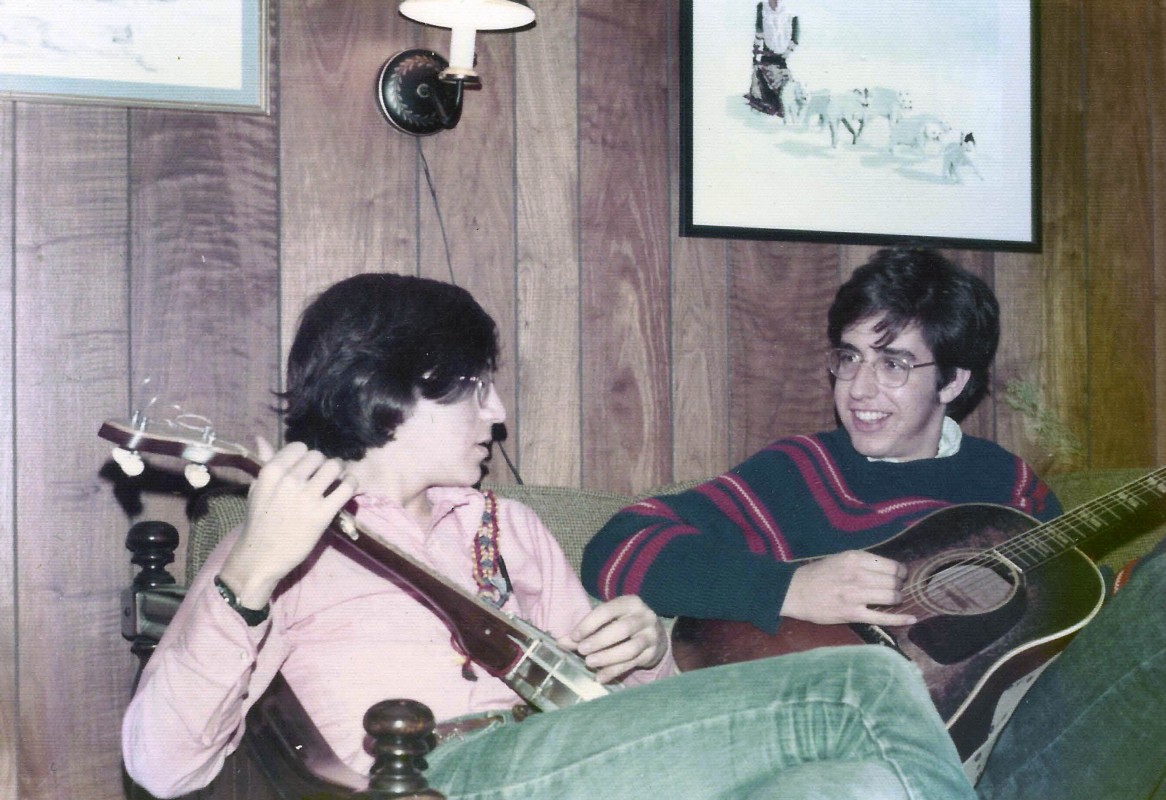
Andy Revkin (left) with his brother Jim in their younger days.
Revkin went in and talked about his plans with then-Executive Editor Bill Keller (who’s now leaving the Times himself), but kept it fairly vague. It’s lucky he did, because a day later the Times announced a generous buyout offer he wouldn’t have gotten had he already resigned.
The continuing mission of the Dot Earth blog, Revkin said, is, “How do we head into [the likely world population of] 9 billion people by mid-century with the fewest regrets.” Rather than focusing simply on goals — an 80 percent reduction in greenhouse gas emissions by 2050, for instance — he’s identified traits we’ll need to survive as a species.
“Resilience is a good trait; it’s overused but very real,” he said. “It means, for instance, not having a rigid approach to risk management. Flexibility is also a good trait, and so is transparency — maintaining the ability to clarify what is happening.” He sums up his approach as “Bend, stretch, reach, teach, reveal, reflect, rejoice, repeat.”
Revkin, author of “The Burning Season” (about Amazon activist Chico Mendes) and, for young readers, “The North Pole Was Here,” might have written the two books he talked about when he left the Times, but his plans were thrown into disarray by a life-changing event. In 2011, he had a potentially life-threatening “brain attack” stroke that among other things lost him the use of his right hand for weeks.
It led to a re-evaluation. Revkin promised himself he would:
Write a hard-hitting print article about stroke care.
Start working out.
Stop taking red-eye flights (to save his neck and carotid arteries).
Get serious about the guitar he’d been playing since he was 17 and start playing scales.
Well, much of that fell by the wayside, and he didn’t stick with the scales, but he did get more serious about music. “I’ve been writing and performing since the early 1990s, and played guitar since I was a teenager, but never got rigorous about recording,” Revkin said. “The stroke was a wake-up call. I wanted to put something on the public record.”
And that led to the album “A Very Fine Line,” recorded near his home in Beacon, N.Y. As you may know, Beacon was also the long-term home of Pete Seeger, and the two were friends. They played together now and then, and Seeger even helped him with lyrics for “Arlington,” a song about the growing space problem at our national cemetery. “I used some of the suggestions, not all of them,” Revkin said.
Other musician friends helping out on the album include singer/songwriter Dar Williams (another neighbor), mandolin virtuoso Mike Marshall and multi-instrumentalist Bruce Molsky, probably the best old-time interpreter around.
Andy Revkin performs a private concert at the Mother Nature Network office in Atlanta.
Revkin describes reporting and music as “a natural dual track, given that journalism and ballads have an intertwined history.” Indeed they do, and being a trained reporter also helps you in something most musicians are clueless about — record promotion. Revkin was recently in Atlanta for a climate change forum, and he didn’t waste the opportunity. He visited the offices of the site I write for, Mother Nature Network, and stopped by a local radio station and performed “Breakneck Ridge” (a song about the Hudson Highlands, “from Breakneck Ridge to the Bear Mountain Bridge.”)
The song (which I played on WPKN on Thursday afternoon) references “a billion years of time and toil” that are “etched in these old hills,” and Revkin told me he’d looked it up, to make sure that the “billion years” was accurate. Once a journalist, always a journalist. Here’s “Breakneck Ridge” on video:














 Territorial Imperatives